
The safest way to travel with a dog in a car is to keep them in a secure, well-ventilated part of the vehicle using a suitable restraint, such as a correctly fitted car harness or a properly secured crate.
Your dog should not be able to move freely around the vehicle, interfere with the driver or be thrown forwards if you brake suddenly. The right arrangement will depend on your dog, your car and the restraint you use, but it must protect both the dog and everyone else in the vehicle.
What Is the Safest Way for a Dog to Travel in a Car?
For most dogs, a safe car-travel arrangement means:
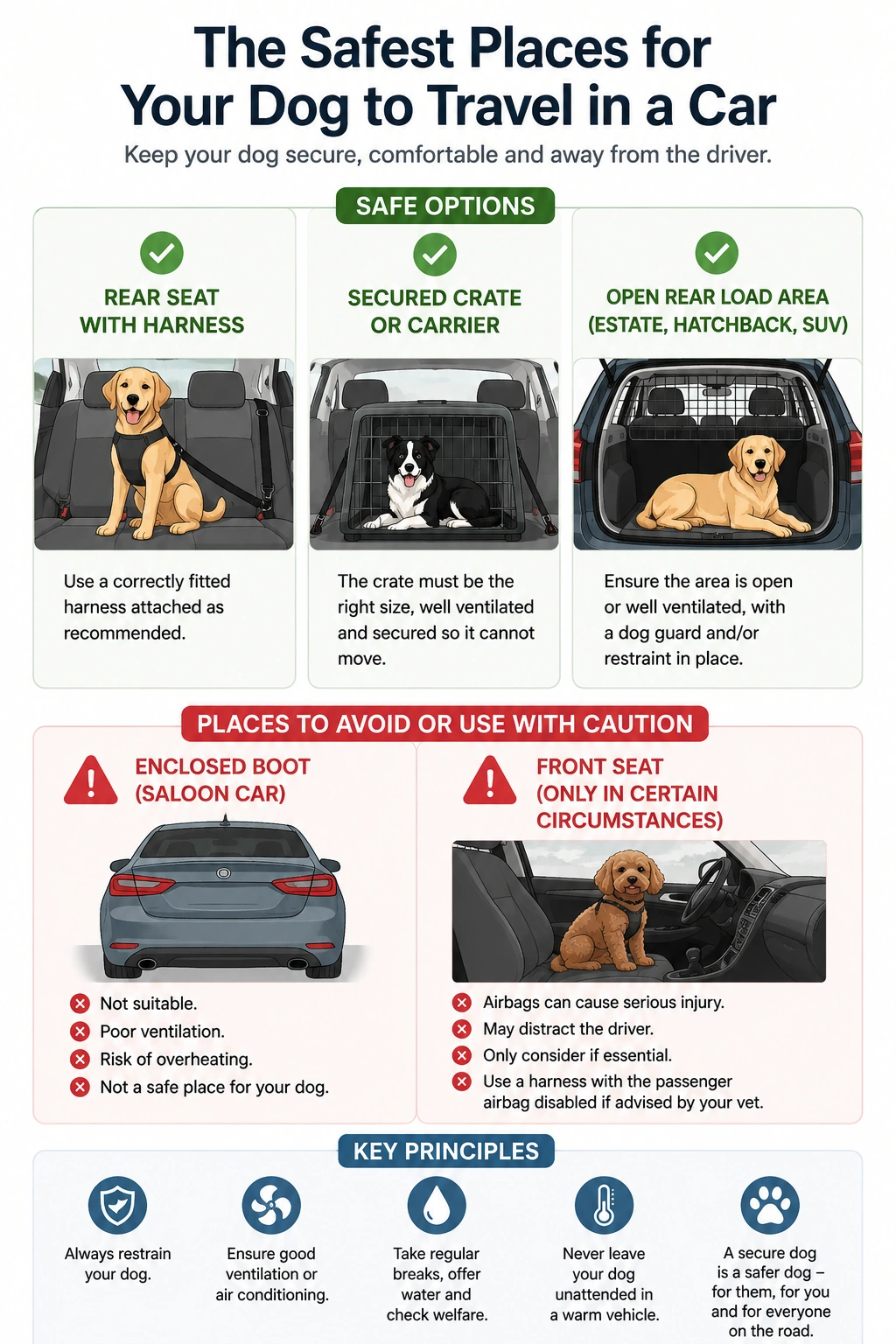
- Travelling on a rear seat in a correctly fitted car harness.
- Travelling in a properly sized crate or carrier that is secured against movement.
- Travelling in the open rear load area of a suitable estate car, hatchback or SUV with appropriate containment and restraint.
- Remaining safely separated from the driver.
- Having ventilation or air conditioning that reaches the dog’s position.
- Being monitored throughout the journey.
A dog should not travel loose in the car. Even a calm dog can be thrown forwards during sudden braking, distract the driver or escape when a door is opened.
Quick dog car-safety checklist
Before setting off:
- Check that the harness, crate or carrier is secure.
- Make sure your dog cannot reach the driver or controls.
- Secure loose luggage and equipment.
- Confirm that cool air reaches your dog.
- Carry water, a bowl, a lead and waste bags.
- Attach the lead before opening a door or tailgate.
- Never leave your dog unattended in a warm vehicle.
What Does UK Law Say About Dogs Travelling in Cars?
Highway Code Rule 57 says that dogs and other animals should be suitably restrained so that they cannot distract the driver or injure themselves or another person if the vehicle stops quickly. It lists a seat-belt harness, pet carrier, dog cage and dog guard as possible forms of restraint.
The important word is should, rather than must.
The Highway Code explains that rules using “MUST” or “MUST NOT” normally identify a specific legal requirement. Failure to follow an advisory rule does not automatically create a separate offence by itself, although the rule can be used as evidence in court proceedings when establishing liability.
This means it is too simplistic to say that every unrestrained dog automatically results in a particular fine or number of penalty points.
However, allowing a dog to distract you, obstruct your view or interfere with control of the vehicle could contribute to offences such as careless or dangerous driving. The Highway Code also says drivers must not drive dangerously or without due care and attention.
Your motor insurer may also have its own requirements relating to pets and vehicle use, so check your policy rather than assuming every insurer takes the same approach.
Where Should a Dog Sit in the Car?
The safest place depends on the vehicle, the dog and the restraint system. The rear of the vehicle is normally preferable to placing a dog beside the driver.
On a rear seat
A dog can travel on a rear seat when secured in a suitable car harness attached exactly as the manufacturer instructs.
The harness should:
- Fit securely without restricting normal breathing.
- Be appropriate for the dog’s size and body shape.
- Attach to a suitable point in the vehicle.
- Prevent the dog reaching the driver.
- Avoid leaving enough loose tether for the dog to become tangled.
A seat cover or car hammock may protect the upholstery and improve grip, but it is not a restraint.
In a secured crate or carrier
A crate or carrier may be suitable when:
- It is large enough for the dog to travel comfortably.
- The dog is already comfortable being confined in it.
- It has adequate ventilation.
- It is positioned safely.
- It is secured so that it cannot slide, tip or move dangerously.
Do not place an unsecured crate on a seat or loose in the rear load area. In sudden braking or a collision, the crate itself could move through the vehicle.
A soft-sided crate can provide containment and comfort, but it should not automatically be assumed to provide the same structural protection as a rigid crate
In the open rear load area
Some dogs travel in the rear load area of an estate car, hatchback or SUV.
This is different from putting a dog in the fully enclosed boot of a saloon car.
The area must:
- Be open to the passenger compartment or properly ventilated.
- Provide enough usable space for the dog.
- Be free from unsecured luggage.
- Prevent the dog reaching the driver.
- Include appropriate containment or restraint.
A dog guard can help stop a dog entering the passenger area, but it does not necessarily restrain the dog within the load area or protect them in a collision. A guard and a dog restraint perform different jobs.
For a fuller explanation of vehicle types and rear-load-area arrangements, see the dedicated guide to whether a dog can travel safely in the boot.
In the front seat
The front passenger seat is not the preferred default place for a dog.
Potential concerns include:
- Distraction to the driver.
- The dog reaching vehicle controls.
- Airbag deployment.
- Incompatible seat-belt or restraint positioning.
- The dog being thrown towards the windscreen or dashboard.
Where there is no practical alternative, the restraint and vehicle manufacturer’s instructions need to be checked carefully.
In an enclosed boot
A dog should not travel in the sealed boot of a saloon car. It does not provide an appropriate passenger environment, adequate supervision or reliable ventilation.
Which Dog Car Restraint Should You Use?
There is no single restraint that is automatically best for every dog and every vehicle.
| Option | Most suitable when | Main benefit | Important limitation |
|---|---|---|---|
| Car harness | The dog travels on a vehicle seat | Restricts movement and access to the driver | Fit, attachment method and product quality vary |
| Secured crate | The dog is comfortable in a crate and the vehicle has suitable space | Creates a defined travel area | It must be correctly sized and anchored |
| Pet carrier | A smaller dog needs secure containment | Easier to position and move than a large crate | It must still be ventilated and secured |
| Dog guard | The dog travels in an open rear load area | Separates the dog from occupants | It does not necessarily restrain the dog in a collision |
| Seat cover or hammock | You want to protect seats and improve grip | Helps with cleanliness and comfort | It is not a safety restraint |
Look beyond general claims such as “car safe” or “crash tested”. Not all pet-travel products are tested under identical conditions or against one compulsory universal crash-test standard.
Check:
- The exact size range.
- The fitting method.
- Vehicle compatibility.
- Weight restrictions.
- Attachment instructions.
- Whether the dog can sit or lie naturally.
- Whether the product remains secure under braking.
How to Prepare Your Dog for a Car Journey
Before travelling, consider whether your dog is fit for the journey.
Contact your vet before travelling if your dog:
- Is significantly unwell.
- Has recently had surgery.
- Has serious breathing difficulties.
- Has suffered repeated or severe car sickness.
- Is in pain or unable to settle comfortably.
- Has a condition that may be affected by heat, stress or confinement.
Give your dog an opportunity to toilet before leaving. A calm walk may also help them settle, although you should not exhaust them before the journey.
Avoid feeding a very large meal immediately before travelling. Dogs that regularly experience nausea may need an individual feeding and medication plan from their vet rather than a generic rule.
Check that your dog’s collar tag and microchip contact details are current, particularly when travelling away from home.
Pack:
- Drinking water.
- A portable bowl.
- Lead and walking harness.
- Waste bags.
- Bedding that does not interfere with the restraint.
- Any prescribed medication.
- Cleaning supplies.
- A towel.
- Details for your regular vet and, on longer trips, a vet near your destination.
Dogs that are frightened of the vehicle should be introduced to it gradually rather than forced into repeated stressful journeys. A separate guide to helping a dog get used to car travel can cover that training process in detail.
How to Prepare the Car
Before loading your dog, check the complete travel area rather than concentrating only on the restraint.
Make sure:
- The restraint anchor is secure.
- A crate cannot slide or tip.
- A dog guard is correctly installed.
- Air conditioning or ventilation reaches the dog.
- Loose luggage cannot fall or move into the dog.
- Leads and tethers cannot become tangled.
- The dog cannot operate an electric window.
- The dog cannot reach the driver.
- Mirrors and the driver’s view remain clear.
- Doors and the tailgate are fully closed.
- The vehicle is already at a comfortable temperature.
A dog travelling in the rear of a large vehicle may experience different conditions from people sitting in the front. Check the dog’s actual position instead of assuming that the temperature and airflow are the same throughout the car.
How to Get Your Dog In and Out Safely
Loading and unloading are common opportunities for a dog to escape.
Where possible:
- Park away from moving traffic.
- Check the surrounding area before opening the vehicle.
- Attach the lead before opening the dog’s exit.
- Open only the necessary door or tailgate.
- Keep control of the dog until the restraint is fitted or removed.
- Do not allow the dog to jump directly into the road.
- Recheck the restraint before setting off again.
A ramp or set of steps may help puppies, older dogs, large dogs and dogs with joint or mobility problems. It should have a stable surface and be introduced gradually rather than first used beside a busy road.
Do not attach the primary car restraint to a collar. Sudden force around the neck can cause injury. Use the equipment exactly as its manufacturer directs.
Keeping Your Dog Comfortable Without Compromising Safety
Comfort can help a dog settle, but it must not interfere with restraint or ventilation.
Useful measures may include:
- Non-slip bedding.
- Familiar blankets.
- Calm, smooth driving.
- Moderate sound levels.
- Effective ventilation.
- Window shades that do not obstruct the driver.
- Water during suitable stops.
- Familiar toys that cannot become a hazard.
Do not add so much bedding that the dog overheats, cannot lie naturally or is pushed against the roof of a crate.
A temperature monitor may provide additional information, especially in a large vehicle, but it does not replace checking your dog directly. Sensor position, battery condition and connectivity can all affect what the device tells you.
How to Keep a Dog Cool During Car Travel
Cool the vehicle before loading your dog when possible.
During the journey:
- Use air conditioning or controlled ventilation.
- Make sure cool air reaches the dog’s position.
- Use sunshades only where they do not affect visibility.
- Keep the dog out of strong direct sunlight where possible.
- Watch for heavy panting, agitation, drooling or weakness.
- Stop safely if your dog appears too hot.
Strong sunlight through the windows can also expose vulnerable skin to UV. If your dog develops red or sore skin after sun exposure, see our guide to how to treat dog sunburn safely.
A cooling mat may help with comfort, but it cannot compensate for a dangerously hot vehicle, poor ventilation or unsuitable journey timing. See the separate guide to cooling mats designed for cars and travel for help choosing one.
For broader equipment options, the Cool Canine guide to keeping a dog cool in the car explains the role and limitations of car-cooling products.
Never leave a dog unattended in a warm vehicle. Parking in the shade or leaving windows partly open does not make this safe. The RSPCA warns that cars can become dangerously hot even when the weather does not initially feel particularly warm.
There is no single car-temperature number that guarantees safety for every dog. Risk is affected by sunlight, ventilation, humidity, duration, the dog’s health and body shape, and where the dog is positioned in the vehicle. The dedicated guide to when a car is too hot for a dog explains these factors in more detail.
How Often Should You Stop?
There is no one stopping interval that suits every dog and every journey.
How often you need to stop depends on:
- Journey length.
- The dog’s age and health.
- Temperature.
- Water and toileting needs.
- Anxiety or travel sickness.
- Medication.
- How familiar the dog is with car travel.
Plan safe opportunities to offer water, allow toileting and check that your dog is coping.
Stop sooner if your dog becomes restless, distressed, hot or nauseous.
During stops:
- Park safely.
- Attach the lead before opening the vehicle.
- Keep the dog away from moving traffic.
- Do not leave the dog unattended in a warm car.
- Recheck the harness, crate and other equipment before continuing.
For multi-hour routes, motorway journeys and overnight travel, see the complete guide to planning a long-distance car journey with your dog.
Government welfare guidance says journeys should be planned properly, animals should be fit to travel and their needs for water, rest and welfare should be checked during transport. It also says animals must not be transported in a way likely to cause injury or unnecessary suffering.
Signs Your Dog Is Not Coping with the Journey
Dogs may show signs of anxiety, motion sickness, overheating, pain or another health problem during travel.
| What you notice | What to do |
|---|---|
| Mild restlessness, occasional whining or repeated repositioning | Check temperature, restraint fit, driving style and whether a safe stop is needed |
| Drooling, repeated lip licking, swallowing, panting or retching | Stop safely and assess for nausea, stress or heat |
| Vomiting, diarrhoea, marked shaking or persistent distress | Shorten or end the journey where practical and contact your vet if symptoms are significant or recurrent |
| Weakness, collapse, confusion, severe breathing difficulty or reduced responsiveness | Treat as urgent and contact a vet or emergency vet immediately |
PDSA lists drooling, panting, frequent swallowing, lip licking and retching among signs of travel sickness. Fear-related signs can include barking, whimpering, shaking, toileting in the car or refusing to enter the vehicle.
These signs are not diagnostic. Panting, for example, can be caused by heat, anxiety, pain or illness.
Persistent car sickness should be discussed with your vet. Prescription treatment may sometimes help, but PDSA advises that human or non-prescription travel-sickness medicines may be ineffective or cause side effects.
For fuller guidance, see our guide to car-sickness symptoms and causes.
What to Do If Your Dog Becomes Unwell in the Car
If your dog becomes unwell:
- Pull over in a safe place.
- Keep the dog secure so they cannot escape into traffic.
- Check their breathing, responsiveness and temperature.
- Move them away from heat where relevant.
- Contact your vet if symptoms are significant, persistent or unexplained.
- Do not give human medication unless a vet has specifically told you to do so.
- Do not continue merely because the destination is close.
Contact a vet or emergency vet urgently if your dog:
- Collapses.
- Becomes confused or poorly responsive.
- Has severe or worsening breathing difficulty.
- Shows signs of suspected heatstroke.
- Has a seizure.
- Suffers a significant injury during sudden braking or a collision.
- Cannot stand or walk normally.
- Continues vomiting and becomes weak.
- Appears seriously unwell.
Where overheating is suspected, the complete dog heatstroke guide explains warning signs and emergency action in more detail.
Dogs That Need Extra Planning
Some dogs require more careful journey planning.
Puppies
Puppies may be more prone to motion sickness and may have limited experience of the car. Use short, positive introductions and make sure the restraint can be adjusted as the puppy grows.
Older dogs and dogs with mobility problems
These dogs may need:
- A lower loading height.
- A ramp or steps.
- Additional non-slip support.
- More frequent assessment.
- Extra space to lie comfortably.
- Veterinary advice before a demanding journey.
Flat-faced dogs
Brachycephalic dogs, such as French Bulldogs and Pugs, can be more vulnerable to breathing difficulties and heat. Ventilation, temperature and visible breathing effort require particularly close attention.
Dogs with medical conditions
Dogs with heart, respiratory, neurological or mobility conditions may be less able to cope with heat, stress or prolonged positioning.
Ask your vet whether the journey is appropriate and whether any changes are needed.
Two or more dogs
Each dog needs enough room and a safe restraint arrangement. Two dogs should not be allowed to become tangled, compete for space or distract one another.
The separate guide to travelling with two or more dogs in a car will address shared crates, individual restraints and space planning in greater depth.
Dog Car Travel Safety Checklist
Before leaving
- My dog appears well enough to travel.
- Collar tag and microchip details are current.
- The harness, crate or carrier fits correctly.
- The restraint is secured.
- The vehicle is comfortable and ventilated.
- Cool air reaches the dog.
- Luggage is secured.
- Water and a bowl are packed.
- The lead is accessible.
- Safe stopping places have been considered.
During the journey
- My dog remains restrained.
- My dog cannot reach or distract the driver.
- The dog is not showing distress, sickness or overheating.
- Ventilation remains effective.
- The restraint has not twisted or loosened.
- I will stop safely if anything seems wrong.
At a stop
- The lead is attached before the door or tailgate opens.
- The stopping place is away from moving traffic where possible.
- The dog is offered an appropriate opportunity to drink and toilet.
- The dog is not left unattended in a warm vehicle.
- The restraint is checked before continuing.
Frequently Asked Questions
Is it illegal to have a dog loose in a car in the UK?
Highway Code Rule 57 says dogs should be suitably restrained so that they cannot distract the driver or cause injury during sudden stopping. Because the rule uses “should” rather than “must”, failing to follow it is not automatically a separate offence by itself. However, it may be used as evidence if the dog contributes to unsafe driving, a collision or liability.
Can a dog travel in the footwell?
The footwell is not a suitable default travel position. A dog may interfere with controls, move into the driver’s area, be difficult to restrain properly or be exposed to injury from the dashboard, seat movement or airbags.
Use a suitable rear-seat restraint, secured carrier or properly arranged rear load area instead.
Should a dog wear a collar or harness in the car?
Use a purpose-appropriate car restraint as the manufacturer directs. A collar should not normally be used as the primary point of restraint because sudden force could be concentrated around the dog’s neck.
Can two dogs share one crate?
That depends on the crate, the dogs and the journey, but shared confinement can create problems with space, heat, stress and injury. Separate secured spaces are often easier to manage safely.
Can I give my dog human travel-sickness tablets?
Do not give human travel-sickness medication without veterinary instruction. Human and non-prescription products may be ineffective or cause side effects in dogs. Contact your vet about suitable treatment.
Should I open the window for my dog?
Ventilation is important, but do not allow your dog to put their head or body out of the window. They could be injured by debris, escape or interfere with other road users.
Use controlled ventilation or air conditioning while keeping the dog fully inside and securely restrained.
Final Safety Takeaway
Safe car travel with dogs depends on the whole setup: the dog must be fit to travel, positioned safely, correctly restrained, kept at a comfortable temperature and monitored throughout the journey.
A harness, crate, dog guard or cooling product can support that system, but no individual product replaces careful driving, secure loading, effective ventilation and attention to your dog’s welfare.
For help with the wider journey rather than the car setup alone, continue to the complete guide to planning travel with your dog.