

If you’re looking for a single temperature that tells you when it’s safe to leave your dog in a parked car, you’re asking a question that doesn’t have a simple numerical answer.
There isn’t a magic outside temperature that separates “safe” from “dangerous”. A parked car can become dangerously hot even when the weather feels only pleasantly warm, while the risk to your dog also depends on factors such as direct sunshine, how long the vehicle is parked, airflow and your dog’s age, breed and overall health.
For that reason, leading UK animal welfare and veterinary organisations do not recommend relying on an outside temperature to decide whether it’s safe to leave a dog in a vehicle. Instead, the safest approach is to avoid leaving a dog unattended in a parked car whenever there is a risk that temperatures could rise.
If you’re travelling with your dog during warm weather, careful planning can make journeys much safer. But if your dog is already showing signs of overheating, quick action is essential. Heatstroke is a veterinary emergency and prompt treatment can save your dog’s life.
This guide explains why there isn’t a universal “too hot” temperature, why parked cars become dangerous so quickly, how to recognise the warning signs of heat-related illness and the practical steps you can take to help keep your dog safe before, during and after a journey.
The Short Answer
There is no single outside temperature that makes it safe to leave a dog unattended in a parked car.
The temperature inside a parked vehicle can rise much faster than many people expect, and it is the temperature inside the vehicle—not simply the air temperature outside—that puts dogs at risk.
The RSPCA and PDSA both use a well-known example to illustrate how quickly this can happen: when the outside temperature is 22°C, the temperature inside a parked car can reach approximately 47°C within an hour. This is an illustration of how rapidly a vehicle can heat up—it is not intended to suggest that temperatures below 22°C are automatically safe.
Research carried out in the UK has shown that vehicle temperatures can exceed 25°C during every month of the year, with temperatures above 35°C recorded from April through to September under the conditions studied. The exact temperature reached depends on many factors, but the important message is consistent: a parked car can become dangerously hot far more quickly than many people realise.
The safest rule is therefore simple:
- Never leave a dog unattended in a parked vehicle if there is a possibility it could become dangerously warm.
- If you suspect your dog is suffering from heat-related illness, remove them from the hot environment immediately, begin cooling and contact a veterinary practice without delay.
Thinking in terms of preventing dangerous heat build-up, rather than trying to identify a “safe” outside temperature, will help you make better decisions for your dog’s welfare.
If Your Dog Is Overheating in the Car Right Now
If you think your dog is becoming dangerously hot, don’t wait to see whether they improve by themselves. Heat-related illness can progress quickly, and early action offers the best chance of a successful outcome.
Move your dog into a cooler environment
If it is safe to do so, stop the vehicle and remove your dog from the hot environment immediately.
Move them into shade or, ideally, an air-conditioned building if one is available and dogs are permitted. Simply opening the vehicle’s windows is unlikely to cool a dangerously hot car quickly enough.
Begin cooling immediately
Current veterinary guidance recommends cool first, transport second.
Begin cooling your dog as soon as possible while arranging veterinary advice.
- Pour cold tap water over your dog’s body, taking care to avoid the nose and mouth.
- Wet the whole body rather than concentrating on one small area.
- Encourage airflow using a fan, air conditioning or natural airflow where available.
- Continue cooling while following your vet’s advice.
Do not wrap your dog in a wet towel, as this can trap heat rather than allowing it to escape.
Contact a vet immediately
Heatstroke is a veterinary emergency.
Even if your dog appears brighter after cooling, they should still be assessed by a veterinary professional. Heatstroke can cause serious complications, including damage to internal organs, and some problems may not become obvious immediately.
Prompt veterinary assessment gives your dog the best chance of a full recovery.
What if You See Another Dog Trapped in a Hot Car?
Finding a distressed dog inside a parked vehicle can be alarming.
If the dog appears alert and is not showing signs of heat-related illness, try to locate the owner immediately by asking nearby businesses to make an announcement or checking whether they are close by. If possible, stay near the vehicle and continue monitoring the dog’s condition.
If the dog appears to be suffering from heatstroke—for example, if it has collapsed, is struggling to breathe or has become unresponsive—treat the situation as an emergency and call 999, asking for the police.
Avoid assuming that a slightly open window, a bowl of water or a shaded parking space means the dog is safe. None of these measures reliably prevents a parked vehicle from becoming dangerously hot.
Do not put yourself or others at risk. If you believe forced entry may become necessary to prevent serious suffering, tell the police what you intend to do wherever circumstances allow and follow their advice.
Why There Isn’t a Single “Too Hot” Temperature
It’s understandable why people ask this question. We naturally want a clear rule that tells us when something becomes dangerous.
Unfortunately, parked vehicles don’t work like that.
The outside air temperature is only one part of the picture. How quickly a vehicle heats up depends on several factors, including whether it is parked in direct sunshine, how long it has been stationary and how much heat has already built up inside.
The dog also matters.
A healthy adult dog travelling in a well-ventilated, air-conditioned vehicle may cope very differently from an older dog with heart disease or a flat-faced breed with breathing difficulties.
That is why responsible veterinary and animal welfare organisations do not publish a universal “safe” outside temperature for every dog and every situation.
Instead of asking:
“Is today’s temperature safe?”
a more useful question is:
“Could my dog become trapped in a vehicle that is getting hotter?”
If the answer is yes—or if you’re not sure—the safest decision is to change your plans before your dog is ever placed at risk.
Why Hot Cars Become Dangerous for Dogs
Most of us have opened the door of a parked car on a sunny day and been surprised by the wave of hot air inside. What feels uncomfortable to us can become life-threatening for a dog.
A parked car acts as a heat trap. Sunlight passes through the windows and warms the dashboard, seats and other interior surfaces. Those surfaces then continue releasing heat into the enclosed cabin, causing the temperature inside the vehicle to rise.
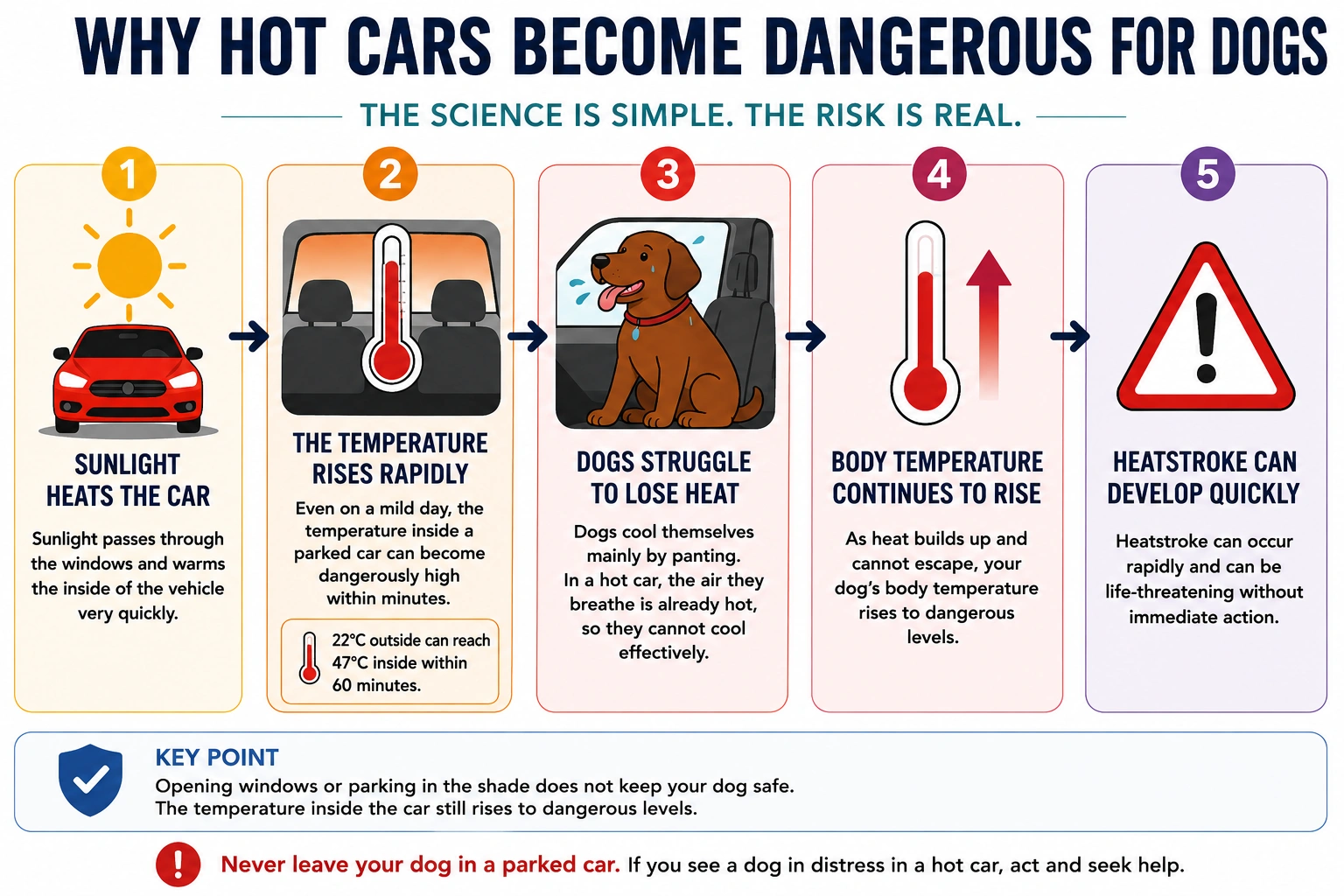
The important point is that it’s the temperature inside the car—not simply the air temperature outside—that puts dogs at risk.
This is why the weather forecast alone doesn’t tell the whole story. Two days with the same outside temperature can present very different levels of risk depending on factors such as:
- whether the vehicle is parked in direct sunshine or shade;
- how long it has been parked;
- how much heat has already built up inside;
- whether the vehicle is occupied or left unattended.
Rather than trying to judge whether today’s weather is “hot enough”, it is safer to ask whether your dog could become trapped in a vehicle that is continuing to warm.
Why “I’ll only be a minute” can become dangerous
Most owners who leave a dog in a car don’t expect to be away for long.
Unfortunately, unexpected delays happen.
A queue forms at the checkout. A prescription takes longer than expected. Traffic delays your return. A quick errand can easily become much longer than planned.
While you’re delayed, the temperature inside the vehicle may continue to rise.
Planning on the assumption that nothing will go wrong is a risk not worth taking when your dog’s welfare is involved.
Why open windows aren’t enough
Leaving the windows slightly open is one of the most common ways people try to reduce the risk of overheating.
Although partially open windows may improve ventilation a little, they do not prevent the vehicle from heating up. The RSPCA specifically warns that open windows are not enough to keep a parked dog safe.
If a car is capable of becoming dangerously hot, opening the windows a few centimetres should never be regarded as an effective safeguard.
Shade helps—but doesn’t remove the danger
Parking in the shade is always preferable to parking in direct sunshine when you’re travelling with your dog.
However, shade should be seen as a way of reducing heat build-up during a supervised journey—not as a reason to leave a dog unattended.
The sun moves throughout the day, shade can disappear surprisingly quickly and the surrounding air may already be warm enough for the temperature inside the vehicle to continue rising.
For that reason, the RSPCA advises that even a shaded car should not be considered a safe place to leave a dog.
Why Dogs Struggle to Cope with Heat
Dogs regulate their body temperature differently from people.
Instead of cooling themselves mainly by sweating, they rely primarily on panting, together with a limited ability to sweat through their paw pads.
Panting can be very effective under the right conditions because it allows heat to leave the body as moisture evaporates from the respiratory tract.
However, as the surrounding environment becomes hotter, cooling becomes increasingly difficult.
If a dog continues absorbing heat faster than it can lose it, body temperature rises and heat-related illness may develop.
Without prompt treatment, heatstroke can cause serious complications including internal bleeding, seizures, organ damage, coma and, in severe cases, death.
Preventing overheating is therefore far safer than trying to treat it once it has developed.
Which Dogs Need Extra Care?
Any dog can develop heat-related illness if conditions become dangerous enough.
However, some dogs are recognised by veterinary and animal welfare organisations as being at increased risk.
These include:
- flat-faced (brachycephalic) breeds such as Pugs, French Bulldogs and English Bulldogs;
- puppies;
- older dogs;
- overweight dogs;
- dogs with heart or breathing problems;
- dogs that are unwell or recovering from illness.
Flat-faced breeds deserve particular attention because their shortened airways make panting less efficient, reducing their ability to lose heat.
If you own one of these breeds—or any dog with an existing medical condition—take extra care when travelling during warm weather.
If you own a Labrador, our guide on how hot is too hot for a Labrador explains how weather, exercise, age, weight and individual health affect a Labrador’s ability to cope with warm conditions.
Some Journeys Carry More Risk Than Others
Not every car journey presents the same level of risk.
Extra planning is sensible if you expect:
- heavy traffic;
- long motorway journeys;
- holiday travel during peak summer;
- delays caused by roadworks or breakdowns;
- long waits before boarding ferries or entering events.
It’s also worth checking that cool air from the vehicle’s ventilation system is actually reaching the part of the car where your dog is travelling. Depending on the vehicle, rear seats, luggage areas or travel crates may not receive the same airflow as the front of the cabin.
If you’re planning a longer journey, our Long-Distance Car Travel with Dogs: Complete Guide explains how to prepare, plan rest stops and keep your dog comfortable throughout the trip.
How to Recognise the Signs of Heat-Related Illness
Heat-related illness doesn’t always develop in exactly the same way, and dogs won’t necessarily show every warning sign.
Recognising early changes in your dog’s behaviour can help you act before the situation becomes an emergency.
Early warning signs
Possible early signs include:
- persistent or unusually heavy panting;
- increased drooling;
- restlessness;
- low energy or reluctance to continue walking or moving;
- faster breathing than normal.
If you notice these signs during a journey, stop somewhere safe and assess your dog rather than assuming they’ll recover without help.
More serious signs
As heat-related illness progresses, you may notice:
- excessive drooling or foaming at the mouth;
- vomiting or diarrhoea;
- unusually bright red or very pale gums;
- weakness;
- poor coordination or collapse;
- confusion.
These signs require immediate cooling and urgent veterinary advice.
Emergency signs
Heatstroke is a veterinary emergency.
Signs that require immediate veterinary treatment include:
- collapse;
- seizures;
- unconsciousness;
- severe breathing difficulty;
- blood in vomit or diarrhoea;
- unresponsiveness.
Do not wait for these severe signs to appear before taking action.
If you suspect heat-related illness at any stage, remove your dog from the hot environment, begin cooling immediately and contact a veterinary practice without delay.
What to Do if Your Dog Overheats During a Journey
If your dog starts showing signs of heat-related illness while you’re travelling, act promptly. Continuing the journey because you’re “almost there” could allow your dog’s condition to become much more serious.
1. Stop somewhere safe
Pull over as soon as it is safe to do so.
Choose a location where you can remove your dog from the hot environment without creating additional danger for yourself, your passengers or other road users.
2. Move your dog into a cooler environment
Take your dog out of the vehicle immediately.
Move them into shade or, where possible, an air-conditioned building that allows dogs. The priority is to prevent any further heat build-up.
3. Begin cooling immediately
Current veterinary guidance is cool first, transport second.
As soon as your dog is out of the hot environment:
- pour cold tap water over the body, avoiding the nose and mouth;
- wet the whole body rather than cooling only one area;
- create airflow using a fan, air conditioning or natural airflow where possible;
- continue cooling while seeking veterinary advice.
Do not wrap your dog in a wet towel, as this can slow heat loss.
Offer fresh drinking water if your dog is alert and willing to drink, but never force them.
4. Contact your veterinary practice immediately
Heatstroke is a veterinary emergency.
Even if your dog appears to recover after cooling, they should still be examined if heatstroke is suspected. Serious complications can develop after the initial overheating episode, so professional assessment remains important.

Common Myths About Dogs in Hot Cars
Many misconceptions about hot cars sound sensible but don’t provide reliable protection.
Understanding why they’re misleading makes it much easier to make safe decisions.
“The windows are open.”
Leaving the windows slightly open may improve ventilation a little, but it does not stop the temperature inside the vehicle from rising.
The RSPCA specifically advises that open windows should never be relied upon to keep a dog safe in a parked car.
“The car is in the shade.”
Shade is better than direct sunshine, but it is not a guarantee of safety.
The position of the sun changes throughout the day, and the temperature inside a parked vehicle may continue rising even when the car starts in shade.
Shade reduces one source of heat—it does not remove the overall risk.
“I’ve left plenty of water.”
Fresh drinking water is essential during warm-weather travel.
However, it cannot prevent the surrounding air becoming dangerously hot.
A dog can still develop heatstroke despite having access to water if the vehicle continues heating up.
“My dog has a cooling mat.”
Cooling mats may help improve comfort during a supervised journey.
However, they are not designed to prevent heatstroke inside a dangerously hot vehicle.
They should be viewed as one small part of keeping a travelling dog comfortable—not as a substitute for supervision or sensible journey planning.
For help choosing one, see Best Cooling Mats for Cars & Travel.
“I’ve got a fan running.”
This is one of the easiest myths to misunderstand.
A fan cannot make it safe to leave a dog unattended in a parked vehicle.
However, airflow does have an important role when actively cooling an overheated dog. Current veterinary guidance recommends creating airflow over a wetted dog because this helps increase evaporative cooling.
The distinction is important:
- A fan is useful during active cooling.
- A fan is not a solution for leaving a dog in a hot car.
For more detail, see Are Fans Safe for Dogs?
“The air conditioning is running.”
Air conditioning is one of the best ways to keep a travelling dog comfortable.
However, it should never replace supervision.
If your dog is travelling in the rear of the vehicle, check that cool air is actually reaching them rather than assuming the whole cabin is the same temperature.
No mechanical system should be treated as a guarantee that conditions will remain safe if a dog is left unattended.
How to Make Car Journeys Safer in Hot Weather
The best way to prevent heatstroke is to reduce the chance of overheating developing in the first place.
Before leaving home
Ask yourself:
- Does my dog need to make this journey?
- Can I travel earlier or later when conditions are cooler?
- Have I checked the weather forecast?
- Will there be any point where my dog could be left in the vehicle?
Thinking ahead avoids many avoidable emergencies.
Before your dog gets into the car
If your vehicle has been parked in sunshine:
- open the doors to release trapped heat;
- allow the cabin to cool where possible;
- start the air conditioning before loading your dog if it is safe to do so.
Never place your dog into a vehicle that already feels excessively hot.
During the journey
While travelling:
- make sure cool air reaches your dog’s position;
- provide fresh drinking water during appropriate breaks;
- check your dog’s behaviour regularly;
- stop if you notice signs of heat-related illness.
Long journeys require more planning than short local trips.
If you’re preparing for a longer drive, Long-Distance Car Travel with Dogs: Complete Guide explains how to plan breaks, hydration and safe travel in more detail.
If your plans change unexpectedly
Traffic jams, road closures, breakdowns and delays are impossible to predict.
If circumstances change, reassess the situation rather than assuming your original plan is still safe.
Changing your plans is always preferable to risking your dog’s welfare.
Are Temperature Monitors Worth Using?
A vehicle temperature monitor can provide useful additional information, particularly during supervised journeys.
However, it should never be regarded as your dog’s primary safety system.
A monitor cannot assess:
- how well your dog is coping;
- whether cool air is reaching them effectively;
- whether they are beginning to develop heat-related illness.
Use monitoring devices as an additional source of information—not as a replacement for supervising your dog and assessing their condition directly.
The Risk Doesn’t End When You Park
Even if your dog has travelled comfortably in an air-conditioned vehicle, another hazard may be waiting outside.
Roads, pavements and car parks absorb heat throughout the day and can become much hotter than the surrounding air.
Before allowing your dog to walk:
- look for shaded routes;
- avoid prolonged standing on exposed tarmac;
- keep walks short if surfaces appear very hot.
If you’re unsure when pavements become dangerous, What Pavement Temperature Is Too Hot for Dogs? explains how different surfaces heat up and how to help protect your dog’s paws.
Is It Heat Stress or Travel Anxiety?
Panting, drooling and restlessness may be caused by travel anxiety, heat-related illness or a combination of both.
During warm weather, always consider heat as a possible cause first.
Ask yourself:
- Is the vehicle becoming warmer?
- Is cool air reaching my dog?
- Has the journey taken longer than expected?
- Has my dog’s breathing changed noticeably?
- Are they becoming weak or unsteady?
If there is any possibility that heat is contributing, stop somewhere safe, remove your dog from the hot environment and begin cooling while seeking veterinary advice if appropriate.
If your dog remains anxious during otherwise cool journeys, How to Stop a Dog Barking in the Car offers practical advice to help reduce travel-related stress.
Your Responsibility as a Dog Owner
Dog owners—and anyone temporarily responsible for a dog—have a duty to protect the animal from avoidable suffering.
The exact animal welfare legislation differs between England, Wales, Scotland and Northern Ireland, so this article does not provide detailed legal advice.
In practical terms, the safest approach is straightforward:
Do not leave a dog in circumstances where a parked vehicle could become dangerously hot.
If you’d like a broader discussion of leaving dogs unattended in vehicles, including common real-world situations, see Can You Leave a Dog in a Car?
Frequently Asked Questions
Is 18°C too hot to leave a dog in a car?
It can be.
There is no outside temperature below which leaving a dog unattended automatically becomes safe. The safest approach is to avoid leaving your dog alone in a parked vehicle whenever temperatures could rise.
Can dogs overheat while the car is moving?
Yes.
If your dog is not receiving adequate airflow, the vehicle becomes warm or they are particularly vulnerable to heat, overheating can still occur during a journey.
Can I leave my dog in the car with the air conditioning running?
Active climate control reduces risk while it is working properly, but it should not be treated as a guarantee that a dog can safely be left unattended.
Supervision remains the safest option.
Are cracked windows enough?
No.
Partially opening the windows does not stop a parked vehicle becoming dangerously hot.
Should I buy a car temperature monitor?
Temperature monitors can be useful as an additional source of information, but they should complement—not replace—careful supervision of your dog.
The Bottom Line
The safest answer to “What temperature is too hot for dogs in a car?” isn’t a single number.
It’s recognising that any situation in which your dog could become trapped inside a warming vehicle carries a risk.
Rather than trying to decide whether today’s temperature is just low enough, focus on preventing dangerous situations before they develop.
Plan journeys carefully, keep the vehicle comfortably cool, supervise your dog throughout the trip and be prepared to change your plans if conditions become less favourable than expected.
If you ever suspect heat-related illness, remove your dog from the hot environment, begin cooling immediately and contact a veterinary practice without delay.