

If your dog drools, retches or vomits during car journeys, even a short drive can become difficult. Fortunately, there are practical ways to make travelling more comfortable, and some dogs improve considerably with gradual, positive experiences in the car.
The best approach is to combine careful journey preparation with gradual car training, while seeking veterinary advice if your dog is already experiencing travel sickness. Short, comfortable journeys, suitable restraint, good ventilation and a sensible feeding routine may all help.
However, there is an important distinction: some dogs feel sick because of the vehicle’s movement, while others become anxious about travelling. Many experience both. Helping a dog feel relaxed in the car can reduce distress, but it does not necessarily eliminate motion-related nausea.
This guide takes you through a practical seven-step process, explains how to recognise progress and shows you what to do if your dog continues to feel unwell.
Before You Start: Is It Safe to Try Travel Training?
Before beginning, consider how your dog currently reacts to travelling.
A dog that hesitates before entering the car but remains comfortable during journeys may benefit from gradual confidence-building. A dog that repeatedly vomits, retches or becomes visibly nauseous needs veterinary advice as well as a careful approach to travel.
Common signs of nausea include:
- Excessive drooling or repeated swallowing.
- Frequent lip licking.
- Retching or vomiting.
- Unusual panting or restlessness.
- Becoming unsettled as the journey progresses.
Some of these behaviours can also indicate anxiety, so the circumstances matter. For a fuller explanation of how travel sickness develops and how it is treated, see our guide to car sickness in dogs.
Contact your vet if your dog experiences car sickness, particularly if it happens repeatedly or is becoming worse.Your vet can assess whether another health problem may be contributing and discuss appropriate treatment.
Seek urgent veterinary advice if your dog has repeated or severe vomiting, collapses, becomes unusually weak, has blood in their vomit or shows other concerning symptoms. Vomiting that continues outside car journeys also needs veterinary assessment.
Do not repeatedly expose a dog to journeys that make them sick in the hope that they will eventually get used to them. If travel is unavoidable, ask your vet how to manage it safely.
Which dogs need extra care?
Puppies can be particularly susceptible to motion sickness, although adult dogs can experience it too.
Older dogs, dogs with existing health conditions and those that have suddenly developed travel sickness may need additional assessment before training.
Dogs with severe travel anxiety may also need a more individualised behaviour plan. Our guide to dog travel anxiety explains how to recognise travel-related fear and help a dog become more comfortable.
What You Need to Help a Travel-Sick Dog
You do not need expensive equipment to begin helping your dog. The essentials are a safe travelling environment and enough time to progress at your dog’s pace.
| Essential | Why it matters |
|---|---|
| Suitable car restraint | Keeps your dog secure and reduces the risk of injury or driver distraction |
| Comfortable, non-slip surface | Helps your dog remain stable during movement |
| Fresh drinking water | Allows you to offer water during breaks and after journeys |
| Safe, quiet practice location | Makes early training sessions easier to manage |
| Small, suitable rewards | Helps your dog develop positive associations with the car |
Familiar bedding, absorbent towels and cleaning materials can also be useful.
If possible, have another adult accompany you during early journeys. They can observe your dog while you concentrate on driving.
Make sure your dog is properly restrained
Rule 57 of the UK Highway Code says dogs should be suitably restrained so they cannot distract the driver or injure themselves or others during sudden braking.
Depending on the vehicle and dog, suitable options may include a properly fitted travel harness, secure carrier or appropriately installed travel crate.
A dog guard can help prevent access to the passenger area, but it should not automatically be considered equivalent to a crash-tested restraint.
Our guide to travelling safely with a dog in the car explains how to prepare a secure travelling space and choose an appropriate restraint arrangement.
How to Stop Car Sickness in Dogs: A Step-by-Step Plan
The aim of this process is to help your dog develop comfortable experiences with the car before gradually introducing movement.
Only progress when your dog is comfortable at the current stage. If they become distressed or nauseous, stop and reassess rather than pushing through.
If your dog already suffers from motion sickness, follow your vet’s advice about whether and when to introduce moving journeys.
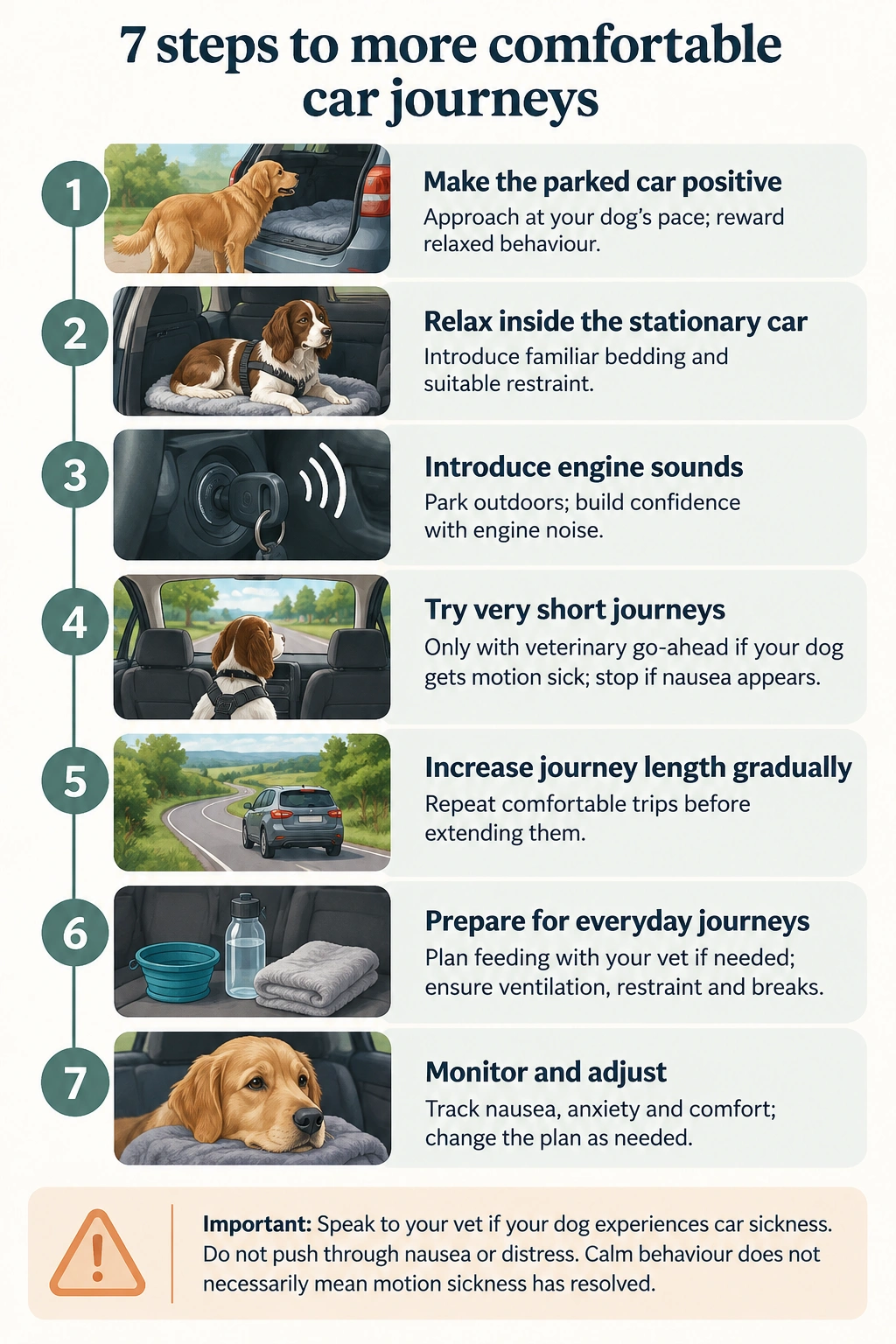
Step 1 — Make the Parked Car a Positive Place
Start with the car parked somewhere quiet and safe, with the engine switched off.
Walk towards the car with your dog and allow them to investigate at their own pace.
Reward relaxed behaviour with a small treat, praise or a favourite toy, depending on what your dog enjoys.
The Blue Cross also recommends gradually introducing dogs to the car and rewarding calm behaviour during training.
You do not need to encourage your dog inside immediately. Initially, simply approaching the car without hesitation may be enough.
Keep sessions short and finish while your dog is still comfortable.
Ready to progress? Your dog approaches the vehicle willingly and shows no obvious signs of fear or avoidance.
If they refuse to approach, move further away and reward comfortable behaviour at that distance. Gradually work closer over later sessions.
Step 2 — Help Your Dog Relax Inside the Car
Once your dog is comfortable approaching the vehicle, introduce the interior.
Open the appropriate door and allow your dog to enter without being forced. Use a safe ramp or assistance if they cannot get in comfortably.
Place familiar bedding on their travelling surface and allow them to investigate.
Initially, keep the engine off. Practise sitting calmly inside the stationary car, then leaving again.
Gradually introduce the normal travelling arrangement, including the restraint your dog will use.
Some dogs dislike the sensation of being secured, so this may need its own short familiarisation sessions.
Reward calm behaviour and let your dog leave before they become distressed.
Ready to progress? Your dog enters willingly, accepts their restraint and remains comfortable during a short stationary session.
If your dog becomes restless or tries to escape, reduce the difficulty. Never force them to remain in the car as a training exercise.
Step 3 — Introduce Engine Noise and Normal Car Sounds
A dog that is comfortable in a silent, stationary car may still become unsettled when the engine starts.
With your dog safely secured, introduce the engine while the vehicle remains parked.
Choose a well-ventilated outdoor location. Never run a vehicle engine in an enclosed garage or another space where exhaust fumes could accumulate.
Observe your dog’s response to the sound and vibration.
If they remain comfortable, offer gentle praise or a suitable reward.
If they become frightened, switch off the engine and return to an easier stage during a later session.
You can also gradually introduce ordinary sounds such as doors closing, but avoid overwhelming your dog with several new experiences at once.
Ready to progress? Your dog remains relaxed with the engine running and shows no significant signs of distress.
Remember that a dog can appear calm while still being susceptible to motion sickness. The next stage introduces a different challenge: movement.
Step 4 — Begin With Very Short Journeys
Once your dog is comfortable in the stationary car, and your vet has advised that moving journeys are appropriate, begin with a very short drive.
For some dogs, this may mean travelling for only a minute or two before returning home.
Choose a quiet route with gentle bends, minimal traffic and somewhere safe to stop.
Drive smoothly, avoiding harsh acceleration, sudden braking and sharp cornering wherever possible.
Have another adult monitor your dog if one is available.
Watch for early signs of nausea, including:
- Repeated swallowing.
- Excessive drooling.
- Lip licking.
- Retching.
- Increasing restlessness or unusual panting.
If these signs appear, stop somewhere safe as soon as practical.
Do not continue driving simply to complete a planned training duration.
Once stopped, assess your dog and allow them to recover in a safe environment. Seek veterinary advice if symptoms are significant, recurrent or do not settle.
Ready to progress? Your dog completes several very short journeys without obvious nausea or distress.
There is no universal minimum journey length that every dog must achieve before moving on.
Step 5 — Increase Journey Length Gradually
When your dog is consistently comfortable on very short journeys, begin extending the distance or duration.
Make small increases rather than moving straight from a short trip to a long drive.
For example, a dog that is comfortable on a brief journey might next try a slightly longer route under similar conditions.
The important measure is not how many minutes you have added. It is how your dog responds.
Where practical, include pleasant destinations, such as a familiar walking area, so the car does not become associated only with unpleasant experiences or veterinary appointments.
Avoid making every journey more demanding than the previous one. Repeating a comfortable journey can be valuable.
If your dog becomes sick again, do not assume that you simply need to train harder.
Return to a level they can tolerate and discuss persistent symptoms with your vet.
Ready to progress? Your dog remains comfortable across repeated journeys of the current duration, without signs of increasing nausea or fear.
Some dogs improve steadily. Others require a much slower approach or veterinary treatment to travel comfortably.
Step 6 — Prepare Carefully for Everyday Journeys
Even when your dog is becoming more comfortable with travelling, preparation can make a difference.
Plan feeding sensibly. PDSA suggests feeding dogs at least two to three hours before travelling as one possible way to reduce sickness. However, this is not suitable as a rigid rule for every dog.
Puppies, dogs with diabetes and dogs with other medical or dietary needs may require a different feeding routine. Ask your vet before changing their meal timing or withholding food.
Allow a suitable toilet break and gentle exercise. A calm walk before travelling may help some dogs settle. Avoid strenuous exercise immediately before departure, particularly in warm weather.
Keep the vehicle comfortably cool. Check that ventilation or air conditioning reaches your dog’s actual travelling position, including the rear seats or boot area.
Provide a stable travelling surface. Secure bedding or a suitable non-slip surface can reduce unnecessary sliding during bends and braking.
Drive gently. Smooth driving can reduce abrupt movement, although it cannot guarantee prevention of motion sickness.
Plan opportunities to stop. For longer journeys, allow appropriate breaks for water, toileting and rest.
Never leave your dog unattended in a parked vehicle. Cars can become dangerously hot even when the outside temperature does not feel particularly high.
For practical ways to manage heat and comfort during journeys, see our guide to keeping dogs cool in the car.
Step 7 — Monitor Each Journey and Adjust the Plan
Keep a simple record of how your dog responds.
You might note:
- The journey duration.
- Whether your dog was comfortable before departure.
- Whether they showed signs of nausea or anxiety.
- When any symptoms began.
- Whether they recovered promptly after stopping.
- Changes to feeding, route or travelling conditions.
You do not need a complicated tracking system. A few notes on your phone are enough.
Look for patterns rather than relying on one successful journey.
For example, your dog might manage a short drive comfortably but become nauseous when travelling for longer. Alternatively, they may show distress before the engine starts, suggesting that anxiety is also involved.
Use these observations to guide your next steps and share them with your vet if symptoms persist.
The goal is to build comfortable, repeatable travel experiences, not to reach a particular journey length by a deadline.
How to Tell Whether Your Dog Is Making Progress
Improvement may appear gradually.
Encouraging signs include your dog:
- Approaching and entering the car willingly.
- Settling comfortably into their restraint.
- Remaining relaxed when the engine starts.
- Completing short journeys without excessive drooling, retching or vomiting.
- Recovering normally after travelling.
- Tolerating familiar journey lengths consistently.
It is useful to distinguish behavioural progress from improvement in motion sickness.
A dog may become less frightened of the car but continue to feel nauseous when it moves. Conversely, veterinary treatment may control nausea while the dog still needs help overcoming fear associated with previous journeys.
Both aspects deserve attention.
Avoid judging progress by whether your dog manages one unusually long journey. Several comfortable experiences are generally more useful than one difficult trip.
Common Mistakes That Can Make Car Sickness Worse
Rushing into longer journeys
A dog that manages one short drive is not necessarily ready for a lengthy outing.
Increase journey duration gradually and repeat successful experiences before introducing more demanding travel.
Continuing when your dog is becoming sick
Repeatedly exposing a dog to nausea or distress can make travelling increasingly unpleasant.
If warning signs develop, stop safely and reassess. Persistent sickness warrants veterinary advice.
Feeding a large meal immediately before travelling
A full stomach may contribute to travel-related vomiting in some dogs.
Consider an appropriate feeding schedule, but do not withhold necessary meals or alter a medically important routine without veterinary guidance.
Using an uncomfortable restraint
An unsuitable harness or poorly fitted crate can make travel uncomfortable and may create additional safety risks.
Check fit, installation, stability and the manufacturer’s instructions. Your dog should have an appropriate amount of space for the restraint system being used.
Overlooking temperature and ventilation
A dog travelling in the rear of a vehicle may not receive the same cooling airflow as the driver.
Check the actual conditions around your dog rather than assuming the vehicle is comfortable because the front seats feel cool.
Punishing your dog for vomiting or showing fear
Travel sickness is not deliberate misbehaviour.
Scolding, forcing a dog into the car or using punishment to suppress signs of distress can make the experience more frightening.
Use calm handling and reward-based familiarisation instead.
What to Do If Your Dog Still Gets Car Sick
If the training process is not working, the next step depends on what you observe.
| What you notice | What it might mean | What to do next |
|---|---|---|
| Your dog becomes distressed before entering the car | Previous negative experiences or travel-related anxiety may be contributing | Return to stationary familiarisation and discuss significant anxiety with your vet |
| Your dog is calm until the car moves, then begins drooling or retching | Movement-related nausea may be an important factor | Stop safely, avoid repeated provoking journeys and ask your vet about treatment |
| Your dog manages short trips but becomes sick on longer ones | Longer exposure or more demanding movement may be difficult to tolerate | Return to a comfortable journey length and seek veterinary advice if sickness continues |
| Your dog becomes frightened despite no longer vomiting | Fear associated with travelling may remain | Continue gradual confidence-building and seek qualified behavioural support where needed |
| Your dog suddenly develops car sickness after previously travelling comfortably | A new health issue may be contributing | Arrange a veterinary assessment rather than assuming it is ordinary travel anxiety |
| Your dog must travel despite recurrent sickness | Training alone may not be sufficient for the immediate journey | Contact your vet beforehand about suitable management and treatment |
If barking is a major part of your dog’s reaction, How to Stop a Dog Barking in the Car offers a useful approach to understanding the behaviour and responding without punishment.
Persistent travel anxiety may also require help from a suitably qualified, reward-based behaviour professional, ideally working with your vet.
Can a Vet Help Prevent Car Sickness?
Yes. Veterinary advice can be particularly valuable when a dog repeatedly vomits during journeys or when travel cannot reasonably be avoided.
Your vet can assess your dog’s symptoms, consider other possible health problems and recommend appropriate treatment.
For some dogs, prescription anti-sickness medication may help prevent vomiting associated with motion sickness.
However, medication does not necessarily remove the fear a dog has developed around travelling. A dog that has experienced repeated unpleasant journeys may still benefit from gradual, positive car training.
Likewise, training alone may not adequately control nausea caused by movement.
Should you give your dog human travel-sickness tablets?
Do not give your dog human travel-sickness medication unless your vet specifically advises it.
Medicines intended for people may be unsuitable for dogs, may cause side effects or may interfere with other treatment.
There is also insufficient reliable evidence to recommend herbal remedies such as ginger or mint as dependable treatments for canine motion sickness.
If you are considering supplements, calming products or medication, discuss them with your vet first.
The most appropriate approach depends on the individual dog, their symptoms and the reason for travelling.
Keeping Your Dog Comfortable on Future Journeys
Once your dog is travelling more comfortably, continue providing positive experiences rather than assuming the problem has permanently disappeared.
Maintain a consistent preparation routine where possible.
Use the same suitable restraint, keep the vehicle comfortably ventilated and allow enough time to prepare without rushing.
For occasional journeys, consider arranging a short, comfortable practice trip before an important outing if your dog has previously struggled with travel.
For longer drives, plan appropriate rest stops and make sure you have drinking water, cleaning materials and any veterinary treatment prescribed for your dog.
Our complete guide to long-distance car travel with dogs helps with planning extended journeys, including breaks, comfort and travel preparation.
If your dog becomes sick again, return to the measures that previously helped and contact your vet if symptoms recur.
Sometimes the kindest choice is to postpone a non-essential journey or arrange alternative care rather than expecting a dog to tolerate travel that repeatedly makes them unwell.
Frequently Asked Questions
Do puppies grow out of car sickness?
Some puppies become less susceptible to motion sickness as they mature, but improvement is not guaranteed.
Early, positive car experiences may help prevent additional travel anxiety. However, repeated vomiting should not simply be ignored while waiting for a puppy to grow older.
Speak to your vet about appropriate management, especially if your puppy needs to travel regularly.
Can dogs still feel car sick even when they are not anxious?
Yes. Motion sickness can occur because of the vehicle’s movement, even when a dog appears relaxed.
Anxiety can contribute to the problem, but it is not always the underlying cause.
If your dog seems comfortable before departure but repeatedly becomes nauseous during movement, veterinary advice is particularly important.
The Next Step for Your Dog
Helping a travel-sick dog starts with understanding what makes journeys difficult and avoiding experiences that repeatedly cause distress or nausea.
Speak to your vet about existing sickness, then begin with a comfortable stage of car familiarisation and progress gradually according to your dog’s response.
With suitable preparation, positive training and veterinary support where needed, many dogs can become more comfortable travellers.
The aim is not simply to complete longer journeys. It is to help your dog travel as safely and comfortably as possible.