
Most healthy, car-confident dogs can manage a long-distance car journey, provided the trip is planned around their individual needs. Safe restraint, suitable ventilation, regular breaks and close monitoring matter more than reaching a particular number of miles or hours.
There is no universal maximum journey time that suits every dog. A relaxed adult dog may cope comfortably with several driving stages, while a puppy, senior dog, flat-faced breed, anxious traveller or dog with a medical condition may need shorter stages, more frequent stops or a different plan altogether.
This guide explains how to decide whether your dog is ready, prepare the car, plan breaks, manage food and water, recognise trouble and respond safely if your dog becomes distressed or overheated.
If you’re planning more than just a long car journey, our complete guide to travelling with your dog covers preparing for different types of trips, holidays and travel situations.
Quick answer: can dogs travel long distances by car?
Yes, many dogs can travel long distances by car. The journey should be broken into manageable stages, with opportunities to drink, toilet, stretch and settle. Your dog should be suitably restrained throughout the moving journey and should never be left unattended in a warm vehicle.
- Do not make a long drive your dog’s first substantial car journey.
- Plan a suitable break roughly every two to three hours as a starting point, but stop sooner whenever your dog needs it.
- Allow more frequent breaks for puppies, senior dogs, anxious dogs and dogs with health or mobility needs.
- Stop the journey if your dog shows persistent distress, repeated vomiting, breathing difficulty, weakness, overheating or collapse.
Is a long car journey right for your dog?
Start by assessing the dog in front of you rather than relying on a general rule. The best indication is how your dog behaves on ordinary journeys and how quickly they recover afterwards.
Signs your dog is likely to cope well
- They enter the car without significant fear.
- They settle when secured in their normal travelling position.
- They can lie down comfortably and change position.
- They do not repeatedly drool, retch or vomit.
- They remain calm during normal traffic, braking and motorway driving.
- They have no untreated health problem likely to be worsened by prolonged travel.
Dogs that need extra planning or veterinary advice
Speak to your vet before a long journey if your dog has repeated car sickness, severe travel anxiety, breathing or heart disease, significant mobility problems, recent surgery or illness, or medication and feeding needs that will be difficult to manage on the road.
Take particular care with puppies, senior dogs, overweight dogs and flat-faced breeds. These dogs may need more frequent stops, closer temperature monitoring or a shorter journey. Dogs with respiratory or heart disease can also heat up more quickly and take longer to recover.
When staying at home may be kinder
Not every dog benefits from joining every trip. If your dog is consistently frightened, becomes very sick despite veterinary support, cannot travel comfortably or will struggle at the destination, a trusted sitter or reputable boarding arrangement may provide better welfare. This is a practical decision, not a failure.
If you’re planning a UK break, our guide to dog-friendly holidays in the UK explains how to choose destinations and accommodation that genuinely suit your dog’s needs rather than simply accepting dogs.
Prepare your dog before a long-distance journey
Build up journey time gradually
A long drive should not be the first test of whether your dog tolerates the car. Begin with short, positive journeys and gradually increase the duration only when your dog remains relaxed. Practise the same restraint, bedding and position you intend to use on the main journey.
For a dog that is not yet comfortable, use the dedicated guide on getting your dog used to car travel rather than attempting to solve the problem during a high-pressure trip.
Test the complete setup
Before departure, carry out a short trial with the car loaded as it will be for the trip. Check that:
- the harness, crate or guard is securely fitted;
- the dog can stand, turn and lie in a natural position where the setup is intended to allow this;
- bedding does not slide around;
- luggage cannot fall onto the dog;
- air from the ventilation or air-conditioning system reaches the dog’s actual position;
- direct sunlight does not make the rear seat, crate or boot area excessively warm;
- you can attach the lead before opening a door or tailgate.
Plan the route around your dog
How often should you stop?
There is no exact break interval that is right for every dog. For planning purposes, a stop approximately every two to three hours is a sensible starting point for many healthy adult dogs. This is not a guaranteed safe limit and it is not a reason to ignore your dog between planned stops.
Stop sooner if your dog needs to toilet, drink, cool down, move around or recover from stress. Puppies, older dogs, dogs taking medication and dogs with anxiety, sickness or mobility problems may need much more frequent breaks.
Choose useful stopping places
A useful dog stop is more than a parking space. Look for a safe walking area away from fast traffic, enough room for a controlled toilet break, shade in warm weather and a place where you can offer water. Identify backup stops in case the planned service area is crowded, closed or unsuitable.
Keep your dog on a lead at unfamiliar stops. Attach the lead before opening the door, crate or tailgate, and make sure the dog’s collar or harness carries up-to-date identification.
Allow contingency time
A rigid arrival time encourages poor decisions. Build in time for traffic, an extra toilet stop, cooling down, cleaning after sickness or finding veterinary help. If a ferry, appointment or check-in time makes the schedule too tight to meet your dog’s needs, change the schedule rather than reducing the breaks.
Restrain your dog safely for the whole journey
Highway Code Rule 57 says dogs and other animals should be suitably restrained so they cannot distract the driver or injure themselves or occupants if the vehicle stops quickly. It gives a seat-belt harness, pet carrier, dog cage and dog guard as examples.
The most appropriate arrangement depends on the dog, the vehicle and the specific product. Follow the manufacturer’s fitting instructions and use secure anchor points. Do not assume that every harness, crate or guard offers the same level of protection.

Main restraint options
| Option | May suit | Important checks |
|---|---|---|
| Car harness and seat-belt attachment | Dogs travelling on a rear seat | Correct fit, suitable attachment point, safe tether length and no neck attachment |
| Secured crate or carrier | Dogs comfortable resting in an enclosed space | Correct size, secure installation, ventilation and no loose luggage around it |
| Dog guard or partition | Suitable estate or hatchback cargo areas | Secure fit, adequate space and ventilation; consider whether additional restraint is needed |
| Combined setup | Vehicles and dogs needing separation plus restraint | Compatibility of every component and enough room to rest normally |
Never attach a travel tether to a collar
A sudden stop can place severe force on the neck. Attach a compatible tether to an appropriate body harness, or use a correctly secured carrier or crate. A seat cover or hammock protects upholstery but is not a restraint.
Prevent driver distraction
Do not allow your dog onto the driver’s lap or to move freely into the front of the vehicle. Avoid letting a dog travel with their head out of the window: they can be injured by debris, strike an object, fall or distract other road users.
For fuller restraint, loading and vehicle-safety guidance, read How to Travel with a Dog in a Car Safely.
Can a dog travel in the boot on a long journey?
A dog may be able to travel in the cargo area of a suitable estate car, hatchback or similar vehicle when that space is part of the ventilated passenger compartment. The dog must be suitably restrained, have enough room to rest comfortably and be protected from loose luggage.
A sealed luggage boot is not a suitable travelling space. Even in an open cargo area, check whether cool air reaches the dog and whether direct sun, thick bedding, a covered crate or packed luggage is trapping heat. The detailed guide Can Dogs Travel in the Boot of a Car? explains the vehicle and setup considerations more fully.
Food, water and toilet breaks
Carry more water than you expect to use
Take enough drinking water for the whole journey plus a reserve. Offer it regularly, especially at breaks, and monitor whether your dog is drinking normally. Do not rely on every service area having a suitable tap or shop.
A portable bowl can be useful, but secure it while the vehicle is moving so it does not become a loose object. Some travel setups allow a secure non-spill bowl; others are safer when water is offered at stops.
Plan food around the individual dog
A large meal immediately before travel can make nausea worse. For dogs prone to car sickness, veterinary guidance commonly recommends allowing roughly two to three hours between feeding and travel. If your dog needs food or medication at a particular time, follow your vet’s instructions.
On a very long journey, use a proper stop for a light meal and allow time for digestion before continuing. Carry your dog’s usual food rather than depending on finding a familiar brand on the route.
Use breaks for gentle movement and reassessment
A break should allow your dog to toilet, sniff, walk gently and change position. It is not the ideal time for intense ball chasing or strenuous exercise, particularly in warm weather. Before setting off again, check breathing, behaviour, bedding, restraint and the temperature around the dog.
Keep Your Dog Cool Without Relying on Cooling Products Alone
Check the whole route, not only the temperature at home
Look at the forecast for the journey and destination, likely traffic delays and the time of day. On warm days, travelling early in the morning or later in the evening may reduce risk, but the vehicle still needs effective ventilation and monitoring.
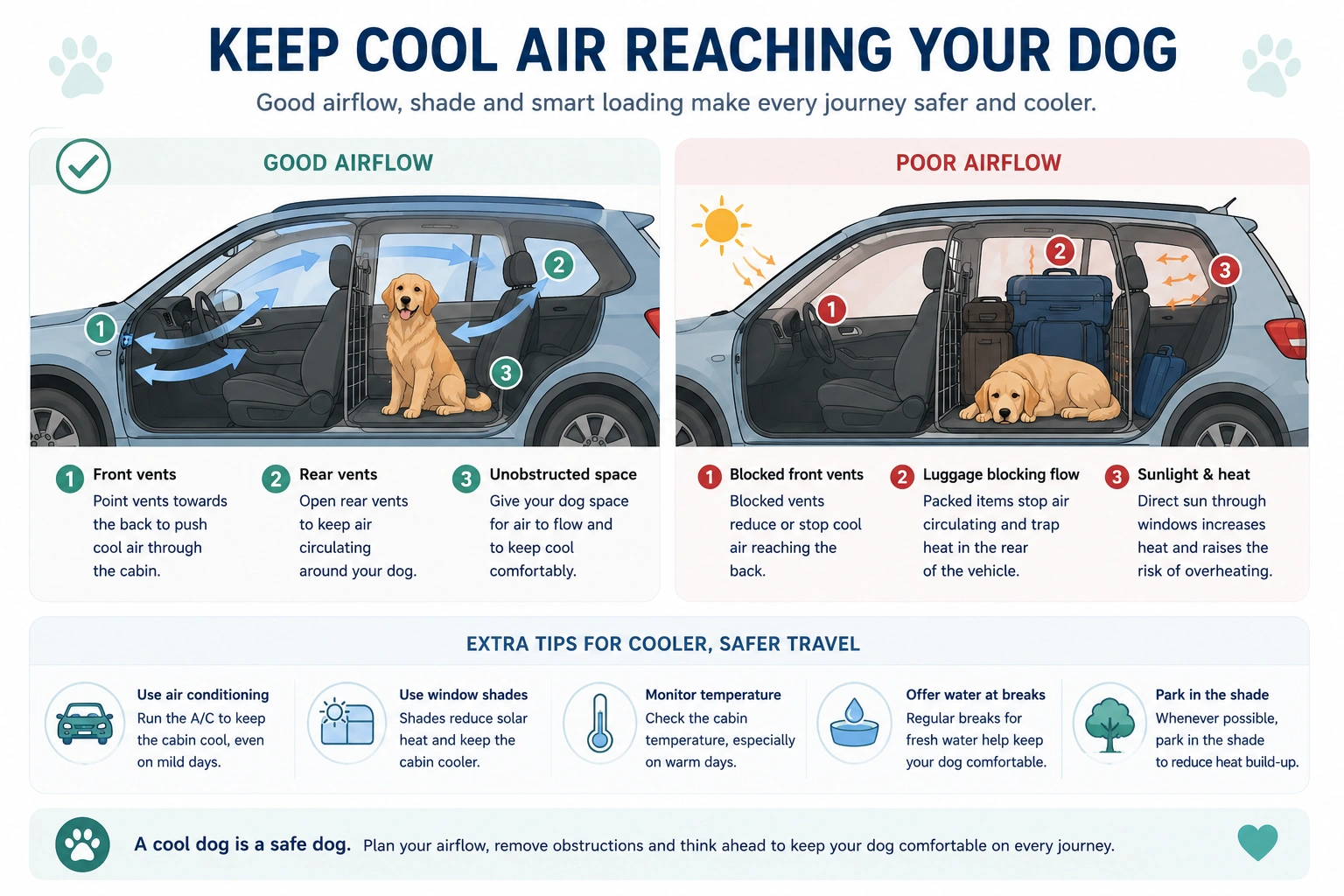
Make sure cool air reaches the dog
The driver may feel comfortable while the rear seat, covered crate or boot area is warmer. Check airflow with the dog’s position and luggage in place. Watch for direct sun, blocked vents, heavy bedding and covers that restrict ventilation.
Never leave a dog unattended in a warm vehicle
Open windows and shade do not make a parked car safe. The RSPCA warns that when it is 22°C outside, a car could reach 47°C within an hour. Do not leave the dog while you use the toilet, buy food or check in. Arrange for another adult to stay with the dog, use dog-friendly facilities or change the plan.
Cooling mats and temperature monitors
A suitable cooling mat may improve comfort, and a temperature monitor may help you understand conditions in the rear of the vehicle. Neither replaces ventilation, air conditioning, breaks and direct observation. Your dog should be able to move away from a cooling surface, and any product should be used according to its instructions.
For product selection rather than emergency advice, see Best Cooling Mats for Cars & Travel.
Recognise when your dog is struggling
Signs of stress or anxiety
- persistent panting when heat is not the explanation;
- pacing or repeatedly changing position;
- trembling, whining or barking;
- repeated yawning or lip licking;
- ears held back, a tucked posture or refusal to enter the car;
- inability to settle even after a suitable break.
If travel anxiety is a recurring problem, a dedicated plan on how to keep a dog calm in the car is more useful than trying multiple products during the journey.
Signs of car sickness
- drooling;
- repeated swallowing;
- lip licking;
- panting;
- retching;
- vomiting;
- growing fear of approaching or entering the car.
Repeated sickness should be discussed with a vet. Licensed veterinary anti-sickness medication can be appropriate for some dogs, but human travel-sickness products and unverified remedies may be ineffective or harmful. See the guide to the signs and causes of car sickness in dogs for a fuller explanation.
Signs of overheating
- heavy or difficult breathing;
- excessive drooling;
- weakness or unusual lethargy;
- uncoordinated movement;
- vomiting or diarrhoea;
- confusion, collapse, seizures or loss of consciousness.
What to do if your dog is overheating
- Stop safely and prevent further heating.
- Move the dog out of the hot vehicle or direct sun.
- Begin cooling immediately with water that is cooler than the dog, focusing on the body rather than pouring water over the head; create airflow where possible.
- Call a vet and explain the symptoms.
- Transport the dog in a cooled, well-ventilated vehicle once cooling has begun.
Suspected heatstroke is an emergency. Do not delay cooling while waiting for advice, and do not continue the original journey. Read Dog Heatstroke: Symptoms, Treatment & Prevention for the full emergency guidance.
What to pack for a long car journey with your dog
Keep the essentials accessible rather than buried under luggage.
Essential items
- the fitted restraint, crate or carrier;
- lead, collar or harness and current identification;
- a spare lead;
- water and a portable bowl;
- the dog’s normal food where needed;
- prescribed medication and instructions;
- poo bags;
- absorbent towels and a basic cleaning kit;
- familiar bedding;
- vet, insurance and emergency contact details;
- a recent photograph of the dog;
- any documents required for the destination or onward transport.
Useful for some dogs and journeys
- cooling mat;
- window shades;
- rear-compartment temperature monitor;
- ramp or steps for mobility-limited dogs;
- spare bedding;
- secure storage for food and medicines.
For a fuller preparation resource, use the complete dog travel packing list.
Special considerations
Puppies
Puppies often need more frequent toilet breaks and may be more prone to motion sickness. Build up travel gradually and consider vaccination status when choosing public exercise areas. Keep the experience calm rather than turning the first long journey into a test of endurance.
Senior dogs and dogs with mobility problems
Use non-slip footing, comfortable support and an entry method that does not require a painful jump. Plan more frequent opportunities to change position. Check for stiffness, reluctance to stand or signs of pain at every stop.
Flat-faced, overweight and medically vulnerable dogs
These dogs can be more vulnerable to heat and breathing difficulty. Avoid warm travel conditions where possible, make sure cool air reaches them and seek veterinary advice if you are unsure whether the journey is appropriate.
Two or more dogs
Each dog needs a safe travelling arrangement. Do not rely on the dogs simply lying together in an open space. Consider whether they need separating, whether each can rest normally and how you will manage both safely at busy stops.
A practical long-distance journey routine
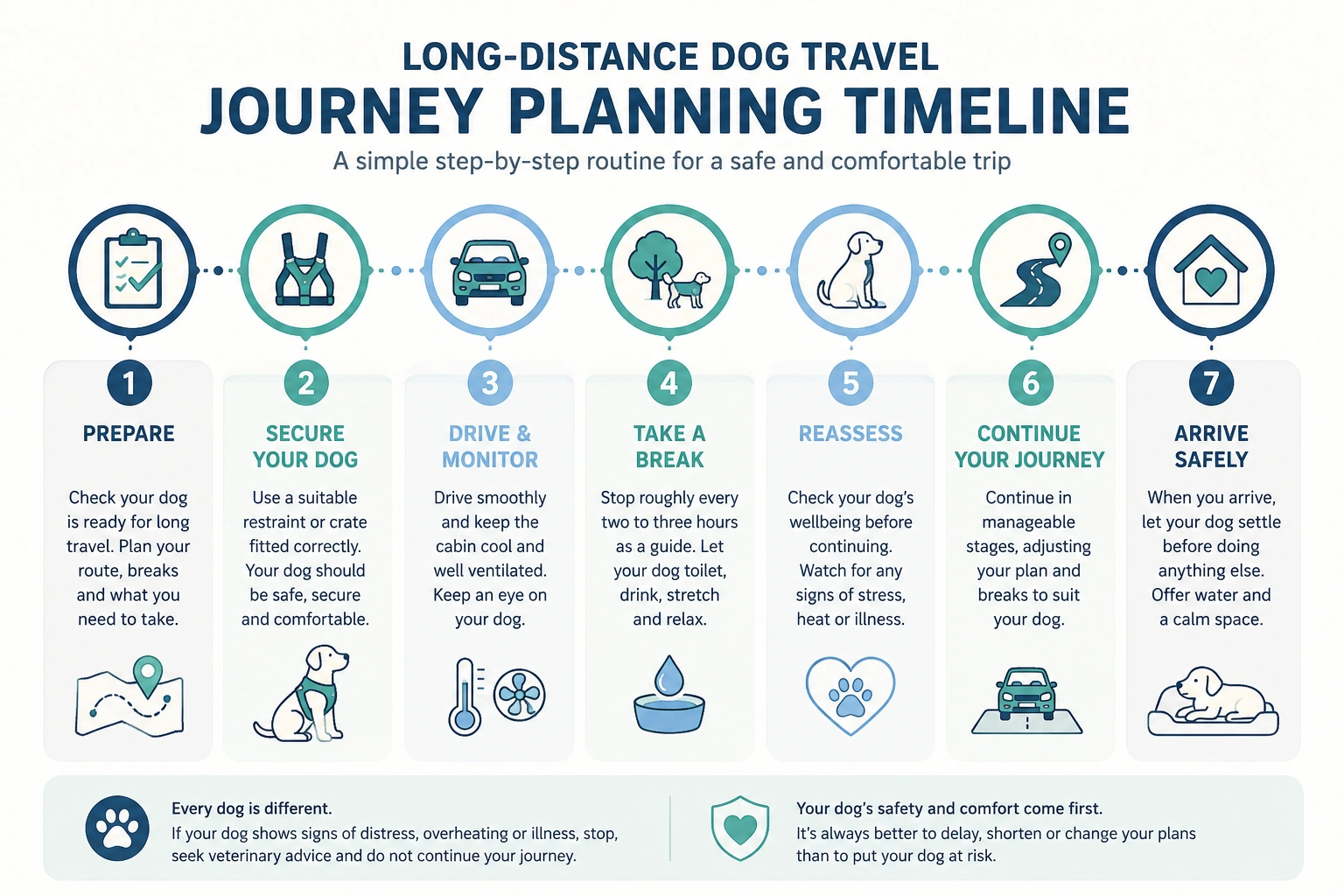
The day before
- Check the route, weather and likely delays.
- Confirm planned and backup stops.
- Test the restraint and airflow.
- Pack water, medicines, food and emergency details.
- Avoid unusually strenuous activity that may leave the dog sore or exhausted.
Before setting off
- Give your dog a suitable walk and toilet opportunity.
- Feed according to the individual plan.
- Offer water.
- Check identification.
- Secure the dog before the vehicle moves.
- Confirm that the dog’s area is cool, stable and free from loose luggage.
During each driving stage
- Drive smoothly.
- Monitor posture, breathing and behaviour.
- Check for direct sun and changing temperature.
- Stop before the planned time if your dog shows discomfort.
At every break
- Attach the lead before opening the vehicle.
- Allow toileting and gentle movement.
- Offer water.
- Check breathing, behaviour, paws, bedding and restraint.
- Continue only when your dog is comfortable.
On arrival
- Unload in a secure area.
- Offer water and a toilet break.
- Allow quiet time to decompress.
- Check for stiffness, nausea or unusual panting.
- Return to the normal routine gradually.
Long-distance dog travel checklist
- Your dog is physically and emotionally suitable for the journey
- Practice journeys have gone well
- A vet has been consulted where needed
- The restraint is fitted and tested
- The dog has enough comfortable space
- Route and backup stops are planned
- Weather and likely delays have been checked
- Water, food and medication are packed
- Identification and contact details are current
- Emergency vets can be found on the route
- Someone can remain with the dog at stops
- You are prepared to delay, shorten or abandon the journey
A successful journey is planned around the dog
Long-distance car travel with dogs is not about proving how many hours a dog can tolerate. It is about creating a series of safe, manageable stages and being willing to change the plan when the dog needs something different.
Prepare gradually, use suitable restraint, carry water, control the temperature and reassess your dog at every break. For plans involving other forms of transport, accommodation or international travel, continue with the complete guide to travelling with a dog.
If you’re still deciding where to stay, see our guide to dog-friendly holidays in the UK for help choosing the right type of accommodation and holiday for your dog.
Read next
- How to Travel with a Dog in a Car Safely
- Best Cooling Mats for Cars & Travel
- Can Dogs Travel in the Boot of a Car?