
Mild dog sunburn can often be managed at home by getting your dog out of direct sunlight and gently cooling the affected skin with a cool compress. More severe sunburn, or any burn that is causing significant pain, should be checked by a vet straight away.
Avoid reaching for human aftersun, painkillers or unverified home remedies. What is safe to put on a dog’s sunburn depends on the condition of the skin and the product involved, and some ingredients found in human products can be harmful to dogs.
What to do if your dog has sunburn
If you think your dog has been sunburnt, first move them indoors or somewhere completely out of direct sunlight. Then look at the affected skin and consider how uncomfortable your dog seems.
According to current PDSA guidance on sunburn in pets, mild sunburn can often be treated at home, while severe sunburn should be checked by a vet straight away.
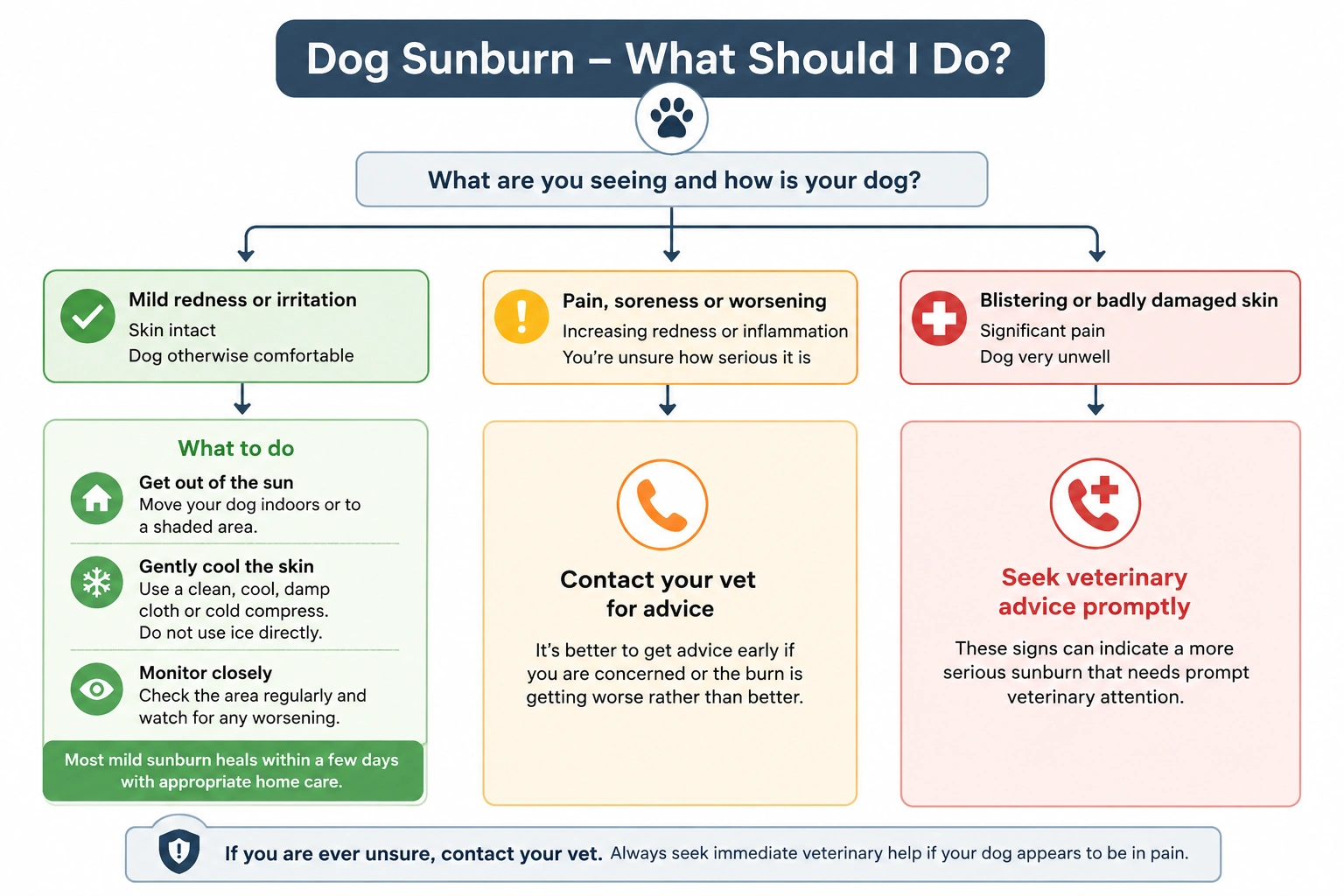
A useful first decision is:
| What you’re seeing | What to do |
|---|---|
| Mild redness or irritation, intact skin and a dog who otherwise seems comfortable | Move them out of the sun, gently cool the skin and monitor them closely |
| Pain, significant soreness, worsening inflammation or uncertainty about how serious the burn is | Contact your vet for advice |
| Blistering, badly damaged skin or a dog who appears very unwell or in significant pain | Seek veterinary advice promptly |
If you are not sure whether the skin changes you’re seeing are actually sunburn, our guide to what dog sunburn looks like explains the signs in more detail.
Can mild dog sunburn be treated at home?
Yes. PDSA advises that mild sunburn often heals within a few days with appropriate home care.
The important word is mild.
Home care is appropriate only when the skin damage appears minor and your dog is otherwise comfortable. It should not be used as a reason to delay veterinary advice if your dog is in pain, the skin is badly damaged or you are unsure how serious the burn is.
Sunburn can cause redness, crusting, flaking, itching, blisters and pain. If you need a broader explanation of why dogs get sunburnt and the areas most commonly affected, see our complete guide to dog sunburn.
How to soothe mild dog sunburn safely
For a genuinely mild case, treatment should be simple. You do not need to create a complicated home-remedy routine.
1. Get your dog out of direct sunlight
Prevent further UV exposure immediately.
Keep your dog away from direct sunlight while the affected skin heals. This may mean changing when they go outside and providing reliable shade or physical protection when outdoor trips are unavoidable.
2. Gently cool the affected skin
PDSA recommends a cold compress to gently cool mild sunburn.
A simple approach is to use a clean, cool, damp cloth against the affected area. PDSA’s more recent sun-protection guidance specifically advises wrapping a cold compress rather than putting ice or a frozen compress directly against the skin.
Do not scrub or rub the burnt area.
3. Leave damaged skin alone
Avoid picking at flaky or crusted skin or breaking blisters.
If your dog keeps licking, scratching or rubbing the affected area, contact your vet for advice. Repeated interference can make already damaged skin harder to manage.
4. Keep watching the burn
Check the affected area regularly while it heals.
Pay particular attention to increasing pain, worsening redness, blistering, discharge, significant crusting or other deterioration. Contact your vet if the burn is getting worse rather than better or if you become concerned at any stage.
When does dog sunburn need a vet?
Severe sunburn should be checked by a vet straight away. PDSA also advises contacting a vet immediately if your pet appears to be in pain.
Contact your vet if:
- the skin is blistered or badly damaged;
- your dog appears to be in significant pain;
- the affected area is becoming more inflamed rather than settling;
- there are signs that damaged skin may have become infected;
- the burn appears extensive;
- your dog seems unwell as well as having damaged skin;
- you are unsure whether the burn is mild enough to manage at home.
Current Blue Cross summer safety guidance also recommends prompt veterinary advice if a dog’s skin looks sore, crusty or scaly.
You don’t need to work out precisely how severe a burn is before contacting your vet. If the appearance of the skin or your dog’s behaviour is making you concerned, ask for veterinary advice rather than experimenting with additional home treatments.
What should you not put on dog sunburn?
It can be tempting to treat dog sunburn in the same way you would treat your own. That isn’t necessarily safe.
Unless your vet has specifically advised otherwise, avoid putting human creams, ointments, aftersun or other medicated products onto burnt skin.
PDSA’s general first-aid guidance for burns advises against applying creams or ointments to burns. Although sunburn has its own specific home-care guidance for mild cases, this reinforces why adding products to damaged skin without veterinary advice is not a sensible default.
Human painkillers should not be given as a DIY treatment for sunburn. If your dog needs pain relief, contact your vet so they can decide what treatment is appropriate.
Human sunscreen should not be used as a treatment for an existing burn either. Some ingredients used in human sunscreen may be unsafe for pets. Prevention should use an appropriate pet-safe product rather than whatever happens to be in the bathroom cupboard.
Can you use aloe vera on dog sunburn?
Aloe vera is often suggested as a home remedy for human sunburn, but that doesn’t mean you should automatically apply an aloe product to your dog.
There are important differences between the aloe gel itself, other parts of the plant and the many commercially formulated products sold as aloe gels or aftersun.
The ASPCA’s information on Aloe vera lists the plant as toxic to dogs because it contains compounds including saponins and anthraquinones, although it separately notes that the gel is considered edible. Commercial aloe products may also contain other ingredients that have not been selected with dogs in mind.
That makes a blanket recommendation such as “put aloe vera on your dog’s sunburn” too simplistic.
Do not use aloe vera as a default dog-sunburn treatment. If your vet recommends a particular veterinary-safe aloe product for your dog’s skin, follow their instructions for that specific product.
Does coconut oil help dog sunburn?
Coconut oil is another commonly suggested home remedy, but there isn’t a good reason to make it part of the standard first-line treatment for dog sunburn.
The established home-care measures for mild sunburn are much simpler: gently cool the affected skin, prevent further direct sun exposure and monitor your dog.
Adding an oily product is unnecessary unless your vet has recommended a particular topical treatment.
If your dog’s skin is uncomfortable enough that you feel it needs more than basic cooling and protection, that is a good point to ask your vet what should be applied rather than working through a series of home remedies.
What will a vet do for dog sunburn?
Veterinary treatment depends on how badly the skin has been affected.
For severe sunburn, PDSA says treatment may include:
- pain relief;
- anti-inflammatory medication;
- wound dressings;
- antibiotics where appropriate;
- intravenous fluids in very severe cases.
These are veterinary treatments rather than things to reproduce at home.
The vet can also assess whether what appears to be sunburn could be another skin problem and determine how extensive the damage actually is.
How to care for your dog’s skin while the sunburn heals
Protecting the skin from another dose of UV radiation is an important part of recovery.
Keep your dog out of direct sunlight until the affected skin has healed. Short outdoor trips may still be necessary, but avoid unnecessary sun exposure and follow any protection advice your vet has given you.
If you need to travel while your dog is recovering, make sure the journey itself is planned safely, particularly in warm weather — see our guide to how to travel with a dog safely in a car.
Be especially careful with exposed areas such as the nose, ears, eyelids, belly and areas where the coat is thin or missing. PDSA identifies these as common locations for pet sunburn.
If the affected area is your dog’s nose, our dedicated guide to dog nose sunburn covers the particular causes, treatment and prevention issues associated with this exposed area.
Continue monitoring the skin rather than assuming that the problem is resolved as soon as the redness begins to fade. Contact your vet if healing is not progressing as expected or the area becomes more painful or damaged.
How to prevent another sunburn
Once the current burn has healed, the priority changes from treatment to prevention.
Dogs with light-coloured skin or fur, thin or patchy coats and exposed areas of skin can be particularly vulnerable. Reducing direct exposure and using appropriate protection where needed can help.
For the full prevention strategy, including when sun protection may be needed, see how to prevent dog sunburn.
Where sunscreen is appropriate, use a suitable pet-safe product rather than assuming a human sunscreen is safe. PDSA recommends pet-safe sunblock that is at least SPF30 and waterproof, while Blue Cross advises avoiding products containing zinc oxide or para-aminobenzoic acid (PABA).
Protective clothing can also be useful for some dogs and situations, but it should be comfortable, appropriate for the conditions and never used in a way that increases the risk of overheating.
How long does mild dog sunburn take to heal?
PDSA says mild sunburn often heals within a few days with appropriate home treatment.
That isn’t a deadline by which every dog’s skin should have completely returned to normal. The severity and extent of the burn will affect recovery.
The important thing is the direction of travel: a mild burn should be settling rather than becoming increasingly painful, inflamed or damaged.
If your dog’s skin is not improving as expected, or you have any concerns about how it is healing, contact your vet.
The safest next step
If your dog’s sunburn appears genuinely mild and they are otherwise comfortable, get them out of direct sunlight, gently cool the affected skin and monitor it closely.
Avoid experimenting with human creams, painkillers or internet home remedies.
If your dog is in pain, the skin is blistered or badly damaged, the problem is worsening, or you simply aren’t confident that the burn is mild, contact your vet. Once the skin has recovered, focus on preventing another burn rather than relying on treatment after the damage has occurred.
Read next
- Dog Sunburn: Symptoms, Treatment & Prevention (Complete Guide)
- How to Prevent Dog Sunburn
- Dog Sunburn Symptoms: What Does Dog Sunburn Look Like?