

If you drive with a dog in the UK, the Highway Code says they should be suitably restrained so they cannot distract you while you are driving or injure you, themselves or other occupants if you stop suddenly.
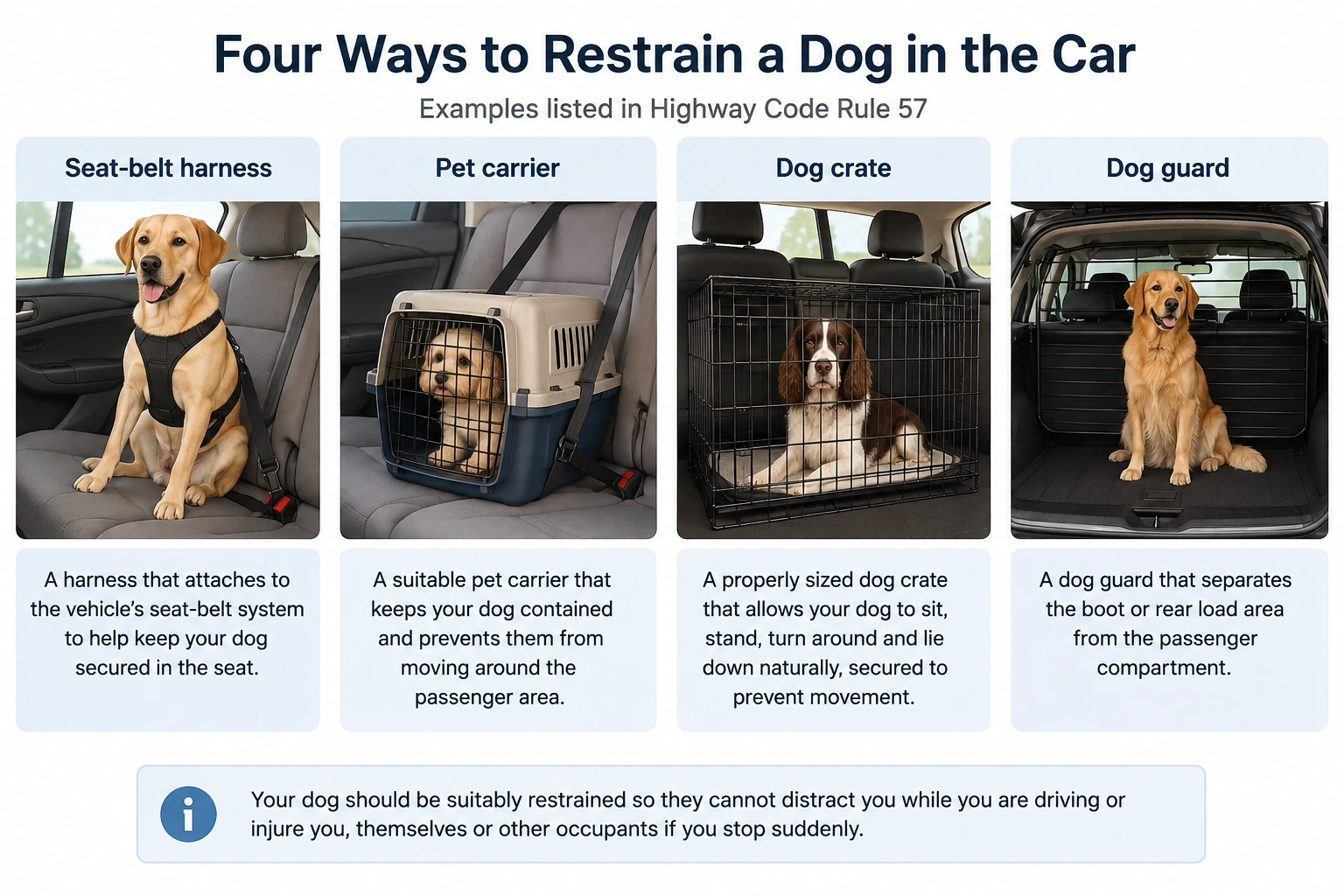
Rule 57 gives a seat-belt harness, pet carrier, dog cage and dog guard as examples of ways to restrain an animal in a car.
The legal position is slightly more nuanced than it is sometimes presented online, however. Rule 57 is not itself written as a statutory MUST rule carrying an automatic fine simply because your dog is unrestrained. But ignoring the Highway Code can still have legal consequences, particularly if a loose dog distracts you or contributes to careless or dangerous driving.
Here is what UK drivers need to understand.
The key point: Rule 57 of the Highway Code says dogs should be suitably restrained in a vehicle. Rule 57 is not itself a standalone offence carrying an automatic fine, but ignoring it can matter if a loose dog contributes to careless or dangerous driving.
What does UK law say about dogs travelling in cars?
For England, Scotland and Wales, Rule 57 of the Highway Code says:
When in a vehicle make sure dogs or other animals are suitably restrained so they cannot distract you while you are driving or injure you, or themselves, if you stop quickly.
It then lists four examples of restraint:
- a seat-belt harness;
- a pet carrier;
- a dog cage;
- a dog guard.
Northern Ireland’s Highway Code gives materially the same Rule 57 advice.
The important principle is therefore straightforward: your dog should not be loose in a position where they could interfere with your driving or be thrown around the vehicle during sudden braking.
That does not mean every dog must use the same type of restraint. The Highway Code describes several options rather than prescribing one universal device for every dog and vehicle.
Is Highway Code Rule 57 actually a law?
This is where many explanations of the UK dogs-in-cars rules become misleading.
Some Highway Code rules are direct legal requirements. The Code identifies these using words such as MUST or MUST NOT and normally includes a reference to the legislation creating the offence.
Rule 57 does not use that wording.
Rule 57 vs a standalone offence
Rule 57 tells drivers what they should do, but it does not create a specific offence called “having an unrestrained dog in a car”. Failure to follow the Highway Code can still be used as evidence where an actual road-traffic offence is alleged.
That means simply failing to follow Rule 57 is not the same as committing a specific standalone offence called something like “having an unrestrained dog in a car”.
But that does not make the rule optional advice that can safely be ignored.
The Highway Code explains that failure to comply with its other rules can be used as evidence in court proceedings to establish liability under road-traffic law.
That distinction matters.
If your dog is loose but never affects your driving, there is not an automatic “Rule 57 fine”. If your loose dog climbs onto you, obstructs your view, interferes with the controls or otherwise distracts you and your standard of driving falls as a result, existing driving offences can become relevant.
Do dogs legally have to be restrained in a car?
For practical purposes, UK drivers should work on the basis that dogs need to be suitably restrained whenever they travel in a vehicle.
The Highway Code expressly tells drivers to do this, and restraint protects against two different problems:
- Driver distraction — preventing the dog from interfering with the person controlling the vehicle.
- Injury during sudden stopping — reducing the risk of the dog injuring themselves or another occupant.
What the rules do not say is that every dog must wear a particular dog seat belt.
A harness may be suitable for one dog and vehicle, while a properly used carrier, crate or dog guard may be more appropriate in another.
If you want a more detailed explanation of the distinction between the Highway Code requirement and the underlying law, our guide Do Dogs Have to Be Restrained in a Car? looks specifically at that question.
What counts as suitable restraint for a dog?
Rule 57 does not define one product or setup as the only legal solution. Instead, it identifies several ways in which animals can be restrained.
The appropriate choice will depend on factors such as your dog’s size, the vehicle, where the dog travels and the restraint system being used.
Seat-belt harnesses
A car harness can secure a dog using an appropriate connection to the vehicle’s restraint system.
The important distinction is between a restraint designed for travelling and an ordinary walking harness simply being present on the dog. Any restraint should be suitable for its intended use, correctly fitted and used according to its instructions.
If you are choosing this type of restraint, our Best Dog Car Harnesses & Seat Belts guide covers the purchasing decision in more detail.
Pet carriers and dog crates
A carrier or crate can keep a dog contained and prevent them from moving freely around the passenger compartment.
It also needs to be suitable for the individual dog and used securely.
The RSPCA advises that when a dog travels in a crate or container, there should be enough room for them to sit and stand at full height, turn around easily and lie down naturally. Appropriate ventilation and airflow are also important.
A crate should not simply become another unsecured object that can move around the vehicle.
For help choosing one specifically for car journeys, see Best Dog Travel Crates for Cars.
Dog guards
A dog guard is another restraint method specifically mentioned in Rule 57 and is commonly used to separate a dog travelling in the rear load area from the passenger compartment.
However, “mentioned by the Highway Code” should not be confused with a claim that every dog guard offers identical protection in a collision. Its design, installation and intended purpose still matter.
Does a dog legally need a seat belt?
No specific rule says that every dog must wear a dog seat belt.
A seat-belt harness is one of the restraint methods named in Rule 57, alongside carriers, cages and dog guards.
The important requirement is the outcome: the dog should be suitably restrained so they cannot distract the driver or cause injury if the vehicle stops quickly.
What can happen if your dog is loose in the car?
There is no single automatic “unrestrained dog fine” attached to Rule 57.
Instead, what happens depends on the circumstances.
In Great Britain, driving without due care and attention is an offence under the Road Traffic Act 1988. If a loose dog materially distracts you and your driving falls below the standard expected of a competent and careful driver, careless driving may become relevant.
Imagine, for example, that a dog moves from the passenger seat onto the driver’s lap, blocks a mirror, interferes with the steering wheel or causes the driver to look away from the road. The legal concern is no longer simply that the dog was unrestrained: it is the effect that situation has had on the driving.
More serious circumstances could potentially engage more serious road-traffic offences.
This is why suitable restraint should be viewed as part of controlling the vehicle safely, rather than simply as a box to tick before setting off.
Could you get penalty points or a fine?
Potentially, but the penalty would relate to the actual driving offence, not an automatic penalty for breaching Rule 57.
In England, Scotland and Wales, driving without due care and attention carries 3 to 9 penalty points. A court dealing with careless or inconsiderate driving can also impose a fine and, depending on the circumstances, disqualify the driver.
Northern Ireland has its own road-traffic penalty system. Current Northern Ireland guidance also lists 3 to 9 penalty points for driving without due care and attention, while its penalties differ in some other respects from Great Britain.
This is why claims such as “an unrestrained dog automatically means a £5,000 fine” are misleading. They confuse the Highway Code restraint rule with penalties that may apply to a separate driving offence.
There is no automatic £5,000 Rule 57 fine
Any fine, points or disqualification would depend on the actual driving offence and the circumstances. Rule 57 itself does not impose an automatic £5,000 penalty simply because a dog is unrestrained.
Can a dog travel in the front seat, boot or on someone’s lap?
Rule 57 focuses on suitable restraint and driver distraction rather than providing a simple list of seats or areas where dogs are always permitted or prohibited.
The details still matter.
Can a dog travel in the front seat?
Rule 57 does not contain a blanket statement saying dogs are forbidden from the front passenger seat.
However, a dog travelling there must still be suitably restrained and must not distract the driver. There are also safety considerations beyond the basic Rule 57 question, including the dog’s position and the vehicle’s occupant-protection systems.
See Can Dogs Travel in the Front Seat of a Car? for the full explanation.
Can a dog travel in the boot?
Dogs can travel in the rear load area of suitable vehicles, but putting a dog in the boot does not remove the need to think about restraint, comfort and safety.
A dog guard is one of the restraint options expressly mentioned by the Highway Code, while crates may also be appropriate depending on the vehicle and dog.
Our guide Can Dogs Travel in the Boot of a Car? covers this arrangement in detail.
Can a dog sit on the driver’s lap?
Allowing a dog to sit on the driver’s lap creates an obvious potential for distraction or interference with steering and other controls. It is also difficult to reconcile with Rule 57’s instruction to keep animals suitably restrained.
For the specific legal and safety issues involved, see Can a Dog Sit on Your Lap in a Car?
Does your dog have to be restrained if a passenger is holding them?
Having another person in the car does not remove Rule 57’s underlying requirement.
The relevant question is still whether the dog is suitably restrained so they cannot distract the driver or injure themselves or other occupants during sudden stopping.
Simply holding a dog should not automatically be assumed to provide the same protection as an appropriate restraint system. In sudden braking or a collision, a passenger may not be able to keep hold of the animal.
Using a suitable restraint is the more dependable approach.
Does the law say where a dog should sit in the car?
Rule 57 does not prescribe one universal seating position for every dog.
Instead, it concentrates on preventing distraction and injury through suitable restraint.
That means two questions need to be kept separate:
- Is the dog suitably restrained?
- Is this a sensible and safe position for this particular dog and vehicle?
The second question involves considerations beyond the wording of Rule 57. Our guide Where Should a Dog Sit in a Car? deals specifically with the different positions and their practical implications.
Legal compliance is only part of safe car travel
Restraint is important, but complying with Rule 57 does not by itself make every journey safe or comfortable for a dog.
Owners also need to consider the dog’s welfare, the suitability of the vehicle and the journey itself.
In England and Wales, animal-welfare legislation places duties on people responsible for animals to take reasonable steps to meet their welfare needs. There are also specific welfare rules intended to prevent animals being transported in ways that cause or are likely to cause injury or unnecessary suffering.
So a dog may be restrained and still be travelling in unsuitable conditions.
For the wider safety considerations — including preparing the vehicle and dog for the journey — see How to Travel with a Dog in a Car Safely. For longer journeys, Long-Distance Car Travel with Dogs: Complete Guide covers the additional planning involved.
Dogs that struggle to get into or out of a vehicle may also need a different approach to access. Our Best Dog Ramps & Steps for Cars guide covers those products separately; ramps and steps can help with access but they are not substitutes for a suitable restraint once the dog is travelling.
Quick checklist for travelling with a dog in a car
Before setting off:
- Restrain your dog appropriately. Choose a setup that prevents them from distracting the driver and reduces uncontrolled movement during sudden stopping.
- Use the restraint correctly. Follow the instructions for the harness, carrier, crate or guard rather than improvising an attachment.
- Secure crates and carriers appropriately. A contained dog is not fully protected if the whole container can move dangerously around the vehicle.
- Keep the driver’s view and controls clear. Your dog should not be able to interfere with steering, pedals, mirrors or gear controls.
- Consider your dog’s comfort and welfare. They need a suitable travelling environment as well as physical restraint.
- Think about access separately. Ramps and steps may help some dogs enter and leave a vehicle, but they do not provide restraint during the journey.
- Check current official guidance when necessary. Highway Code and road-traffic rules can change, so rely on current government guidance rather than old penalty claims circulating online.
The bottom line
The UK Highway Code says dogs travelling in vehicles should be suitably restrained so they cannot distract the driver or cause injury during sudden stopping.
That does not mean Rule 57 creates an automatic standalone fine whenever a dog is unrestrained, nor does it require every dog to wear the same type of seat belt. The legal consequences depend on the circumstances and whether an actual road-traffic offence has been committed.
The sensible approach is much simpler: choose an appropriate restraint, use it correctly and make sure your dog cannot interfere with your ability to drive safely.
Once that is sorted, the next step is making sure the rest of the journey is suitable too. How to Travel with a Dog in a Car Safely covers the wider safety considerations beyond the law.
Read next
- How to Travel with a Dog in a Car Safely
- Do Dogs Have to Be Restrained in a Car?
- Where Should a Dog Sit in a Car?