
Travelling with a dog can be safe, comfortable and enjoyable, but only when the journey suits the individual dog and every stage has been planned around their welfare.
The best approach is to decide first whether your dog should travel, then check the route, transport rules, accommodation, health requirements and practical needs before you book. Equipment can help, but it cannot make an unsuitable journey safe.
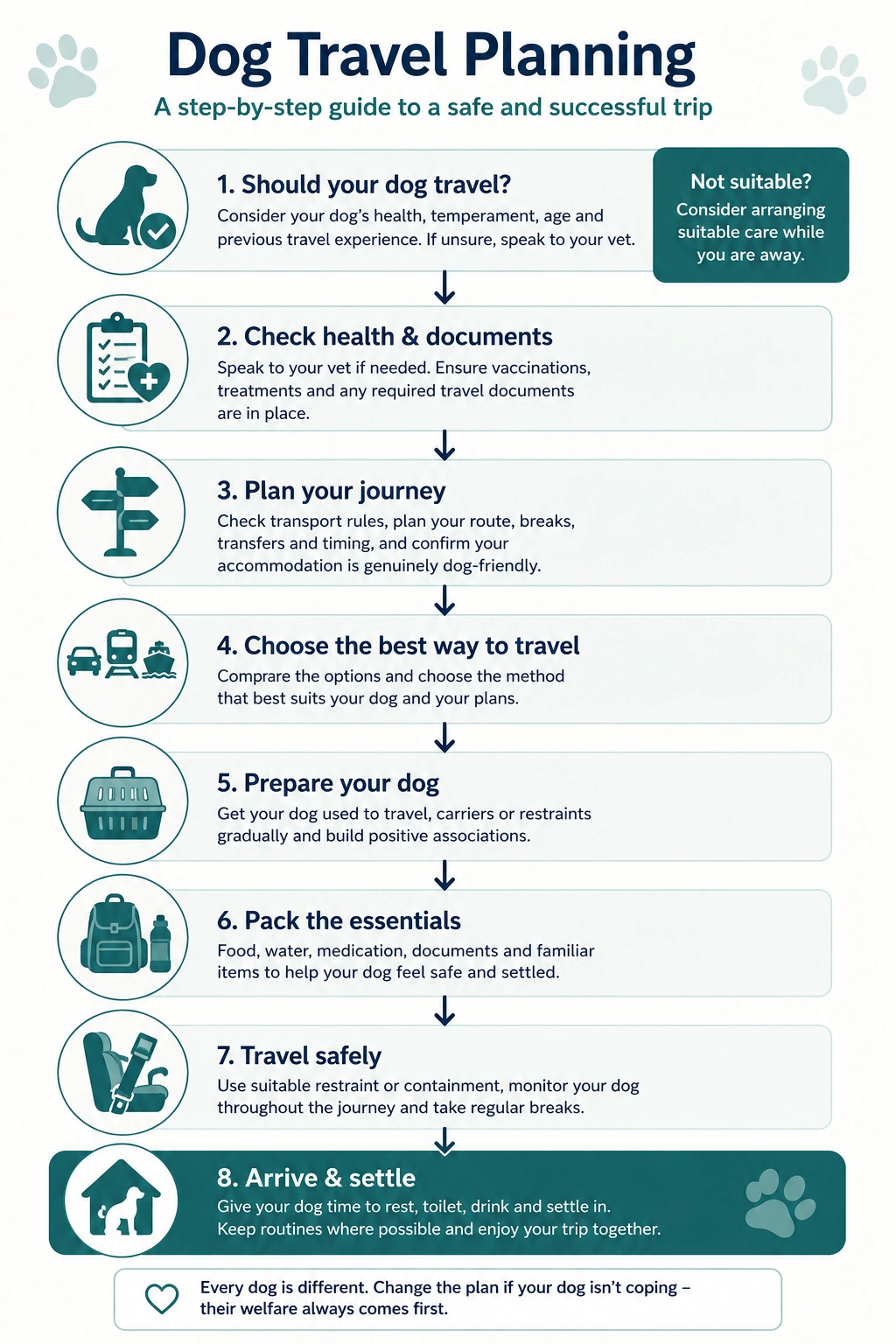
Travelling with a dog in eight steps
- Check whether the trip genuinely suits your dog.
- Speak to your vet if health, travel sickness or anxiety may be an issue.
- Check transport, accommodation and destination rules before booking.
- Arrange identification and any required travel documents.
- Practise the journey, carrier or restraint in advance.
- Use suitable restraint or containment.
- Pack food, water, medication and familiar essentials.
- Monitor your dog throughout and change the plan if they are not coping.
First decide whether your dog should travel
A dog-friendly destination is not automatically a dog-suitable trip. Think about the whole experience: the journey, waiting times, transfers, accommodation, weather, activities and the return home.
Consider your dog, not only the destination
Some dogs settle quickly in new places. Others find unfamiliar vehicles, crowds, noise or changes in routine stressful. Before committing to a trip, consider:
- your dog’s previous travel experience;
- their temperament and ability to settle;
- the total journey time, including waiting and transfers;
- their age, mobility and general health;
- any history of travel sickness or severe anxiety;
- expected temperatures and access to shade and water;
- whether your dog can join most of the planned activities;
- whether suitable rest, exercise and toilet opportunities will be available.
Puppies, older dogs, brachycephalic breeds and dogs with heart, respiratory or mobility problems may need additional planning or veterinary advice. A dog that copes with a short local drive may still struggle with a long, hot or complicated journey.
Signs the proposed journey may not be suitable
Reconsider the trip if your dog experiences severe distress despite gradual preparation, repeatedly vomits, cannot settle, has difficulty breathing, cannot maintain a safe temperature or has a medical condition that makes the journey risky.
The same applies when the travel arrangements require prolonged separation, the accommodation cannot meet the dog’s needs, or most of the holiday would involve leaving the dog alone.
When staying at home may be kinder
Sometimes the most dog-friendly choice is not to take the dog. A trusted family member, home sitter or suitable boarding arrangement may provide a safer and calmer alternative.
This is not a failure of training. The right decision is the one that protects the dog’s welfare.
Plan the whole trip before booking
Good dog travel planning covers much more than the time spent moving. Map the journey from your front door to the final accommodation, including check-in, queues, transfers and delays.
Map every stage of the journey
Write down:
- how your dog will reach the departure point;
- how long check-in and waiting may take;
- where toilet and water breaks are possible;
- whether transfers involve crowds, stairs or long walks;
- what happens if the journey is delayed;
- how you will travel from the arrival point;
- when your dog can first rest, drink and toilet;
- how the return journey will work.
A journey advertised as two hours may take much longer once loading, check-in and waiting are included.
Check the transport provider’s current rules
Rules vary between train operators, ferry companies, airlines, taxis and other services. Before paying, confirm:
- whether dogs are accepted on the chosen service;
- whether advance booking or a pet fee is required;
- any size, number or breed restrictions;
- whether a carrier, crate, muzzle or specific restraint is required;
- where your dog must travel;
- whether you can remain with your dog;
- check-in and documentation requirements;
- what happens during delays or disruption.
Check again close to departure because policies can change.
Confirm that the accommodation is genuinely suitable
“Dog friendly” can mean little more than “dogs accepted”. Ask practical questions:
- How many dogs are allowed?
- Are there size or breed restrictions?
- Are dogs allowed in bedrooms and shared areas?
- Can a dog ever be left unattended?
- Is there secure outdoor space?
- Where is the nearest suitable toilet area?
- Are nearby walks safe and accessible?
- Is the property likely to remain cool?
- Are there additional cleaning fees or deposits?
- Where is the nearest veterinary practice and emergency clinic?
A property may accept dogs but still be unsuitable for an anxious dog, an elderly dog or a dog that needs frequent outdoor access.
If you’re planning a UK break, our guide to dog-friendly holidays in the UK explains how to choose the right destination, accommodation and holiday style for both you and your dog.
Research local risks and veterinary help
Check the weather, local parasites and diseases, wildlife hazards, access restrictions and the location of veterinary care.
For overseas travel, ask your vet about destination-specific prevention rather than relying on general internet advice.
Check your dog’s health, identification and documents
Decide whether a pre-travel vet appointment is needed
Veterinary advice is sensible if your dog:
- has an ongoing health condition;
- takes regular medication;
- suffers from repeated travel sickness;
- shows severe travel anxiety;
- is pregnant, elderly, very young or physically vulnerable;
- will travel abroad;
- may face unfamiliar parasites or diseases;
- will be exposed to unusual heat, altitude or exertion.
Do not give human travel-sickness remedies, sedatives or other medicines unless your vet has specifically advised them for your dog.
Update identification and contact details
Before travelling:
- check that the microchip registration holds your current details;
- use a secure collar and identification tag where appropriate;
- carry a recent, clear photograph;
- save your accommodation address and emergency contacts;
- keep copies of relevant health and travel documents separately;
- consider including a temporary contact number if someone else could reliably help.
Check the legal identification requirements that apply to your journey and destination.
Travelling abroad requires separate preparation
International dog travel has its own documentation, health and route requirements.
For Great Britain residents travelling to the EU, current GOV.UK guidance says an Animal Health Certificate is normally required. Great Britain residents should not assume that an existing EU pet passport can still be used for entry to the EU. The rules changed on 22 April 2026, and individual destination countries may impose additional requirements.
Before an Animal Health Certificate can be issued, the dog must meet the relevant microchip and rabies-vaccination requirements. The certificate must be signed by an official veterinarian. Current guidance says it can be used for entry to the EU within ten days of issue and, while the rabies vaccination remains valid, for onward EU travel and re-entry to Great Britain for up to six months.
For non-EU destinations, an Export Health Certificate and additional country-specific steps may be required. Return requirements also depend on the country from which you are travelling.
Because these rules can change, use current government guidance, the destination authority, your official veterinarian and your transport provider rather than relying on an old checklist.
Check travel and veterinary insurance
Do not assume ordinary pet insurance covers every trip. Check:
- the countries or regions covered;
- maximum trip length;
- emergency veterinary treatment;
- third-party liability;
- cancellation or curtailment;
- pre-existing-condition exclusions;
- activities that are excluded;
- whether the insurer requires advance notice or specific documents.
Help your dog become comfortable with travel
Preparation should begin before the real journey.
Introduce the transport environment gradually
Start at a level your dog can manage. For car travel, this may mean sitting in a stationary vehicle, then starting the engine, taking a very short journey and gradually increasing the duration.
For a carrier or crate, allow your dog to explore it at home before closing the door or moving it. Use calm, positive experiences and avoid forcing your dog into a situation that causes panic.
Gradual familiarisation, short initial journeys and positive associations are also recommended by established animal-welfare guidance.
Practise the exact equipment before the trip
A harness, carrier, crate, muzzle, ramp or travel bed should not be introduced for the first time at a station, port or airport.
Check fit and comfort in advance. Your dog should be able to maintain a safe, natural position, and the equipment should be used exactly as instructed by the manufacturer.
Learn your dog’s stress signals
Possible signs of travel stress include:
- persistent panting that is not explained by heat;
- drooling;
- trembling;
- pacing or repeated position changes;
- vocalising;
- repeated lip licking or yawning;
- escape attempts;
- vomiting or diarrhoea;
- being unable to settle.
These signs can also overlap with heat stress or illness. Breathing difficulty, weakness, collapse, confusion or rapidly worsening distress require urgent action.
Get help with travel sickness or severe anxiety
Repeated sickness or severe fear deserves veterinary advice. Gradual behaviour work may help, but medication decisions should be made by a vet who knows your dog’s health and the journey involved.
If fear is a significant part of the problem, our guide to helping a dog with severe travel anxiety explains how to recognise the signs, identify possible triggers and gradually build more positive experiences with travelling.
If nausea or vomiting is the main problem, learn more about the signs and treatment of car sickness in dogs.
Choose the most suitable way to travel
The right transport method depends on your dog, destination, journey length and the available services.
| Method | Often suits | Main advantages | Main considerations |
|---|---|---|---|
| Car | Flexible UK journeys and many European routes | Control over stops and environment | Restraint, heat, sickness and long-journey planning |
| Train | Dogs comfortable with people, noise and stations | Owner and dog usually remain together | Crowds, operator rules, transfers and toilet planning |
| Ferry | Island or international routes | Some services offer pet cabins or kennels | Where the dog stays, deck access, heat and company rules |
| Plane | Journeys with no practical alternative | Access to distant destinations | Strict rules, stress, crate requirements and limited options |
| Taxi, bus or rideshare | Short local transfers | Useful for connections | Permission, space and restraint vary |
Travelling by car
Travel safely with your dog
In Great Britain, Highway Code Rule 57 says dogs and other animals should be suitably restrained so that they cannot distract the driver or injure themselves or other occupants if the vehicle stops quickly. It lists a seat-belt harness, pet carrier, dog cage or dog guard as possible methods.
Choose equipment that suits your dog and vehicle, fit it correctly and introduce it before the journey. Keep your dog away from the driver’s controls and do not allow them to travel with their head out of a window.
For step-by-step advice on choosing the safest restraint, where your dog should travel in the vehicle and how to prepare for safe journeys, read our guide on how to travel with a dog safely in a car.
For long journeys, plan safe stops, water, toileting and the possibility of delays.
If you’re planning a journey lasting several hours, see our complete guide to long-distance car travel with dogs for detailed advice on planning breaks, managing heat, choosing suitable equipment and preparing your dog for extended journeys.
Travelling by train
Check the individual operator’s rules before travelling. Consider whether your dog can cope with busy stations, announcements, narrow aisles and other passengers or dogs.
Where practical:
- avoid the busiest services;
- allow extra transfer time;
- plan toilet opportunities;
- carry a mat or familiar settling cue;
- keep your dog under control without blocking aisles or doors;
- have a backup plan for cancellation or overcrowding.
Travelling by ferry
Ferry arrangements differ substantially. Depending on the service, a dog may stay in the vehicle, a kennel, a pet-friendly cabin or a designated passenger area.
Before booking, check:
- whether you can visit or remain with your dog;
- ventilation and temperature arrangements;
- exercise and toilet areas;
- muzzle requirements;
- check-in procedures;
- documentation rules;
- what happens during delays or rough weather.
Do not assume that a car deck will be accessible during the crossing.
Flying with a dog
Air travel requires an especially careful suitability assessment. Airline, route, destination and dog-specific restrictions vary, and some dogs may face increased health or stress risks.
Check current airline and destination rules before booking, including:
- whether ordinary pets can travel on the route;
- cabin, hold or cargo arrangements;
- carrier or crate standards;
- check-in procedures;
- breed or health restrictions;
- seasonal temperature restrictions;
- veterinary and documentary requirements.
Brachycephalic and medically vulnerable dogs require particular caution and veterinary advice.
Taxis, buses and local transport
Policies vary. Ask before booking, allow extra time and use suitable restraint where possible.
Assistance dogs have separate access protections and should not be treated as ordinary pets when checking rules.
Keep your dog safe during car journeys
Car travel is the most flexible option for many UK owners, but it still needs careful planning.
Use suitable restraint or containment
Possible options include:
- a properly fitted seat-belt harness;
- a suitable carrier;
- a travel crate;
- a securely installed dog guard.
No option is automatically right for every dog or vehicle. Consider your dog’s size and shape, the available space, correct fit, installation and the manufacturer’s instructions.
Do not assume every product marketed for car travel has been independently crash-tested.
Plan breaks around your dog
There is no single break interval that suits every dog. Age, health, weather, toilet habits, stress and journey duration all matter.
Use breaks to offer water, allow toileting, provide calm movement and check how your dog is coping. Stop only in safe places and keep your dog secured before opening a door.
Prevent escape at stops
Motorway services and unfamiliar car parks are high-risk places for escape.
- Attach the lead before opening the vehicle.
- Check the fit of the collar or harness.
- Do not open a crate directly beside moving traffic.
- Use two-stage control where necessary.
- Keep identification details current.
Feed and hydrate your dog sensibly while travelling
Maintain familiar food where practical
Take enough of your dog’s normal food for the journey and stay, with extra for delays. Sudden diet changes can cause digestive problems, particularly when a dog is already stressed.
Carry food securely and follow veterinary advice for dogs with medical or dietary needs.
Make water available throughout the journey
Carry more water than you expect to use and offer it at suitable opportunities. Do not restrict water simply to reduce toilet stops.
Plan for warm weather, delays and places where safe drinking water may not be readily available.
Time meals around the journey carefully
A large meal immediately before travel may not suit a dog prone to sickness, but rigid fasting advice is not appropriate for every dog.
Keep your dog’s normal routine where possible and ask your vet for individual guidance when sickness, diabetes, medication or another condition affects meal timing.
Protect your dog in warm weather
Travel can expose a dog to heat in places owners may not anticipate: queues, stationary traffic, terminals, ferry decks, crowded trains, sunny windows and hot service-station surfaces.
Never leave a dog unattended in a vehicle
Open windows, cooling mats and cooling vests do not make it safe to leave a dog unattended in a vehicle. If conditions become unsafe, change your plans rather than relying on cooling products.
Consider the entire travel environment
Before setting off, check:
- expected temperature and humidity;
- how long your dog may be in a stationary vehicle;
- whether air conditioning or ventilation will remain reliable;
- access to water and shade;
- the temperature of surfaces at stops;
- whether delays could extend the journey into a hotter part of the day.
Travel earlier or later when that meaningfully reduces heat exposure, but continue to assess the actual conditions.
Never rely on cooling equipment to make an unsafe journey safe
Cooling mats and vests may provide comfort for some dogs when correctly used and supervised, but they do not replace ventilation, water, shade, cooler timing or changing the journey.
Never leave a dog unattended in a vehicle because a cooling product, open window or fan is present.
Know when to stop and seek help
Stop safely and act promptly if your dog develops:
- breathing difficulty;
- marked weakness;
- collapse;
- confusion or reduced responsiveness;
- repeated vomiting;
- rapidly worsening distress;
- an inability to cool down.
Move your dog away from the heat and contact a vet or emergency vet. Do not delay professional help while trying products or home remedies.
Learn more about the signs of dog heatstroke and what to do if you suspect your dog has heatstroke.
What to pack when travelling with a dog
A compact packing list helps prevent last-minute omissions. Adjust it for your dog, journey and destination.
Identification and documents
- microchip details checked;
- collar and identification tag;
- required travel certificate or passport;
- vaccination or health records where needed;
- insurance details;
- booking confirmations;
- veterinary and emergency contacts;
- a recent photograph of your dog.
Food and water
- familiar food;
- drinking water;
- food and water bowls;
- treats where appropriate;
- secure food storage;
- feeding and medication instructions.
Safety and control
- lead and spare lead;
- harness;
- restraint, carrier or crate;
- muzzle if required and already introduced;
- poo bags;
- towels and cleaning supplies;
- visibility equipment where appropriate.
Comfort and health
- familiar bedding or mat;
- a familiar toy;
- prescribed medicines in labelled packaging;
- weather-appropriate equipment;
- basic first-aid supplies appropriate for ordinary travel.
Contingencies
- extra supplies for delays;
- a backup route or accommodation plan;
- copies of important documents;
- contact details for someone who could help;
- local veterinary details.
For a more detailed breakdown of what to take, use our complete dog travel packing list before you set off.
Help your dog settle at the destination
Secure the new environment before unpacking
Keep your dog controlled while checking doors, gates, fencing, balconies and possible escape points. Identify a quiet resting place, offer water and remove obvious hazards.
Re-establish a familiar routine
Familiar meal, toilet, sleep and medication routines can help a dog settle. Avoid overwhelming your dog with several new activities immediately after a tiring journey.
Do not assume “dog friendly” means suitable for every dog
A venue may accept dogs but still have unsecured grounds, noisy communal areas, hot rooms or restrictions that make it unsuitable for your dog.
Plan around the dog you have rather than the label used in the listing.
Monitor your dog during the first day
Watch for failure to settle, refusal of food or water, vomiting, diarrhoea, escape behaviour, unusual tiredness, worsening anxiety or signs of overheating.
Seek veterinary advice when symptoms are severe, persistent or concerning.
Common dog-travel problems and the right next step
| Problem | Immediate response | Next step |
|---|---|---|
| Your dog becomes anxious before departure | Reduce the intensity and return to gradual acclimatisation | Seek veterinary or qualified behaviour support |
| Your dog vomits during journeys | Stop safely, allow recovery and assess your dog | Seek veterinary advice if recurrent or severe |
| Your dog becomes too hot | Stop travelling safely and move to a cooler environment | Follow heatstroke guidance and contact a vet |
| The accommodation is unsuitable | Do not leave your dog in unsafe conditions | Contact the provider and use your backup plan |
| A carrier or harness does not fit | Do not improvise with unsafe restraint | Replace it with properly fitted equipment |
| Documents appear incomplete | Do not rely on an unofficial summary | Check GOV.UK, destination rules, your provider and official vet |
| Your dog cannot cope with the trip | Shorten, change or cancel the journey | Arrange appropriate alternative care |
Final pre-travel checklist
Several weeks before
- Decide whether the trip suits your dog.
- Arrange veterinary advice if needed.
- Research the route, destination and accommodation.
- Begin acclimatisation.
- Check document and vaccination lead times.
- Review insurance.
- Reserve suitable transport and accommodation.
Several days before
- Reconfirm provider rules.
- Check the weather and likely disruption.
- Prepare food and medication.
- Verify identification.
- Save veterinary and emergency contacts.
- Inspect restraint and travel equipment.
On the day
- Check your dog’s health and behaviour.
- Allow time for toileting.
- Fit restraint correctly.
- Load water and essentials where they are accessible.
- Avoid unnecessary rushing.
- Keep the option to change the plan.
During the trip
- Monitor breathing, behaviour and comfort.
- Offer suitable water and toilet opportunities.
- Keep your dog secure.
- Adapt for weather and delays.
- Stop if your dog’s welfare is deteriorating.
Frequently asked questions
Can a dog travel all day?
Some dogs can manage a long journey with suitable preparation and breaks, but there is no universal safe duration. Age, health, stress, weather, transport conditions and previous experience all matter.
Plan conservatively and stop if your dog is not coping.
Should I feed my dog before travelling?
Follow your dog’s normal routine where possible. A large meal immediately before travel may worsen sickness in some dogs, but puppies, dogs with diabetes and dogs taking medication may have specific needs.
Ask your vet when individual health factors affect meal timing.
What is the safest way for a dog to travel in a car?
Your dog should be suitably restrained so that they cannot distract the driver or be thrown around if the vehicle stops suddenly.
The right harness, carrier, crate or guard depends on your dog and vehicle, and it must be correctly fitted and installed.
Is a crate or harness better for dog travel?
Neither is automatically better. The decision depends on your dog’s size, body shape and behaviour, the vehicle layout, the available space and the quality and fit of the equipment.
What should I do if my dog becomes very anxious during travel?
Stop safely where possible and reduce the intensity of the situation. Do not punish your dog or give unprescribed medicines.
Repeated or severe anxiety needs veterinary advice and may also benefit from help from a suitably qualified behaviour professional.
The best journey is one your dog can cope with safely
Successful dog travel starts with suitability, preparation and flexibility—not with buying the most equipment.
Choose a journey your dog can manage, check every stage before booking and remain willing to slow down, change route or cancel if their welfare is deteriorating.