

If your dog shakes, pants, whines, refuses to get into the car or becomes distressed once a journey starts, travel anxiety may be part of the problem. Some dogs show much subtler signs, though, and similar behaviours can also be caused by motion sickness.
The best way to help usually isn’t to keep taking your dog on frightening journeys until they “get used to it”. First work out when the problem begins and whether sickness, pain or another physical issue could be involved. Then, if gradual training is appropriate, make the car predictable and positive and progress at a level your dog can comfortably cope with.
There is no fixed timetable. The aim is not simply to get your dog into the car, but to help them become genuinely more comfortable with travelling.
What Does Dog Travel Anxiety Look Like?
Travel anxiety can begin long before the car moves. A dog might become worried when you pick up the car keys, approach the vehicle, open the door or fasten their restraint.
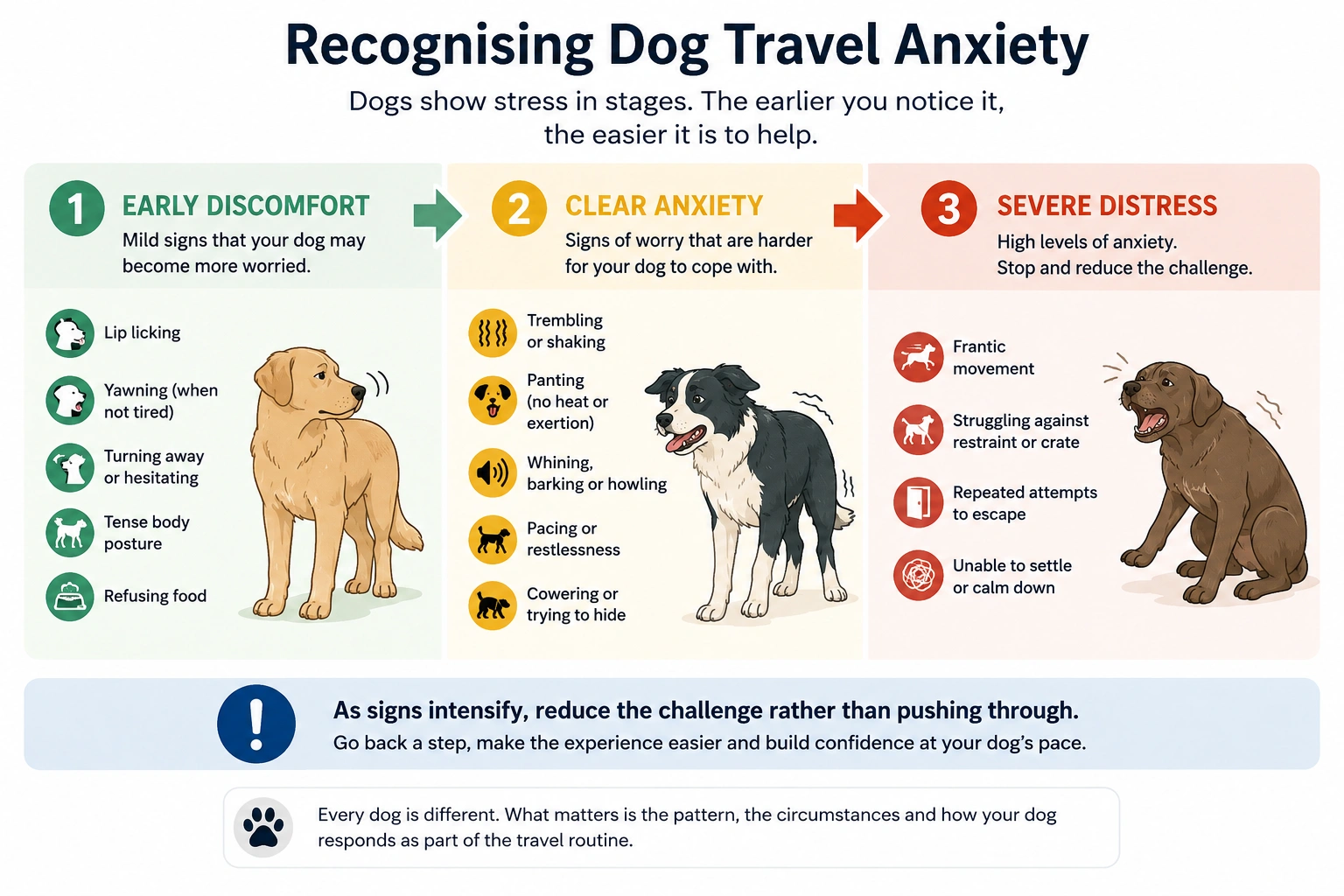
Dogs Trust advises looking at a dog’s overall body language rather than relying on one behaviour in isolation. Signs of stress and anxiety can range from subtle changes such as lip licking, yawning, turning away and becoming tense to much more obvious trembling, cowering, vocalising or attempts to escape.
Early signs your dog may be uncomfortable
You might notice your dog:
- slowing down or hesitating as you approach the car;
- turning their head or body away;
- licking their lips repeatedly;
- yawning when they are not tired;
- holding their ears back;
- becoming unusually still or tense;
- refusing to jump or step into the car when they normally would;
- refusing food they would usually be keen to take.
One sign on its own does not prove that a dog is anxious. What matters is the pattern, the circumstances and whether the behaviour reliably appears as part of the travel routine.
More obvious signs of travel anxiety
As distress increases, a dog might:
- tremble or shake;
- pant heavily when heat or exertion does not explain it;
- whine, bark or howl;
- pace or repeatedly change position;
- cower or try to hide;
- drool excessively;
- scratch at a door, crate or restraint;
- struggle to settle;
- try to escape or refuse to enter the vehicle.
Panting in a car is particularly important to interpret in context. Dogs Trust notes that increased panting in the car may reflect excitement, anxiety or distress, while excessive panting can also have medical or heat-related causes.
Is It Anxiety or Car Sickness?
This is one of the most important questions to consider before starting behaviour work because anxiety and motion sickness can look surprisingly similar.
PDSA lists signs of car sickness including drooling, lip licking, panting, swallowing, retching and vomiting. It also notes that anxiety and stress can contribute to motion sickness and that dogs who have unpleasant travelling experiences can develop negative associations with the car.
| What you notice | Anxiety may be involved | Motion sickness may be involved |
|---|---|---|
| Reluctance before entering the car | Yes | Possibly, if the dog has learned to associate the car with feeling sick |
| Trembling or cowering | Yes | Can occur alongside nausea or distress |
| Panting | Yes | Yes |
| Lip licking | Yes | Yes |
| Excessive drooling | Yes | Yes |
| Repeated swallowing or retching | Less specific | Stronger reason to suspect nausea |
| Vomiting | Anxiety can contribute to upset | Strong reason to investigate motion sickness |
| Distress before the vehicle moves | Stronger evidence of an existing negative association | Previous sickness may still be the reason for that association |
The overlap means you should not assume that a dog who pants or drools is simply frightened.
If your dog repeatedly retches, vomits or appears nauseous during journeys, speak to your vet rather than treating the problem solely as anxiety. Our guide to car sickness in dogs explains the signs, possible causes and treatment pathway in more detail.
A dog can also have both motion sickness and anxiety. In that situation, addressing the nausea may be an important part of making behavioural training possible.
Why Do Some Dogs Become Anxious About Car Travel?
There is no single cause of dog travel anxiety. Different dogs can be worried by completely different parts of the experience.
The car itself may feel unfamiliar or frightening
A car introduces movement, engine noise, vibration, confined space and rapidly changing sights and sounds.
Dogs Trust recommends introducing dogs to cars carefully because the sensation can feel unusual, particularly for dogs with little previous travel experience. Some may also react to what they see moving past the windows.
Previous journeys may have created a negative association
A dog may learn that the car predicts something unpleasant.
That could follow:
- repeated motion sickness;
- a frightening journey;
- being forced into the vehicle;
- travelling while already distressed;
- uncomfortable restraint;
- repeated journeys to somewhere the dog dislikes.
Sometimes the original trigger has gone but the learned association remains.
Your dog may expect to feel sick
A dog who has repeatedly experienced nausea while travelling can start becoming distressed before the journey begins.
That can create a difficult cycle: the dog associates the car with feeling ill, becomes increasingly anxious about travelling and may then experience anxiety alongside the original motion sickness. PDSA specifically recognises the relationship between travel sickness and anxiety or stress.
The travel setup may feel unstable or uncomfortable
Sliding around, struggling to balance, an unsuitable restraint or an unstable carrier can make travelling more difficult.
A safe setup matters independently of anxiety. Highway Code Rule 57 says dogs and other animals should be suitably restrained so that they cannot distract the driver or injure themselves or occupants if the vehicle stops quickly. It gives a seat-belt harness, pet carrier, dog cage and dog guard as examples.
For the wider practical safety considerations, see our guide to travelling with a dog safely in a car.
Pain or illness can affect behaviour
A sudden change in travel behaviour deserves particular attention.
Pain, nausea or another health problem can make a dog less willing to jump into a vehicle, remain in one position or cope with movement. Dogs Trust recommends veterinary assessment when a behavioural problem may have an underlying medical cause.
If a dog who previously travelled comfortably suddenly becomes fearful, reluctant or distressed, speak to your vet rather than assuming it is purely a training problem.
Before You Start: Find Your Dog’s Starting Point
Before trying to make journeys longer, work out when your dog’s discomfort actually begins.
For example, does your dog become anxious when:
- you pick up their travel harness;
- you walk towards the car;
- you open the door;
- they are asked to get inside;
- you close the door;
- you fasten the restraint;
- the engine starts;
- the car begins moving;
- the journey lasts beyond a certain point?
This gives you a much more useful starting point than simply thinking, “My dog doesn’t like the car.”
If your dog is relaxed beside the vehicle but panics as soon as the engine starts, there is little value in repeatedly practising walking towards the car. Equally, if your dog is already trembling several metres away from it, beginning the session inside the vehicle is probably too difficult.
Signs the exercise is currently too difficult
Reduce the challenge or end the session if your dog shows clear escalating distress, such as:
- desperately trying to move away;
- struggling against the restraint;
- freezing or shutting down;
- sustained trembling;
- frantic movement;
- increasingly intense barking or whining;
- repeated attempts to escape.
Refusing food can also be useful information if your dog normally takes the same food readily, although food refusal alone does not diagnose anxiety.
The principle is simple: start at a level your dog can cope with, rather than starting with the journey you ultimately want them to make.
How to Help a Dog With Travel Anxiety
For dogs whose anxiety is suitable for gradual home training, the aim is to change what the car predicts and increase difficulty gradually.
Veterinary behavioural guidance recognises desensitisation and counter-conditioning as approaches used for fear of car journeys. Dogs Trust similarly recommends gradual, positive introduction rather than forcing a dog to confront something frightening.
Step 1: Reduce unnecessary frightening journeys while you train
Where practical, avoid repeatedly putting your dog through journeys that cause intense distress while you are trying to improve their response.
That does not mean a dog should miss necessary veterinary care or another essential journey. If unavoidable travel is extremely difficult, speak to your vet about how best to manage it.
Reducing unnecessary high-stress exposure gives you a better opportunity to practise at an easier level.
Step 2: Make the travel setup safe and predictable
Decide where your dog will travel and use a suitable restraint consistently.
Depending on the dog and vehicle, that may involve a properly used car harness, carrier, crate or dog guard. The arrangement must keep the dog suitably restrained and should not compromise the driver’s ability to drive safely.
Then look for avoidable sources of discomfort:
- Is your dog sliding around?
- Is a carrier stable?
- Is their normal position difficult to reach?
- Does equipment fit correctly?
- Is the environment excessively hot?
- Is the dog being asked to use unfamiliar equipment at the same time as learning to tolerate the car?
A familiar blanket or bedding may help some dogs if it can be used safely. Dogs Trust suggests familiar-smelling bedding as one option when introducing a tentative dog to the car.
Keep the setup consistent enough for the dog to learn what to expect.
Step 3: Begin before your dog becomes significantly anxious
Your first training exercise may not involve driving anywhere.
For one dog, the appropriate starting point might be walking past the parked car and receiving a reward for relaxed behaviour.
For another, it might be sitting briefly inside a stationary car with the doors open.
A dog already happy in a stationary vehicle may be ready for the next part of the sequence.
The starting point is determined by your dog’s response, not by a standard timetable.
Step 4: Build positive associations at that stage
At the manageable starting point, pair the experience with things your dog genuinely values.
That might include:
- small food rewards;
- calm praise or attention if your dog enjoys it;
- a familiar blanket;
- a favourite activity before or after the session;
- simply being allowed to leave again before becoming worried.
Dogs Trust recommends rewarding calm behaviour around the car and introducing the vehicle gradually and positively.
Do not drag, push or repeatedly lure a frightened dog farther into the situation than they can cope with.
If your dog stops taking treats because they are becoming increasingly worried, do not keep offering food as a way of persuading them through the fear. Make the situation easier instead.
Step 5: Increase the difficulty gradually
Once your dog is genuinely comfortable at one stage, introduce a small new challenge.
A possible progression might look like:
- being comfortable near the parked car;
- entering the stationary car;
- spending a short period inside;
- closing the door briefly;
- hearing the engine running;
- experiencing a very small amount of vehicle movement;
- taking a very short journey;
- gradually building towards ordinary travel.
This is an example, not a compulsory eight-stage programme.
Some dogs will need smaller stages. Others may already be comfortable with several of them.
Change one important variable at a time where possible so that you can tell what your dog is finding difficult.
For a complete staged introduction, see our guide on how to get a dog used to car travel.
Step 6: Make the first journeys short and easy
When your dog is ready for actual movement, start conservatively.
Dogs Trust recommends beginning with short, slow and gentle journeys and driving smoothly with plenty of time for braking, because a jerky or uncomfortable journey can contribute to anxiety and stress.
Where practical, allow some early trips to lead somewhere neutral or enjoyable rather than making the car reliably predict something your dog dislikes.
Do not extend a journey simply because it has been going well. Finishing while your dog is still coping can be more useful than continuing until they become distressed.
Step 7: Progress According to Your Dog, Not the Calendar
There is no reliable rule such as “practise for three days” or “your dog should be comfortable within two weeks”.
Move forward when your dog is repeatedly coping well with the current stage.
If behaviour deteriorates after increasing the challenge, make the next session easier.
Progress is rarely perfectly linear. A dog may cope less well after a stressful day, an unpleasant journey or a change in circumstances. That does not mean the whole process has failed.
If your dog is still struggling with whining, shaking or settling during journeys, our guide to how to keep a dog calm in the car provides practical, step-by-step training advice.
How Will I Know the Training Is Working?
Success is not simply getting a dog to stay in the car.
Look for evidence that their emotional response is improving.
Depending on the dog, progress might include:
- approaching the car willingly;
- entering with less hesitation;
- showing softer, more relaxed body language;
- accepting familiar rewards;
- settling more readily;
- showing less anxiety-related panting or vocalising;
- recovering quickly after a small increase in difficulty;
- coping comfortably with slightly longer or more complex stages.
A quiet dog is not automatically a relaxed dog. Freezing and shutting down can themselves be signs that a dog is struggling. Dogs Trust includes freezing among behaviours that can accompany stress or fear.
Judge progress from the dog’s overall body language and behaviour, not from the absence of barking alone.
Common Mistakes That Can Make Travel Anxiety Worse
Forcing the dog into the car
Physically pushing, dragging or repeatedly pressuring a frightened dog may strengthen the negative association you are trying to change.
Dogs Trust advises allowing dogs a choice to move away from things they are worried about and warns that making a dog “face their fear” can make matters worse.
Assuming repeated long journeys will solve the problem
Exposure is not automatically helpful.
If each journey overwhelms the dog, repeating it is very different from controlled, gradual familiarisation.
Moving on because a certain number of days have passed
Progress should depend on what your dog can comfortably handle, not an arbitrary schedule.
Changing too many things at once
If you introduce a new harness, shut the doors, start the engine and drive for the first time in one session, it becomes difficult to know what caused a setback.
Punishing frightened behaviour
Do not tell a dog off for whining, barking, hesitating or showing fear.
Dogs Trust recommends reward-based approaches and advises against training that relies on fear, intimidation or pain, which can reduce confidence and worsen negative emotions.
Treating nausea as a behaviour problem
A dog who feels sick needs the physical problem investigated rather than simply being trained to tolerate it.
Repeated drooling, swallowing, retching or vomiting should prompt consideration of car sickness, particularly if symptoms become more obvious after movement begins.
Expecting a product to fix the underlying fear
A crate, harness or other piece of travel equipment can contribute to a safe and predictable setup, but equipment does not automatically change a dog’s emotional response to travelling.
Similarly, supplements, sprays or other calming products should not replace investigation of sickness, pain, severe fear or inappropriate training progression.
What If My Dog Still Panics in the Car?
If the process stalls, look at what changed immediately before the problem appeared.
| What you observe | What may be happening | Sensible next step |
|---|---|---|
| Dog becomes anxious as soon as the car is visible | The starting point is already too difficult | Begin farther from the trigger or seek professional help if the response is severe |
| Dog is relaxed in a stationary car but distressed once it moves | Movement may be the trigger and nausea may also contribute | Reduce the movement challenge and discuss possible sickness with your vet |
| Dog drools, repeatedly swallows, retches or vomits | Motion sickness needs consideration | Speak to your vet and follow the car-sickness pathway |
| Dog was progressing but suddenly struggles | The last increase may have been too large, or another stressor may be involved | Return to the previous comfortable stage |
| Dog cannot remain comfortable even with very low-level exposure | Home training may not be sufficient | Ask your vet about appropriate behavioural support |
| Dog risks injuring themselves while panicking | The situation is no longer a routine DIY training problem | Stop the exercise and seek veterinary or qualified behavioural help |
Do not respond to a setback by making the next session longer or more intense.
When Should You Speak to a Vet or Behaviour Professional?
Contact your vet if:
- your dog’s travel anxiety has appeared suddenly;
- they repeatedly vomit or retch during journeys;
- you suspect nausea, pain or another health problem;
- they show unusual breathing or other physical symptoms;
- the dog becomes severely distressed;
- panic creates a risk of injury;
- necessary journeys are becoming impossible;
- the problem is getting worse despite careful management.
Health and behaviour can interact. Dogs Trust’s specialist behavioural service works under veterinary referral specifically so physical and behavioural health can be considered together.
If physical contributors have been assessed and substantial fear remains, a suitably qualified behaviour professional may be appropriate.
The Animal Behaviour and Training Council provides a practitioner directory, and its Clinical Animal Behaviourists work on veterinary referral on behavioural problems that can include fears and phobias.
In some cases a vet may also discuss medication as one part of a wider treatment plan. Do not give your dog sedatives or human anti-anxiety medication without veterinary advice. Our guide to Sedatives for Dog Travel: Are They Safe? explains the difference between sedation and anxiety relief, the potential risks and when medication might be appropriate.
Preparing for Longer Journeys Once Your Dog Is Comfortable
Being relaxed on a five-minute journey does not automatically mean a dog is ready for several hours in the car.
Once ordinary travel is comfortable, longer journeys introduce separate considerations such as:
- journey length;
- rest and toilet breaks;
- water;
- route planning;
- temperature;
- safe loading and unloading;
- destination arrangements.
Our complete guide to long-distance car travel with dogs covers that next stage.
For the broader planning involved in travelling beyond the immediate car-anxiety problem, see How to Travel with a Dog: The Complete Guide.
The Key Is Making Car Travel Predictable, Safe and Gradual
Travel anxiety rarely improves because a dog is simply made to endure more of the thing they fear.
First work out where the anxiety begins and whether motion sickness, pain or another physical issue may be contributing. Then, if gradual training is suitable, begin at a level your dog can cope with and build positive experiences in manageable stages.
If your dog becomes increasingly distressed, step back rather than pushing through. And if the fear is severe, sudden, associated with sickness or difficult to manage safely, involve your vet rather than treating it as a training problem alone.