
A dog-friendly holiday should work for your dog as well as the people travelling. That means looking beyond a simple “pets allowed” label and checking whether the accommodation, journey, location, activities and time of year genuinely suit your dog’s needs.
There is no single best dog-friendly holiday in the UK. A lively holiday park may be ideal for one household, while a quiet cottage with direct walking access may be much better for an older, anxious or reactive dog.
The best choice is usually the one that balances five things:
- your dog’s health, temperament and exercise needs;
- the needs of everyone travelling;
- the accommodation itself;
- the surrounding area;
- the season and likely weather.
This guide will help you compare your options, ask the right questions before booking and prepare for a safer, more comfortable trip.
What makes a holiday genuinely dog-friendly?
Some accommodation providers use “dog-friendly” to mean that dogs are accepted for an additional charge. That tells you very little about whether the property will actually work for your dog.
A genuinely suitable property may offer practical features such as:
- secure outdoor access;
- suitable flooring;
- enough room for a bed or crate;
- nearby walking routes;
- a place to rinse or dry a muddy dog;
- clear rules about where dogs are allowed;
- sensible arrangements for waste;
- good ventilation and shade;
- safe access away from busy roads.
Even then, the property still needs to suit your individual dog.
A first-floor apartment that accepts dogs may be manageable for a small, healthy dog but difficult for a large senior dog with reduced mobility. A busy holiday park may offer excellent facilities but be overwhelming for a noise-sensitive dog.
“Pets allowed” versus genuinely suitable
| Question | Basic pet-allowed property | More genuinely dog-friendly property |
|---|---|---|
| Are dogs accepted? | Yes | Yes, with clear and practical policies |
| Is there outdoor space? | Possibly | Details are given about access, sharing and boundaries |
| Are nearby walks available? | Not always stated | Suitable routes are explained accurately |
| Are dog restrictions clear? | Sometimes hidden in booking terms | Number, size, room and furniture rules are easy to find |
| Can the dog settle comfortably? | Unknown | Layout, flooring, noise and facilities can be assessed |
| Are cleaning needs considered? | An extra fee may apply | Useful washing, drying or easy-cleaning facilities may be available |
Treat “dog-friendly” as the beginning of your research, not the final answer.
How to choose the right UK holiday for your dog
Start with the dog rather than the destination.
A beautiful location is not a good choice if the journey, accommodation or daily routine will make your dog uncomfortable.
Consider your dog’s age, health and mobility
Think realistically about:
- how long your dog can travel comfortably;
- whether stairs are manageable;
- whether slippery floors are a problem;
- how much walking your dog can safely manage;
- whether your dog needs regular medication;
- how easily you could reach veterinary care;
- whether the planned activities match your dog’s fitness.
Puppies, older dogs and dogs with existing medical conditions may need a slower itinerary and more rest.
A holiday does not need to be highly active to be enjoyable. For some dogs, a quiet cottage with short local walks and familiar routines will be far more suitable than a demanding week of long hikes.
Speak to your vet before travelling when you are unsure whether your dog is fit for the journey or planned activities.
Consider temperament and surroundings
Your dog’s behaviour in unfamiliar environments matters just as much as physical fitness.
Ask yourself how your dog normally responds to:
- unfamiliar people;
- other dogs;
- children;
- traffic;
- livestock;
- loud entertainment;
- communal corridors;
- shared gardens;
- being left in an unfamiliar room;
- changes to feeding and sleeping routines.
A sociable dog may enjoy a busy park or resort. A reactive or anxious dog may cope better in a detached property with private outdoor space and quiet walks from the door.
Dogs with unreliable recall may also need secure exercise arrangements and destinations where enjoyable walks do not depend on being off the lead.
Match the holiday to your dog’s activity level
Some dogs thrive on long walks and shared outdoor activities. Others need shorter outings, plenty of sleep and a less demanding schedule.
Possible holiday styles include:
- rural cottage breaks;
- coastal holidays;
- caravan or holiday-park stays;
- lodge or cabin holidays;
- walking breaks;
- camping and glamping;
- activity holidays;
- canal-boat or waterside breaks;
- hotels and inns;
- city or town breaks.
The right answer depends on how much stimulation, exercise and travel your dog genuinely enjoys.
Consider coat and heat vulnerability
Warm weather can affect dogs very differently.
Flat-faced dogs, puppies, senior dogs, overweight dogs, thick-coated dogs and dogs with certain health conditions can be more vulnerable to heat-related illness. The RSPCA also identifies respiratory conditions, age, thick coats and brachycephalic conformation among important heatstroke risk factors.
Do not choose a summer holiday on the assumption that a cooling product will solve every heat problem. Look at:
- shade around the property;
- indoor ventilation;
- the amount of direct sun;
- whether walks can be taken at cooler times;
- how far you will need to drive;
- whether the dog can rest comfortably;
- whether plans can be changed during hot weather.
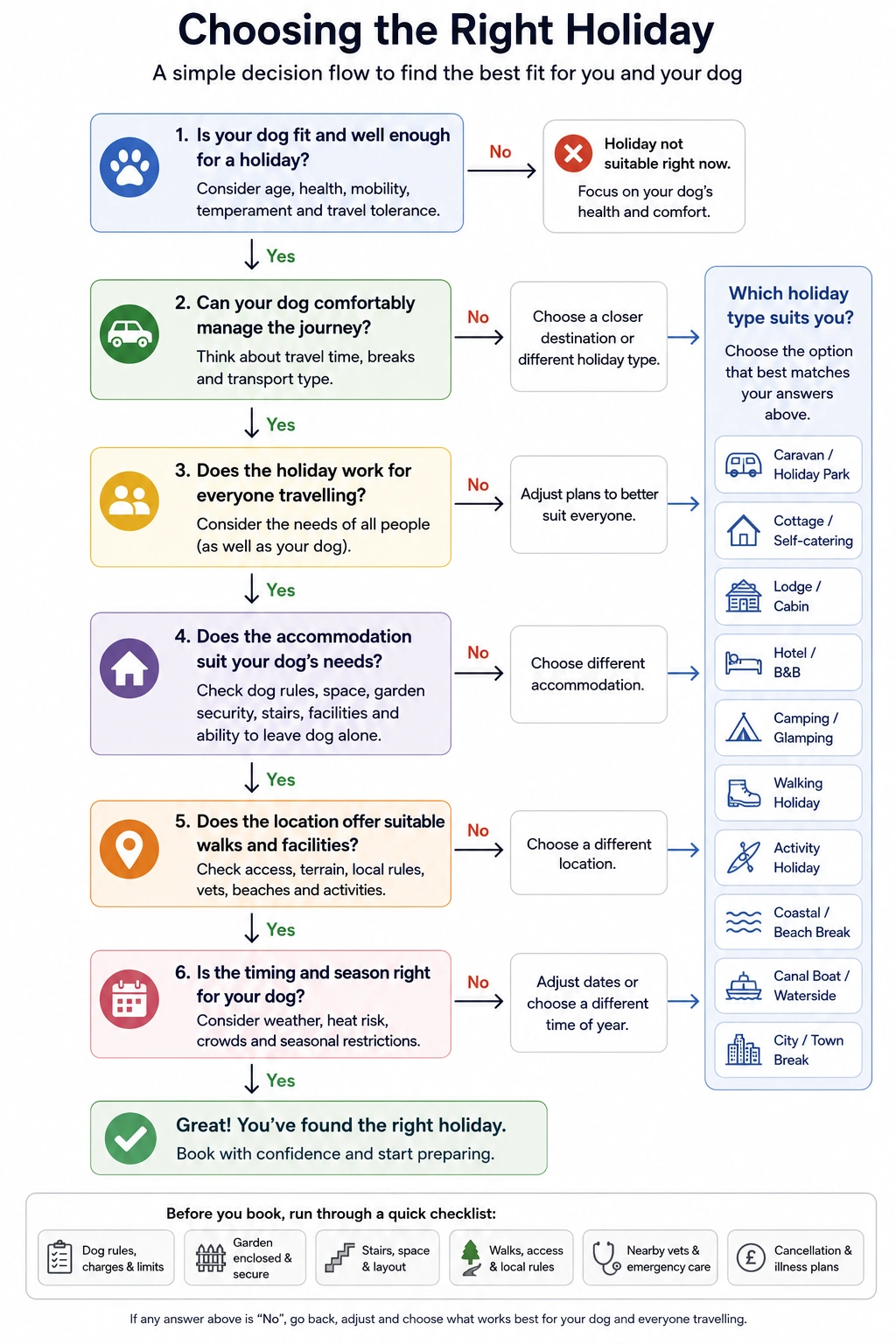
Which type of dog-friendly holiday should you choose?
Different accommodation and holiday styles solve different problems.
| Holiday type | May suit | Possible drawbacks | Check before booking |
|---|---|---|---|
| Self-catering cottage | Dogs needing quiet, routine and private space | Remote properties may have limited facilities nearby | Garden security, stairs, road access and dog rules |
| Caravan or holiday park | Families, multi-dog households and people wanting on-site facilities | Noise, close neighbours and communal areas | Dog limits, park rules, exercise areas and ventilation |
| Lodge or cabin | Readers wanting countryside access and more space | Decking, steps or open boundaries may be unsuitable | Access, fencing, flooring and surrounding terrain |
| Hotel, inn or B&B | Short breaks and people who do not want to self-cater | Dogs may be restricted from dining or communal areas | Where dogs may go and whether they can be left alone |
| Camping or glamping | Dogs comfortable outdoors and owners wanting an active break | Heat, cold, noise, wildlife and shared facilities | Shade, secure sleeping arrangements and site rules |
| Coastal break | Dogs enjoying beaches, coast paths and water | Seasonal restrictions, cliffs, tides and limited shade | Current beach rules and safe walking access |
| Walking holiday | Fit dogs and owners wanting shared daily activity | Terrain, livestock and overexertion risks | Route difficulty, lead rules, water and veterinary access |
| Activity holiday | Dogs suited to organised outdoor experiences | Not every activity or provider accepts every dog | Participation rules, fitness requirements and rest time |
| City or town break | Confident dogs used to traffic and busy settings | Noise, crowds and limited outdoor space | Parks, toileting access, indoor dog policies and transport |
For more detailed help choosing a park and checking its facilities, see Dog-Friendly Caravan Holidays in the UK.
If you want to build the holiday around walking, paddling or other shared experiences, see Dog-Friendly Activity Holidays in the UK.
How to choose a dog-friendly destination in the UK
The best destination is not necessarily the place appearing most often in holiday roundups.
Instead, compare destinations using practical criteria.
Journey length
A remote destination may look ideal until you consider how your dog manages long car journeys.
Account for:
- total travel time;
- likely delays;
- suitable places for breaks;
- whether the journey can be divided;
- how your dog behaves in traffic;
- the temperature during travel.
A closer destination may provide a better holiday if your dog arrives calmer and less tired.
Terrain and walking options
Look at whether the area offers walks that match your dog’s ability.
Questions to ask include:
- Are routes flat, steep, rocky or muddy?
- Are there many stiles?
- Is livestock common?
- Is shade available?
- Are there shorter alternatives?
- Can walks start from the accommodation?
- Are routes accessible for everyone travelling?
A walking destination known for difficult mountain routes may still work if easier valley or lakeside options are available. The important thing is researching the actual routes rather than relying on the destination’s general reputation.
Beaches and local restrictions
Coastal destinations can be excellent for dogs, but access arrangements may vary by beach and season.
Check:
- current dog restrictions;
- tidal conditions;
- cliff and rock hazards;
- local wildlife;
- freshwater availability;
- shade;
- parking and access;
- whether the sand or promenade becomes uncomfortably hot;
- whether nearby alternatives accept dogs.
Do not assume that a destination described as dog-friendly allows dogs on every beach throughout the year.
Veterinary access
Identify both:
- the nearest ordinary veterinary practice;
- the nearest provider offering emergency or out-of-hours care.
Save the details before travelling, particularly when staying in a rural or isolated area.
Food, attractions and wet-weather options
A good dog-friendly destination should give you realistic things to do with your dog.
Check whether local:
- pubs;
- cafés;
- gardens;
- heritage sites;
- outdoor attractions;
- transport services;
- sheltered walks
accept dogs and under what conditions.
For more help choosing and checking suitable days out, see Dog-Friendly Attractions Around the UK.
How to check whether accommodation really meets your needs
Accommodation descriptions often use broad phrases such as “enclosed garden”, “rural location” or “dogs welcome”. Ask for details.
Check the complete dog policy
Before paying, confirm:
- how many dogs are allowed;
- whether size or breed restrictions apply;
- whether puppies are accepted;
- whether dogs are allowed upstairs;
- whether dogs may use furniture;
- which communal areas allow dogs;
- whether dogs can be left unattended;
- whether crates are required;
- whether leads are required on site;
- what charges or deposits apply;
- whether additional cleaning fees can be imposed.
Read the booking conditions as well as the main property page.
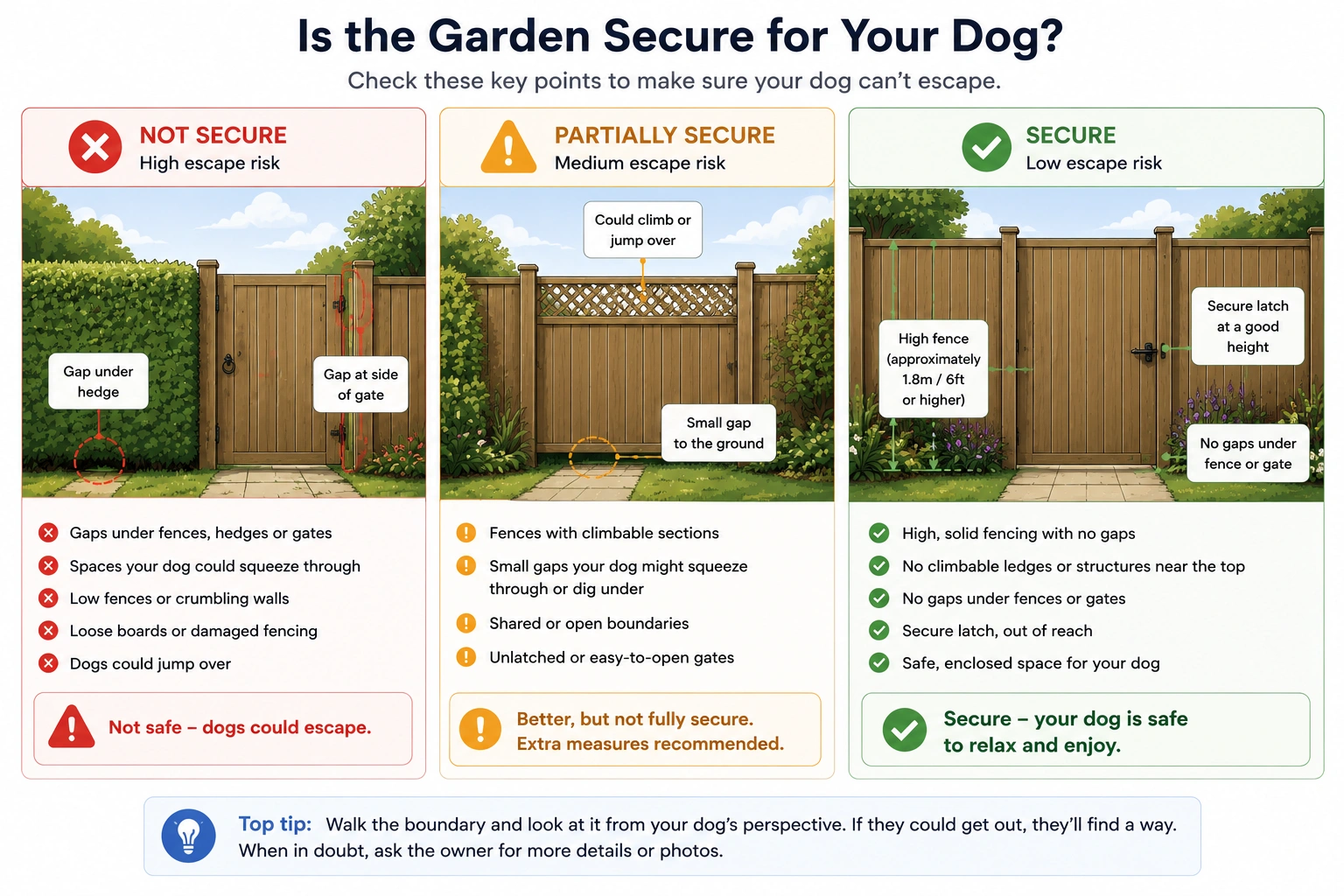
Ask exactly what “enclosed garden” means
An enclosed garden is not necessarily secure for every dog.
Ask the provider:
- How high are the boundaries?
- Are there gaps beneath gates or fences?
- Is any part shared?
- Does the gate lead directly onto a road?
- Are there hedges a small dog could pass through?
- Are there ponds, drops or other hazards?
- Can neighbouring animals enter?
- Is the garden reached directly from the property?
No ordinary holiday garden should be described as escape-proof.
Check the area yourself when you arrive before allowing your dog to explore freely.
Look at the property layout
Useful information includes:
- number and steepness of stairs;
- flooring type;
- balcony access;
- location of external doors;
- space for the dog’s bed or crate;
- distance from parking;
- ventilation;
- access to shade;
- whether the entrance is shared;
- whether outdoor toilet trips are practical after dark.
Photographs may not show all of this clearly, so ask when something matters.
Prioritise practical facilities
Welcome treats are pleasant, but practical facilities often matter more.
Depending on your dog, useful features may include:
- an outdoor tap;
- a hose;
- a washable entrance area;
- hard flooring;
- dog towels;
- freezer or fridge space for food;
- secure equipment storage;
- nearby waste bins;
- enough room for a crate;
- a quiet sleeping area.
Planning an accessible and dog-friendly holiday
“Accessible” does not mean the same thing to every traveller. A property may be step-free but still have narrow doors, an unsuitable bathroom or difficult outdoor terrain.
Give the accommodation provider a clear list of your actual requirements and request written confirmation.
Depending on the traveller, questions may include:
- Is the route from parking to the entrance step-free?
- What are the surface and gradient like?
- How wide are the doors?
- Is there enough turning space?
- What type of shower is provided?
- Are grab rails fitted?
- What is the height of the bed?
- Is there space to charge mobility equipment?
- Is the kitchen usable from the required position?
- How far is the dog-exercise area?
- Do nearby routes contain gates, steps or stiles?
- Is there a suitable emergency evacuation procedure?
- Can required equipment be hired or delivered?
Also check whether the dog can accompany the traveller into all facilities they need to use.
A pet dog and a trained assistance dog are not always treated in the same way under access policies, so clarify the relevant arrangements directly rather than relying on a generic pet rule.
Questions to ask before booking
Use this checklist before committing to a property:
- How many dogs are allowed?
- Are there size, breed or age restrictions?
- What dog charges, deposits or cleaning fees apply?
- Which rooms and facilities can the dog enter?
- Can the dog be left alone?
- Is outdoor space private or shared?
- What are the garden boundaries made from?
- How high are the fences and gates?
- Are there stairs or slippery floors?
- Is the property beside a road, livestock field or open water?
- Where are the nearest suitable walks?
- What local beach or access restrictions apply?
- Is adequate shade and ventilation available?
- Where are the nearest daytime and emergency vets?
- Are the required accessibility features confirmed?
- What happens if the dog becomes ill or the booking must change?
Keep the provider’s answers with your booking confirmation.
Preparing your dog before the holiday
Preparation should reduce unnecessary change and prevent predictable problems.
Check identification details
Make sure the information associated with your dog’s microchip is current and that the dog wears suitable identification.
Save:
- your normal vet’s number;
- your insurer’s details;
- your policy number;
- the destination vet’s details;
- emergency contact information.
Organise food and medication
Take enough of the dog’s normal food for the stay, with a reasonable contingency amount.
A sudden change of food during travel may cause digestive problems, so do not assume the same product will be available locally.
Bring prescribed medication in its original packaging and check that you have enough before leaving.
Do not give human medication unless a vet has specifically instructed you to do so.
Practise travel and equipment
A long holiday journey should not be the first time the dog experiences:
- a travel crate;
- a seat-belt harness;
- a carrier;
- a dog guard;
- extended car travel.
Introduce unfamiliar equipment gradually where possible.
Prepare the coat where relevant
Dogs likely to spend time on beaches, muddy tracks or in water may need appropriate coat care during the trip.
Labrador owners can see How to Prepare and Maintain a Labrador’s Coat for an Active Holiday for more specific coat-care guidance.
Where loose hair in the accommodation may be a concern, see Managing Labrador Shedding While You Are Away for more detailed advice.Travelling safely with your dog in the UK
Travelling by car
Highway Code Rule 57 says dogs and other animals should be suitably restrained so that they cannot distract the driver or injure themselves or occupants if the vehicle stops quickly. It gives a seat-belt harness, pet carrier, dog cage and dog guard as examples.
Choose a restraint arrangement that suits the dog, vehicle and journey. Do not assume every product provides the same level of protection.
Plan:
- appropriate rest breaks;
- access to water;
- secure lead control before doors open;
- a comfortable temperature;
- a calm loading routine;
- extra time for delays.
Never leave a dog in a parked vehicle because you expect an open window, shade or cooling accessory to keep conditions safe.
Train, ferry and other transport
Dog policies vary between operators and can change.
Before booking, check:
- whether dogs are accepted;
- how many dogs can travel;
- whether a reservation is required;
- charges;
- carriers or restraint requirements;
- permitted areas;
- toilet arrangements;
- assistance-dog provisions.
Use the operator’s own current policy rather than relying on an old travel article.
Travelling outside Great Britain
This article focuses on UK holidays.
Taking a dog abroad and returning to Great Britain involves additional rules concerning approved travel routes, microchipping, rabies vaccination, documentation and, in some cases, tapeworm treatment. Current GOV.UK guidance says dogs returning to Great Britain may require tapeworm treatment between 24 hours and five days before arrival, depending on where they are travelling from.
Pet-travel rules changed again in April 2026 for Great Britain residents entering the EU, which is another reason to check current official guidance rather than relying on remembered requirements.
What to pack for a dog-friendly holiday
Everyday essentials
Pack:
- normal food;
- food and water bowls;
- fresh water for the journey;
- lead and spare lead;
- harness;
- collar and identification;
- bed or familiar blanket;
- poo bags;
- medication;
- veterinary and insurance information.
Accommodation supplies
Depending on the property, you may also need:
- towels;
- cleaning cloths;
- a permitted furniture cover;
- the dog’s crate;
- a torch for evening toilet trips;
- food-storage containers;
- bedding suitable for the expected temperature.
Activity and weather equipment
Possible items include:
- a portable water container;
- suitable drying equipment;
- first-aid supplies;
- visible or reflective equipment;
- a shade solution for supervised use;
- activity-specific equipment.
Cooling mats, cooling vests, portable water bottles and thermometers may sometimes be useful, but none of them proves that an environment or activity is safe.
The safest response to unsuitable heat is usually to change the timing, location or activity rather than adding more equipment.
Helping your dog settle into the accommodation
The first few hours can shape the rest of the stay.
On arrival:
- Keep your dog secured while luggage is unloaded.
- Inspect the garden, gates and exits.
- Check for accessible food, rubbish, cleaning chemicals and other hazards.
- Set up water, bedding and familiar items.
- Take a calm toilet and orientation walk.
- Keep feeding and sleeping routines as familiar as possible.
- Allow time to rest before beginning a demanding activity.
Some dogs need longer than others to adjust.
Avoid leaving your dog alone immediately after arrival, even where the property permits it. First establish whether the dog is settling comfortably.
Seek veterinary advice if distress is severe, persistent or accompanied by signs of illness.
Planning dog-friendly days out
A venue allowing dogs does not necessarily mean your dog will enjoy it.
Consider:
- crowds;
- noise;
- waiting;
- flooring;
- shade;
- water;
- escape risks;
- other dogs;
- livestock;
- the length of the outing;
- opportunities to rest.
Beaches
Before visiting a beach, check:
- current dog restrictions;
- tides;
- water conditions;
- cliffs and rocks;
- local wildlife;
- shade;
- drinking water;
- safe access and exit points.
Rinse salt, sand or dirty water from the dog where appropriate and check paws and coat afterwards.
Countryside walks
The Countryside Code for England and Wales advises keeping dogs under effective control, in sight and away from wildlife, livestock, horses and other people unless invited. It also says local signs must be followed.
On open-access land, dogs must be on a lead around livestock and between 1 March and 31 July, even where livestock are not present. Specific rules can differ elsewhere in the UK, so check the relevant national and local guidance.
Keep the dog close around livestock. If cattle or horses threaten you, official guidance advises releasing the dog rather than putting yourself in danger trying to hold it.
Also consider:
- route length;
- gradients;
- weather;
- water availability;
- ground conditions;
- gates and stiles;
- wildlife;
- the dog’s fitness.
Pubs, cafés and attractions
Check whether dogs are allowed:
- indoors;
- only in gardens;
- in particular rooms;
- at particular times;
- on booked tours;
- on site transport.
A busy pub may be technically dog-friendly but unsuitable for a dog that cannot relax around noise, food or close contact with strangers.
Keeping your dog safe in warm weather
Holiday routines can make overheating more likely. Dogs may spend longer outdoors, walk at unfamiliar times or rest in accommodation with poor ventilation.
Reduce risk by:
- moving walks to cooler parts of the day;
- shortening or cancelling activities;
- providing water;
- creating shade;
- allowing plenty of rest;
- checking the dog rather than relying only on the weather forecast;
- avoiding hot vehicles, tents, conservatories and poorly ventilated spaces.
Watch for concerning changes including:
- unusually heavy panting;
- weakness;
- confusion;
- vomiting or diarrhoea;
- difficulty standing;
- collapse;
- seizures.
These can indicate serious heat-related illness.
If you suspect significant overheating or heatstroke:
- Stop the activity and remove the dog from the heat.
- Begin cooling the dog promptly with water cooler than the dog, while protecting the airway.
- Create airflow where possible.
- Contact a vet urgently and arrange transport in a cooled, well-ventilated vehicle.
The RSPCA’s current guidance summarises the priority as cooling first and transport second.
For complete emergency guidance, see Dog Heatstroke: Symptoms, Treatment & Prevention (Complete Guide).
Do not delay veterinary help because the dog appears to improve.
What to do if your dog becomes ill or injured
Before leaving home:
- save the local vet’s number;
- identify an emergency practice;
- check your insurance;
- pack medication;
- keep relevant medical information available.
Contact a vet when your dog becomes unwell and you are unsure what to do.
Urgent assessment may be needed for problems such as:
- breathing difficulty;
- collapse;
- suspected heatstroke;
- serious wounds;
- poisoning;
- persistent vomiting or diarrhoea;
- severe pain;
- inability to stand;
- major eye injuries;
- significant bloating or abdominal distress.
Do not postpone treatment simply because you are away from your usual practice.
Common dog-friendly holiday mistakes
Avoid these frequent problems:
- booking solely through a “pets allowed” filter;
- assuming a garden is secure;
- failing to read dog charges and restrictions;
- choosing activities that do not suit the dog;
- planning too much on the first day;
- overlooking stairs or slippery floors;
- failing to check seasonal beach restrictions;
- allowing a dog too close to livestock;
- assuming cooling equipment makes hot conditions safe;
- forgetting emergency veterinary details;
- relying on a generic “accessible” label;
- leaving a dog alone in an unfamiliar property before checking that it can settle.
Dog-friendly holiday planning checklist
Before booking
- Assess your dog’s health, temperament and travel tolerance.
- Decide which holiday style suits everyone.
- Check the complete dog policy.
- Verify outdoor-space details.
- Confirm accessibility requirements.
- Research walks and local restrictions.
- Identify daytime and emergency veterinary care.
- Check cancellation and illness arrangements.
Two to four weeks before travelling
- Update identification details.
- Organise medication.
- practise travel where necessary.
- Confirm transport policies.
- plan food and equipment.
- Save important contact details.
- Check that planned activities remain suitable.
The day before
- Check the weather.
- Review local warnings and restrictions.
- Pack food, documents and medication.
- Confirm the route and rest stops.
- Download information that may be needed without internet access.
On arrival
- Inspect the property and garden.
- Set up water and bedding.
- Remove or block hazards.
- Take a calm orientation walk.
- Keep the first part of the stay relaxed.
- Recheck any local rules displayed at the property.
Final takeaway
The best dog-friendly holidays in the UK are not defined by one destination or accommodation type.
The right holiday is one that fits your dog, the people travelling, the property, the location and the season.
Check the details before booking, plan for the journey and keep your itinerary flexible. A little preparation makes it much easier to enjoy the holiday without compromising your dog’s comfort or safety.
Read next
- Dog Friendly Caravan Holidays UK
- Dog Friendly Activity Holidays UK
- Camping with Dogs: The Ultimate UK Guide
- Dog Heatstroke: Symptoms, Treatment & Prevention (Complete Guide)