
There is no single pavement temperature that is guaranteed to be safe for every dog. The risk depends on how hot the surface is, how long your dog remains in contact with it, the type of surface and the condition of their paw pads.
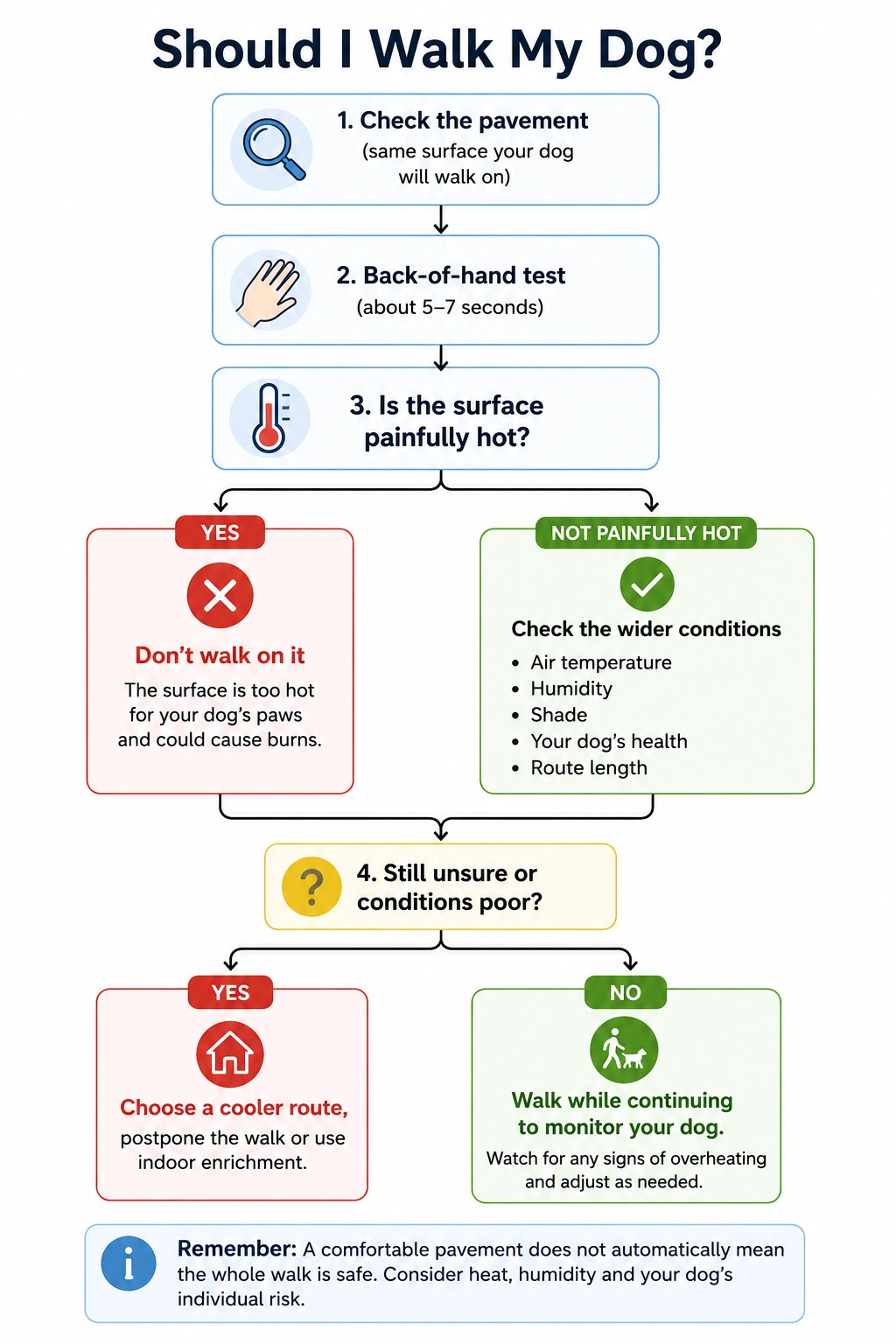
A practical rule is to place the back of your hand on the pavement for around five to seven seconds. If it feels painfully hot or you need to pull your hand away, treat the surface as too hot for your dog’s bare paws.
Do not rely on the forecast air temperature alone. Tarmac, concrete, paving, artificial grass and sand can become much hotter than the surrounding air when they are exposed to direct sunlight.
Check before your dog steps onto a hot surface
- Test the actual ground with the back of your hand.
- Keep your hand there for around five to seven seconds, but stop sooner if it hurts.
- If the surface is painful or uncomfortably hot, do not walk your dog on it.
- Choose a cooler surface, change the route or postpone the walk.
- If your dog is limping, licking their paws or has red, blistered or damaged pads, remove them from the heat and contact a vet.
Is There a Safe Pavement Temperature for Dogs?
There is no well-established universal surface-temperature cut-off below which pavement is always safe and above which it will always burn a dog’s paws.
A thermal injury depends on both temperature and contact time. A very hot surface may cause injury quickly, while a less extreme surface could still become painful during prolonged contact.
Dogs also vary. Paw pads provide some natural protection, but they are living tissue and can be burned. Their condition may differ according to the dog’s health, age, previous activity, existing pad damage and the surfaces they normally walk on.
This is why a number displayed by a weather app—or even one surface-thermometer reading—should not be treated as a guarantee of safety.
The safest practical approach is:
- Check the actual surface.
- Avoid it if it feels painfully hot.
- Watch your dog’s movement and behaviour.
- Consider the wider heat risk before deciding to walk.
A pavement that feels cool enough does not necessarily mean the whole walk is safe. Air temperature, humidity, sunlight, exercise, route length and your dog’s individual vulnerability still matter. See our complete guide to deciding whether it is too hot to walk your dog.
Use the Five-to-Seven-Second Pavement Test
The hand test is a quick way to screen a surface before allowing your dog to walk on it.
The RSPCA advises that if the ground is too hot to touch with your hand for five seconds, it is too hot for paws. The Royal Kennel Club uses a seven-second back-of-hand test. PDSA guidance also uses a short hand-contact test, although the exact wording varies between its pages. st the pavement
- Find a section of the same surface your dog would walk on.
- Test an area exposed to the same sunlight—not a conveniently shaded patch beside it.
- Place the back of your hand flat against the ground.
- Hold it there for around five to seven seconds.
- Stop immediately if it feels painful.
- If it is too hot for your hand, do not let your dog walk on it.
Repeat the test where conditions change. A route may include shaded paving, sun-exposed tarmac, artificial grass and metal surfaces, all at very different temperatures.
Do not force yourself to complete the count if the surface already hurts. The purpose is to avoid a burn, not prove exactly how long you can tolerate the heat.
The test is a practical safety check rather than a scientifically precise measurement. A comfortable result also does not assess whether the air temperature, humidity or exercise itself could cause your dog to overheat.
Why Pavement Can Be Much Hotter Than the Air
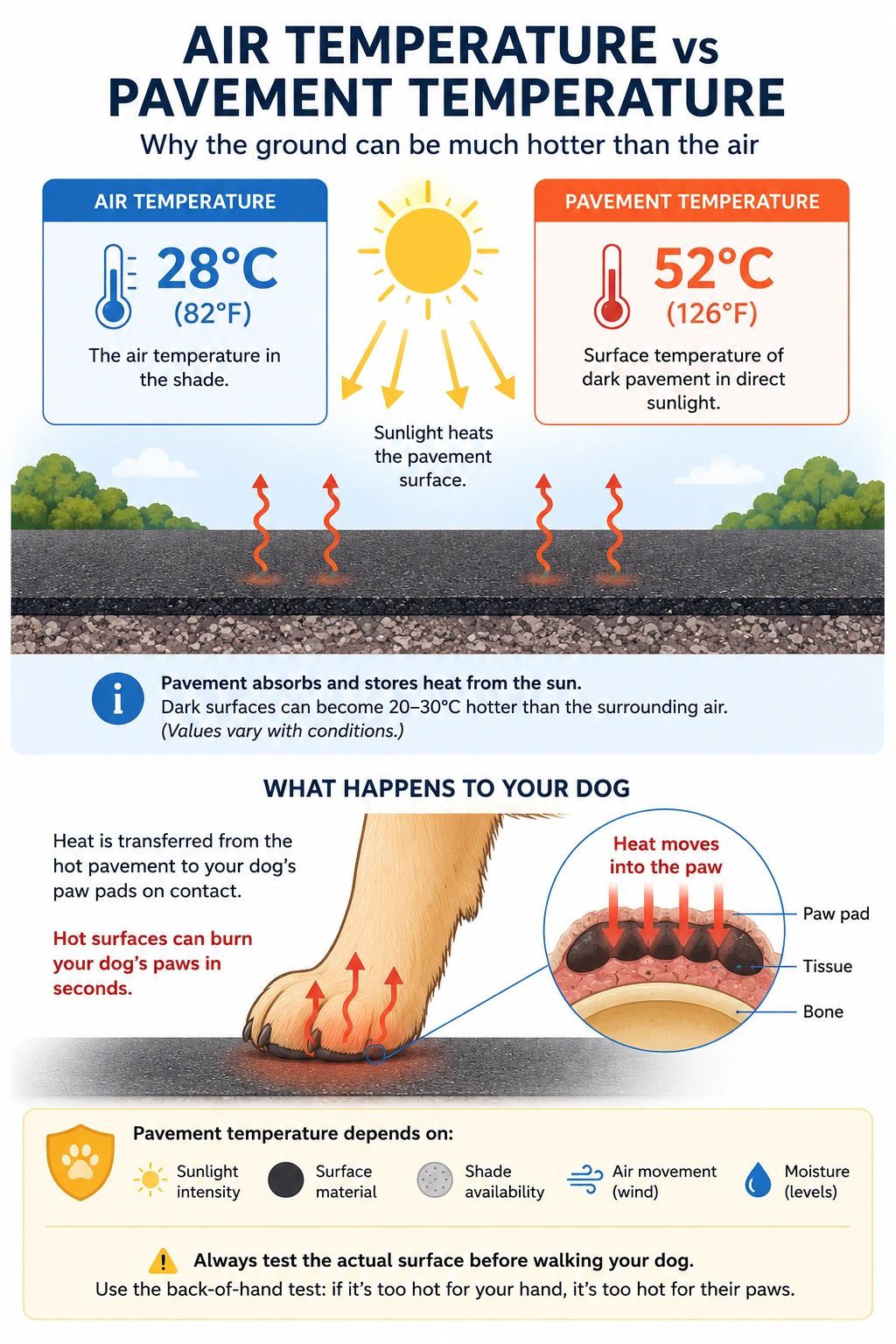
Weather forecasts report air temperature. They do not tell you the temperature of a specific section of tarmac in direct sunlight.
Dark surfaces absorb solar energy and convert it into heat. Tarmac and similar materials may become considerably hotter than the surrounding air, particularly when:
- the sun is strong;
- the surface is dark;
- there is little shade;
- wind is light;
- the surface has been heating for several hours;
- the material stores heat efficiently.
This is also why an evening walk is not automatically safe. The air may have started to cool while paving, tarmac or artificial surfaces still retain heat absorbed earlier in the day.
Shade generally reduces surface heating, but it is not an automatic all-clear. Ground that has only recently moved into shade may remain hot, and patches along the same route can differ significantly.
What Affects Pavement Temperature?
Direct sunlight
Direct solar exposure is one of the biggest influences on ground temperature. Two sections of the same pavement can feel very different if one is shaded and the other has been in full sun.
Surface material
Different materials absorb, reflect and retain heat differently.
Surfaces that may become particularly hot include:
- dark tarmac and asphalt;
- concrete and paving slabs;
- artificial grass;
- rubberised playground surfaces;
- decking;
- dry sand;
- metal ramps, plates or drain covers.
Grass is often cooler than hard paving, but it is not guaranteed to be safe. It can still be warm, and it does not remove the risk of whole-body overheating.
Surface colour
Darker surfaces generally absorb more solar radiation than lighter ones, although colour is not the only factor. Material, thickness, moisture, shade and airflow also matter.
Time of day
Ground temperature usually builds as a surface absorbs sunlight. Early morning is often safer than late afternoon, but there is no clock time that guarantees safe pavement.
The actual surface should still be checked before every walk.
Recent weather
A surface can remain warm after cloud appears or the air temperature falls. Conversely, rain, shade or a cool breeze may reduce surface temperature.
Local conditions matter more than a general rule based only on the forecast.
Can You Check Pavement with an Infrared Thermometer?
A handheld infrared thermometer can measure surface temperature rather than air temperature. It may help you compare:
- sunny and shaded areas;
- tarmac and grass;
- different parts of a route;
- conditions at different times of day.
However, it should be treated as an additional tool—not a universal safety detector.
Infrared readings can be affected by:
- the device’s accuracy;
- its distance from the ground;
- the angle of measurement;
- the type and reflectiveness of the surface;
- the exact spot measured;
- differences between shaded and exposed areas.
Take several measurements from representative parts of the route rather than relying on one convenient reading.
If you take a reading, you can use our dog pavement temperature chart to convert and compare surface temperatures in °C and °F.
Most importantly, a thermometer cannot account fully for your individual dog or prove that a prolonged walk is safe. If the surface is painful to your hand, your dog is uncomfortable or conditions are uncertain, choose the safer option regardless of the displayed number.
| What you find | Safer response |
|---|---|
| The surface is painful to your hand | Do not walk your dog on it |
| Sunny areas are much hotter than shaded ones | Change the route or postpone the walk |
| Readings vary greatly along the route | Assume hot sections may be unsafe |
| The surface feels tolerable but the day is very hot or humid | Assess the wider risk of walking in heat |
| Your dog lifts their paws, limps or resists walking | Stop immediately, regardless of the reading |
Which Outdoor Surfaces Can Burn a Dog’s Paws?
Tarmac and asphalt
Dark road and pavement surfaces can absorb substantial heat in direct sun. They are among the most important surfaces to check during warm weather.
Concrete and paving slabs
Concrete may appear less threatening than black tarmac, but exposed slabs can still become uncomfortably hot.
Different types of paving may also heat at different rates, so do not assume the next section of a route is safe because the previous one was comfortable.
Artificial grass
Artificial turf can become very hot in sunlight. It may look similar to a cooler natural lawn, but its surface properties are different.
Test it directly before allowing your dog onto it.
Sand
Dry sand can heat rapidly and may burn paws at beaches, dunes and play areas. Test the exact section your dog would cross, particularly away from the water.
Decking and rubber surfaces
Dark decking, composite materials and rubberised surfaces can absorb heat. These may occur in gardens, parks, outdoor seating areas and play spaces.
Metal
Metal drain covers, ramps, plates and other outdoor fittings can become extremely hot in the sun. Avoid allowing your dog to stand on them during warm weather.
Signs That Hot Pavement May Have Burned Your Dog’s Paws
Dogs do not always show obvious damage immediately. Stop and inspect your dog’s paws if they suddenly:
- refuse to continue walking;
- slow down or repeatedly stop;
- lift one or more paws;
- alternate between their feet;
- limp or walk unusually;
- whimper or appear distressed;
- lick or chew their paws.
The RSPCA lists limping, refusing to walk, licking or chewing the feet, darker pads, redness, blisters and missing sections of pad as warning signs associated with hot-pavement injury. vet if you notice:
- redness or swelling;
- blisters;
- discolouration;
- peeling or loose pad tissue;
- raw or exposed tissue;
- bleeding;
- discharge;
- marked tenderness;
- persistent licking;
- refusal or inability to bear weight.
Do not try to judge the full depth of a burn from its appearance. Burns may look limited initially and then worsen or blister after the original injury. If Your Dog’s Paws Have Been Burned
A suspected thermal burn needs prompt veterinary advice.
1. Remove your dog from the hot surface
Move them into shade or onto a cool, safe surface immediately.
Carry your dog if this is safe and practical. Do not make them continue walking home on painful or damaged pads.
2. Contact your vet
Call your veterinary practice or nearest emergency vet and explain:
- what surface your dog walked on;
- when the exposure occurred;
- how long they may have been exposed;
- which paws appear affected;
- what signs or visible damage you have noticed;
- whether your dog is also showing signs of overheating.
PDSA advises contacting a vet for any burn because burns are painful, can become infected and may be more extensive than they first appear. he affected area
If your dog permits and doing so will not delay urgent veterinary care, place the affected paw under cool running water.
PDSA advises cooling a burn with cool water for at least 10 to 20 minutes, while the Blue Cross first aid advice for burns recommends cooling for at least five minutes and warns not to delay transport when a dog has a severe burn, is struggling or is in extreme pain. A practical approach is to start cooling immediately while veterinary help is being arranged, then follow your vet’s advice about how long to continue and when to travel.
4. Prevent further damage
Keep your dog away from hot, rough or dirty surfaces.
Try to prevent licking, but do not force painful handling or place a tight covering around the paw.
Do not:
- apply ice or iced water;
- apply butter, oil, creams or ointments;
- use human burn treatments unless a vet specifically tells you to;
- place adhesive material directly over the pad;
- wrap the paw tightly;
- force your dog to continue walking;
- delay veterinary help to try a home remedy.
PDSA specifically advises against ice, iced water, creams and ointments for burns. Signs of Heatstroke Too
A paw-pad burn is a localised injury, but the conditions that heat pavement can also cause whole-body overheating.
Seek urgent veterinary help if your dog is showing possible signs of heatstroke and what to do, including:
- heavy or persistent panting;
- difficulty breathing;
- excessive drooling;
- weakness;
- confusion;
- vomiting or diarrhoea;
- poor coordination;
- collapse;
- seizures;
- loss of consciousness.
Heatstroke can progress rapidly and may become life-threatening. Start appropriate cooling and contact a vet immediately rather than waiting to see whether the dog recovers unaided. vent Paw Burns on Hot Days
Walk earlier
An early-morning walk is often safer because surfaces have had time to cool overnight.
Do not assume that late evening is equally safe. Tarmac and paving may retain heat after the surrounding air begins to cool.
For more detail on choosing between morning and evening, see the best time to walk your dog in hot weather.
Test the route
Check the actual surface before leaving and test again if the route changes between:
- sun and shade;
- grass and paving;
- tarmac and concrete;
- natural and artificial surfaces.
Choose cooler ground
Where conditions are otherwise suitable, natural grass or genuinely shaded routes may reduce contact with hot paving.
A strip of grass beside an unsafe pavement may help on a necessary brief toilet outing, but it does not make a long walk in excessive heat safe.
Shorten or postpone the walk
Dogs do not need to complete their normal route regardless of conditions.
On a very hot or humid day, replace a walk with indoor enrichment such as:
- scent games;
- short training sessions;
- food puzzles;
- calm play;
- scatter feeding;
- supervised searching activities.
Missing or shortening one walk is safer than risking burned paws or heatstroke.
Keep necessary outings brief
When your dog needs to go outside, choose the coolest available surface and return indoors once they have toileted.
Watch your dog throughout
Do not rely only on the test performed at the start. Stop if your dog:
- hesitates;
- changes gait;
- lifts their feet;
- seeks shade;
- becomes unusually slow;
- pants heavily;
- appears tired or distressed.
A cooler surface is only one part of walking your dog safely in hot weather. Air temperature, humidity, exercise intensity, water availability, route length and the dog’s health must also be considered.
Do Dog Boots Make Hot Pavement Safe?
Well-fitting dog boots may reduce direct contact with a hot surface in limited circumstances, but they do not make an unsafe hot-weather walk safe.
Boots have important limitations:
- they must fit correctly;
- dogs need gradual acclimatisation;
- poor fit can cause rubbing;
- footwear may alter the dog’s gait;
- some boots can trap moisture or heat;
- they do not protect against heatstroke;
- their protection may vary by material and construction.
Do not put unfamiliar boots on a dog immediately before a hot walk and assume they will cope normally.
Even when boots are used, check the route, keep the outing brief and monitor the dog carefully.
Paw waxes and balms should not be treated as reliable insulation from dangerously hot pavement. They may have other paw-care uses, but they do not turn a hazardous surface into a safe one.
For an optional walk during excessive heat, postponing it is normally safer than relying on equipment.
Hot Pavement Is Only One Hot-Weather Risk
Pavement temperature, air temperature and vehicle temperature are different measurements.
A dog may be at risk even when the pavement feels tolerable because:
- the air is hot or humid;
- the route has little shade;
- exercise is strenuous;
- the walk is too long;
- the dog is dehydrated;
- the dog has a condition that affects breathing or temperature control.
Likewise, a car’s interior temperature cannot be predicted from the pavement temperature. Vehicle interiors create a separate and potentially fatal heat hazard.
Breed and individual differences can influence how easily a dog overheats, but they do not provide a scientifically established breed-specific safe pavement temperature. A Labrador, French Bulldog or other dog should still have the actual ground checked before walking.
The Safest Decision When You Are Unsure
There is no single pavement-temperature number that guarantees safety for every dog.
Test the actual surface with the back of your hand. If it feels painful or uncomfortably hot within around five to seven seconds, do not expose your dog’s bare paws to it.
Remember that:
- pavement can be much hotter than the air;
- different surfaces and locations heat differently;
- ground may remain hot into the evening;
- a comfortable pavement does not prove that the whole walk is safe;
- limping, licking, redness, blistering or damaged pads require prompt attention.
When the result is uncertain, change the route, use a cooler surface or postpone the walk. If you suspect a paw burn, start safe cooling and contact a vet.
Read next
- Is It Too Hot to Walk My Dog? (Complete Guide)
- Dog Heatstroke: Symptoms, Treatment & Prevention (Complete Guide)
- Walking Your Dog in Hot Weather Safely