
Fans are generally safe for dogs when they are stable, properly guarded and positioned where the dog cannot reach the blades or chew the cable. They can improve airflow and help a dog feel more comfortable, but they do not make a dangerously hot, humid or enclosed space safe.
Your dog should always be able to move away from the airflow. Provide fresh drinking water, keep the room well ventilated and never rely on a fan alone to prevent heatstroke.
Is your dog overheating?
A fan is not enough on its own. Stop any activity, move your dog out of the heat and begin cooling them with water that is cooler than their body while creating airflow. Contact a vet immediately and follow their advice. Do not wait to see whether the fan solves the problem.
How Much Do Fans Help Dogs Stay Cool?
Fans can help dogs, but not in exactly the same way that they help people.
Humans can sweat across much of their skin. Air moving over that sweat increases evaporation and helps remove heat. Dogs sweat only to a limited extent, mainly through their paw pads, and depend much more heavily on panting to control their temperature.
Air movement may still:
- make a moderately warm room feel more comfortable;
- improve ventilation;
- move warm air away from the dog;
- support evaporation when water is used to cool an overheated dog;
- supplement shade, drinking water and access to a cooler resting place.
However, an ordinary fan mainly moves the existing air around. It does not reduce the room temperature in the way that air conditioning can.
The hotter and more humid the environment becomes, the less reassurance a fan should provide. Dogs can struggle to lose heat through panting in hot, humid conditions, so moving the same warm, moisture-laden air may not protect them from overheating.
For a closer look at how effective fans are at cooling dogs, see How Effectively Do Fans Cool Dogs? The important safety point is that a fan can be a useful part of a cooling plan, but it should never be treated as a complete heat-safety system.
When Can a Fan Be Unsafe for a Dog?
The airflow itself is not usually the greatest danger. Most risks come from the appliance, its position or the conditions in which it is being used.
Exposed blades or an inadequate guard
A dog’s nose, paw, tongue, coat or tail could be injured if it can reach moving blades.
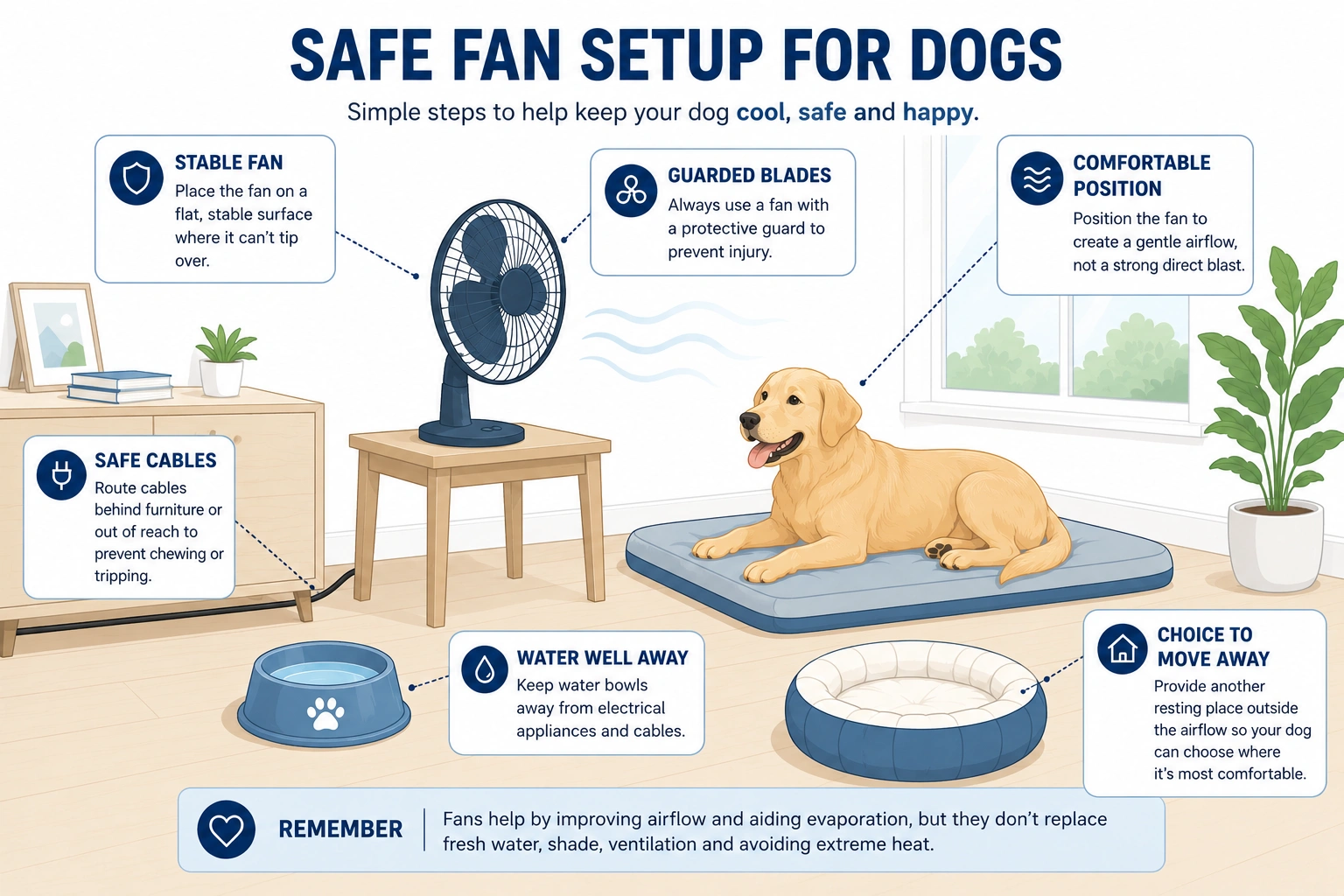
Choose a fan with a secure guard whose openings are too small for your dog to reach through. Check that the guard is not bent, loose or damaged, particularly if the fan has been dropped or stored for a long time.
Puppies and inquisitive dogs may investigate a fan closely, so do not assume they will instinctively avoid it.
Trailing or chewable cables
Electrical cables can be particularly attractive to puppies and dogs that chew.
Keep the lead behind furniture, use suitable cable protection or position it completely outside the dog’s reach. Do not run a cable through or immediately beside a crate where the dog could pull it inside.
Never use a fan with:
- a frayed or cut cable;
- exposed wiring;
- a damaged plug;
- scorch marks;
- an unusually hot plug or motor;
- a burning smell;
- buzzing, crackling or other abnormal sounds.
If a dog receives an electric shock, switch off the electricity before touching them and contact a vet immediately. Internal injuries may not be visible straight away, so veterinary assessment is important even when the dog initially appears well.
A fan that can be knocked over
Place the fan on a firm, level surface where it cannot be knocked from a table, pulled over by its cable or tipped by a passing dog.
Floor-standing and pedestal fans need enough stability for the household in which they are being used. A calm older dog may ignore one completely, while an energetic puppy or large wagging tail may make a precarious setup unsafe.
Clip-on fans must be attached to a suitable, stable structure and secured according to the manufacturer’s instructions.
Water near electrical equipment
Fresh drinking water should always be available in warm weather, but the bowl should not be positioned where it can spill onto a mains-powered fan, plug, extension lead or socket.
Avoid online cooling “hacks” that place wet towels, open containers of water or melting ice where moisture could enter the fan or reach its electrical connections.
Water and mains electricity must remain safely separated.
Noise, fear or forced airflow
Some dogs are unsettled by the noise, movement or vibration of a fan.
Introduce an unfamiliar fan at a low setting and watch your dog’s response. Signs such as repeatedly leaving the room, hiding, trembling, barking at the appliance or being unable to settle suggest that the setup is not comfortable for that dog.
Do not restrain or confine a dog where they have no option but to remain directly in the airflow.
Is It Safe for a Fan to Blow Directly on a Dog?
Gentle airflow directed towards a dog is usually acceptable when the dog appears comfortable and is free to move away.
It is generally better to use the fan to circulate air around the resting area than to place a powerful fan extremely close to the dog’s face. Adjust the speed and angle if your dog turns away, repeatedly changes position or avoids the area.
There is no authoritative universal distance or fan-speed rule that applies to every dog and every appliance. Use the dog’s behaviour, the strength of the airflow and the manufacturer’s instructions rather than an invented measurement.
Ask your vet for individual advice if your dog has an eye condition, breathing disorder or another medical problem that may affect how they tolerate continuous airflow.
Can Dogs Sleep With a Fan On?
A dog may be comfortable sleeping in a room where a fan is circulating air, provided that:
- the room itself is not dangerously hot;
- the fan is stable and undamaged;
- the blades and cable are inaccessible;
- the dog can choose another resting place;
- the airflow is not excessively strong;
- fresh water is available;
- the appliance is being used according to its instructions.
There is, however, a separate household electrical-safety consideration. Electrical Safety First advises against leaving an electric fan running overnight or while nobody is at home because a fault could go unnoticed.
A timer that switches the appliance off does not change the need for safe placement, a sound electrical condition and suitable supervision. During very hot nights, focus on making the room itself safer by reducing solar heat gain, improving ventilation where appropriate and giving the dog access to the coolest suitable part of the home.
Do not leave a fan running as the only protection for a dog confined in a room that may continue to heat up.
Are Crate Fans Safe for Dogs?
A properly selected and securely installed crate fan can improve local airflow, but it does not cool an unsafe environment.
Before using one, check that:
- the fan is designed for the intended mounting method;
- it cannot fall into the crate;
- the dog cannot reach the blades;
- cables and charging leads remain outside chewing range;
- batteries are enclosed securely;
- the dog has enough room to change position;
- airflow is not continuously forced into the face;
- the crate is kept out of direct sun;
- the surrounding room is well ventilated;
- the dog is monitored appropriately.
A crate fan must never be used to justify leaving a dog in a hot vehicle, conservatory, tent, shed or poorly ventilated room. Moving hot air around a confined space does not make that space safe.
The same applies to travel crates. A portable fan can supplement a safe, ventilated setup, but it cannot compensate for dangerous ambient conditions.
For suitable options, see Dog Crate Fans and Portable Fans for Dogs after considering these limitations.
When Is a Fan Not Enough to Keep a Dog Safe?
Treat a fan as inadequate whenever the underlying environment or the dog’s condition remains unsafe.
This includes situations where:
- the room is extremely hot;
- humidity is high;
- the dog is in direct sunlight;
- ventilation is poor;
- the dog cannot move to a cooler area;
- drinking water is unavailable;
- the dog has recently exercised;
- the dog is already panting heavily or behaving abnormally;
- the dog is confined;
- the fan is simply moving very hot air around.
Humidity matters because dogs rely heavily on evaporation from panting. As the air becomes increasingly humid, moisture evaporates less readily and panting may become less effective.
There is no single humidity percentage that guarantees safety for every dog. Temperature, direct sunlight, ventilation, exertion, duration of exposure and individual vulnerability all matter. The dedicated guide to how humidity affects a dog’s safety should be used for the fuller decision process.
During prolonged hot weather, a fan should form only one part of a wider plan for keeping your dog safe during a heatwave.
Which Dogs Need Extra Care in Hot Weather?
Any dog can overheat, but some are more vulnerable and should not be assumed safe merely because a fan is running.
Higher-risk dogs include:
- flat-faced breeds such as French Bulldogs, English Bulldogs and Pugs;
- puppies;
- older dogs;
- overweight dogs;
- dogs with thick coats;
- unfit dogs;
- dogs with heart or respiratory conditions;
- dogs with restricted mobility;
- dogs that cannot freely leave the warm area.
Flat-faced dogs may have more difficulty moving air through their shortened airways and may not cool themselves as effectively through panting.
French Bulldog owners can find breed-specific practical advice in our guide to keeping a French Bulldog cool in summer.
Dogs with limited mobility need particular attention because they may be unable to relocate themselves when an area becomes uncomfortable. Make sure they have a genuinely safe resting temperature rather than relying on their ability to seek somewhere cooler.
For breed-specific advice, our guide on how to keep a Golden Retriever cool in summer covers exercise, hydration, the home environment and other cooling methods alongside appropriate fan use.
Signs That Your Dog Needs More Than a Fan
A fan should not be used as a reason to continue monitoring at home when a dog may be developing heatstroke.
| Situation | Possible signs | What to do |
|---|---|---|
| Your dog may be becoming too warm | Increased panting, restlessness, repeatedly seeking cooler places or reluctance to continue an activity | Stop the activity, move the dog to a cooler area, provide water and monitor closely |
| Significant overheating may be developing | Persistent heavy panting, excessive drooling, weakness, vomiting, abnormal breathing, unusually red or pale gums, confusion or poor coordination | Begin active cooling and contact a vet immediately |
| Possible heatstroke emergency | Collapse, seizure, severe breathing difficulty, marked disorientation, loss of consciousness or inability to stand | Cool the dog immediately and seek emergency veterinary care |
These signs are not a diagnosis and dogs do not always develop them in a predictable order. Any rapid deterioration, severe breathing problem, collapse or neurological sign requires urgent veterinary help.
The complete guide to dog heatstroke symptoms and what to do should provide the fuller recognition, first-aid and veterinary information.
What to Do if Your Dog Is Overheating
Current UK animal-welfare and veterinary guidance follows the principle:
Take the following action:
- Stop further heating. End exercise and move the dog out of direct sun, a vehicle or another hot environment.
- Begin cooling immediately. Pour water that is cooler than the dog’s body over the body. Do not waste time trying to find water at a supposedly perfect temperature.
- Create airflow. Use a fan, breeze or air conditioning to encourage evaporation.
- Contact a vet immediately. Explain the dog’s symptoms and follow the clinic’s instructions.
- Continue cooling during the journey in a well-ventilated or air-conditioned vehicle, unless your vet tells you otherwise.
Avoid pouring water directly over the head of a dog that is already struggling to breathe. Do not delay action to buy a cooling product, search for a thermometer or wait to see whether resting in front of a fan is enough.
Cooling is first aid. It is not a substitute for veterinary assessment when heatstroke is suspected.
Fan Safety Checklist for Dog Owners
Before using a fan around your dog, check that:
- The fan and power cable are undamaged.
- Moving blades are protected by a secure guard.
- The fan stands on a firm, level surface.
- It cannot fall into a bed, crate or resting area.
- The dog cannot chew or pull the cable.
- Water cannot spill onto the appliance, plug or socket.
- The dog can move away from the airflow.
- The airflow is not uncomfortably strong.
- The room is ventilated and not dangerously hot.
- Fresh drinking water is available.
- The dog is not confined in direct sunlight.
- High-risk dogs are supervised more closely.
- The fan is not being relied on to prevent or treat heatstroke.
- The manufacturer’s instructions are being followed.
- The fan will be unplugged immediately if it becomes hot, damaged, noisy or produces a burning smell.
Are Fans Good for Dogs?
Fans can be good for dogs when they improve air movement and comfort in an otherwise safe environment.
They are most useful as one part of a broader approach that includes:
- fresh water;
- shade;
- reduced activity;
- good ventilation;
- access to a cooler resting place;
- close observation during warm weather.
They are not “good” when their presence encourages an owner to accept conditions that would otherwise be recognised as dangerous.
The most accurate conclusion is:
A fan can be a useful cooling aid, but it is not reliable protection against severe heat.
Other Safe Ways to Help Your Dog Cool Down
Depending on the circumstances, useful measures may include:
- moving the dog to a cooler part of the home;
- closing curtains or blinds before direct sunlight heats the room;
- providing more than one bowl of fresh water;
- reducing or cancelling exercise;
- creating shade outdoors;
- using an appropriate cooling mat;
- wetting the dog when active cooling is needed;
- using air conditioning where available.
For Labrador owners, How to Keep a Labrador Cool in Summer brings these measures together into a practical hot-weather routine covering the home, exercise, water, shade and cooling options.
Some dogs also enjoy supervised water-based cooling. However, pools create separate risks involving access, water quality, fatigue and supervision, so check whether swimming pools are safe for dogs rather than assuming that any water activity is harmless.
Once the environment is already safe, readers who want help selecting an appropriate appliance can consult the guide to choosing one of the best fans for dogs.
Frequently Asked Questions
Is it safe to point a fan directly at a dog?
Gentle direct airflow is usually safe when the dog appears comfortable and can move away. Avoid placing a powerful fan very close to the face or forcing the dog to remain in its path.
Can a dog sleep in front of a fan?
A dog can choose to sleep in a fan’s airflow when the setup is safe and comfortable. The fan should be stable, guarded and out of chewing reach, and the dog should have another resting option. General UK electrical-safety advice recommends not leaving an electric fan running unattended overnight.
Are crate fans safe for dogs?
Crate fans can be safe when properly secured outside the dog’s reach and used in a safe, ventilated environment. They cannot make a hot vehicle, tent, conservatory or overheated room safe.
Can a fan prevent heatstroke in dogs?
No. A fan may support comfort or evaporative cooling, but it cannot guarantee protection from heatstroke. Environmental temperature, humidity, exercise, ventilation and the individual dog all affect risk.
Should I use a fan to cool an overheated dog?
Airflow can support cooling, particularly after water has been applied to the body. Begin cooling immediately and contact a vet. Do not rely on the fan alone or delay veterinary help.
Final Verdict
Fans are normally safe for dogs when they are stable, guarded, correctly positioned and used in a safe, ventilated environment.
Protect blades and cables, keep water away from the electrics and let your dog move out of the airflow. Most importantly, remember that a fan moves air—it does not make extreme heat, high humidity or an enclosed space safe.
If your dog shows signs of overheating, begin active cooling and contact a vet immediately rather than waiting for the fan to work.