
Car sickness in dogs can cause much more than vomiting. Drooling, lip licking, repeated swallowing, panting and retching can all be signs that a dog feels nauseous during a journey. Some dogs also become frightened of travelling, and nausea and anxiety can then reinforce each other.
If your dog repeatedly becomes sick or distressed in the car, it is worth addressing the problem rather than simply hoping they will tolerate future journeys. A vet can help rule out other causes of illness and, where appropriate, prescribe medication to control travel-related vomiting while you work on making car journeys easier for your dog.
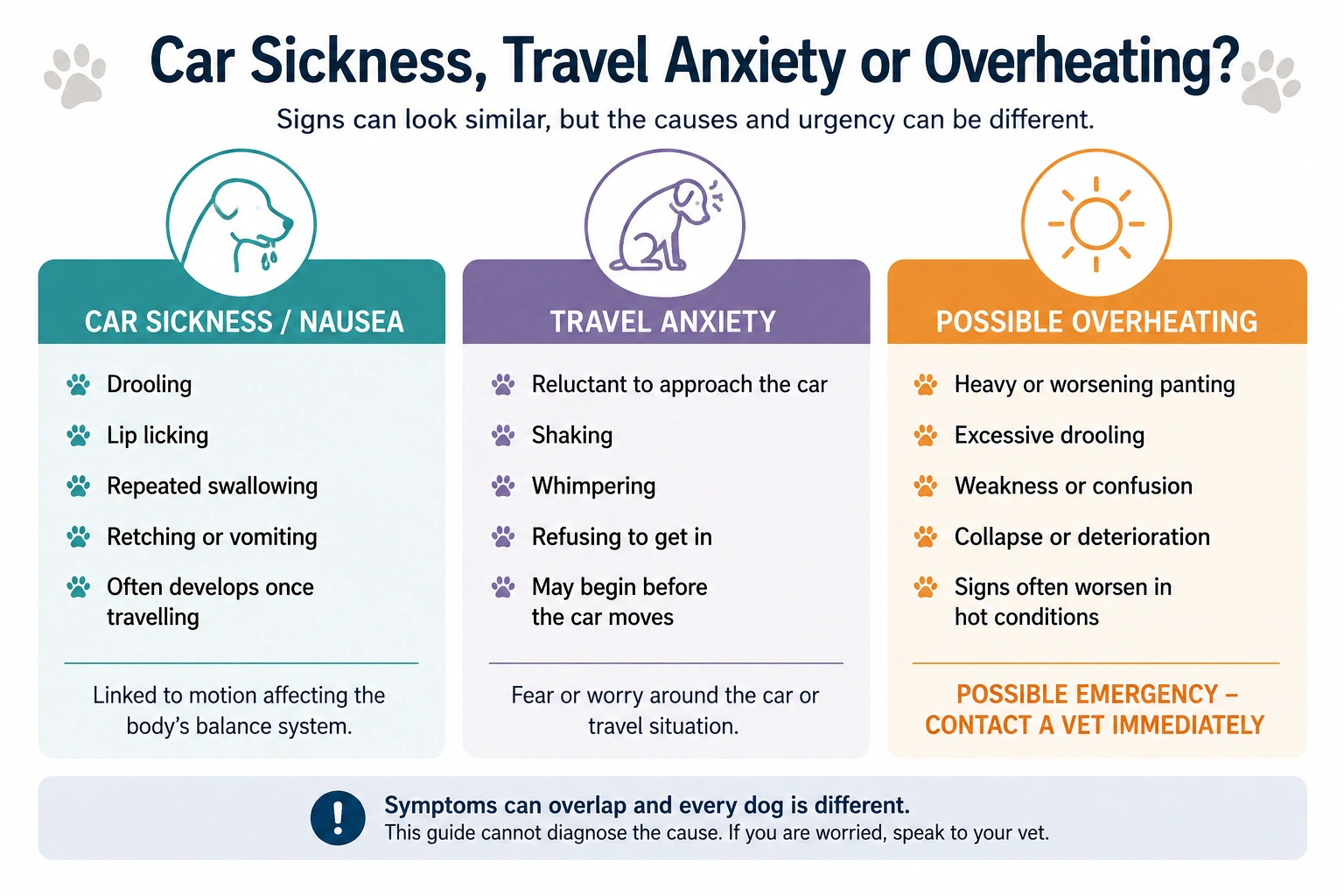
There is also one important safety distinction: panting, drooling, vomiting or weakness during a hot journey should never automatically be dismissed as ordinary car sickness. Overheating and heatstroke can cause some overlapping signs and may require urgent veterinary treatment.
A short summary: car sickness can show as drooling, swallowing, lip licking, retching or vomiting; anxiety can overlap; persistent cases warrant veterinary advice; hot-journey deterioration may indicate overheating.
What Is Car Sickness in Dogs?
Car sickness, motion sickness and travel sickness are different terms commonly used for the same general problem: a dog feels nauseous or becomes sick while travelling.
The exact experience can vary considerably between dogs. Some vomit during almost every journey. Others never actually vomit but spend the trip drooling, swallowing repeatedly or looking visibly uncomfortable.
Motion is thought to play an important part. Veterinary guidance from PDSA describes car sickness as being associated with movement affecting the balance centre in the brain, combined in some dogs with anxiety or stress around travelling. Puppies are commonly affected, although adult dogs can experience travel sickness too. Dogs that are unfamiliar with car travel may also be more susceptible.
The physical and emotional parts of the problem can become difficult to separate. A dog that repeatedly feels nauseous in the car may start to anticipate another unpleasant journey. Eventually, they may become worried before the vehicle even moves.
That can create a cycle:
movement causes nausea → the journey becomes unpleasant → the dog becomes worried about travelling → future journeys become even more stressful
Understanding that relationship matters because simply preventing vomiting may not solve the whole problem.
What Are the Signs of Car Sickness in Dogs?
Vomiting is the most obvious sign, but it is often not the first.
Signs that a dog may be feeling nauseous during a car journey include:
- excessive drooling
- repeated swallowing
- frequent lip licking
- panting
- retching
- vomiting.
These signs are recognised by PDSA as symptoms associated with travel sickness in dogs.
A dog may therefore be car sick even if they never actually vomit.
Some dogs also show signs of fear or distress around travelling, including shaking, barking or whimpering, toileting in the car, pulling away from the vehicle or refusing to get inside.
Quick guide to what you may notice
| What you notice | What it could suggest |
|---|---|
| Lip licking or repeated swallowing | Possible nausea |
| Heavy drooling during travel | Nausea may be involved, although drooling has other causes |
| Retching or vomiting | Stronger evidence that the dog feels sick |
| Shaking or refusing to enter the car before travelling | Fear or travel anxiety may be important |
| Symptoms become worse once the car starts moving | Motion sickness may be contributing |
| Heavy panting, drooling or deterioration during a hot journey | Consider overheating as well as travel sickness |
These clues can help you understand the pattern, but they cannot diagnose the cause of an individual dog’s symptoms.
Why Do Dogs Get Car Sick?
There is rarely a useful single explanation that applies to every dog. Motion, age, previous travel experiences and anxiety can all influence what happens.
Motion can trigger nausea
Car movement affects the body’s balance system. PDSA describes motion sickness as being thought to involve certain kinds of movement affecting the balance centre in the brain.
That helps explain why a dog can appear perfectly well before a journey but start drooling, swallowing or retching after the car begins moving.
Anxiety can make the problem worse
A dog may also associate the car with frightening or unpleasant experiences.
Sometimes anxiety existed first. In other cases, repeated nausea appears to create the fear: if getting into the car has repeatedly been followed by feeling sick, it is understandable that a dog may become reluctant to travel.
This is why car sickness and travel anxiety often overlap rather than existing as completely separate problems.
Puppies are commonly affected
Car sickness is common in puppies, although it can also affect adult dogs.
Some young dogs become better travellers as they mature and gain positive experience of car journeys, but it is unhelpful to assume that every puppy will simply grow out of the problem. Repeated unpleasant journeys can allow fear of the car to become established.
Lack of travel experience can contribute
Dogs that have not gradually become accustomed to travelling may be more likely to develop car sickness.
That does not mean a dog should simply be taken on increasingly long journeys until they adapt. If the dog is already becoming nauseous or frightened, repeatedly exposing them to an experience they find unpleasant can make the association with the car worse.
Why Does My Dog Drool So Much in the Car?
Heavy drooling is one of the classic signs that a dog may be feeling nauseous during a journey.
It can appear before retching or vomiting, which makes it particularly useful to notice early. PDSA includes drooling alongside panting, repeated swallowing, lip licking and retching among signs of nausea associated with travel sickness.
However, drooling alone does not prove that a dog has motion sickness.
Stress and fear can also affect a dog’s behaviour in the car, and heavy drooling can occur when a dog is overheating. The surrounding circumstances matter.
For example, a dog that starts swallowing and drooling once the car moves, then recovers after the journey stops, may fit a travel-sickness pattern. A dog that starts shaking and drooling as soon as they approach the vehicle may have a strong anxiety component as well.
A dog that is heavily panting and drooling while becoming weak or increasingly unwell during a hot journey needs a different level of concern because overheating must be considered.
Is It Car Sickness or Travel Anxiety?
Car sickness and travel anxiety can look remarkably similar — and a dog can have both.
The timing of the signs can provide useful clues.
| More suggestive that nausea is involved | More suggestive that anxiety is important |
|---|---|
| Drooling after travel begins | Reluctance to approach the car |
| Repeated swallowing | Refusing to get inside |
| Lip licking | Shaking before the vehicle moves |
| Retching | Whimpering or barking |
| Vomiting during travel | Escape or avoidance behaviour |
This is not a diagnostic test.
A dog may start with genuine motion sickness and later become anxious because they associate the car with nausea. Equally, a dog that is already frightened of travelling may become increasingly distressed once the journey starts.
If fear itself has become a significant part of the problem, it needs addressing rather than concentrating only on whether the dog vomits. Our guide to dog travel anxiety explains how to recognise the signs, identify possible triggers and gradually help your dog become more comfortable with travelling.
When Car-Sickness-Like Signs Could Be Something More Serious
Not every episode of drooling, panting or vomiting in a vehicle is ordinary travel sickness.
If your dog’s symptoms are new, severe, occurring outside car journeys or accompanied by other signs of illness, speak to your vet rather than assuming motion sickness is responsible.
Don’t mistake overheating for ordinary travel sickness
This is particularly important in warm weather.
Heatstroke can be caused by being trapped somewhere hot, including inside a car. Dogs rely heavily on panting for cooling, and recognised heatstroke signs can overlap with apparent travel sickness.
Heavy or worsening panting, excessive drooling, weakness, confusion, collapse or marked deterioration during a hot journey should therefore never be written off as a dog simply “getting carsick”.
If you suspect heatstroke, treat the situation as an emergency and contact a vet immediately.
Dogs should never be left in a car on a warm day, even for a short time, with the windows open or when the vehicle is parked in shade. PDSA also advises avoiding car travel in hot weather where possible.
How Is Car Sickness in Dogs Treated?
The best approach depends on what is driving the problem.
For many dogs, treatment involves two connected aims:
- controlling significant nausea or vomiting where veterinary treatment is appropriate;
- helping the dog become comfortable and confident with car travel over the longer term.
Reducing nausea
If your dog suffers repeatedly from car sickness, speak to your vet.
Licensed veterinary anti-sickness medication is available for preventing vomiting caused by motion sickness in appropriate dogs. Medication choice and use should be directed by your vet rather than based on human travel-sickness remedies or an owner’s estimate of the correct dose.
An important limitation is that stopping the vomiting does not necessarily mean the dog feels completely normal. Current veterinary product information for maropitant notes that signs of nausea such as excessive salivation and lethargy may remain even when vomiting is controlled.
That is one reason to monitor how your dog actually feels and behaves rather than judging treatment solely by whether they vomit.
Breaking the sickness-and-anxiety cycle
If travelling has repeatedly made your dog feel unwell, the car itself can start to predict something unpleasant.
Reducing nausea can make future experiences easier, but a dog that has already developed a strong fear of travelling may also need help rebuilding a positive association with the vehicle.
PDSA recommends gradual travel training as the main longer-term approach rather than relying only on anti-sickness medication.
For a practical, step-by-step approach, see our guide to how to stop car sickness in dogs, which explains how to introduce the car gradually, build positive associations and progress towards more comfortable journeys.
This should be gradual. A dog that is frightened or becoming sick should not simply be pushed through an increasingly long journey in the hope that they will get used to it.
Making car journeys more comfortable
Simple journey management can also help.
PDSA recommends measures including allowing time for food to digest before travel, using secure restraint, providing a comfortable non-slip travelling area, keeping the dog cool and taking appropriate breaks.
For broader help with planning journeys, choosing transport and preparing your dog, see our complete guide to travelling with a dog.
For UK journeys, restraint is also part of safe car travel. Highway Code Rule 57 says dogs and other animals should be suitably restrained so that they cannot distract the driver or injure themselves or other occupants if the vehicle stops quickly. Examples include a seat-belt harness, pet carrier, dog cage or dog guard.
The safest restraint for a particular dog and vehicle is a separate consideration from treating motion sickness itself. A crate, harness or seat cover should never be presented as a cure for nausea.
Can Medication Help a Dog With Travel Sickness?
Yes. Veterinary anti-sickness medication can be useful for some dogs, particularly when motion-related vomiting is significant.
There are licensed veterinary medicines for preventing vomiting caused by motion sickness in dogs. Their suitability depends on the individual dog, so treatment should be discussed with a vet.
Medication may be especially useful while the dog is gradually learning to feel more comfortable about travelling. If every training journey makes the dog severely nauseous, it becomes much harder to create positive experiences.
However, medication has limits.
An anti-vomiting medicine does not automatically remove every sensation of nausea, and it does not by itself undo a learned fear of the car.
Avoid giving human travel-sickness medicines or non-prescription remedies simply because they are available. PDSA advises that human and non-prescription car-sickness medicines may be ineffective and can cause side effects, while commonly marketed herbal remedies containing ingredients such as ginger or mint do not currently have evidence demonstrating that they work for canine travel sickness.
If you think your dog needs medication for travelling, your vet is the right starting point.
When Should I Contact a Vet About Car Sickness?
Speak to your vet if your dog repeatedly shows signs of travel sickness.
It is particularly sensible to get advice when:
- your dog regularly vomits during journeys;
- nausea or distress happens on most trips;
- the problem appears to be getting worse;
- your dog is becoming increasingly frightened of the car;
- symptoms have appeared unexpectedly in a dog that previously travelled comfortably;
- vomiting or similar symptoms occur away from car journeys too;
- your dog seems otherwise unwell;
- you are considering medication.
PDSA recommends contacting a vet when a dog develops car sickness rather than allowing the problem to become established, because repeated sickness and anxiety can worsen the dog’s relationship with travelling.
Seek urgent veterinary advice if the signs could indicate something more serious, particularly suspected heatstroke or significant deterioration.
Can Dogs Grow Out of Car Sickness?
Some dogs improve with age and experience, particularly when they learn to associate car journeys with safe and positive experiences.
Car sickness is commonly seen in puppies, but that does not mean every affected puppy will automatically grow out of it.
Waiting while a puppy repeatedly becomes nauseous can allow a second problem to develop: fear of the vehicle itself.
A better approach is to recognise the early signs, avoid repeatedly putting the dog through highly unpleasant journeys, obtain veterinary advice when needed and introduce travelling gradually enough that the dog can build better experiences.
The Bottom Line
Car sickness in dogs does not always mean vomiting. Heavy drooling, repeated swallowing, lip licking, panting and retching can all be signs of nausea, while fear and travel anxiety can develop alongside the physical sickness.
The most effective approach is usually to recognise the problem early rather than accepting repeated miserable journeys. Veterinary treatment can help control significant sickness where appropriate, while gradual positive travel experiences address the longer-term association with the car.
And if a dog becomes heavily panting, drooling, weak or increasingly unwell during a hot journey, don’t assume it is simply travel sickness. Overheating needs to be considered promptly.