
There is no single air temperature that is safe for every Labrador. A fit, healthy adult may cope comfortably with conditions that are difficult for an older, overweight or unwell dog, while direct sunshine, humidity and exercise can make a moderate temperature far more hazardous.
As the weather becomes warmer, shorten and reduce the intensity of your Labrador’s activity rather than waiting for a fixed number on a weather app. Stop immediately if their breathing, behaviour, movement or recovery changes.
Is your Labrador already struggling in the heat?
Stop all activity and move them into shade or a cool, well-ventilated place. Pour cold tap water gently over their body, avoiding the nose and mouth, create airflow, and offer drinking water without forcing them.
Contact a vet as soon as possible if heatstroke is suspected. Collapse, confusion, weakness, poor coordination, vomiting, diarrhoea, breathing difficulty, seizures or reduced responsiveness require urgent veterinary care. Continue cooling while arranging transport.
What temperature is too hot for a Labrador?
There is no scientifically established Labrador-specific temperature at which conditions suddenly change from safe to dangerous.
Air temperature is only one part of the decision. You also need to consider:
- humidity and airflow;
- direct sunshine;
- ground temperature;
- how strenuous the activity will be;
- how long your Labrador will be outside;
- whether they are acclimatised to the weather;
- their age, weight, fitness and health;
- what their breathing and behaviour are telling you.
A temperature in the low 20s Celsius may already be unsuitable for vigorous retrieving, running or a long walk in direct sun. The same temperature might be manageable for a brief toilet break in shade for a healthy Labrador, provided the dog remains comfortable.
As temperatures rise further, the sensible response is to reduce activity increasingly rather than searching for one final cut-off. During very hot conditions, recreational outdoor exercise should be replaced with quiet indoor activity and only essential trips outside during the coolest available periods.
A practical temperature guide
| Conditions | Sensible approach for a Labrador |
|---|---|
| Cool or mild weather | Normal activity may be reasonable, subject to the dog’s health, fitness and response |
| Weather warming into the low 20s Celsius | Reduce intensity and duration; assess sun, humidity and airflow carefully |
| Mid-to-high 20s Celsius | Avoid vigorous activity; many Labradors should have only brief outdoor exposure during cooler periods |
| Around 30°C or above | Avoid recreational outdoor exercise and prioritise a cool, ventilated environment |
These are caution bands, not medical cut-offs. A Labrador can overheat below them, particularly during strenuous activity, and should never be pushed to continue simply because the temperature appears to fall within a particular range.
A weather app also reports general air temperature, usually measured under standard shaded conditions. It does not tell you how hot a sun-exposed pavement, garden, conservatory, vehicle or poorly ventilated room has become.
Why the same temperature affects Labradors differently
Humidity and airflow
Dogs primarily lose excess heat through panting. This becomes less effective when the surrounding air is humid, because moisture evaporates less readily.
For more detail on how to interpret the humidity percentage in a weather forecast, see what humidity is safe for dogs.
Still air can also make conditions harder. A shaded room without adequate ventilation may remain uncomfortably hot, while a breeze or controlled airflow may support cooling.
A fan can help move air around a room, but it does not make a dangerously hot environment safe. See whether fans are safe and effective for dogs for a fuller explanation of their benefits and limitations.
Direct sunshine and hot surfaces
A Labrador standing or exercising in full sun may experience a much greater heat load than the shaded air temperature suggests.
Paving, tarmac, sand and artificial grass can also become much hotter than the surrounding air. These surfaces may burn paws, but paw safety and whole-body overheating are separate issues. A surface that does not immediately hurt your hand is not proof that prolonged exercise is safe.
Check the ground independently and read what pavement temperature is too hot for dogs before walking on sun-exposed hard surfaces.
Activity, duration and excitement
Exercise is the most common trigger of canine heat-related illness in the UK. Royal Veterinary College research found that almost three quarters of cases seen in primary veterinary practices followed some form of activity, predominantly walking.
This is particularly relevant to Labradors because many are enthusiastic, energetic dogs that enjoy:
- repeated ball chasing;
- retrieving;
- running;
- active swimming;
- long walks;
- training sessions;
- sustained garden play.
An eager Labrador may continue participating even while accumulating dangerous amounts of body heat. Willingness to chase another ball or continue walking is not reliable evidence that the dog is safe.
The longer and more intense the activity, the more heat the muscles generate. A short sniffing walk and repeated high-speed retrieving are therefore very different propositions, even at the same air temperature.
If you’re unsure whether conditions are suitable for any walk, our guide on is it too hot to walk my dog explains how temperature, humidity, sunshine, activity and your dog’s individual circumstances should all be considered before heading outside.
Acclimatisation
Dogs may be less able to cope with sudden changes in temperature.
Take particular care:
- during the first unexpectedly warm days of spring;
- at the start of a UK heatwave;
- when travelling from a cooler place to a warmer one;
- during the first days of a holiday abroad;
- after a period in which the dog has exercised very little.
The Kennel Club advises that dogs not acclimatised to warm weather may be more likely to develop heat-related illness.
Acclimatisation may affect tolerance, but it never makes extreme heat or prolonged exertion safe.
Are Labradors particularly vulnerable to hot weather?
Labradors are not flat-faced dogs, so they do not have the same airway-related heat risk as brachycephalic breeds such as Bulldogs and French Bulldogs.
That does not make them heatproof.
Labrador characteristics that may affect hot-weather safety include:
- a dense double coat;
- medium-to-large body size;
- energetic and enthusiastic behaviour;
- a strong drive to retrieve, run or continue playing;
- a tendency for some individuals to become overweight;
- individual differences in fitness, health and acclimatisation.
Research has identified overweight dogs, energetic dogs, larger dogs and those with longer or thicker coats among groups requiring greater caution in hot weather.
Labradors are not among the UK breeds shown to have the greatest relative risk of heat-related illness. For example, Royal Veterinary College reporting indicates that Chow Chows have a substantially higher recorded risk than Labradors. Nevertheless, any Labrador can become seriously ill when exercise, environmental heat and individual vulnerability combine.
Does coat colour matter?
A darker coat can absorb more solar radiation than a lighter one, but coat colour alone cannot tell you whether a Labrador is safe.
A black Labrador in direct sunshine may absorb more external heat than a lighter-coloured Labrador in the same position. However, activity, humidity, airflow, duration, weight, health and the dog’s response remain more useful for making practical decisions.
Every Labrador should have reliable shade and should avoid strenuous activity in direct summer sun.
Which Labradors need extra caution?
Use a more conservative approach with:
- puppies;
- older Labradors;
- overweight or obese dogs;
- dogs that are unfit;
- dogs with heart or respiratory conditions;
- dogs with mobility problems;
- dogs recovering from illness or surgery;
- dogs that are dehydrated;
- dogs that have previously experienced heat-related illness;
- dogs not accustomed to the current weather;
- working or highly driven Labradors that may resist stopping.
An older dog may move more slowly yet still struggle to control body temperature because of age-related health conditions. An overweight Labrador may retain more heat and need greater effort to move.
Ask your vet for individual advice when an existing condition, medication or previous heat-related illness may affect your Labrador’s tolerance.
How to tell when your Labrador is becoming too hot
Panting after activity can be normal. What matters is whether it becomes unusually intense, whether your Labrador’s behaviour changes, and how well they recover after stopping.
Early signs that mean you should stop
Watch for:
- panting that becomes heavier or noisier than expected;
- excessive drooling;
- repeatedly seeking shade;
- slowing down;
- reluctance to continue;
- repeatedly lying down;
- very red gums or tongue;
- restlessness or difficulty settling;
- unusual tiredness;
- taking longer than expected to recover after stopping.
These signs do not prove that a dog has heatstroke, but they are reasons to end the activity and begin cooling.
Urgent warning signs
More serious signs can include:
- weakness;
- stumbling or poor coordination;
- confusion or unusual behaviour;
- vomiting;
- diarrhoea;
- breathing difficulty;
- collapse;
- reduced responsiveness;
- seizures.
Signs do not always appear in a predictable order. Do not wait for collapse before taking action.
| What you notice | What to do |
|---|---|
| Increasing panting, slowing down or seeking shade | Stop activity, move somewhere cooler and begin cooling |
| Weakness, vomiting, confusion or poor coordination | Begin active cooling and contact a vet urgently |
| Collapse, seizures, serious breathing difficulty or reduced responsiveness | Treat as an emergency and seek immediate veterinary care |
For a fuller explanation of severity, first aid and veterinary treatment, read the signs of dog heatstroke and what to do.
What to do if your Labrador is overheating
Act promptly and calmly.
1. Stop all activity
Do not make your Labrador walk farther to reach home if safer transport is available.
2. Move them out of the heat
Take the dog into shade or a cool, ventilated room. Remove them from hot ground and direct sunlight.
3. Begin active cooling immediately
Current PDSA guidance advises gently pouring cold tap water over the dog’s whole body, while keeping it away from the nose and mouth. Create a breeze using a fan, air conditioning or open windows.
Offer cold drinking water, but do not force the dog to drink.
4. Contact a vet
Contact your vet as soon as possible if heatstroke is suspected. Do not delay the call until you have finished cooling the dog.
Even when a Labrador appears to improve, internal complications may not be obvious to the owner.
5. Continue cooling during transport
Where possible, transport the dog in an air-conditioned or well-ventilated vehicle. Having another person continue cooling during the journey may help.
What not to do
Do not:
- wait for severe signs to develop;
- force water into your Labrador’s mouth;
- cover the dog with a wet towel, which can trap heat;
- delay veterinary care while trying a cooling mat or other product;
- assume the danger has passed as soon as panting decreases;
- use alcohol, chemicals or unverified remedies on the paws or coat;
- make the dog continue walking unnecessarily.
Cooling is first aid, not a replacement for veterinary assessment.
How to keep a Labrador safe during hot weather
Change the exercise plan early
Do not wait until your Labrador is visibly struggling.
On warm days:
- exercise during the coolest available part of the day;
- shorten walks;
- reduce pace and intensity;
- avoid running and repeated retrieving;
- choose shaded routes;
- take regular rests;
- carry water;
- replace outdoor exercise with quiet indoor enrichment;
- skip the walk when conditions are unsuitable.
The Kennel Club identifies exercise as the most common cause of heatstroke and advises walking during cooler periods while avoiding the midday sun.
For the detailed Labrador-specific decision, read when it is too hot to walk a Labrador. The broader guide to deciding whether it is too hot to walk a dog may also help households with several breeds.
Keep the home environment cool
Provide:
- constant access to fresh drinking water;
- more than one water bowl where useful;
- effective ventilation;
- access to cooler rooms and flooring;
- shade that remains available as the sun moves;
- closed blinds or curtains before direct sunlight heats the room;
- supervision during very warm conditions.
Conservatories, outbuildings, caravans and poorly ventilated rooms can become dangerous heat traps.
For normal daily hydration guidance, see how much water a dog should drink each day. Drinking water is essential, but a dog that is drinking can still overheat.
Make the garden safer
Ensure that your Labrador can return indoors rather than being confined outside.
Check:
- whether shade will remain available throughout the day;
- whether artificial grass or paving is becoming hot;
- whether water bowls are full and positioned away from direct sun;
- whether the dog is becoming overexcited during play;
- whether the garden itself is trapping heat.
Shade and water reduce risk but do not make prolonged exposure or vigorous play safe.
Use water activities carefully
Some Labradors enjoy paddling or swimming, but water is not an automatic safeguard against overheating.
Swimming is exercise and can generate substantial body heat, especially when a Labrador repeatedly retrieves toys or refuses to rest. Natural water can introduce additional risks such as currents, poor water quality and blue-green algae.
Never use swimming as treatment for a Labrador already showing serious heat-related symptoms.
Read how to keep a Labrador safe when swimming before using open water or prolonged swimming as part of a summer routine.
Never rely on a parked car
A parked vehicle can heat rapidly even when the weather does not feel exceptionally hot.
The RSPCA warns that when it is 22°C outside, a vehicle may reach approximately 47°C within an hour. Parking in shade or leaving windows open does not make this safe.
Never leave a Labrador unattended in a vehicle on a warm day. A cooling mat, window shade, fan or temperature monitor does not make unattended confinement acceptable.
Read what temperature becomes dangerous for a dog in a car for the full car-specific guidance.
Can a Labrador live in hot weather?
A Labrador can live in a warmer climate only when the owner can consistently provide a suitable environment and adapt the dog’s routine.
The more useful question is not whether the breed can technically survive hot weather, but whether this individual Labrador can remain safe and comfortable.
Important considerations include:
- reliable indoor cooling and ventilation;
- high overnight temperatures;
- humidity;
- access to shade and fresh water;
- exercise before sunrise or after conditions cool;
- the dog’s weight, age and health;
- gradual acclimatisation;
- safe transport;
- access to veterinary care;
- a contingency plan if air conditioning or electricity fails.
A Labrador that copes with a typical British summer may struggle after travelling to a hotter or more humid climate. Similarly, a dog accustomed to warm weather can still overheat during excessive activity.
When is it too hot to walk a Labrador?
There is no walking threshold based on air temperature alone.
A brief toilet break in shade presents a different level of risk from a long walk, running or repeated ball chasing. Humidity, direct sun, hot surfaces, the dog’s health and lack of acclimatisation may all make a lower temperature unsuitable.
Skip or shorten the walk when you cannot confidently provide a low-intensity route, shade, water, rest and an easy way to stop. Missing one walk is safer than trying to meet a routine exercise target in unsuitable conditions.
Use the dedicated guide to decide when it is too hot to walk a Labrador.
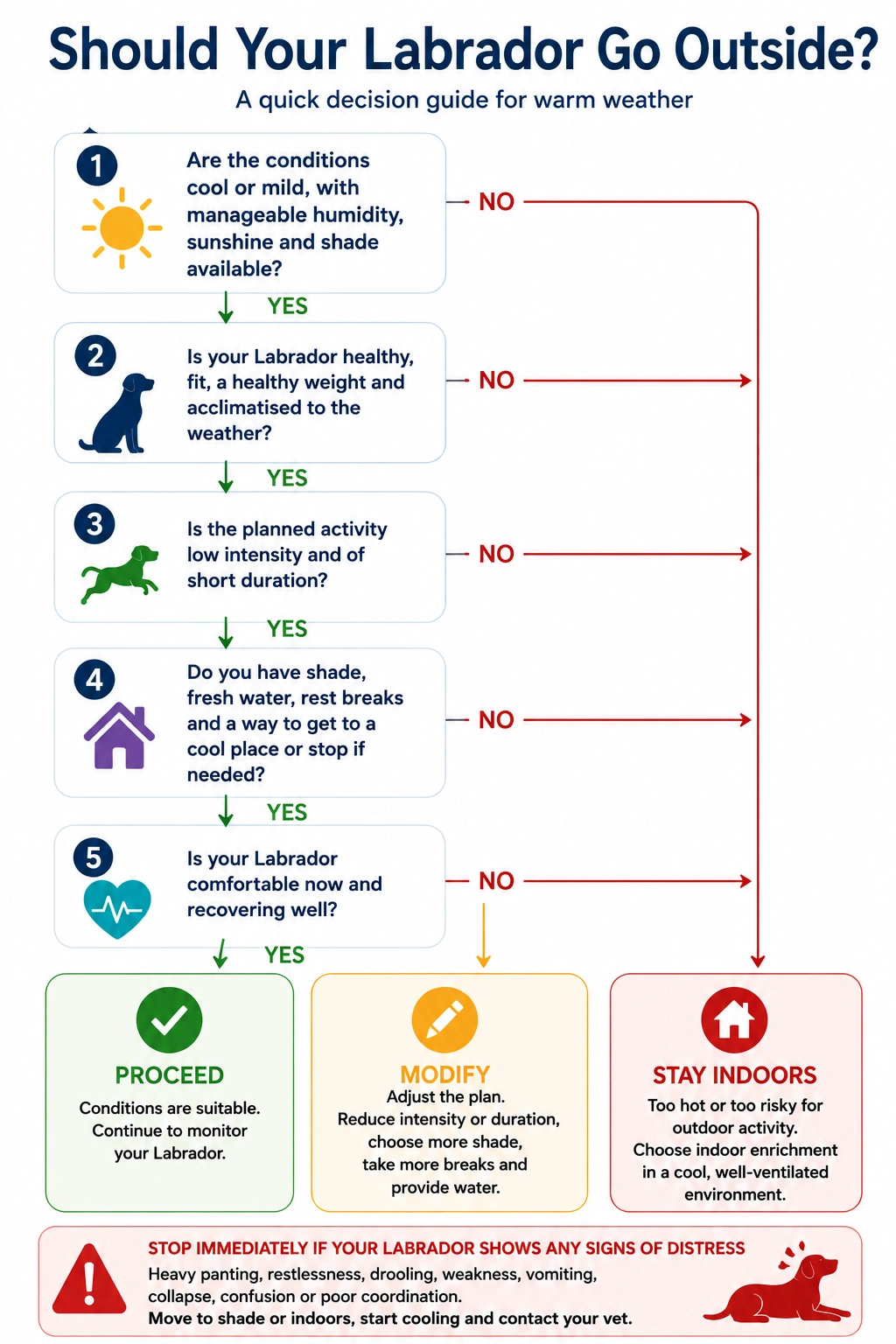
Check these five things before taking your Labrador outside
1. Conditions
Check:
- air temperature;
- humidity;
- direct sunshine;
- wind or still air;
- ground temperature.
2. Your Labrador
Consider:
- age;
- weight;
- fitness;
- health;
- acclimatisation;
- previous heat illness;
- how they have been behaving that day.
3. The planned activity
Distinguish between:
- a brief toilet break;
- a gentle sniffing walk;
- a longer walk;
- running;
- retrieving;
- swimming;
- working or sport.
4. Duration and escape options
Ask:
- How long will the dog be exposed?
- Is reliable shade available?
- Is fresh water available?
- Can we return to a cool indoor space immediately?
- Can I transport the dog if they become unwell?
5. Your Labrador’s response
Continue to watch:
- breathing;
- pace;
- willingness to move;
- coordination;
- behaviour;
- recovery during rest.
If conditions, the activity or your Labrador’s response create doubt, choose the safer option:
- shorten or modify the activity;
- move it to a cooler time;
- replace it with indoor enrichment;
- stop and cool the dog;
- contact a vet if heat-related illness is possible.
Frequently asked questions
Do black Labradors get hotter than yellow Labradors?
A dark coat may absorb more heat from direct sunshine, but coat colour does not create a reliable safe-temperature threshold. Sun exposure, activity, humidity, airflow, weight, health and individual response remain more important to the practical decision.
Every Labrador should have access to shade and should avoid strenuous exercise in direct hot sun.
Should you shave a Labrador in hot weather?
Routine shaving is not a substitute for managing temperature, exercise and the dog’s environment.
A Labrador’s coat provides protection as well as insulation, and shaving may alter how it grows back. Regular brushing can help remove loose undercoat, but speak to a vet or appropriately qualified groomer before clipping or shaving a Labrador for medical or welfare reasons.
Can a fan keep a Labrador cool?
A fan may improve airflow and can support other cooling measures. It cannot make a dangerously hot room, conservatory, vehicle or strenuous activity safe.
Your Labrador still needs a cooler environment, drinking water, restricted activity and supervision.
Can I give my Labrador ice cubes?
Small ice cubes may be offered to a healthy dog that enjoys them, provided they are an appropriate size and do not present a choking risk. They should not delay active cooling or veterinary care when heatstroke is suspected.
The key decision
There is no single temperature at which every Labrador suddenly becomes unsafe.
Use the temperature as a warning to assess the complete situation: humidity, sunshine, airflow, surface heat, activity, duration and the individual dog. Reduce activity before your Labrador starts struggling, and stop immediately if their breathing, movement, behaviour or recovery changes.
If heatstroke is possible, begin cooling at once and contact a vet. Do not wait for the most severe signs.