
There isn’t one humidity percentage that is safe for every dog. Humidity needs to be considered alongside temperature, exercise, direct sun, airflow, duration and the individual dog.
As humidity rises, panting becomes less effective at removing heat. That matters most when the weather is also warm or hot, your dog is exercising, or your dog already has characteristics that make cooling more difficult. Veterinary research supports humidity as an important heat-risk factor, but it does not give ordinary pet owners one reliable percentage that separates “safe” from “dangerous” conditions for every dog.
Cool Canine safety position: Don’t use the humidity percentage by itself to decide whether conditions are safe. Look at the temperature, humidity, activity, environment and your individual dog together.
Why does humidity make hot weather harder for dogs?
Dogs cannot rely on sweating over most of their body in the way humans can. As conditions become hotter, panting becomes increasingly important for evaporative cooling. Moisture evaporating from the respiratory tract helps carry heat away.
Humidity matters because evaporation becomes more difficult as the surrounding air contains more moisture. In hot and humid conditions, a dog therefore has less ability to lose excess heat through panting.
This does not mean that humidity suddenly becomes dangerous at one particular percentage. It means that higher humidity reduces part of the dog’s cooling capacity, so other sources of heat—particularly exercise and high air temperature—become harder to tolerate.
For a deeper explanation of the mechanism, see How Does Humidity Affect Dogs? for a closer look at what humid air does to canine heat regulation.
So what humidity is too high for a dog?
There is no evidence-based relative-humidity percentage that can be used as a universal danger line for all pet dogs.
That’s important because a figure such as 70% humidity tells you only part of the story.
Consider these very different situations:
| What you’re looking at | How useful it is for judging risk |
|---|---|
| Humidity alone | Not enough to decide |
| Temperature + humidity | More useful |
| Temperature + humidity + activity | Better |
| Temperature + humidity + activity + individual dog + sun and airflow | Best practical assessment |
For example, 70% humidity during cool weather while a dog is resting is a very different situation from 70% humidity on a warm afternoon while the same dog is running in direct sun.
Likewise, a young, healthy dog walking gently in shade cannot be assumed to have the same tolerance as a dog with compromised breathing, excess weight or another condition that makes heat regulation more difficult.
The sensible interpretation is therefore:
The higher the humidity becomes, the more cautious you should be as other heat-risk factors accumulate.
What about 60%, 70%, 80% or 90% humidity?
These numbers can tell you how humid the air is, but none of them works as a standalone dog-safety limit.
Is 60% humidity safe for dogs?
60% humidity is not automatically dangerous, but it is not automatically safe either.
At a mild temperature, with a dog resting in good ventilation, 60% relative humidity may present little heat concern. Put the same dog into warmer conditions, direct sunshine or vigorous exercise and the decision changes.
Instead of treating 60% as a green light, use it as one part of the weather picture.
Is 70% humidity too high for dogs?
Again, 70% is not a universal cut-off.
It does mean the air is relatively humid, so evaporative cooling through panting will be less favourable than under drier conditions. That deserves increasing attention as temperatures rise or activity becomes more strenuous.
A muggy day that does not look exceptionally hot on the thermometer can therefore still warrant a more conservative exercise plan.
Is 80% or 90% humidity dangerous for dogs?
Very high humidity deserves particular caution during warm or hot conditions.
A veterinary review of canine heatstroke reports that at high environmental temperatures, increasing relative humidity progressively compromises panting-based cooling, with very high humidity potentially severely limiting that mechanism.
But even that evidence should not be turned into a rule saying “80% is dangerous and 79% is safe”.
The study evidence concerns thermoregulation and heatstroke physiology, not a validated weather-app threshold that works for every pet dog.
The practical lesson is much simpler:
Very humid + warm or hot + active dog = a combination to take seriously.
Why doesn’t Cool Canine use 35% as the danger point?
You may see claims online that humidity above approximately 35% is dangerous for dogs.
The figure has some basis in veterinary literature, but the meaning is often overstated.
A veterinary heatstroke review reports that, when environmental temperatures are high, panting becomes progressively less effective as relative humidity rises beyond roughly 35%.
That does not mean:
- 34% humidity is safe;
- 36% humidity is dangerous;
- dogs should not exercise whenever humidity exceeds 35%;
- humidity alone predicts heatstroke.
It is a physiological observation about decreasing evaporative efficiency under hot conditions, not a clinical safety threshold for everyday dog owners.
That distinction matters. A precise-looking number can create false reassurance on one side of the line and unnecessary alarm on the other.
What about the “temperature plus humidity equals 140” rule?
Another rule you may encounter is to add the temperature in Fahrenheit to the relative humidity percentage.
For example:
80°F + 60% humidity = 140
Some trainers of working or hunting dogs use a total of around 140 as a reason to avoid strenuous exercise. South Dakota Game, Fish and Parks describes it specifically as a general rule of thumb used by some trainers and notes that it was developed around dogs in excellent physical condition.
The problem is that the calculation does not adequately account for:
- breed and skull shape;
- breathing problems;
- age;
- excess weight;
- health conditions;
- fitness;
- acclimatisation;
- direct sunlight;
- airflow;
- duration;
- exercise intensity.
Different versions of the rule also use different totals.
For those reasons, Cool Canine does not use 140—or any similar temperature-plus-humidity total—as a universal safety threshold.
It can serve as a reminder that temperature and humidity interact, but it cannot tell you that conditions below the number are definitely safe for your dog.
A better way to judge temperature and humidity for your dog
Rather than chasing one threshold, make the decision using five questions.
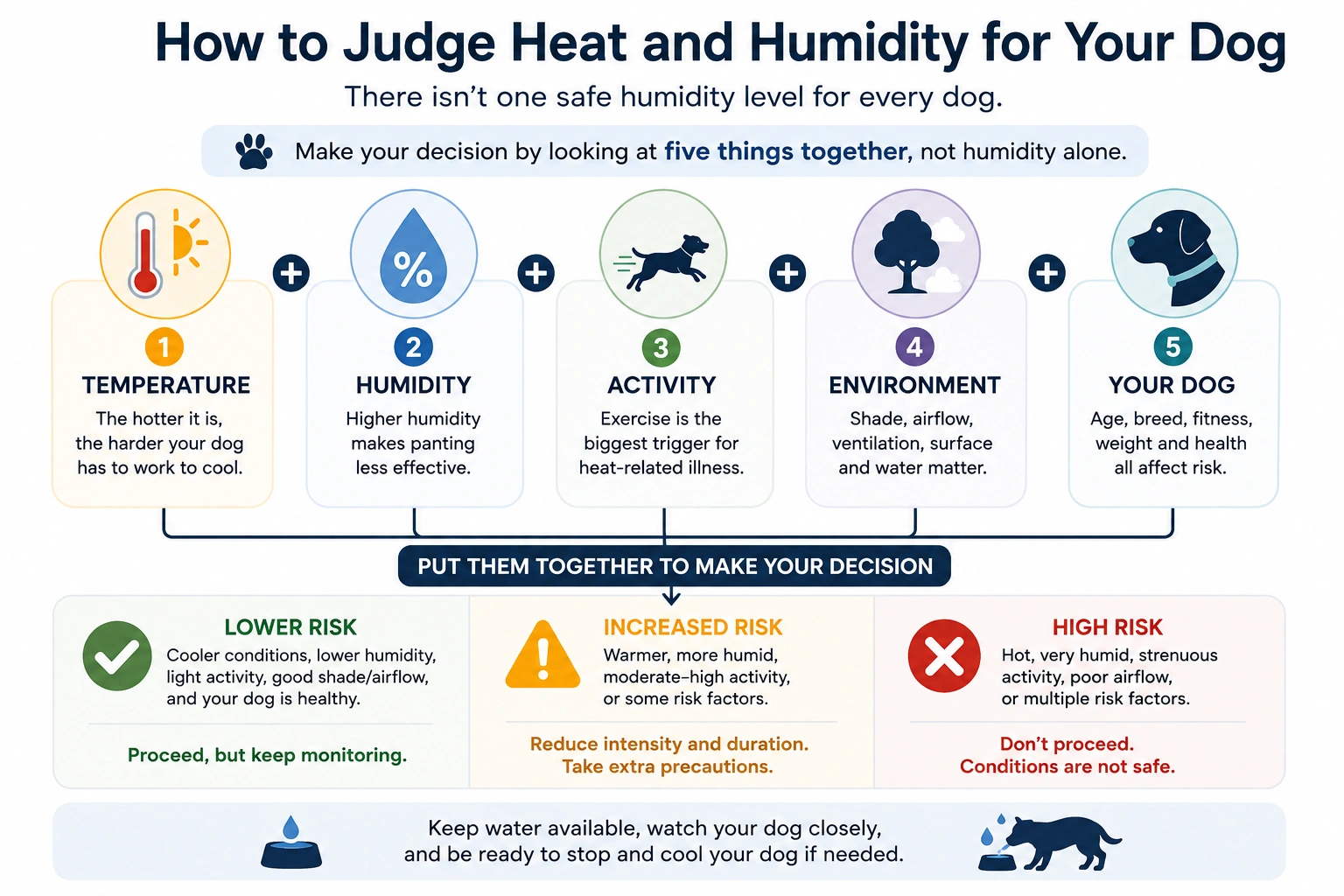
1. What is the temperature?
The hotter the air becomes, the harder your dog must work to lose excess body heat.
Temperature should never be ignored merely because the humidity looks modest.
Equally, a temperature that might normally cause relatively little concern can deserve more caution when the air is very humid.
2. How humid is it?
Use humidity as a risk multiplier.
If the humidity is rising, reduce the amount of reassurance you take from the air temperature alone.
Do not ask:
“Is 70% humidity safe?”
Ask:
“Given today’s temperature, 70% humidity, what my dog will be doing and my dog’s individual risk, does this still look sensible?”
3. What will your dog be doing?
Activity can dramatically change the heat load.
A dog lying quietly in a well-ventilated room produces far less additional heat than a dog running, playing fetch or walking briskly.
UK research using veterinary records has identified exercise as the most common trigger of canine heat-related illness, making activity one of the most important factors to consider.
That is why a forecast that seems acceptable for relaxing at home cannot automatically be used to justify strenuous exercise.
4. What is the environment like?
Consider the conditions immediately around the dog, not just the weather-app numbers.
Ask:
- Is the dog in direct sun or shade?
- Is there useful airflow?
- Is the space well ventilated?
- Will the dog be on hot pavement or another warm surface?
- Is drinking water readily available?
- How long will the exposure last?
- Can the dog stop and move somewhere cooler?
Good shade, ventilation and reduced activity can lower risk. Poor ventilation, direct sun and continued exercise move the decision in the opposite direction.
5. Which dog are you making the decision for?
There is no universal “average dog” on which a reliable humidity cut-off can be based.
Use a more conservative approach when your dog has factors that may make overheating more likely or cooling more difficult.
Which dogs need extra caution in humid weather?
Some dogs have less margin for coping with hot, humid conditions.
Current UK veterinary guidance identifies flat-faced dogs, overweight animals and dogs with relevant respiratory disease among those at increased risk of heatstroke. Some professional guidance also highlights thick-coated dogs.
Flat-faced dogs
Brachycephalic breeds such as French Bulldogs, Pugs and Bulldogs may already have restricted airflow because of their anatomy. Since panting is central to canine cooling, compromised breathing can make heat regulation more difficult.
This means a humidity level tolerated by another dog should not be assumed to be appropriate for a flat-faced dog.
Overweight or unfit dogs
Excess bodyweight and poor conditioning can increase the physical demand of exercise and reduce heat tolerance. Veterinary research has identified bodyweight and other individual characteristics as relevant to heat-related illness severity and risk.
Dogs with breathing or other relevant health problems
Dogs with respiratory disease deserve particular caution because effective breathing and panting are central to heat loss. BSAVA guidance identifies animals with lung disease as being at greater risk of heatstroke.
If your dog has an existing medical condition and you are unsure how heat or humidity affects their individual tolerance, ask your vet for dog-specific advice.
Older dogs
Age can also affect heat-related illness risk and outcome. Avoid assuming that a previously heat-tolerant dog will necessarily cope with the same conditions throughout life.
For a closer look at individual risk factors, see Dog Breeds Most at Risk of Heatstroke.
Is it safe to walk a dog when the humidity is high?
Sometimes—but high humidity should make you more conservative about warm-weather exercise.
Don’t make the decision from humidity alone. Check:
- the current and expected temperature;
- humidity;
- direct sunshine;
- airflow;
- the intensity and duration of the walk;
- whether your dog belongs to a higher-risk group;
- how your dog is behaving.
If several risk factors are stacking up, the safest answer may be to shorten the walk, choose a gentler activity or skip strenuous exercise entirely.
For the broader decision about whether current conditions are suitable, see Is It Too Hot to Walk My Dog? For detailed advice specifically about muggy conditions, see Walking Dogs in High Humidity.
Remember that skipping or shortening one walk is not harmful to your dog’s wellbeing. On an unsuitable day, calm indoor enrichment is a reasonable alternative to pushing ahead with exercise.
Does the time of day solve the humidity problem?
Not necessarily.
Early mornings and evenings are often cooler, which can make them better times for summer exercise. Current BSAVA guidance recommends cooler parts of the day and avoiding exercise during extreme heat.
But temperature is only one factor.
An early morning can be noticeably cooler yet extremely humid. If the air is muggy and your dog is vulnerable or the planned exercise is strenuous, don’t assume the clock makes the conditions safe.
Check the actual weather and your dog rather than relying on “morning equals safe”.
Can a fan help when it is humid?
A fan can be useful because moving air can support heat loss and can help water evaporate during active cooling. Current UK heatstroke advice specifically includes moving air as part of cooling after the dog’s coat has been wetted.
But a fan does not make dangerous heat exposure safe.
It should support a sensible cooling environment, not become a reason to keep a dog exercising, leave them somewhere hot or ignore signs of overheating.
See Are Fans Safe for Dogs? for the full guidance on when fans help, their limitations and how to use them safely.
What should I do if my dog seems too hot?
Stop the activity or heat exposure immediately.
Do not spend time checking whether the humidity has crossed a particular percentage. Once the dog is showing concerning signs, the dog matters more than the forecast.
If you suspect heatstroke
- Stop further heating. Move the dog out of the hot environment or stop the exercise.
- Start cooling promptly. Current RSPCA and BSAVA guidance advises wetting the dog with available water that is cooler than the dog’s body rather than delaying while searching for an “ideal” water temperature.
- Use moving air where appropriate. A fan, breeze or air conditioning can support cooling after wetting.
- Contact your vet. Suspected heatstroke needs veterinary advice and may require emergency treatment.
- Continue safe cooling during transport where practical, using a cool, well-ventilated vehicle.
For young, healthy and conscious dogs, current BSAVA and RSPCA guidance allows cold-water immersion while keeping the dog’s head above water. For older dogs or dogs with underlying health problems, pouring water over the body with airflow is advised instead.
Do not wrap an overheated dog in wet towels. A covering can trap heat against the body instead of allowing it to escape.
For complete guidance on recognising and responding to heatstroke, see Dog Heatstroke: Symptoms, Treatment & Prevention.
What are the warning signs that my dog is overheating?
Dogs do not all progress through heat illness in exactly the same way, so don’t wait for every symptom to appear.
Important signs can include:
Early or concerning signs
- unusually heavy or persistent panting;
- restlessness or agitation;
- excessive drooling;
- seeking water or shade;
- difficulty or reluctance continuing exercise;
- red gums or tongue;
- increasingly noisy or distressed breathing.
More serious warning signs
- weakness;
- poor coordination or wobbliness;
- vomiting or diarrhoea;
- confusion or disorientation;
- collapse;
- seizures;
- loss of consciousness.
These signs are consistent with current RVC, RSPCA and BSAVA heatstroke guidance.
Some of them can occur for reasons other than heatstroke, so this list cannot diagnose your dog. However, if heat exposure or exercise has occurred and heatstroke is a possibility, start safe cooling and seek veterinary advice rather than waiting for the situation to worsen.
How to reduce humidity-related heat risk
You do not need a complicated formula to make safer decisions.
Check both temperature and humidity
Don’t stop after looking at the day’s maximum temperature. Check humidity as well, particularly around the time when your dog will actually be outside.
Reduce exercise when the combination looks unfavourable
Warm weather, high humidity and vigorous activity can create far greater risk together than any one factor considered separately.
When several risk factors are present, reduce duration and intensity—or choose something else.
Prioritise shade and ventilation
Keep resting areas cool, shaded and well ventilated. Current BSAVA guidance specifically recommends access to cool, shaded, well-ventilated areas during warm weather.
Keep drinking water available
Dogs should have ready access to clean drinking water. Don’t rely on waiting until your dog appears obviously thirsty or overheated.
Watch the dog, not just the weather
Weather data helps you avoid bad decisions before exposure begins.
It does not replace observation.
If your dog is panting unusually hard, slowing down, seeking shade, refusing to continue or otherwise behaving differently, respond to the dog even if the forecast numbers looked acceptable.
Be more conservative with higher-risk dogs
If your dog has a flat face, excess weight, breathing difficulties, relevant health problems or reduced heat tolerance, give them a larger safety margin.
The absence of a universal cut-off does not mean that anything goes. It means sensible decisions need to be individualised.
Can swimming cool a dog in humid weather?
Water can help a dog cool down, but swimming should not be treated as a way to make otherwise unsafe hot-weather exercise acceptable.
Swimming creates its own risks, including fatigue, water quality, water ingestion and difficulty exiting the water.
Pools also require supervision and sensible water safety. If your dog uses a pool during warm weather, see Are Swimming Pools Safe for Dogs? for the separate risks and precautions.
Cooling and swimming are therefore two different questions:
- Can water remove heat? Yes.
- Does having access to water make hot, humid conditions automatically safe? No.
What humidity is safe for dogs? The bottom line
There is no single safe humidity level for every dog.
Humidity becomes increasingly important as temperature, activity and individual vulnerability rise because humid air makes evaporative cooling through panting less effective.
Instead of looking for a magic percentage, consider:
temperature + humidity + activity + environment + your dog.
If several risk factors are accumulating, make the more conservative choice.
And if your dog is already showing signs of overheating, stop worrying about the weather numbers: stop the activity, start safe cooling and contact a vet if heatstroke is suspected.