
There is no single outdoor temperature that is safe for every dog.
Whether it is too hot to walk your dog depends on the weather, direct sunlight, humidity, ground temperature, the type of exercise you are planning and your dog’s individual ability to cope with heat.
A healthy dog may manage a short, gentle walk in conditions that would be unsafe for a flat-faced, elderly, overweight or unwell dog. Equally, a temperature that looks fairly mild on a weather app may still be risky if the sun is strong, the pavement is hot or your dog will be running and playing.
When you are uncertain, shortening, changing or postponing the walk is safer than testing how much heat your dog can tolerate.
Possible heat-related illness is an emergency
Stop exercising immediately if your dog develops unusually heavy panting, breathing difficulty, weakness, confusion, poor coordination, vomiting, collapse or another concerning change.
Move them away from the heat, begin cooling them with water that is cooler than their body, create airflow and contact a vet urgently. Current welfare guidance recommends cool first, transport second rather than delaying cooling until you reach the veterinary practice.
Should I walk my dog right now?
Use the following as a cautious starting point rather than a guarantee of safety.
| Situation | Safer decision |
|---|---|
| Conditions are mild, the surface is cool, your dog has no obvious increased risk and the planned exercise is gentle | A carefully monitored walk may be reasonable |
| Conditions are becoming warm, but there is good shade, cool ground and an easy route home | Shorten the walk, reduce the pace and stay close to home |
| It is sunny, humid or poorly ventilated, the ground is warm or your dog is particularly vulnerable | Restrict the outing to essential toileting or postpone it |
| There is an official heat warning, very hot ground, little shade or your dog is already struggling with the heat | Do not take the planned walk |
| Your dog shows any possible sign of overheating | Stop immediately, begin cooling and contact a vet |
A weather-app temperature cannot give a personalised yes-or-no answer. You need to check your dog, the conditions, the route and the activity together.
There is no single safe dog-walking temperature
Temperature charts can look reassuringly precise, but they cannot account for every dog or every walking situation.
Air temperature is only one part of your dog’s total heat exposure. Direct sunlight, humidity, wind, warm ground, route length and exercise intensity can all change the risk.
Dogs also vary considerably in their ability to lose heat. Puppies, older dogs, flat-faced breeds, overweight dogs and dogs with breathing or heart problems may struggle in conditions that a healthy, acclimatised dog manages more comfortably.
Exercise itself is particularly important. UK research found that exertion or exercise was responsible for around three-quarters of recorded canine heatstroke cases in the study population. Walking, playing and running can all generate substantial internal heat, even when the weather is not exceptionally hot.
Dogs Trust therefore advises that there is no simple answer to the question of when it is too hot to walk a dog and notes that dogs can overheat at any time of year.
Why a temperature chart cannot give a personalised answer
A chart may be useful as a cautious prompt to think about risk, but it should not be treated as veterinary clearance.
Two dogs walking in the same air temperature may experience very different levels of strain.
For example:
- one dog may be young, lean, healthy and walking slowly in shade;
- another may be an older French Bulldog walking on sun-exposed tarmac;
- one route may have a cool breeze and easy access to water;
- another may be humid, sheltered and difficult to leave quickly;
- one outing may be a five-minute toilet break;
- another may involve running, ball chasing or a long uphill walk.
The forecast number is therefore the beginning of the decision, not the decision itself.
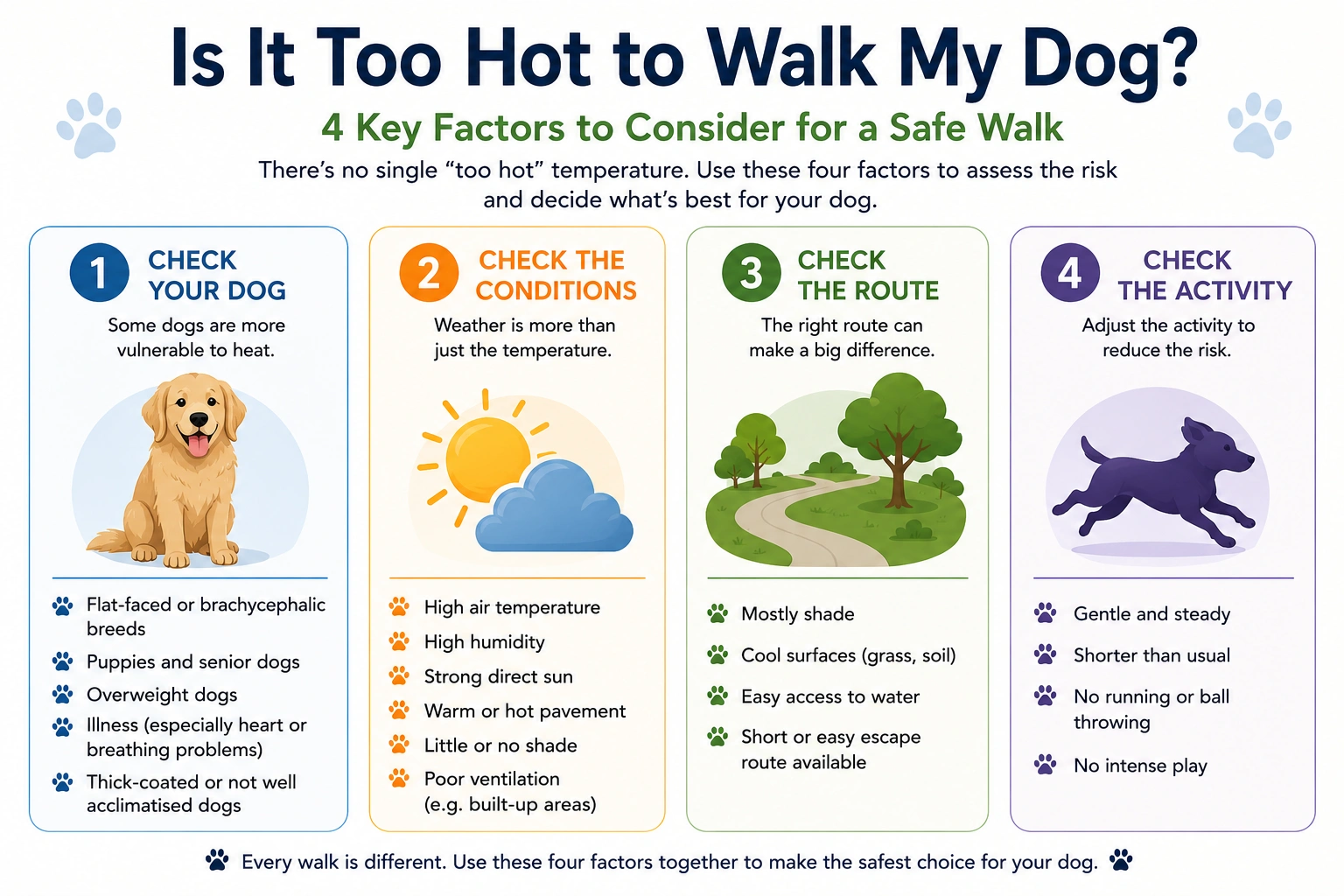
Use this four-part check before deciding to walk
1. Check your dog’s individual risk
Any dog can develop heat-related illness, but some dogs need greater caution.
Risk may be higher in dogs that are:
- flat-faced or brachycephalic;
- very young or elderly;
- overweight or poorly conditioned;
- large or heavily built;
- thick-coated;
- affected by heart, breathing or other relevant health problems;
- dehydrated or already unwell;
- unaccustomed to the current temperature;
- highly energetic or reluctant to stop exercising.
Flat-faced dogs have shortened airways and may be less effective at losing heat through panting. The RSPCA specifically advises avoiding walks on hot days for these dogs or choosing a much cooler period and monitoring carefully.
Owners of particularly vulnerable breeds should use the general decision process in this guide and then apply the more specific advice in when it is too hot to walk a French Bulldog or when it is too hot to walk a Labrador.
A dog’s enthusiasm is not proof that a walk is safe. Some dogs will continue running, playing or following their owner after they have started accumulating dangerous levels of heat.
2. Check more than the forecast temperature
Before leaving, consider:
- the current air temperature;
- whether the temperature is rising or falling;
- direct sun and reflected heat;
- humidity;
- wind and airflow;
- how hot the previous few hours have been;
- whether your route is shaded or exposed;
- any current UK heat-health warnings.
Humidity matters because dogs rely heavily on panting to lose heat. When the surrounding air is humid, evaporation becomes less effective, so a dog may struggle in conditions that do not look exceptionally hot on the thermometer. Dogs Trust specifically notes that panting is less efficient in humid weather.
For more detailed advice on this particular risk, see Walking Dogs Safely in High Humidity
Sustained heatwave conditions also deserve extra caution. Royal Veterinary College research using UK emergency-care records found that heat-related illness cases were considerably more frequent during recognised heatwave periods and UK heat-health alert days.
During these periods, use the dedicated guidance on walking your dog during a heatwave rather than treating each day as an ordinary warm-weather walk.
Shade can reduce direct radiant heat, but it does not automatically make a walk safe. The air may still be hot and humid, the ground may retain heat, and exercise will continue generating internal heat. Read more about why shade alone may not be enough before relying on a shaded route as your main safety measure.
3. Check the ground and the route
A dog can face two separate risks on a hot walk:
- whole-body overheating;
- pain or burns from a hot walking surface.
Tarmac, paving and other hard surfaces exposed to sunlight can become considerably hotter than the surrounding air.
Dogs Trust recommends placing your hand on the tarmac for five seconds. If it is too hot for your hand, postpone the walk until the surface has cooled.
This is a useful screening check, but it is not a complete safety test. A pavement that feels tolerable does not prove that the air temperature, humidity or exercise will be safe for your dog.
When assessing the route, ask:
- Is there continuous shade or only occasional patches?
- Can the dog walk on cooler grass rather than exposed paving?
- Is there water available?
- Can we turn back quickly?
- Are there steep sections?
- Is the route longer than necessary?
- Will the dog become excited by people, wildlife, balls or other dogs?
For a detailed surface-risk assessment, see when pavement is too hot for a dog’s paws.
4. Check the activity you are planning
Not all outings create the same heat load.
A short, slow toilet break is very different from:
- a brisk lead walk;
- off-lead running;
- ball chasing;
- running beside a bicycle;
- hiking;
- agility;
- rough play with other dogs.
Muscle activity produces heat. The harder and longer your dog works, the more heat their body must lose.
This is one reason exercise is such an important trigger for canine heat-related illness. In very warm weather, even an activity your dog normally handles easily may become inappropriate.
If a walk remains reasonable, keep it calm, slow and easy to stop. For practical advice on adapting the walk itself, see Walking Your Dog in Hot Weather Safely.
Quick Decision Flowchart
If you’re still unsure, use this quick decision flowchart to work through the key questions before deciding whether to walk your dog.

Is 22°C too hot to walk a dog?
A temperature of 22°C is not automatically safe or automatically too hot for every dog.
For a healthy, acclimatised dog with no obvious increased risk, a short and gentle early-morning walk on cool ground may be reasonable at 22°C.
The same temperature may be inappropriate when:
- the dog is flat-faced, elderly, overweight or unwell;
- humidity is high;
- the sun is strong;
- the route is exposed;
- the pavement has been heating for several hours;
- the dog will run, play or walk briskly;
- there is little airflow;
- the dog is not acclimatised to warm conditions.
An early-morning temperature of 22°C after a cooler night is not equivalent to 22°C in the evening after a day of intense sunshine. The air reading may be similar while ground and radiant heat are very different.
Do not use 22°C as an automatic green light. Apply the four-part check and consider the individual dog in front of you.
When should you shorten, change or skip the walk?
A normal but monitored walk may be reasonable when
- the conditions are genuinely mild;
- the dog is healthy and coping normally;
- the ground is cool;
- the route has reliable shade;
- the outing will be calm and moderate;
- you can return home easily;
- there are no heat warnings or other concerning factors.
Continue watching your dog throughout the outing. Conditions and behaviour can change.
Modify the walk when risk is beginning to increase
Possible changes include:
- making the walk much shorter;
- slowing the pace;
- staying close to home;
- choosing a cooler, shaded route;
- avoiding steep ground;
- keeping the dog on lead to prevent running;
- removing ball games and vigorous play;
- using the outing only for toileting and sniffing.
Water is useful, but carrying a bottle does not make an unsafe walk safe.
Postpone the walk when the combined risk is too high
Postponing is usually the safer decision when:
- the ground is hot;
- the sun is intense and shade is limited;
- the air is hot or humid;
- there is an official heat warning;
- the route cannot be shortened easily;
- your dog has significant individual risk factors;
- your dog is already panting unusually before leaving;
- the planned activity cannot be kept calm;
- you are unsure whether your dog can cope.
Missing or shortening one normal walk is safer than exposing a dog to preventable heat-related illness.
The safest time is not always simply “the evening”
Early morning is often the most reliable time for a summer walk because the surroundings have had several hours to cool.
An evening walk may be cooler than the middle of the day, but tarmac, walls and buildings can retain heat after the air temperature begins to fall.
Before choosing a time, check:
- the actual temperature;
- recent sunshine;
- pavement temperature;
- humidity;
- airflow;
- the amount of shade on the route.
Do not rely solely on the clock.
For a more detailed comparison, see the best time to walk your dog in hot weather.
Watch your dog throughout the walk
Do not wait for collapse before taking action.
Possible early or developing warning signs include:
- unusually heavy or persistent panting;
- noisy or difficult breathing;
- excessive drooling;
- slowing down;
- reluctance to continue;
- repeatedly seeking shade;
- lying down unexpectedly;
- weakness;
- agitation or distress;
- poor coordination;
- confusion;
- vomiting or diarrhoea.
More severe signs can include collapse, seizures or loss of consciousness.
A single sign does not allow you to diagnose heatstroke yourself, but a concerning change during warm-weather exercise is enough reason to stop.
What to do if your dog appears to be overheating
- Stop the exercise immediately.
- Move the dog away from direct heat and into shade or a cooler place.
- Begin cooling straight away.
- Use water that is cooler than the dog’s body and create airflow.
- Contact a vet urgently and follow their instructions.
- Transport the dog in a cool, well-ventilated vehicle while continuing cooling where practical.
Do not cover an overheating dog with a wet towel. This can trap heat. Current RSPCA guidance supports pouring or applying cooler water to the dog and creating airflow rather than wrapping the body.
The complete guide to signs of heatstroke and what to do explains symptoms, cooling and veterinary escalation in greater depth.
What can your dog do when it is too hot for a normal walk?
A postponed walk does not mean your dog must have no activity at all.
Depending on the indoor temperature and your dog’s health, suitable alternatives may include:
- scent games;
- searching for scattered food;
- short calm training sessions;
- puzzle feeding;
- supervised licking or chewing activities;
- gentle indoor play;
- practising settling and relaxation;
- moving the main walk to a cooler time.
Avoid replacing a cancelled walk with frantic indoor exercise in a hot room. Vigorous play still generates body heat.
A brief toilet outing may still be necessary, but keep it short, choose the coolest available surface and return indoors promptly.
For more alternatives for maintaining appropriate physical activity and enrichment, see How to Exercise Your Dog Safely in Hot Weather.
Final walk-or-wait checklist
Before attaching the lead, ask:
- Have I considered my dog’s breed, age, weight, health and fitness?
- Have I checked temperature, humidity, direct sun and airflow?
- Is there a current heat-health warning?
- Has the ground had time to cool?
- Is the route genuinely shaded and easy to leave?
- Can I shorten the walk?
- Can I prevent running and vigorous play?
- Is my dog calm and breathing normally?
- Am I prepared to stop at the first concerning sign?
- Would postponing be the safer choice?
When several risk factors are present at the same time, do not let one reassuring factor—such as shade, water or a cooler forecast number—override the overall picture.
The safest decision when you are unsure
There is no magic temperature that makes every dog walk safe.
Make the decision by checking:
- your individual dog;
- the weather;
- the surface and route;
- the planned activity.
If the combination looks questionable, shorten, alter or postpone the walk rather than testing your dog’s tolerance.
If your dog develops possible signs of overheating, stop immediately, begin cooling and contact a vet.