
Dogs can get sunburn, particularly on lightly pigmented, thinly haired or exposed areas of skin. The nose, ear tips, eyelids and tummy are among the areas most likely to be affected.
Possible signs include redness, tenderness, itching, flaking, crusting and, in more serious cases, swelling or blisters. Move your dog out of direct sunlight if you suspect sunburn and contact your vet promptly if the skin is painful, blistered, broken, widespread, worsening or not healing normally.
Sunburn can look similar to allergies, infection and other skin conditions, so do not assume that every red or crusted patch is caused by the sun.
Think your dog may be sunburnt?
- Move them indoors or into reliable shade.
- Prevent any further direct sunlight.
- Gently hold a cool, damp cloth against the affected skin if your dog tolerates it.
- Do not put ice directly on the skin.
- Do not apply creams, medicines or home remedies unless your vet has confirmed they are suitable.
- Contact your vet immediately if your dog is in significant pain or has blisters, swelling, open skin or a large affected area.
Can Dogs Get Sunburn?
Yes. A dog’s coat provides some natural protection from ultraviolet radiation, but it does not cover or protect every part of the body equally.
Areas with very short, sparse or missing fur are more exposed. Lightly pigmented skin is also generally more vulnerable than darkly pigmented skin.
A dog does not need to feel dangerously hot to suffer ultraviolet skin damage. Sunburn and heatstroke are different problems:
- Sunburn is damage to the skin caused by ultraviolet exposure.
- Heatstroke happens when the dog’s body temperature rises to a dangerous level.
They can occur during the same outing, but one does not necessarily mean the other is present.
Why Fur Does Not Protect Every Part of a Dog
The amount of protection offered by fur varies according to:
- coat thickness;
- coat length;
- skin pigmentation;
- whether the coat has been clipped;
- hair loss caused by illness or injury;
- scars or recently operated areas;
- the part of the body exposed.
Even a thick-coated dog may have vulnerable skin around the nose, eyes, ears and underside.
Where Dogs Are Most Likely to Burn
The areas most often affected include:
- the nose and muzzle;
- the tips and inner surfaces of the ears;
- the eyelids and skin around the eyes;
- the lips;
- the belly and groin;
- the inner thighs;
- thinly haired parts of the chest;
- bald patches;
- scars;
- recently clipped or shaved areas.
PDSA identifies the ears, nose, eyelids and tummy as common locations for sunburn in pets.
What Does Dog Sunburn Look Like?
Dog sunburn may begin as mildly pink, red or tender skin. The appearance can be difficult to judge on darkly pigmented skin, so changes in behaviour and texture may be just as important as colour.
Possible signs include:
- pinkness or redness;
- warmer-than-normal skin;
- tenderness;
- itching;
- increased licking or scratching;
- dry or flaky skin;
- peeling;
- crusting or scabbing;
- swelling;
- blisters;
- raw, weeping or broken skin;
- reluctance to have the area touched.
| What you notice | What it may mean | Safest next step |
|---|---|---|
| Mild redness, warmth or sensitivity | Possible mild irritation or sunburn | End sun exposure, protect the skin and monitor closely |
| Flaking, crusting or persistent licking | More significant irritation that may need assessment | Contact your vet for advice |
| Blisters, swelling, open skin or marked pain | A potentially serious burn | Arrange prompt veterinary assessment |
| A persistent sore, scab or ulcer | Sun damage or another skin condition may be present | Ask your vet to examine it |
Mild Signs of Sunburn
A mild case may cause:
- limited redness;
- slight sensitivity;
- mild dryness or flaking;
- occasional licking of the area.
Even apparently mild skin damage should be protected from further sunlight while it heals.
Signs That May Indicate a More Serious Burn
Contact your vet promptly if you notice:
- marked pain;
- extensive redness;
- significant swelling;
- blisters;
- open or weeping skin;
- bleeding;
- a large affected area;
- worsening rather than improving;
- signs of infection such as discharge or an unpleasant smell.
Behavioural Signs That Your Dog Is Uncomfortable
A dog with painful or irritated skin may:
- pull away when touched;
- repeatedly lick or scratch;
- seem restless;
- have difficulty settling;
- avoid lying on the affected area;
- appear quieter than usual.
These behaviours are not specific to sunburn, but they suggest that the skin is causing discomfort and deserves closer attention.
What Should You Do If Your Dog Has Sunburn?
The first priority is to end the ultraviolet exposure and protect the damaged area.
Move Your Dog Out of the Sun
Bring your dog indoors or into dependable shade. Do not allow them to continue sunbathing or remain outside simply because the air feels cool.
Keep the affected area out of direct sunlight until it has healed.
Cool the Area Gently Without Using Ice
A cool, damp compress may soothe mildly irritated skin. Hold it gently against the area rather than rubbing.
Do not:
- place ice directly against the skin;
- use iced water;
- scrub the area;
- burst blisters;
- apply heat.
PDSA advises using a cold or cool compress for mild sunburn but warns against placing ice directly on the skin.
Stop Licking, Scratching and Further Damage
Licking and scratching can make damaged skin more inflamed and may introduce infection.
Supervise your dog closely. Your vet may advise using a suitable protective collar or garment if your dog cannot leave the area alone.
Do not cover a burn tightly or put clothing over broken or weeping skin unless your vet has advised it.
Avoid Unapproved Creams, Medicines and Home Remedies
Do not give your dog human painkillers. Some commonly used human medicines can be dangerous to dogs.
Avoid applying products such as:
- human after-sun;
- medicated creams;
- hydrocortisone;
- antiseptics;
- essential oils;
- petroleum jelly;
- aloe products;
- coconut oil;
- zinc-based creams.
A product that seems soothing may irritate the skin, interfere with veterinary examination or cause harm if your dog licks it.
Do not apply any treatment to painful, blistered or broken skin unless your vet has confirmed it is appropriate.
When Should You Contact a Vet?
Seek veterinary advice promptly when:
- the burn is blistered;
- the skin is broken, bleeding or weeping;
- the affected area is extensive;
- your dog appears to be in significant pain;
- the eyelids or area close to the eyes are affected;
- there is marked swelling;
- your dog will not stop licking or scratching;
- the skin smells unpleasant or produces discharge;
- the condition is worsening;
- the area is not healing normally;
- you are not sure whether the problem is sunburn;
- your dog has an existing skin condition;
- your dog takes medication that may increase sensitivity to sunlight.
PDSA recommends immediate veterinary advice for severe burns or when a pet appears to be in pain. Veterinary treatment may include pain relief, anti-inflammatory medication, dressings, fluids or antibiotics where clinically appropriate.
When Sunburn-Like Symptoms May Be Another Skin Condition
Red, flaky, crusted or sore skin can have many causes, including:
- allergies;
- bacterial or fungal infection;
- parasites;
- autoimmune disease;
- contact irritation;
- trauma;
- photosensitisation;
- skin tumours.
A persistent crust or sore on the nose should not automatically be labelled as sunburn. Merck Veterinary Manual notes that nasal solar dermatitis can resemble several other nasal skin diseases and may require veterinary investigation.
Watch for Signs of Heatstroke as Well
Sunburn usually causes a localised skin problem. Whole-body illness may indicate the signs of heatstroke rather than simple sunburn and requires urgent action.
Contact a vet urgently if your dog develops signs such as:
- excessive or distressed panting;
- weakness;
- confusion;
- vomiting or diarrhoea;
- collapse;
- seizures;
- loss of coordination.
Move the dog out of the heat and begin appropriate cooling while arranging emergency veterinary help.
If vomiting or drooling happens specifically during car journeys without signs of overheating, car sickness in dogs can be another possible explanation.
Which Dogs Are Most at Risk of Sunburn?
Any dog can suffer sun damage, but risk is higher when the skin has less natural protection.
Dogs With White or Lightly Pigmented Skin
White fur often grows over pale skin, particularly around the ears, nose and underside. These lightly pigmented areas may be more vulnerable to ultraviolet damage.
A dog can also have isolated white or pink areas even when most of the coat is dark.
Hairless, Thin-Coated or Closely Clipped Dogs
Risk may be higher in dogs with:
- naturally hairless skin;
- a sparse or fine coat;
- areas of hair loss;
- a coat clipped unusually short;
- shaved areas following surgery or treatment.
Avoid shaving a dog’s coat solely to keep them cool unless there is a veterinary or grooming reason. The coat may provide some protection against both sunlight and physical injury.
Dogs With Bald Patches, Scars or Exposed Skin
Skin exposed by:
- alopecia;
- dermatitis;
- injury;
- surgery;
- scarring;
- repeated rubbing;
may need additional protection while outdoors.
Dogs With Medical or Medication-Related Sensitivity
Certain illnesses, chemicals, plants and medicines can make skin react abnormally to sunlight. This is known as photosensitisation and is not the same as ordinary sunburn.
Merck explains that photosensitisation may occur because of particular substances or underlying illness, including liver disease. Any unusual or severe reaction following sun exposure should therefore be assessed by a vet.
Which Parts of a Dog Burn Most Easily?
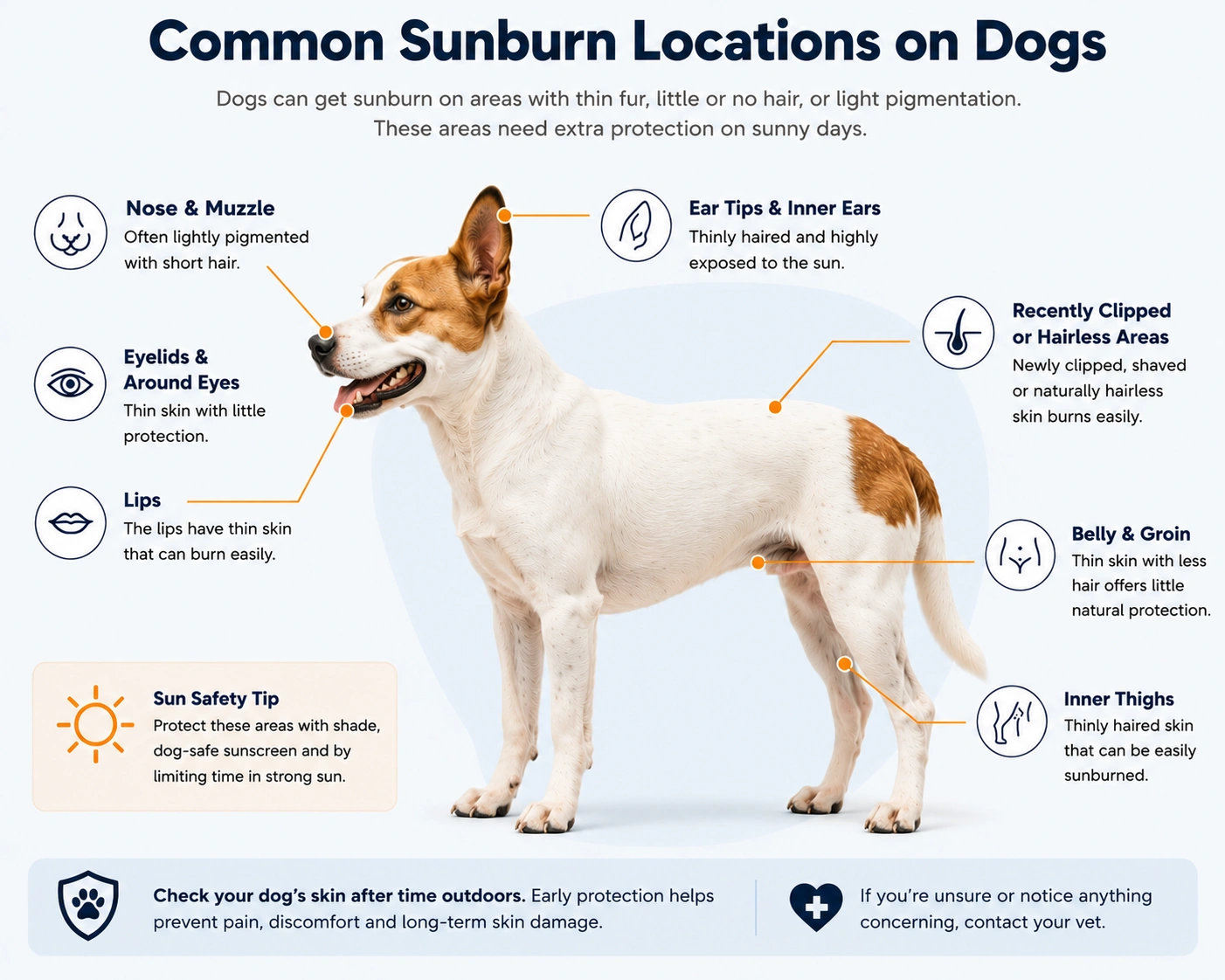
Nose and Muzzle
The nose and surrounding muzzle may have little or no hair protection. Pale or partially pigmented noses may be particularly exposed.
However, persistent crusting, sores, colour changes or ulcers on the nose need veterinary assessment because several conditions can cause a similar appearance.
Ear Tips and Eyelids
The ear tips often have thin skin and limited hair coverage. Eyelids and surrounding skin may also be exposed, especially in dogs with light facial markings.
Do not apply sunscreen close to the eyes unless the product instructions specifically allow it and your vet has advised you how to use it safely.
Belly, Groin and Other Sparsely Haired Areas
Dogs that lie on their backs or sides in direct sunlight may expose the relatively hairless skin of the belly, groin and inner thighs.
These areas can also be overlooked when sunscreen or clothing is considered.
Clipped, Scarred or Hairless Areas
Recently clipped skin, surgical sites, scars and areas affected by hair loss may be much less protected than the surrounding coat.
Ask your vet how long healing or vulnerable skin should be kept out of direct sunlight.
How Is Dog Sunburn Treated?
Treatment depends on the extent and severity of the damage and whether another skin condition is present.
Supportive Care for a Mild Suspected Case
For a small area of mild redness or sensitivity:
- end all further sun exposure;
- keep the dog indoors or properly shaded;
- apply a cool damp compress if comfortable;
- prevent licking and scratching;
- monitor the area closely;
- contact your vet if you are uncertain.
Mild-looking skin damage should improve rather than worsen. Seek advice if redness, pain or irritation persists.
For step-by-step guidance on what to do at home, what not to put on burnt skin and when veterinary care is needed, see our guide to how to treat dog sunburn safely.
Veterinary Treatment for a More Serious Burn
A vet may need to:
- assess the depth and extent of the injury;
- prescribe safe pain relief;
- control inflammation;
- clean and dress damaged skin;
- treat infection;
- manage fluid loss in a serious case;
- investigate another suspected skin disease;
- take samples or perform a biopsy when a lesion is persistent or unusual.
Never use leftover veterinary medication from a previous condition.
How Long Does Dog Sunburn Take to Heal?
A mild burn may settle within several days once protected from further sunlight. More serious skin damage can take much longer and may require repeated veterinary treatment.
Monitor for:
- increasing redness;
- spreading inflammation;
- discharge;
- odour;
- worsening pain;
- persistent licking;
- failure to heal.
A sore that repeatedly returns or remains present should be examined rather than repeatedly treated as ordinary sunburn.
How to Prevent Dog Sunburn
The most reliable approach is to reduce the dog’s ultraviolet exposure rather than relying entirely on a product.
Avoid the Strongest Sun and Provide Reliable Shade
Plan outdoor time for earlier or later in the day when practical.
Provide shade that:
- covers the dog fully;
- remains available as the sun moves;
- has good airflow;
- gives the dog space to move away;
- does not become a hot enclosed area.
Do not assume that a parasol, tree or small shaded patch makes prolonged outdoor exposure safe.
Use Dog-Appropriate Sunscreen Where Suitable
Sunscreen may be useful on exposed, vulnerable areas such as:
- pale ear tips;
- lightly pigmented areas of the nose or muzzle;
- sparse or hairless skin;
- the belly;
- clipped areas.
Use a product specifically described as suitable for dogs or one recommended by your vet.
Follow the product instructions regarding:
- where it can be applied;
- how much to use;
- how long before exposure it should be applied;
- reapplication;
- water resistance;
- preventing licking.
RSPCA advises using pet-safe sunscreen on exposed areas such as the ear tips and nose.
Do not assume a sunscreen made for people is safe for your dog.
Dogs may lick the product, and human formulations may contain ingredients that are unsuitable if swallowed. Choose a dog-appropriate product or ask your vet for guidance.
Contact your vet or a veterinary poison service promptly if your dog swallows sunscreen and you are concerned about the ingredients or quantity.
Consider UV-Protective Clothing for Selected Dogs
Sun-protective clothing may help dogs with large vulnerable areas, including some hairless, thin-coated or recently clipped dogs.
The garment should:
- fit correctly;
- allow unrestricted movement;
- avoid rubbing;
- allow ventilation;
- remain dry and comfortable;
- not cause overheating.
Clothing supplements shade and sensible exposure management; it does not make prolonged time in strong sun risk-free.
Do Not Shave the Coat Simply to Keep a Dog Cool
A dog’s coat may provide some insulation and protection against ultraviolet exposure.
Regular grooming to remove loose undercoat and matting can improve comfort without unnecessarily exposing the skin. Seek breed-appropriate grooming advice before making a major change to coat length.
Protect Healing Skin From Repeat Exposure
Previously burned skin may remain particularly vulnerable.
Keep healing areas covered or out of direct sun according to veterinary advice, and continue protection after the redness first disappears.
Can Sunburn Cause Skin Cancer in Dogs?
Repeated ultraviolet exposure can cause chronic solar skin damage. Over time, this may contribute to precancerous change and certain skin cancers, including squamous cell carcinoma.
This does not mean that every mildly pink patch will become cancer. The concern is repeated or prolonged ultraviolet injury, especially on lightly pigmented, poorly haired skin.
Ask your vet to examine:
- non-healing sores;
- persistent crusts or scabs;
- ulcers;
- thickened or rough skin;
- recurring bleeding;
- dark or abnormal patches;
- a lesion that repeatedly returns.
Early investigation is safer than repeatedly assuming that a persistent lesion is minor sunburn.
Practical Dog Sun-Protection Checklist
Before a sunny day outdoors:
- Check the weather and UV forecast.
- Identify your dog’s pale, hairless or thinly coated areas.
- Plan dependable shade and indoor breaks.
- Avoid unnecessarily prolonged exposure.
- Pack a dog-appropriate sunscreen if needed.
- Follow the application and reapplication instructions.
- Consider well-fitted protective clothing for a vulnerable dog.
- Make sure clothing will not cause overheating.
- Carry fresh drinking water.
- Check exposed skin during and after the outing.
- Know how to contact your normal and emergency vet.
- Watch separately for signs of overheating or heatstroke.
- Check water before allowing your dog to swim, particularly where harmful algal blooms may occur.
Frequently Asked Questions
Can a Dog Get Sunburn on a Cloudy Day?
Yes. Cloud cover does not remove all ultraviolet radiation. A dog with exposed or lightly pigmented skin may still need protection even when the day does not feel particularly hot or sunny.
Base your decision on likely ultraviolet exposure and your dog’s vulnerability, not air temperature alone.
Can Dogs Get Sunburn Through a Window?
Ordinary glass can reduce some forms of ultraviolet radiation more effectively than others. The exact protection varies with the type of glass, coatings and surrounding conditions.
A dog that spends long periods lying in intense direct sunlight through a window may therefore still benefit from being moved to a shaded area, particularly if they have vulnerable skin.
Can a Dog’s Paws Get Sunburnt?
The paw pads are more commonly injured by hot surfaces, chemicals, abrasion or trauma than by ordinary ultraviolet sunburn.
Redness, blisters, limping or persistent paw licking after walking on a hot day may indicate a thermal pavement burn and should not automatically be treated as sunburn.
How Quickly Can Dog Sunburn Develop?
There is no single safe exposure time.
Risk depends on:
- ultraviolet intensity;
- time of day;
- season;
- cloud and reflection;
- skin pigmentation;
- coat coverage;
- body area;
- existing skin damage;
- medication;
- individual sensitivity.
A vulnerable dog may suffer damage sooner than a well-pigmented dog with dense coat coverage.
Should Every Dog Wear Sunscreen?
No. Protection should match the individual dog and the planned exposure.
A dog with dense coat coverage and little exposed pale skin may not need sunscreen over most of the body. A white, hairless, thin-coated, recently clipped or medically vulnerable dog may need much more careful protection.
Shade and avoiding excessive exposure remain important whether or not sunscreen is used.
The Safest Next Step
Most dog sunburn is preventable by limiting direct exposure and protecting vulnerable skin.
When sunburn is suspected, move your dog out of the sun and avoid experimenting with human medicines or unverified creams. Painful, blistered, widespread, unusual or non-healing skin changes should be assessed by a vet.