
If your dog needs protection from the sun, it can be tempting to reach for the same sunscreen you use yourself. But human sunscreen should not automatically be treated as safe for dogs.
For most owners, a sunscreen specifically intended or confirmed suitable for dogs is the better choice. Human sunscreens vary widely in their ingredients and formulations, and dogs may lick sunscreen from their own skin after it has been applied. UK veterinary and animal-welfare guidance therefore recommends using pet-safe or canine-specific sunscreen rather than assuming a human product is suitable.
That does not mean every small exposure to every human sunscreen will poison a dog. The important point is that “safe for people” does not mean “safe for dogs”, especially when the product might be swallowed.
Dog sunscreen vs human sunscreen: the quick verdict
| What matters | Dog/pet sunscreen | Human sunscreen |
|---|---|---|
| Intended for use on dogs | Yes, if genuinely formulated or labelled for pets | No |
| Dog licking the product considered | More likely to be taken into account | Not normally |
| Safe to assume suitable for a dog | Check the label and instructions | No |
| Can provide UV protection | Yes, product-dependent | Yes, product-dependent |
| Convenient if you already have it | Less convenient | More convenient |
| Best default choice for a dog | Yes | No |
The main advantage of dog sunscreen is not that human sunscreen somehow stops working on canine skin. The difference is suitability.
A human sunscreen can provide excellent UV protection for people while still being a poor choice for a dog because of its ingredients, concentration, fragrance, formulation or the consequences if the dog licks it.
If you are not sure whether your dog actually needs sunscreen, that is a separate question from choosing the right product. Some dogs are much more vulnerable to sun damage than others, particularly where skin is lightly pigmented or poorly covered by fur. For broader information about sun damage, see our guide to dog sunburn.
Why human sunscreen is different from dog sunscreen
Sunscreen made for people is designed around human use. We can avoid licking it, follow application instructions and stop using a product if it irritates our skin.
Dogs cannot do all of those things.
A dog may lick sunscreen from its nose, belly, legs or other accessible areas. It may also swallow a larger quantity by chewing the container. Merck Veterinary Manual notes that pets can be exposed to human topical products by licking treated skin, grooming contaminated fur or biting into tubes, and that products can contain several active ingredients that need to be considered together.
That is why looking at one attractive claim on a human sunscreen — such as “sensitive”, “mineral” or “for babies” — is not enough to establish that it is appropriate for a dog.
UK guidance is consistent on the practical decision. The RSPCA advises using pet-safe sunscreen on exposed canine skin and asking a vet if you are unsure which product is suitable. Blue Cross recommends a specially formulated canine sunscreen.
Which is safer if your dog licks it?
This is one of the most important differences between dog sunscreen and human sunscreen.
A product intended for pets should be selected with animal use in mind, although that still does not mean a dog should be encouraged to eat it. Human sunscreen is not designed on the assumption that the person using it may repeatedly lick it off.
The risk from an accidental lick depends on what is in the product, how concentrated it is, how much has been swallowed and whether exposure is repeated.
That distinction matters because internet advice about sunscreen ingredients can sometimes be too absolute.
For example, zinc oxide is used in some human topical products, including sunscreens. Merck reports that acute ingestion of zinc-oxide creams most commonly causes gastric irritation, vomiting or diarrhoea. More serious effects have been associated with repeated ingestion over days or weeks.
So a dog accidentally licking a trace of sunscreen is not the same situation as a dog repeatedly licking a zinc-containing product from its skin or chewing through a tube.
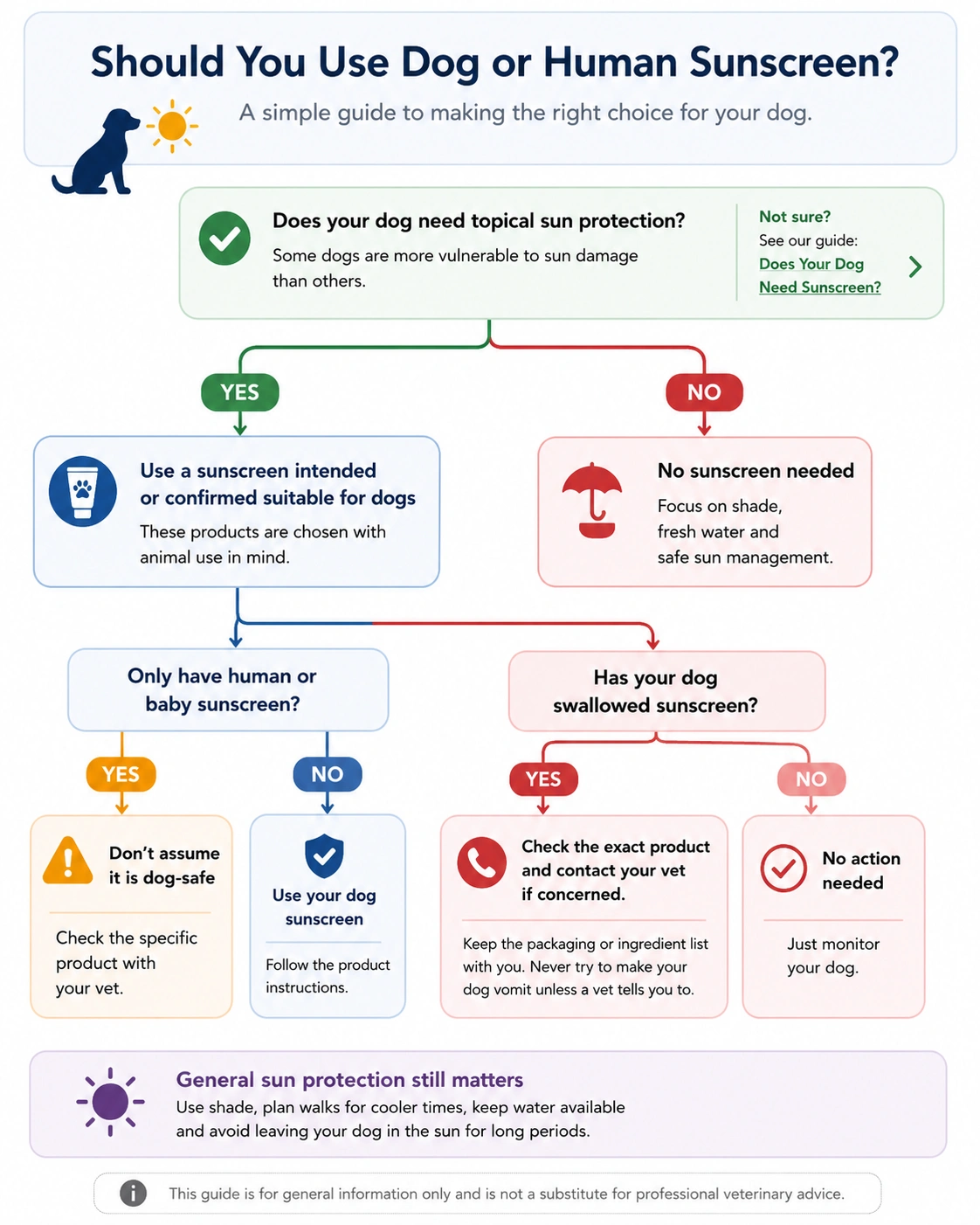
If your dog has swallowed sunscreen rather than merely had it applied, the question changes from “which sunscreen should I use?” to “what has my dog eaten and what should I do now?”
Keep the packaging or ingredient list and contact your vet if you are concerned about an ingestion. Never try to make your dog vomit unless a vet specifically tells you to do so.
Our separate guide on what to do if your dog eats sunscreen covers that situation in more detail.
What sunscreen ingredients should dog owners be careful about?
There is no single ingredient test that can tell you whether an entire sunscreen formulation is suitable for your dog.
The safest approach is to choose a product specifically intended or confirmed suitable for dogs and follow its instructions.
Zinc oxide
PDSA currently advises owners to avoid sunscreens containing zinc oxide when choosing sun protection for dogs and recommends pet-friendly sunscreen instead.
The toxicology is more nuanced than saying that any contact between zinc oxide and a dog automatically causes poisoning.
Merck states that acute ingestion of zinc-oxide creams generally produces gastrointestinal irritation rather than the severe systemic effects sometimes associated with other forms of zinc exposure. It also notes, however, that repeated ingestion of zinc-oxide cream from an animal’s skin can lead to much more serious problems.
A 2026 veterinary review similarly concluded that research into sunscreen use in companion animals remains limited and suggested that zinc-oxide sunscreens may not necessarily cause zinc toxicity when excessive ingestion is prevented. That uncertainty is another reason to avoid turning a single ingredient into a simple “safe” or “dangerous” rule.
For an owner choosing a product at home, the practical conclusion remains straightforward: there is little reason to experiment with human zinc-containing sunscreen when dog-appropriate alternatives are available.
PABA
PDSA also advises that sunscreen used for dogs should not contain para-aminobenzoic acid, or PABA.
Again, there is no benefit in trying to construct a home-made list of acceptable human sunscreens from individual ingredients when a product genuinely intended for pets provides a simpler decision.
Salicylates
Some human topical products can contain salicylate compounds. Merck describes salicylate toxicity as dose-dependent, with effects potentially including gastrointestinal problems and, at higher exposures, more serious systemic illness.
This does not mean that every human sunscreen contains a dangerous amount of salicylate. It means the complete product and exposure matter.
What about titanium dioxide in dog sunscreen?
Titanium dioxide is another mineral UV filter and appears in some sunscreen formulations.
It is tempting to turn this into a rule such as “titanium dioxide is the safe ingredient and zinc oxide is the unsafe one”, but the evidence does not support reducing dog-sunscreen safety to that one distinction.
The veterinary literature on sunscreen use in pets remains relatively limited. A product’s formulation, route of exposure and likelihood of ingestion all matter.
So if you see titanium dioxide in a dog sunscreen, judge the complete product and its instructions, rather than assuming the presence of that ingredient alone guarantees suitability.
Can I use baby sunscreen on my dog?
Do not assume a baby sunscreen is safe for a dog simply because it is designed for sensitive human skin.
“Baby”, “children’s”, “gentle” and “sensitive” describe the product’s intended human use. They are not canine-safety certifications.
There is also some variation in animal-care advice surrounding baby sunscreen. PDSA’s current dog-focused guidance recommends pet-friendly sunscreen and specifically warns against certain ingredients found in human products. Blue Cross’s dog guidance similarly recommends specially formulated canine sunscreen.
That makes the practical choice simple:
If you can obtain a suitable dog sunscreen, use that rather than trying to identify a human baby sunscreen that might also be acceptable.
If you cannot obtain one and believe your dog needs topical sun protection, ask your vet about the specific product and ingredient list you are considering.
Does dog sunscreen protect better than human sunscreen?
Not necessarily in the way you might think.
Human sunscreen is designed to protect human skin from ultraviolet radiation, and a good human product may provide very effective UV protection.
The comparison is not therefore:
effective sunscreen vs ineffective sunscreen.
It is:
sunscreen suitable for the animal using it vs sunscreen intended for a different species and use pattern.
For dogs, that includes considering whether the product can be applied safely to exposed skin and what happens if some of it is licked.
Blue Cross recommends specifically formulated canine sunscreen and following the product’s instructions. PDSA recommends pet-safe sunscreen and currently advises an SPF of at least 30.
A sunscreen being marketed for dogs should not receive an automatic free pass, however. Check that it is genuinely intended for canine use, read its directions and warnings, and ask your vet if your dog has a skin condition or you are uncertain about a product.
Which sunscreen should you use in different situations?
| Situation | Sensible approach |
|---|---|
| Your dog genuinely needs topical UV protection | Choose sunscreen intended or confirmed suitable for dogs |
| You only have your normal adult sunscreen | Do not assume it is suitable |
| You only have baby or children’s sunscreen | Do not assume the label makes it dog-safe; check the specific product with your vet |
| Your dog repeatedly licks sunscreen off | Ask your vet about alternatives and consider physical sun protection where appropriate |
| Your dog needs protection over a larger exposed area | Shade, limiting sun exposure and suitable protective clothing may be more practical |
| Your dog has swallowed sunscreen | Check the exact product and contact your vet rather than relying on general sunscreen advice |
The important principle is to solve the dog’s actual problem rather than insisting that sunscreen is always the answer.
What if you’ve already put human sunscreen on your dog?
Do not panic simply because human sunscreen has touched your dog’s skin.
First, stop your dog licking more of the product if you can do so safely. Find the sunscreen packaging and check what was used.
If your dog has swallowed some, the important details include:
- the exact product;
- its ingredients;
- roughly how much may have been swallowed;
- when it happened;
- your dog’s size;
- whether your dog is showing any symptoms.
If you think your dog has eaten something potentially harmful, contact your vet for advice rather than waiting for symptoms or trying to make your dog vomit yourself.
If only a small amount has been applied and your dog has not swallowed it, your vet can advise you whether it needs to be removed or whether any further action is necessary.
Sunscreen isn’t the only way to protect a dog from the sun
Sunscreen should be part of sensible sun management rather than a way to make unlimited sun exposure safe.
Blue Cross advises avoiding peak UV periods where possible and providing shade, while the RSPCA recommends pet-safe sunscreen as one part of keeping dogs safe during summer.
Depending on the dog and situation, protection may include:
- providing reliable shade;
- reducing time in strong direct sun;
- using sunscreen on vulnerable exposed areas where appropriate;
- considering UV-protective clothing for dogs that can wear it comfortably.
For a complete approach to reducing UV exposure and protecting vulnerable skin, see our guide to how to prevent dog sunburn.
Sun protection and heat protection are also not the same thing. Sunscreen may protect vulnerable skin from UV damage, but it does not stop a dog overheating. On hot days, cooling, water, shade and environmental conditions still need separate consideration. If you use airflow as part of your dog’s cooling setup, see Are Fans Safe for Dogs?
Water can complicate matters too. If your dog swims, check the sunscreen’s instructions to see whether reapplication is required. And remember that the sunscreen question is separate from whether the swimming environment itself is suitable — our guide to whether swimming pools are safe for dogs covers that issue.
Final verdict: dog sunscreen or human sunscreen?
For normal use, choose sunscreen specifically intended or confirmed suitable for dogs rather than using whatever human sunscreen you happen to have at home.
Human sunscreens vary significantly, dogs may lick them, and labels such as “baby”, “mineral” or “sensitive” do not establish canine suitability.
At the same time, there is no need to exaggerate the risk by assuming that every tiny exposure to every human sunscreen will cause severe poisoning. The exact formulation, amount and route of exposure matter.
The simple rule is therefore:
Don’t assume a human sunscreen is dog-safe. Choose a genuine pet-appropriate product, follow its instructions and ask your vet when you are uncertain about a particular formulation.
Once you have chosen an appropriate sunscreen, correct application and wider sun protection matter just as much as the product itself.
Read next
- Does Your Dog Need Sunscreen?
- Best Dog Sunscreens (UK Buyer’s Guide)
- How to Apply Dog Sunscreen Correctly