
Blue-green algae can produce toxins that cause rapid and potentially fatal poisoning in dogs. If your dog may have drunk from, swum in or come into contact with water containing blue-green algae, move them away from the water and contact a vet immediately.
Do not wait for symptoms to appear. A dog may initially seem well even though urgent veterinary treatment is needed.
Suspected exposure: what to do now
- Move your dog away from the water and prevent further drinking or swimming.
- Stop them licking wet or contaminated fur.
- Contact your vet or an emergency vet immediately.
- If it can be done safely and without delaying veterinary advice, rinse contaminated fur with plenty of clean fresh water.
- Do not induce vomiting or give charcoal, food, medication or home remedies unless a vet specifically tells you to.
- Tell the vet where and when the exposure happened and whether your dog drank, swam or licked its coat.
What is blue-green algae?
Blue-green algae is the common name for a group of organisms called cyanobacteria. Despite the name, they are bacteria rather than true algae.
Cyanobacteria occur naturally in fresh water and some coastal waters. Under favourable conditions, particularly during settled and warm weather, they can multiply and form a visible bloom.
A bloom may look like:
- green, blue-green, brown or reddish discolouration;
- small flakes, dots or clumps suspended in the water;
- streaks that resemble spilled paint;
- foam or scum gathered around the shore;
- a surface film.
However, appearance alone cannot confirm whether water contains harmful toxins. Some blooms are difficult to see, while harmless algae and plants can resemble cyanobacteria.
The practical rule is therefore simple: if water looks suspicious, carries an official warning or is known to contain blue-green algae, keep your dog away.
Are all blue-green algae blooms toxic?
Not every bloom produces dangerous levels of toxins. The problem is that an owner cannot reliably tell which blooms are toxic by looking at them.
Toxin levels can also vary within the same body of water and may change over time. A patch of concentrated scum along the shoreline can present a different risk from apparently clearer water only a short distance away.
Because there is no dependable visual test for safety, suspected blue-green algae should be treated as potentially harmful.
Why is blue-green algae dangerous to dogs?
Dogs are particularly vulnerable because they often interact with water in several ways at once. A dog may drink from a lake, swallow water while swimming and then lick more contaminated water from its coat.
Concentrated bloom material can collect near the shoreline, where dogs may sniff, lick or eat it. Dogs retrieving toys from the water may also repeatedly swallow small amounts.
Some cyanobacteria produce toxins that can damage the liver. Others affect the nervous system and the muscles involved in breathing. Exposure can therefore cause severe illness very quickly.
The seriousness of an individual exposure depends on factors including:
- whether toxins were present;
- the type and concentration of toxin;
- how much contaminated water or material the dog ingested;
- the dog’s size;
- how the exposure occurred;
- how quickly veterinary treatment begins.
There is no known amount of suspect water that an owner should regard as safe.
How can a dog be exposed to blue-green algae?
A dog does not need to deliberately drink a large quantity of water to be exposed.
| Exposure route | How it may happen |
|---|---|
| Drinking | The dog drinks directly from a lake, pond, reservoir, canal or slow-moving section of a river. |
| Swimming | The dog swallows water while paddling, swimming or retrieving a toy. |
| Licking the coat | Contaminated water or scum remains on the fur and is swallowed during grooming. |
| Shoreline contact | The dog investigates, licks or eats concentrated scum, foam or dried material beside the water. |
| Repeated retrieval | The dog repeatedly enters the water and swallows small amounts while carrying a ball or toy. |
Contact with suspect water should be taken seriously even if the dog did not appear to drink.
What are the symptoms of blue-green algae poisoning in dogs?
Symptoms vary according to the toxin involved and the amount absorbed. A dog may develop digestive, neurological, breathing or liver-related signs.
Possible symptoms include:
- vomiting;
- diarrhoea, which may contain blood;
- excessive drooling;
- weakness or unusual tiredness;
- loss of coordination;
- confusion or disorientation;
- twitching, tremors or muscle rigidity;
- seizures;
- difficulty breathing;
- pale or discoloured gums;
- collapse;
- loss of consciousness.
Some dogs may develop signs associated with liver injury, such as jaundice, abnormal bleeding or marked weakness. These signs require veterinary interpretation and should not be used to diagnose poisoning at home.
How quickly do symptoms begin?
Symptoms can begin very quickly—sometimes within minutes or hours of exposure. In other cases, signs associated with organ damage may take longer to become apparent.
Do not use the absence of immediate symptoms as reassurance. If exposure is possible, contact a vet straight away.
Waiting until a dog looks ill can reduce the opportunity for early treatment.
What should you do if your dog may have been exposed?
Move your dog away from the water
Prevent any further drinking, swimming or contact with shoreline scum.
Keep your dog on a lead and move to a safe area. Do not enter contaminated water yourself to retrieve a toy or other object.
Prevent your dog licking its coat
Contaminated water can remain on the fur after swimming. Keep your dog from grooming as far as you reasonably can.
A lead, towel or close supervision may help while you seek veterinary advice, but do not use force that could frighten or injure the dog.
Contact a vet immediately
Phone your usual veterinary practice or the nearest emergency vet. Explain that your dog may have been exposed to blue-green algae.
Do this even if your dog:
- appears completely normal;
- only paddled briefly;
- did not obviously drink;
- was exposed some time ago;
- has already been rinsed.
Your vet will decide how urgently the dog should be examined and what action is appropriate.
Rinse contaminated fur where safe
If your dog has blue-green algae or suspect water on its coat, rinsing with plenty of clean fresh water may reduce further ingestion from licking.
Only do this where it is safe and practical. Rinsing should not delay the call to the vet or the journey to the practice.
Wear gloves if available and avoid getting suspect material on your own skin. Do not use water from the affected lake, river or pond to rinse the dog.
Give the vet useful information
Tell the veterinary team:
- where the exposure occurred;
- the approximate time it happened;
- whether the dog drank, swam, paddled or rolled in shoreline material;
- how long the dog was in or near the water;
- whether warning signs were displayed;
- what the water or shoreline looked like;
- whether any symptoms have begun;
- the dog’s approximate weight and relevant health conditions.
A photograph of the water, shoreline or warning sign may be useful if it was taken safely from land. Do not return to the water or handle the bloom to obtain a sample.
For a more focused emergency sequence, see what to do if your dog has drunk or swum in suspected blue-green algae.
Do not try to treat poisoning at home
Do not:
- wait to see whether symptoms develop;
- induce vomiting unless a vet instructs you;
- give activated charcoal unless prescribed and administered under veterinary direction;
- give human medication;
- give supplements or “detox” products;
- assume rinsing has removed the risk;
- rely on an online symptom list to rule poisoning out.
Home treatment cannot replace urgent veterinary assessment.
How do vets treat blue-green algae poisoning?
There is no specific antidote that reverses all blue-green algae toxins. Treatment is therefore aimed at limiting further absorption, supporting the dog’s vital functions and managing complications.
The exact treatment depends on:
- the suspected toxin;
- how the exposure occurred;
- how long ago it happened;
- the dog’s symptoms;
- whether the liver, nervous system, breathing or circulation are affected.
Veterinary care may include:
- decontamination where clinically appropriate;
- intravenous fluids;
- blood tests and monitoring of liver, kidney and clotting function;
- medication to control seizures or tremors;
- oxygen or breathing support;
- treatment for shock;
- medicines and supportive care for liver injury;
- blood products in severe cases;
- intensive monitoring.
Some procedures may only be appropriate shortly after ingestion or for dogs that are stable enough to undergo them safely. Treatment decisions must therefore be made by the attending vet.
Owners should not attempt veterinary decontamination procedures at home.
Can a dog recover from blue-green algae poisoning?
Recovery is possible, particularly when exposure is recognised quickly and veterinary treatment begins before severe complications develop.
However, some cyanobacterial toxins act very rapidly. A dog can deteriorate suddenly, and severe poisoning may be fatal despite treatment.
The likely outcome depends on several factors, including:
- the toxin and concentration;
- the amount swallowed;
- whether concentrated scum was ingested;
- the time between exposure and treatment;
- the dog’s size and general health;
- whether serious liver, neurological or breathing problems have developed.
There is no single reliable survival percentage that applies to every exposure.
For a more detailed explanation of severity and prognosis, read how blue-green algae can become fatal to dogs.
What does blue-green algae look like?
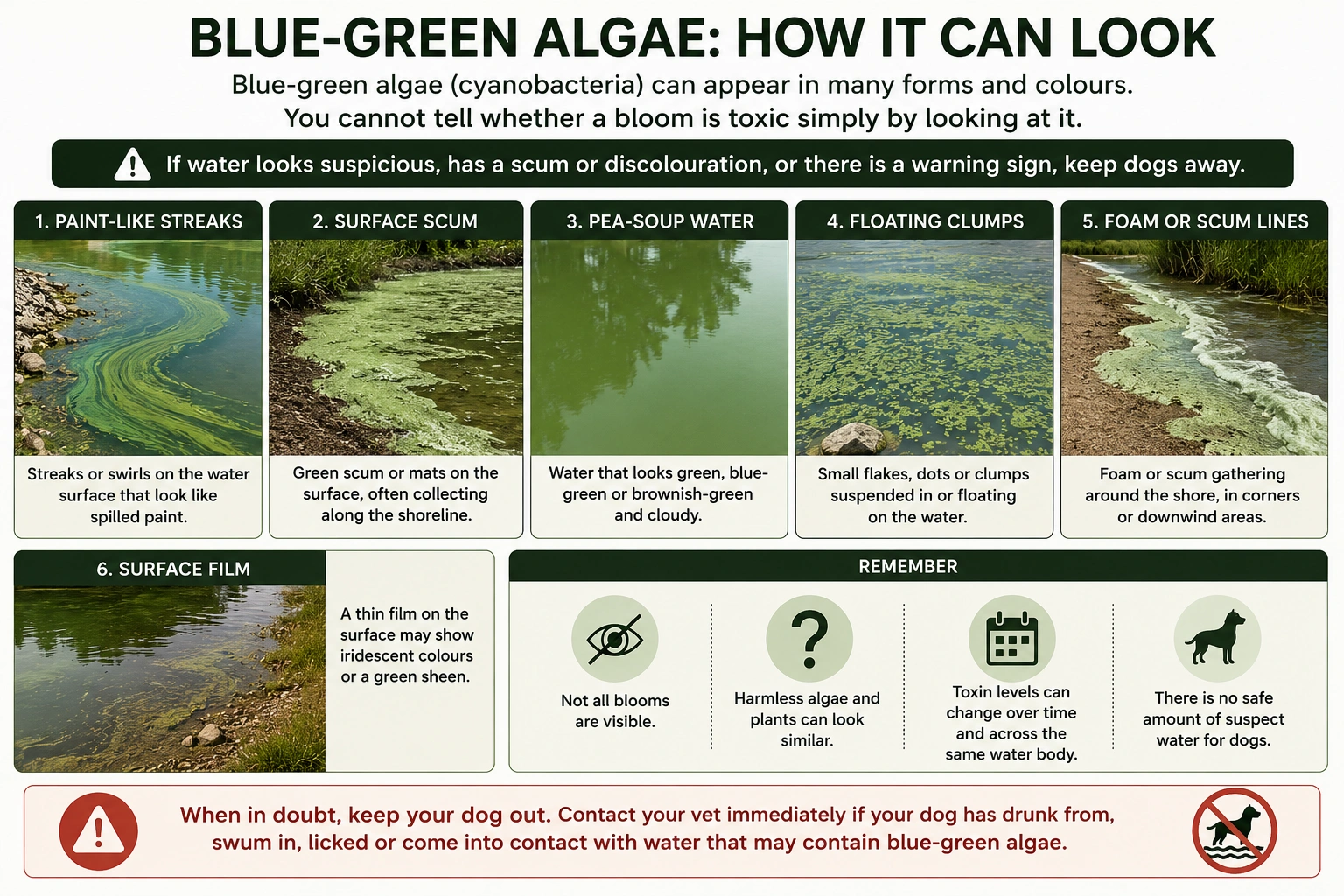
Blue-green algae does not have one consistent appearance.
Possible warning signs include:
- green or blue-green water;
- brown, red or dark-coloured discolouration;
- streaks that resemble paint;
- fine particles suspended in the water;
- pea-soup-like water;
- foam or scum collected at the edge;
- crusty or dried material along the shore.
It may have an earthy, grassy or musty smell, but smell is not a reliable safety test.
You should not approach, touch or smell suspect material closely. Do not allow your dog to investigate it.
It is also important not to assume that clear-looking water is safe. Cyanobacteria or toxins may be present without an obvious surface bloom.
Where is blue-green algae found?
Blue-green algae is most often associated with fresh water, including:
- lakes and lochs;
- reservoirs;
- ponds;
- canals;
- slow-moving rivers;
- sheltered river margins;
- ornamental or park lakes.
It can also occur in brackish and coastal waters.
Blooms are more likely where water is calm or slow-moving, but a river should not automatically be considered safe simply because water is flowing. Cyanobacteria can accumulate in sheltered sections, backwaters, margins and downstream areas. Learn more about whether a river is safe for dogs to swim in before allowing your dog into unfamiliar water.
Dogs should only swim where access is permitted and the water appears suitable. Broader guidance on assessing currents, access points, water quality and other hazards is available in the Dog Swimming Safety Guide.
When is blue-green algae most likely in the UK?
Blooms are commonly associated with warmer, sunnier and more settled weather, particularly from late spring into early autumn.
However, there is no completely safe month. Blooms and toxins may persist after the weather changes, and local conditions matter more than the date alone.
Nutrients in the water, sunlight, temperature, wind and water movement can all affect where bloom material forms and accumulates.
Before allowing a dog into unfamiliar water:
- check signs at the site;
- look for notices from the landowner or water operator;
- check relevant council or environmental-agency information;
- follow local closures and warnings;
- keep away if the water looks suspicious.
For location-sensitive information, use the guide to current blue-green algae warnings for dogs in the UK.
How can you prevent blue-green algae exposure?
Check the site before letting your dog approach the water
Look for:
- official warning signs;
- temporary closures;
- visible surface scum;
- discoloured water;
- foam or material gathered along the shore;
- dead fish or other signs that something may be wrong.
A lack of signage does not guarantee that water is safe. Conditions can change before warnings are installed.
Keep your dog away from suspect water
Do not allow swimming, paddling or drinking if:
- blue-green algae has been confirmed;
- a warning sign is present;
- a bloom is suspected;
- the water or shoreline looks unusual;
- you cannot assess the site confidently.
Use a lead near the water if necessary.
Bring clean drinking water
Carry enough fresh water for your dog and offer it regularly. A thirsty dog is more likely to drink from a lake, pond or river.
Clean water does not remove the need to prevent access, but it reduces one reason a dog may drink from an unsafe source.
Be careful around the shoreline
Concentrated scum may collect at the water’s edge, exactly where dogs are most likely to sniff and explore.
Do not allow your dog to lick or eat:
- foam;
- surface scum;
- dried shoreline crusts;
- dead fish;
- unidentified plant-like material.
Do not rely on colour alone
Blue-green algae is not always blue or green. Other harmless organisms may also turn water green.
Treat appearance as a reason to avoid water, not as a way to confirm that it is safe.
Rinse your dog after ordinary outdoor swimming
Rinsing your dog with clean fresh water after swimming can remove mud, microorganisms and other material from the coat.
This is sensible general hygiene, but it must not be presented as protection after known or suspected blue-green algae exposure. Possible exposure still requires immediate veterinary advice.
Choose swimming locations carefully
Prefer managed locations where:
- dogs are allowed;
- water access is clearly marked;
- currents and entry points can be assessed;
- local warnings are displayed;
- water quality information is available where applicable.
For wider planning, read the guide to general dog swimming safety precautions.
How do you report suspected blue-green algae in the UK?
Reporting arrangements vary across the UK and may depend on who owns or manages the water.
As a general starting point:
- notify the landowner, local authority, park authority or water operator;
- follow any reporting instructions displayed at the site;
- report suspected blooms to the relevant national environmental authority;
- keep people and animals away while the report is investigated.
In England, suspected blooms may be reported to the Environment Agency. Scotland, Wales and Northern Ireland have their own environmental authorities and reporting arrangements.
Contact routes can change, so they should be checked against the relevant authority’s current official guidance rather than copied permanently from an old notice.
Do not collect a sample yourself unless an appropriate authority specifically instructs you and provides safe handling guidance.
Blue-green algae poisoning or heatstroke?
Some signs of blue-green algae poisoning—such as vomiting, weakness, confusion, collapse and breathing difficulty—can also occur with heatstroke and other emergencies.
Recent contact with a lake, pond or river may raise concern about poisoning. Exercise in hot conditions, exposure to a warm car or difficulty cooling down may raise concern about heatstroke.
A dog could also face more than one problem at once. For example, a dog swimming on a hot day may be exposed to contaminated water while also becoming overheated.
Do not delay veterinary treatment while trying to decide which condition is responsible. Both suspected poisoning and heatstroke can require emergency care.
See the complete guide to signs of heatstroke in dogs for further information.
Other warm-weather hazards near open water
Blue-green algae is not the only risk during a day beside a lake or river.
Dogs may also face:
- strong currents and sudden changes in depth;
- cold-water shock;
- submerged objects;
- fishing hooks and lines;
- contaminated water;
- heatstroke before or after swimming;
- sunburn during prolonged exposure.
Dogs with pale, thin or sparsely covered skin may need particular protection from sunlight. Read more about protecting dogs from sunburn during long summer days outdoors.
Blue-green algae prevention checklist
Before allowing your dog near open water:
- Check for warning signs, closures and current local notices.
- Look at the water and shoreline before letting your dog approach.
- Keep your dog on a lead if the water is suspect or difficult to assess.
- Bring clean drinking water and a bowl.
- Prevent drinking from unknown water sources.
- Keep away from scum, foam and shoreline deposits.
- Do not assume moving or clear-looking water is safe.
- Rinse your dog after ordinary outdoor swimming.
- Contact a vet immediately after any suspected exposure.
- Never wait for symptoms before seeking advice.
Frequently asked questions
Can blue-green algae occur in moving rivers?
Yes. Blooms are more often associated with still or slow-moving water, but cyanobacteria and concentrated bloom material may be present in rivers, particularly in slow sections, sheltered margins and connected backwaters.
A river should not be judged safe simply because the main channel is flowing.
Can a dog be poisoned without swimming?
Yes. A dog may be exposed by drinking, licking contaminated fur, investigating shoreline scum or eating material washed onto the bank.
Even brief contact can justify veterinary advice if blue-green algae is suspected.
Is green water always blue-green algae?
No. Water may turn green because of harmless algae, plants, sediment or other organisms.
Owners cannot reliably identify cyanobacteria or determine toxicity by appearance. Avoid suspect water and follow local official advice.
Can old or dried algae still be dangerous?
Potentially harmful material can collect or dry along the shoreline. Dogs should not be allowed to lick or eat dried scum, crusts or other unidentified material beside affected water.
The most important next step
You cannot tell whether a blue-green algae bloom is toxic simply by looking at it.
Prevent exposure by keeping dogs away from suspect water, warning areas and shoreline scum. If your dog may already have been exposed, contact a vet immediately—even if no symptoms have appeared.
Read next
- My Dog Drank or Swam in Blue-Green Algae: What Should I Do?
- Blue-Green Algae Warning for Dogs (UK)
- Dog Swimming Safety Guide