
Providing reliable shade is one of the most important things you can do for your dog on a warm or sunny beach day. But good dog beach shade involves more than putting up a tent and assuming your dog is protected.
The best setup gives your dog enough shade to lie down comfortably, allows plenty of air to circulate, provides a comfortable surface away from hot sand and sits beside a ready supply of fresh drinking water. Your dog should also be able to move to a different position if they are uncomfortable.
You do not necessarily need a purpose-built dog beach shade tent. A well-positioned beach umbrella, open-front shelter, canopy or safe natural shade can all work. What matters is whether the shade actually keeps your dog comfortable in the conditions.
And there is an important limit: shade can reduce heat and sun exposure, but it cannot make an excessively hot day safe for your dog. For a closer look at that distinction, see Shade Safety: Is Shade Enough to Protect Your Dog?
Good beach shade needs more than a roof overhead. Your dog needs enough shade to lie down fully, good airflow, a comfortable resting surface and fresh water. Shade can help reduce heat and sun exposure, but it cannot make excessively hot conditions safe.
Why Dogs Need Shade at the Beach
A beach can expose a dog to direct sunshine for much longer than a normal walk. There may also be little natural shade, while activity such as running, playing and swimming adds to the heat their body needs to lose.
Providing shade helps in several different ways.
It reduces direct sun exposure
Moving out of direct sunlight reduces the amount of solar heat falling directly on your dog’s body. It also gives them somewhere to rest without continually being exposed to the sun.
This does not mean the air underneath a shelter will always be cool. On a very hot day, shaded air can still be too warm for a dog that is struggling to regulate its body temperature.
It helps protect against sun exposure
Dogs can get sunburn, particularly on areas with little hair and on dogs with pale skin or light-coloured coats. Shade reduces direct exposure but does not necessarily protect every exposed part of the dog throughout the day.
If your dog is particularly vulnerable to sunburn, Dog Sunburn: Symptoms, Treatment & Prevention (Complete Guide) explains the risk, prevention and signs to look for in more detail.
It gives your dog somewhere to stop
The beach can be highly stimulating. Some dogs will continue running, playing or exploring even when they would benefit from a rest.
A comfortable shaded area creates an obvious place for your dog to settle between periods of activity. You still need to watch the dog rather than assuming that having a shaded base means they are coping well.
For the wider hazards to consider around sand, sea, tides and beach activities, read our complete dog beach safety guide.
What Makes Good Beach Shade for a Dog?
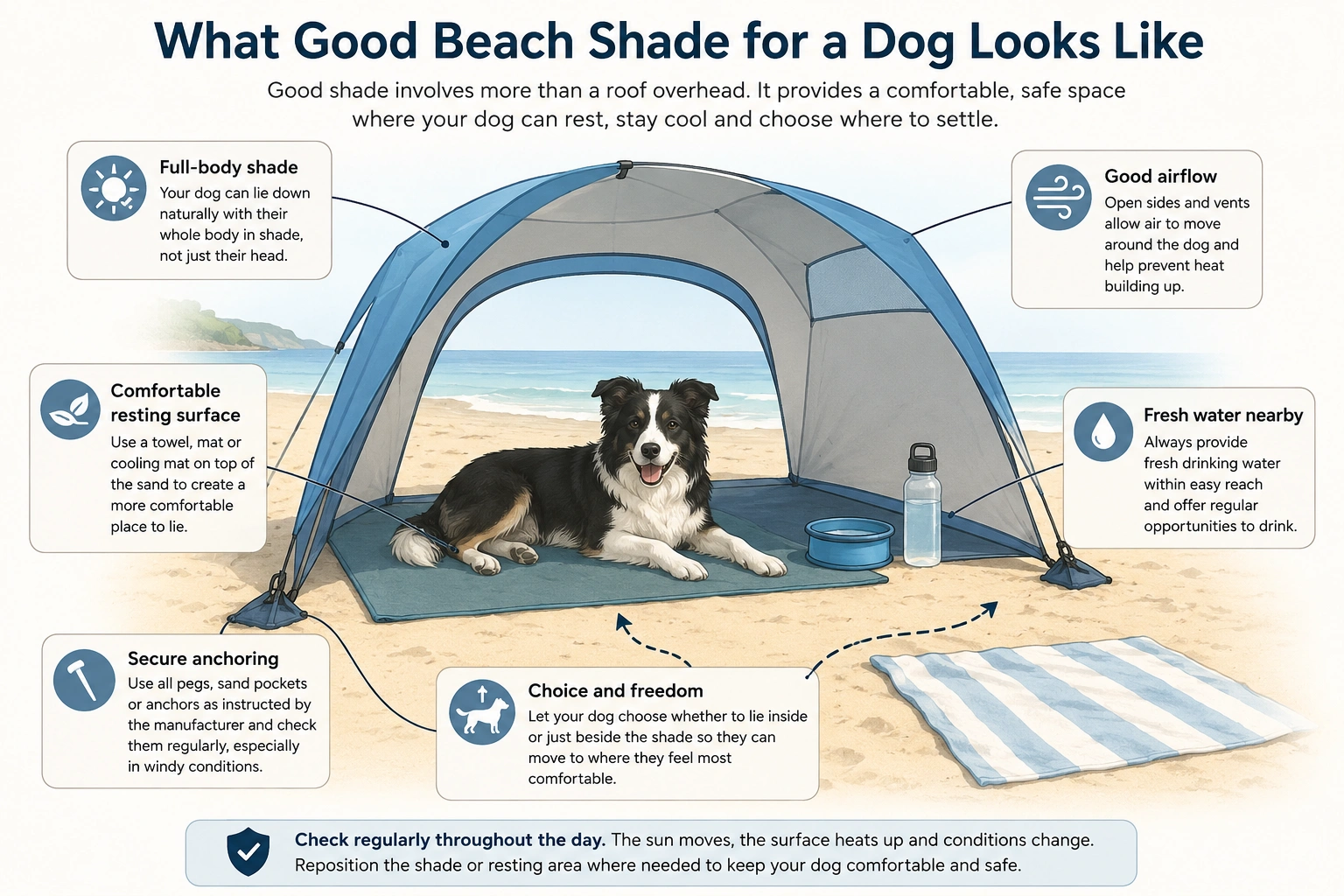
A shelter only helps if the shaded area itself is suitable for the dog. There are five things worth looking at.
Enough shade for your whole dog
Your dog should be able to lie naturally with their body inside the shaded area rather than having their head in shade while the rest of them remains in direct sunlight.
Allow extra space if you have more than one dog.
Remember that the position of the sun changes. A shelter that provides excellent shade when you arrive may leave your dog’s resting spot exposed later, so check it periodically and reposition the shelter or resting area where necessary.
Plenty of airflow
Air needs to be able to move around the dog.
This makes open umbrellas, open-sided canopies and well-ventilated beach shelters useful options. A small enclosed tent can become uncomfortable if heat builds inside it, especially when there is little air movement.
Avoid trapping heat inside the shelter. If you use a tent-style shade, open vents and mesh panels where the design allows. Never close your dog into a hot, poorly ventilated enclosure.
A comfortable surface underneath
Shade above the dog does not automatically mean the surface beneath them is comfortable.
Beach sand exposed to strong sunshine can become very hot. Even after you create shade, it may take time for a hot surface to cool.
Choose a suitable resting spot and check it regularly. A towel, suitable mat or cooling mat can provide a more comfortable surface where appropriate, but none of these should be relied upon to make excessively hot conditions safe.
Secure anchoring
Beach shelters have to cope with wind as well as sun.
Use the shelter exactly as its manufacturer instructs and secure every required anchor, peg or sand pocket. A lightweight umbrella or canopy that can lift, collapse or move suddenly is a hazard to both dogs and people.
If conditions are too windy for the shelter to be used securely, take it down rather than improvising an unsafe anchoring method.
A choice of where to settle
Where practical, let your dog choose whether to lie inside or just beside the shelter.
Some dogs readily settle under a canopy. Others dislike small tents or enclosed spaces. A dog that repeatedly leaves a particular shelter may be telling you that the location, temperature, surface or enclosure is uncomfortable.
Shade works best when it creates a comfortable option rather than somewhere the dog has to be confined.
The Main Ways to Create Dog Beach Shade
There is no single type of beach shade that is best for every dog or every trip.
| Shade option | Main advantage | Things to consider |
|---|---|---|
| Beach umbrella or parasol | Simple, portable and very open to airflow | Limited shaded area, moving sun and secure anchoring |
| Open-front beach shelter | Creates a useful shaded base and some protection from wind | Ventilation varies significantly between designs |
| Canopy or sun shade | Can provide a large, well-ventilated shaded area | More equipment, more space and secure anchoring required |
| Dog shade tent | Compact and designed around a dog’s resting space | Check usable size, airflow and stability rather than assuming a dog-specific design is automatically better |
| Natural shade | Requires no additional equipment | Availability, safety and shade position can change throughout the day |
If you want a broader overview of the different ways to provide outdoor shade, How to Create Shade for Your Dog: The Best Dog Shade Ideas explains the main options beyond the beach.
Permanent outdoor situations have different requirements. Dog Shade for the Garden looks specifically at creating useful shade around the home, while Dog Kennel Shade covers shade around kennels and similar structures.
How to Choose the Right Beach Shade for Your Dog
Rather than starting with the product, start with your dog and the beach.
Consider your dog’s size. A small pop-up shelter might comfortably shade a small dog while leaving a larger breed cramped or partly exposed.
Allow space for every dog. If you are taking two dogs, a shelter that technically fits both but gives them no comfortable room to lie down is not providing a very useful resting area.
Prioritise ventilation. A large opening and good cross-flow of air can matter more than enclosing the dog on several sides.
Think about how far you have to carry it. A large canopy may provide excellent shade but be impractical if reaching the beach involves a long walk.
Consider the wind. Beaches can be exposed. Choose equipment that can be securely anchored and follow its instructions.
Watch where the sun moves. A fixed shelter does not create a permanently fixed patch of shade.
Think about your dog’s behaviour. If your dog dislikes confined spaces, an open canopy or umbrella may make more sense than a small tent.
Most importantly, consider the conditions themselves. A more sophisticated shelter is not a substitute for choosing a cooler time or abandoning the trip when the weather is unsuitable.
Is a Dog Beach Shade Tent Better Than an Umbrella?
Not necessarily.
A dog beach shade tent can be convenient because it creates a defined resting area and many designs pack down for travel. A larger shelter may also give more consistent coverage than a single umbrella.
An umbrella has advantages too. It is open on every side, so it usually allows unrestricted airflow, and many families already own one.
The better choice is the one that provides sufficient usable shade, good ventilation and a secure setup for your particular dog and beach.
If you are specifically considering a tent rather than other forms of shade, Dog Shade Tents looks more closely at what to consider when choosing and using one.
Shade Alone Is Not Enough on a Hot Beach
One of the easiest mistakes to make is treating shade as a complete solution to hot weather.
It is not.
Your dog should also have fresh drinking water available and regular opportunities to rest. Limit strenuous activity when conditions are warm and keep monitoring how your dog is behaving.
Hot sand matters too. If the surface is uncomfortable or excessively hot, do not expect your dog simply to tolerate it between trips into the water or periods underneath the shelter.
You should also remember that swimming is exercise. A dog that repeatedly runs into the sea, retrieves toys and races around the beach may still overheat even though water is nearby.
The most important question is therefore not simply, “Is my dog in the shade?” but “Is my dog comfortable and coping well with the conditions?”
If you are planning the rest of your beach setup as well as the shade, Essential Dog Beach Equipment covers the wider kit that can make a beach visit safer and easier.
Which Dogs Need Extra Care in Beach Heat?
Any dog can become too hot, but some dogs have a lower margin for coping with heat.
Extra care is particularly important with:
- flat-faced or brachycephalic dogs, such as French Bulldogs, Bulldogs and Pugs;
- overweight dogs;
- older dogs;
- puppies;
- dogs with thick or heavy coats;
- dogs with respiratory, cardiovascular or other health conditions that affect their ability to cope with heat.
Individual dogs vary, so breed alone should never be used to decide that conditions are safe or unsafe.
A dog that is fit, enthusiastic and keen to keep playing can still become overheated. Likewise, a dog may be struggling even though another dog beside them appears comfortable.
When Beach Shade Is Not Enough
Do not use the presence of a tent, umbrella or canopy as a reason to stay when your dog is becoming too hot.
Warning signs of heat-related illness can include increasingly heavy panting, excessive drooling, lethargy or weakness, vomiting, loss of coordination, confusion or collapse.
If you suspect heatstroke, move the dog away from the heat and start cooling them immediately while arranging urgent veterinary care. Current UK welfare guidance emphasises cooling first rather than delaying cooling until you reach the vet.
Our Dog Heatstroke: Symptoms, Treatment & Prevention guide explains how to recognise heatstroke and what to do.
If your dog is simply becoming uncomfortable or struggling to settle before reaching that point, leaving the beach for a cooler environment is the sensible choice. You do not need to wait for an emergency before deciding that conditions are no longer suitable.
Quick Dog Beach Shade Checklist
Before settling down, check:
- Is the shaded area large enough for your dog to lie fully inside it?
- Is there plenty of airflow?
- Is the surface underneath comfortable?
- Is the shelter securely anchored?
- Can your dog move into or out of the shade comfortably?
- Is clean, fresh drinking water immediately available?
- Has the position of the shade changed as the sun has moved?
- Is your dog genuinely relaxed and comfortable?
- Are the overall conditions still suitable for staying at the beach?
The Bottom Line
The best beach shade for dogs is not necessarily the most elaborate shelter or the product marketed most heavily for pets.
A simple umbrella may be perfectly suitable if it gives your dog enough coverage, airflow and a comfortable place to rest. In other situations, an open beach shelter, canopy or dog shade tent may work better.
Whatever you use, keep watching both the conditions and your dog. Shade is an important layer of protection, but if the day is simply too hot for your dog to remain comfortable, the safest option is to leave the beach and come back at a cooler time.