
Good dog shade for the garden is more than a patch of ground that happens to be out of direct sunlight. The best shaded area is available when your dog actually needs it, large enough for them to rest comfortably, well ventilated, positioned over a suitable surface and close to fresh drinking water.
Trees, shrubs, building shade, parasols, gazebos, canopies and shade sails can all work. What matters most is how the shade performs in your particular garden — especially as the sun moves through the day.
Shade is also only one part of keeping a dog comfortable in hot weather. On very hot or humid days, even a shaded garden may be too warm, and a cooler indoor environment may be the better place for your dog.
What makes good shade for a dog in the garden?
Useful garden shade should give your dog somewhere they can choose to get away from direct sun and settle comfortably.
A good shaded area should ideally:
- provide enough coverage for your dog to lie fully out of direct sunlight;
- be available during the times your dog is likely to use the garden;
- allow plenty of air movement;
- cover a surface that is comfortable to stand or lie on;
- have fresh drinking water nearby;
- be easy for your dog to enter and leave voluntarily;
- remain useful as the position of the sun changes.
Dogs Trust recommends providing dogs with a quiet garden area that includes shade, shelter and fresh drinking water, while the RSPCA advises giving dogs constant access to shaded areas and clean, fresh water during hot weather.
The important point is that shade should work for the dog, not simply look shaded from where you are standing.
A narrow strip beneath a fence may technically be out of the sun, for example, but it is little use if your dog cannot lie comfortably in it. Similarly, a shaded corner that works well in the morning may be in full sun during the hottest part of the afternoon.
For a broader look at different ways of providing shade away from direct sun, see How to Create Shade for Your Dog: The Best Dog Shade Ideas.
What can you use to create dog shade in a garden?
You do not necessarily need a specialist dog product. In many gardens, existing plants and structures already provide useful shade. Elsewhere, adding a movable or permanent source of shade can make the space much more comfortable.
Trees and shrubs
Established trees and large shrubs can provide excellent natural garden shade.
Blue Cross specifically recommends large shrubs and trees as ways of providing shaded areas for dogs in summer.
Natural planting can work particularly well because it may create a relatively large area of shade without taking up usable floor space with a separate structure.
There are limitations, though. The amount and position of shade will change during the day, and newly planted trees or shrubs may take years to provide substantial cover.
Plants within your dog’s reach also need to be suitable for a dog-accessible garden. Garden shade should never be created at the expense of introducing a different avoidable hazard.
Shade from your house and existing structures
A house wall, extension, shed, garage, fence or other permanent structure can cast a useful area of shade without requiring you to buy anything.
Observe it rather than assuming it will always be there.
A patio that is cool and shaded early in the morning can be exposed to direct sunlight later, while another part of the garden may become shaded as the afternoon progresses.
Enclosed buildings require particular caution. A shed, greenhouse, conservatory or similar space should not be treated as a safe refuge simply because it blocks direct sunlight. The RSPCA warns against leaving dogs in conservatories and outbuildings in warm weather because these environments can become dangerously hot.
Parasols and garden umbrellas
A sturdy garden parasol can be one of the simplest ways to create extra dog shade, particularly on a patio or in a smaller garden.
Its main advantage is flexibility. You can move or adjust it as the sun changes rather than relying on one permanently shaded location.
Make sure it is stable and suitably secured, particularly in windy conditions, and check that the shaded area underneath is large enough for your dog rather than just covering their head or part of their body.
Gazebos, canopies and shade sails
A gazebo, canopy or properly positioned shade sail can provide a larger shaded area where there is little natural cover.
These can work particularly well in exposed gardens or over a patio, sitting area or part of a lawn.
Think about ventilation as well as coverage. An open-sided shade structure allows air to circulate much more freely than an enclosed shelter made from materials that trap warm air.
Secure temporary structures appropriately and follow the manufacturer’s installation guidance. Wind can turn an inadequately secured canopy or parasol into a hazard.
Purpose-built dog shade shelters
A dedicated dog shade shelter may make sense if you want to create a defined resting area or need something that can be moved around the garden.
Design matters more than simply having a roof. The shelter needs enough space for your dog, effective shade and good ventilation. A small enclosed shelter can become uncomfortable if warm air builds up inside.
If you decide that a dedicated shelter is the right approach, Best Dog Shade Shelters can help you compare purpose-built options.
For dogs using outdoor kennels or runs, shade needs slightly different consideration because the dog may have access to a more restricted area. Dog Kennel Shade looks specifically at providing shade in that setting.
Where should you put your dog’s shaded area?
The best position is not necessarily the place that looks coolest when you first go outside.
Watch what happens to your garden over several hours.
PDSA advises owners to remember that shade from trees and hedges moves as the sun changes position.
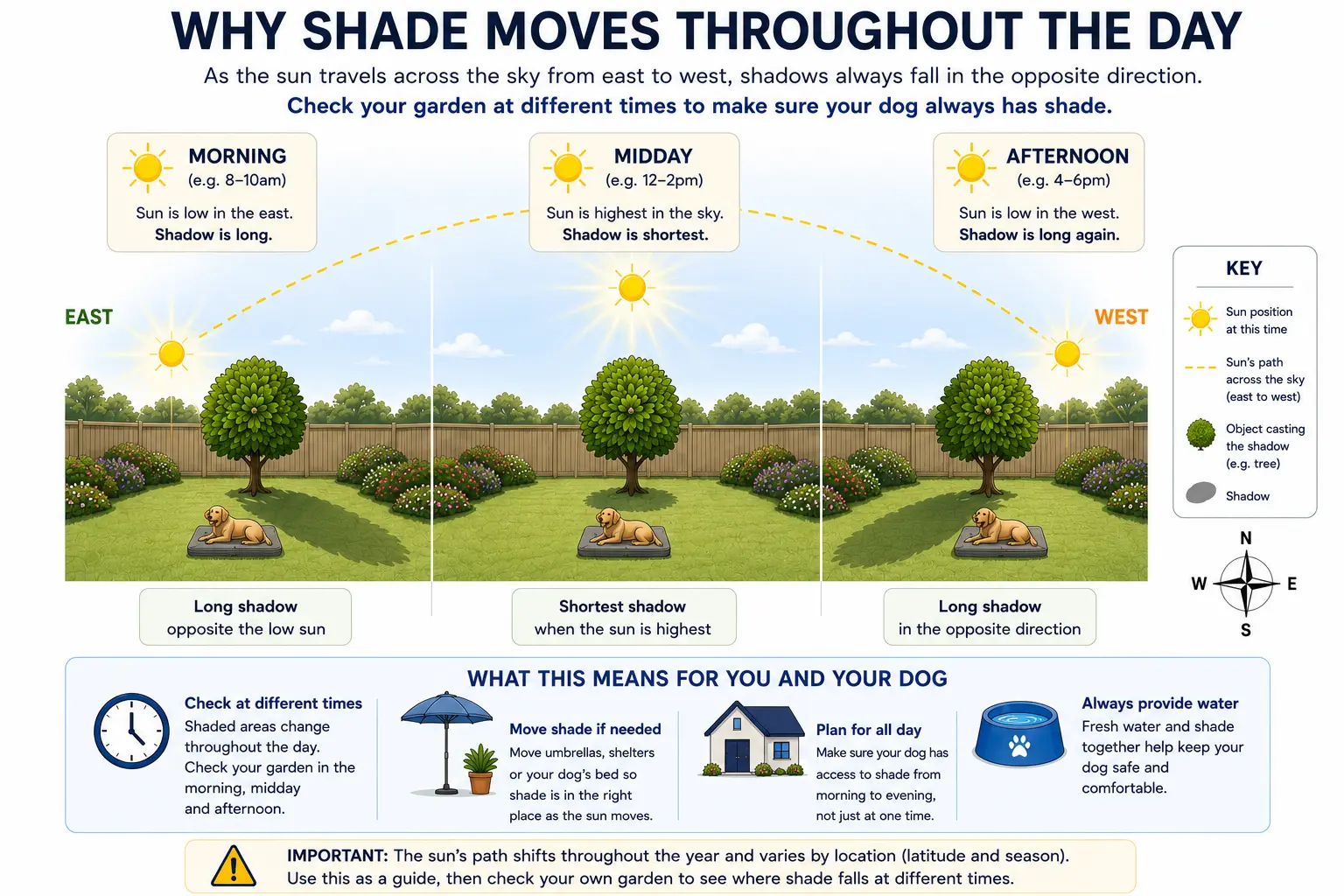
If possible, look at the garden during the warmest part of the day as well as in the morning. Ask yourself:
- Where is the shade at midday and later in the afternoon?
- Can my dog lie completely within it?
- Does air circulate through the area?
- What is the surface underneath like?
- Is drinking water within easy reach?
- Can my dog move freely to another area?
You may find that the most useful solution is not one permanent shade spot but a combination — perhaps natural tree shade for part of the day and a movable parasol or canopy when the sun shifts.
The location also needs to make sense to your dog. A beautifully shaded corner will not be particularly useful if your dog dislikes settling there or cannot easily reach it.
The ground underneath the shade matters too
Blocking direct sunlight is important, but remember to consider what your dog will actually be standing or lying on.
Grass is often comfortable, while patios, decking and artificial surfaces can behave differently in strong sunshine.
Artificial grass deserves particular care. Blue Cross warns that artificial grass can become too hot for dogs to stand on during summer and advises checking its temperature before allowing a dog onto it.
A surface that has been exposed to strong sun for hours will not instantly become cool simply because you move a parasol over it.
If your usual shaded resting spot has a hard or artificial surface, check it before encouraging your dog to settle there. Giving your dog access to different surfaces and allowing them to choose where they are comfortable is often more useful than trying to create one supposedly perfect resting place.
An outdoor dog bed may also provide a comfortable resting option, but it should not become another source of trapped heat. Thick, enclosed or heavily padded beds may be less appealing in warm conditions than a breathable surface.
Should your dog have one shaded area or several?
There is no requirement for every garden to contain several purpose-built dog shelters.
What matters is that your dog can reliably get out of direct sunlight.
However, having more than one usable shaded location can be helpful because the sun moves and dogs may prefer different resting places at different times.
A larger garden might naturally offer tree shade in one area, building shade somewhere else and a parasol near the patio.
In a smaller garden, simply being able to move a parasol may achieve much the same thing.
Giving your dog a choice can also help. Dogs do not necessarily want to rest in the same place throughout the day, and the spot they prefer may change with temperature, surface, airflow and household activity.
Garden shade for small, paved or exposed gardens
A lack of mature trees does not prevent you from creating useful shade.
Small gardens and patios
Movable shade can be particularly useful where space is limited. A parasol or compact canopy can cover a resting area without permanently taking over the garden.
Where the garden is heavily paved, pay extra attention to the temperature of the surface beneath the shade.
Exposed gardens
Gardens with little existing cover may benefit from a larger canopy, gazebo, shade sail or carefully positioned planting.
If you are introducing a structure, make sure it can cope with the conditions in that part of the garden and is installed or anchored securely.
Rented gardens
If you cannot make permanent alterations, portable options such as a parasol or freestanding canopy may be more practical than fixed structures.
Existing natural and building shade can also be used more deliberately once you know where it falls during different parts of the day.
If you are making wider changes to create a safer outdoor space, How to Dog Proof Your Garden covers the broader practical considerations.
Some dogs need more protection from heat than others
Every dog needs access to shade in warm weather, but some dogs have a greater risk of overheating.
Dogs at increased risk can include:
- flat-faced or brachycephalic breeds;
- dogs with thick coats;
- overweight dogs;
- puppies;
- older dogs;
- dogs with heart or respiratory conditions.
The Royal Veterinary College warns that breed, age, body condition, coat and underlying health can all influence heatstroke risk.
This matters when thinking about garden shade because there is no single outdoor setup that makes hot conditions equally safe for every dog.
A garden that one healthy adult dog copes with comfortably may be unsuitable for another dog in the same weather.
Is shade enough to keep a dog safe on a hot day?
Not always.
Shade protects your dog from direct sunlight, but it does not necessarily make the surrounding air cool.
A dog can still overheat in a shaded area when the weather is hot or humid, particularly if ventilation is poor. The Royal Veterinary College specifically identifies warm or humid, poorly ventilated environments as a cause of overheating.
That is why garden shade should be combined with fresh water, ventilation, appropriate activity levels and judgement about whether your dog should be outside at all.
Blue Cross advises keeping dogs in a cool room during the hottest parts of the day in extreme temperatures, while PDSA likewise advises that during extreme heat it may be better to keep a dog indoors.
Our Shade Safety: Is Shade Enough to Protect Your Dog? guide explains in more detail why shade should not be treated as a guarantee against overheating.
Watch your dog as well as the weather. Heavy or distressed panting, excessive drooling, weakness, confusion, vomiting, collapse or breathing difficulty can be signs of serious overheating.
If you suspect heatstroke, start cooling your dog immediately and contact a vet. The current Royal Veterinary College guidance is to cool first, transport second rather than delaying cooling until the dog reaches the veterinary practice.
For the warning signs and what to do next, see Dog Heatstroke: Symptoms, Treatment & Prevention.
Common garden-shade mistakes
Assuming morning shade will still be there in the afternoon
The sun moves. Check the garden at the times when heat is most likely to be a problem rather than judging it from one moment in the morning.
Making the shaded area too small
Your dog should be able to get their whole body out of direct sunlight and settle normally.
Treating an enclosed shelter as automatically cool
Blocking sunlight is only part of the job. Airflow matters too.
Ignoring the surface underneath
Paving, decking and artificial grass may retain considerable heat even when shade is added later.
Leaving all drinking water in direct sunshine
Placing water in a shaded location can help keep it cooler for longer. Blue Cross specifically recommends putting water sources in shady areas.
Assuming shade makes a very hot day safe
If conditions are too hot, keeping your dog in a cooler indoor environment is safer than trying to compensate with ever more garden equipment.
Choosing the right garden shade for your dog
Start with what you already have.
If established trees, shrubs or buildings provide reliable shade at the right time of day, you may not need to buy anything. Check the size of the shaded area, the surface underneath it, airflow and water access first.
If the shade disappears as the sun moves, a movable parasol or other temporary shade may be enough to fill the gap.
For an exposed garden with little natural cover, a larger canopy, gazebo or shade sail may provide more useful coverage.
If you want a dedicated resting shelter, consider the space available, ventilation and how easily your dog can use it before choosing a product.
And if you enjoy building things yourself, DIY Dog Shade Structures explores ways of creating your own outdoor shade.
The shaded part of the garden should also remain an enjoyable space rather than simply somewhere your dog is expected to stay during warm weather. Appropriate play and enrichment can help make a dog-friendly garden more interesting; Best Garden Toys for Dogs looks at options designed for outdoor use.
If you are heading away from home, the same basic principles still apply, although wind, portability and the environment become much more important. Beach Shade for Dogs covers providing suitable shade on trips to the coast.
The bottom line
Good dog shade for the garden should give your dog reliable protection from direct sunlight while still providing ventilation, a comfortable resting surface and easy access to fresh water.
Check where the shade actually falls as the day progresses rather than assuming one spot will remain suitable.
Most importantly, treat shade as one part of hot-weather care rather than a guarantee that it is safe for your dog to remain outside. If the garden is still hot despite the shade, moving your dog somewhere cooler is the better option.