
A day at the beach can give your dog space to explore, paddle and enjoy new surroundings, but a beach is not automatically safe simply because dogs are allowed there.
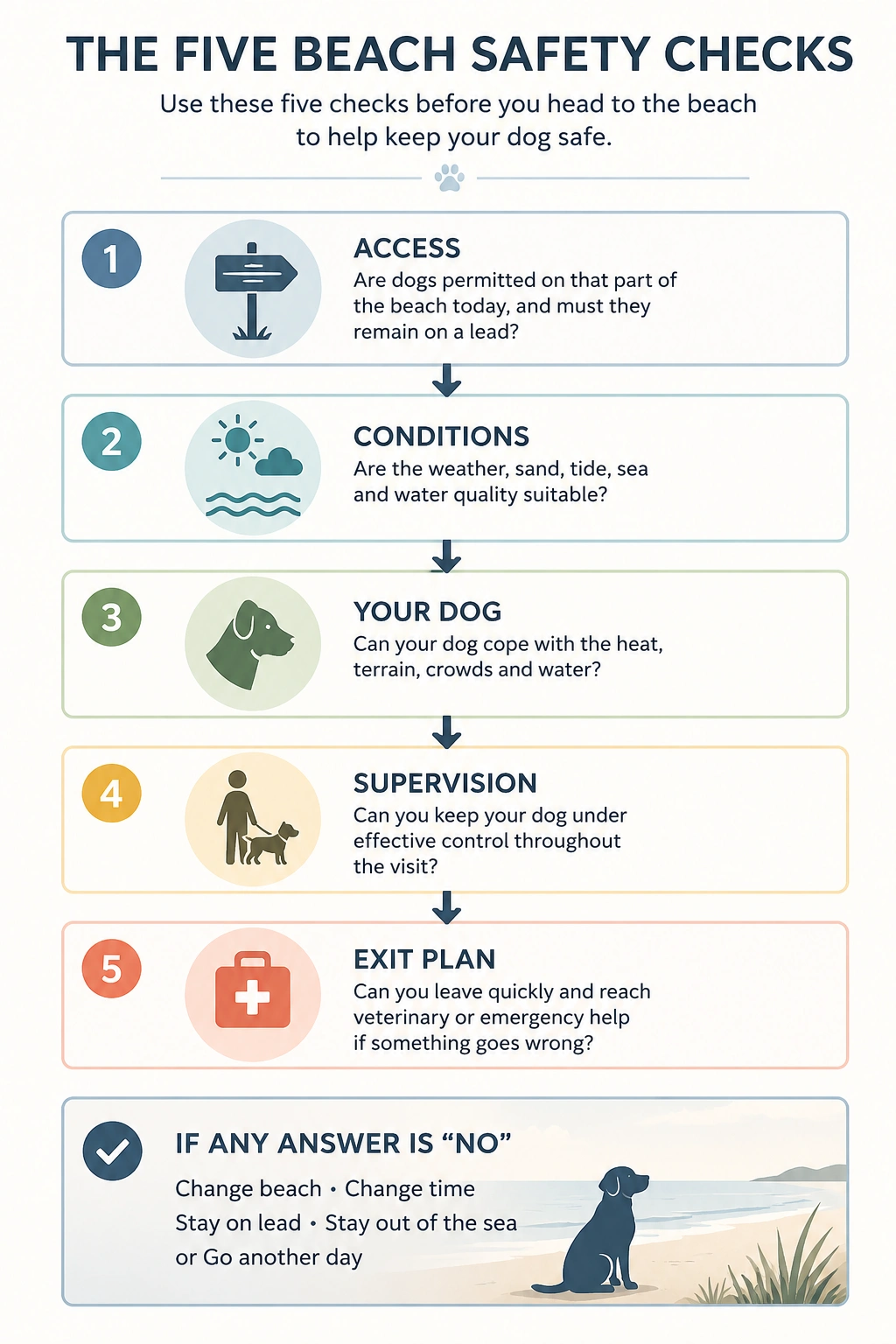
Before setting out, check five things:
- Access: Are dogs permitted on that part of the beach today, and must they remain on a lead?
- Conditions: Are the weather, sand, tide, sea and water quality suitable?
- Your dog: Can your dog cope with the heat, terrain, crowds and water?
- Supervision: Can you keep your dog under effective control throughout the visit?
- Exit plan: Can you leave quickly and reach veterinary or emergency help if something goes wrong?
A safe plan may mean visiting earlier, choosing another beach, keeping your dog on a lead or staying out of the sea. Sometimes the right decision is to go another day.
Before taking your dog to the beach
Before leaving home:
- check that dogs are allowed;
- look for seasonal restrictions and dog-free zones;
- check the weather, tide times and sea conditions;
- review any pollution or bathing-water warnings;
- choose a cooler and quieter time where possible;
- pack plenty of fresh water;
- bring a normal lead, secure equipment, waste bags, towels and usable shade;
- save the details of a nearby veterinary practice;
- make sure your phone is charged.
Once you arrive, recheck the signs and conditions. Local restrictions, lifeguard instructions and the state of the water may be different from what you expected.
Is it safe to take your dog to the beach?
It may be safe to take your dog to the beach when:
- dogs are permitted in the area;
- the weather is mild enough for that particular dog;
- the tide and sea conditions are manageable;
- there is a safe way onto and off the beach;
- your dog can remain under control;
- you can provide fresh water, rest and effective shade;
- you can supervise any paddling or swimming continuously.
However, a dog-friendly sign only tells you that dogs are permitted under the stated conditions. It does not mean that the sand is cool, the water is safe or your dog is capable of swimming.
Consider your individual dog rather than treating all dogs alike. Puppies, older dogs, overweight dogs, brachycephalic breeds and dogs with heart, breathing or mobility problems may be less able to cope with heat, exertion or difficult terrain.
Dogs that become anxious around crowds, unfamiliar dogs, children, horses, waves or loud noises may also find a busy beach stressful rather than enjoyable.
Check the beach rules before you travel
Dog restrictions vary between UK beaches. There is no single national beach season during which the same rules apply everywhere.
In England and Wales, local authorities can use Public Spaces Protection Orders to:
- exclude dogs from specified areas;
- require dogs to be kept on leads;
- require an owner to put a dog on a lead when directed;
- impose other local controls.
Ignoring an applicable order can lead to a fixed penalty or prosecution. Councils must publish information about their orders, and restricted areas should be signposted.
Rules can apply to only one section of a beach or promenade. They may also change according to the date, time or presence of protected wildlife.
Before travelling, check:
- the local council website;
- the beach or landowner’s website;
- seasonal restriction dates;
- maps of dog-exclusion areas;
- lead requirements;
- wildlife protection notices;
- signs at each beach entrance.
Do not rely entirely on a general beach directory or an old social-media post. Current council information and on-site signs should take priority.
For a longer coastal trip, check these rules alongside accommodation, travel and local facilities when planning a dog-friendly beach holiday in the UK.
Check access, facilities and your route home
A beach may allow dogs but still be unsuitable for your visit.
Check:
- how far the beach is from the car or public transport;
- whether the access involves steep steps or cliffs;
- whether fresh water is available;
- whether there is reliable shade;
- whether the beach is lifeguarded;
- whether mobile reception is likely;
- where the nearest veterinary practice is;
- whether the rising tide could affect your route back.
Remote coves can be especially difficult if a dog becomes injured, overheated or unable to climb back up the access route.
Decide whether the conditions are safe today
Weather and heat
A sea breeze may make a beach feel cooler to you, but your dog can still overheat.
Risk is affected by more than the air temperature. Consider:
- direct sunlight;
- humidity;
- duration of the visit;
- running, digging and swimming;
- the temperature of the sand;
- whether the available shade has good airflow;
- the dog’s age, breed, fitness, health and coat;
- whether the dog is accustomed to warm weather.
Avoid relying on one universal temperature cut-off. A temperature tolerated by a healthy, acclimatised dog during a gentle outing may be dangerous for another dog exercising in direct sun.
Visit earlier in the morning or later in the day where possible, and be prepared to leave before your dog appears exhausted.
Warning signs such as heavy or distressed panting, weakness, confusion, vomiting, collapse or abnormal breathing require immediate action. Move the dog away from the heat and seek urgent veterinary advice. See the full guide to dog heatstroke symptoms and what to do for detailed emergency guidance.
Hot sand and paw safety
Sand can become hot enough to hurt a dog’s paw pads, particularly in strong sunshine.
Check the surface when you arrive and continue checking it during the visit. Conditions can change as the sun moves and the day becomes warmer.
Reduce the risk by:
- using cooler, damp or shaded routes where safe;
- avoiding long walks across exposed dry sand;
- not making your dog stand in one place on a hot surface;
- carrying a small dog where necessary;
- leaving if there is no cooler route.
A hand or bare-foot test may alert you to an obviously hot surface, but it is only a rough warning check. It does not prove that the sand is safe for prolonged contact.
If your dog starts limping, lifting its paws, licking them repeatedly or refusing to walk, move it onto a cooler surface. Contact a vet if you suspect a burn or see blistering, marked redness or damaged skin.
Tide times, waves and changing sea conditions
Check tide times before you leave, particularly when visiting:
- coves;
- sandbanks;
- beaches beneath cliffs;
- estuaries;
- rocky areas;
- beaches with limited exits.
Tides and water conditions can change during the visit. A route that was open when you arrived may later be covered by water.
Do not assume that calm-looking water is harmless. Waves, currents and sudden changes in depth can place even a confident swimming dog in difficulty.
Where practical, choose a lifeguarded beach and follow all instructions and warning flags. A lifeguarded swimming area is not automatically a dog-swimming area, so local dog rules still apply.
Bring what your dog genuinely needs
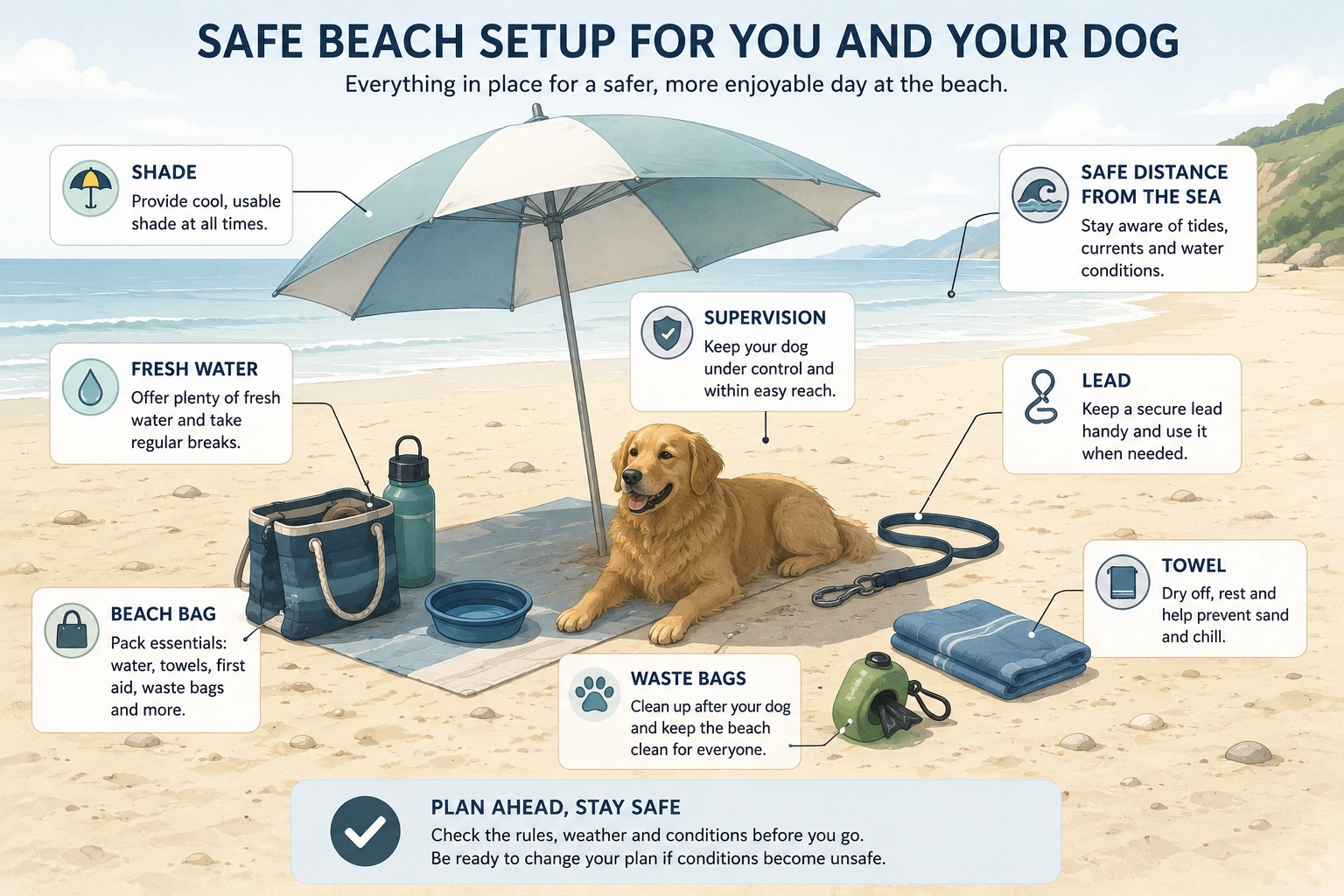
A basic beach safety kit should include:
- plenty of fresh drinking water;
- a portable bowl;
- your dog’s normal short lead;
- a secure harness where appropriate;
- a long line only where it can be used safely;
- waste bags;
- towels;
- usable shade if natural shade is unavailable;
- any prescribed medication;
- a basic canine first-aid kit;
- a charged phone;
- emergency veterinary details;
- a collar and current identification tag.
Your dog should also be microchipped, with your contact details kept up to date.
Equipment supports a safe plan, but it does not turn an unsuitable beach or dangerous weather into safe conditions. A shelter, cooling product or flotation aid cannot replace supervision.
For a more detailed packing and equipment guide, see essential dog beach equipment.
Provide shade, water and regular rest
What usable beach shade needs to do
Good beach shade should:
- be large enough for your dog to lie fully out of direct sunlight;
- allow air to circulate;
- remain secure in the wind;
- stay clear of the incoming tide;
- remain available as the sun changes position;
- avoid trapping warm air around the dog.
A small patch of shade over only part of your dog’s body is not enough. Nor should a poorly ventilated shelter be treated as a safe refuge during extreme heat.
For help choosing and positioning a shelter, see the guide to beach shade options for dogs.
Even with good shade, shorten or cancel the visit if the overall conditions are too warm. Shade reduces direct solar exposure but does not remove the effects of high air temperature, humidity or exertion.
Prevent dehydration and sea-water drinking
Bring more fresh water than you expect to need and offer it regularly.
Do not wait until your dog appears obviously thirsty or tired. Swimming, running and excitement may make a dog less willing to pause voluntarily.
Use a clean bowl rather than allowing your dog to drink from:
- the sea;
- stagnant pools;
- unknown puddles;
- containers shared by many unfamiliar dogs.
Take regular breaks from swimming and retrieving. Repeatedly fetching a toy from the sea can increase the amount of salt water swallowed.
Keep your dog under effective control
When your dog should remain on a lead
Keep your dog on a lead when:
- local rules require it;
- recall is unreliable;
- you are near cliffs, roads or deep water;
- there are strong currents or large waves;
- the beach is crowded;
- children, horses, wildlife or nervous dogs are nearby;
- your dog chases birds;
- your dog scavenges;
- visibility is poor;
- the area contains fishing equipment, litter or other hazards.
Recall that works in a quiet park may fail around waves, birds, food, unfamiliar dogs and moving toys.
Do not use a busy beach as the first test of off-lead recall.
Long lines can help, but they have limitations
A long line can provide controlled freedom, but it is not suitable everywhere.
It can:
- wrap around people or dogs;
- become caught on rocks;
- trail through fishing line or debris;
- be difficult to manage in crowds;
- become dangerous in moving water;
- give the false impression that a dog cannot reach a hazard.
Where a long line is appropriate, it is generally safer to attach it to a well-fitting harness rather than using it to stop a fast-moving dog by the neck.
Return to a normal lead before approaching other dogs, horses, children, narrow paths or crowded entrances.
Is it safe for your dog to swim in the sea?
Not every dog can swim safely, and even a capable swimmer can become overwhelmed by cold, fatigue, waves or currents.
Before allowing your dog into the sea, consider:
- previous swimming experience;
- confidence in water;
- age and physical fitness;
- body shape and breed-related limitations;
- heart, breathing, joint or mobility problems;
- water temperature;
- wave height;
- current and tide;
- the depth close to shore;
- the entry and exit points;
- whether your dog repeatedly drinks the water.
Start with shallow, controlled paddling if you are uncertain.
Never:
- throw or force a dog into the water;
- encourage a dog to swim far from shore;
- assume enthusiasm means ability;
- leave a dog unsupervised;
- allow repeated swimming until obvious exhaustion;
- use a flotation aid as permission to enter unsafe water.
Some dogs may benefit from a correctly fitted canine flotation aid, but it cannot make rough water, strong currents or poor supervision safe.
For a fuller assessment, read about whether dogs are safe in salt water and see the complete dog swimming safety guide.
Stop your dog drinking sea water or eating sand
Sea-water ingestion
Drinking sea water can cause vomiting and diarrhoea. Larger or repeated amounts can lead to potentially serious salt-related illness.
Reduce the risk by:
- offering fresh water frequently;
- interrupting deliberate sea-water drinking;
- limiting prolonged retrieving from the sea;
- taking regular breaks;
- stopping the activity if your dog keeps swallowing water.
Contact a vet promptly if your dog has drunk a significant amount or develops symptoms such as:
- repeated vomiting;
- diarrhoea;
- unusual thirst;
- marked weakness or lethargy;
- disorientation;
- tremors;
- seizures;
- collapse.
Do not attempt to treat suspected salt toxicity by forcing large amounts of water or giving homemade electrolyte mixtures unless a vet specifically instructs you to do so.
See the dedicated guide to salt water poisoning in dogs for the fuller warning signs and veterinary context.
The Dogs Trust advises preventing sea-water drinking and rinsing salt and sand from the coat and paws after the visit.
Sand ingestion
Dogs can swallow sand while:
- picking up sand-covered balls;
- digging;
- eating dropped food;
- licking their paws and coat;
- chewing objects on the ground.
Large amounts of sand can cause serious digestive problems.
Reduce the risk by using toys that do not collect large quantities of sand and by stopping repeated digging or sand eating.
Contact a vet if your dog has swallowed a substantial amount or develops:
- repeated vomiting;
- abdominal pain;
- loss of appetite;
- marked lethargy;
- straining to pass stools;
- a swollen or uncomfortable abdomen.
Do not attempt to diagnose or treat a possible blockage at home.
Watch for hidden beach hazards
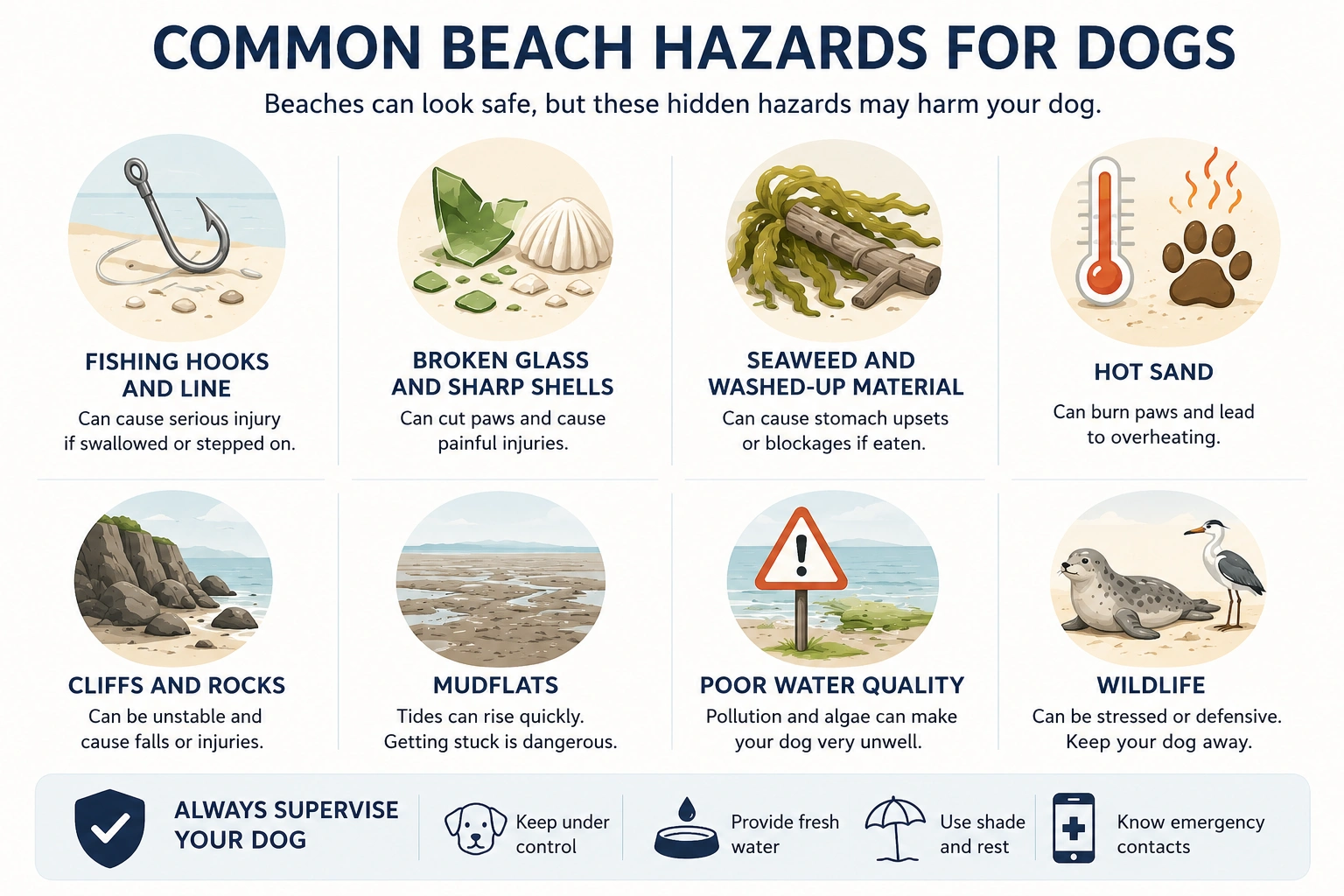
| Hazard | How to reduce the risk | What to do if there is a problem |
|---|---|---|
| Fishing hooks and line | Keep your dog close around fishing areas and inspect the ground | Prevent further movement and contact a vet; do not pull an embedded hook out blindly |
| Broken glass and sharp shells | Check the area before settling and avoid littered sections | Rinse minor contamination with clean water and seek veterinary advice for deep, painful or heavily bleeding wounds |
| Seaweed and washed-up material | Prevent scavenging and obey local warnings | Contact a vet if your dog eats an unknown substance or becomes unwell |
| Hot sand | Check repeatedly and use cooler routes | Move to a cool surface and contact a vet if a burn is suspected |
| Cliffs and rocks | Use a lead near edges and slippery terrain | Do not enter a dangerous cliff area; call the Coastguard in an emergency |
| Mudflats and soft ground | Follow signs and avoid known mud hazards | Do not enter mud to rescue your dog; call the Coastguard |
| Poor water quality | Check official information and local notices | Keep the dog out of the water and follow official warnings |
| Wildlife | Keep distance and use a lead where necessary | Leave the area if your dog cannot remain under control |
Fishing hooks, line and sharp debris
Fishing hooks can become embedded in the mouth, paws or skin. Fishing line can also tighten around limbs or be swallowed.
Do not pull hard on an embedded hook or line. Prevent your dog from chewing at it and contact a vet.
Broken glass, metal, sharp shells and discarded barbecue items can be partly hidden by sand or pebbles. Check the immediate area before allowing your dog to run or settle.
Seaweed, dead animals and washed-up substances
Do not allow your dog to eat:
- unfamiliar seaweed;
- dead fish or birds;
- bait;
- carcasses;
- plastic;
- oil-like or waxy substances;
- unidentified washed-up material.
It may not be possible to tell whether a substance is harmful by looking at it. Follow local warnings and contact a vet if your dog eats something unknown or develops symptoms.
Rocks, cliffs, caves and mud
Keep your dog on a lead near:
- cliff edges;
- unstable rocks;
- slippery surfaces;
- caves affected by tides;
- mudflats;
- fast-moving water.
If your dog becomes trapped in mud, enters dangerous water or goes over a cliff, do not follow. Dogs Trust and the RNLI advise moving to a place the dog may be able to reach safely and calling 999 or 112 and asking for the Coastguard if help is needed.
Wildlife and other animals
Beaches may support nesting birds, seals and other protected wildlife. Nearby paths may also cross land containing livestock or horses.
Keep your dog at a distance and follow local signs. A dog does not have to catch an animal to cause disturbance; chasing or repeatedly approaching wildlife can be harmful.
Use a lead where there is any doubt.
Poor or suspicious water quality
Check current official bathing-water information and local notices before allowing your dog to enter the water.
Avoid the water when:
- an official warning advises against bathing;
- a pollution alert is active;
- sewage pollution is suspected;
- the water is unusually discoloured or scummy;
- dead fish or other wildlife are present;
- there is an algal warning;
- a lifeguard or beach operator advises against entry.
In England, bathing-water classifications are based on samples gathered over several seasons rather than being a guarantee of conditions at every moment. Short-term pollution warnings may also be issued where a temporary deterioration is predicted.
Use official bathing-water information as one part of your decision, not as proof that the water is safe for an individual dog.
Help your dog cope with crowds and other dogs
A beach can be overwhelming for a dog that is normally calm elsewhere.
Possible triggers include:
- running and shouting children;
- kites;
- surfboards;
- horses;
- ball games;
- unfamiliar dogs;
- food and picnics;
- waves and machinery;
- narrow or crowded access points.
Choose a quieter time if your dog struggles with busy environments.
Call your dog back or attach the lead before approaching other people or animals. Do not allow your dog to run up to unfamiliar dogs, steal toys, disturb picnics or chase children.
Leave toys at home if your dog guards them or becomes overexcited around other dogs.
A shorter, calm visit is better than remaining until your dog becomes stressed or difficult to control.
Know what to do in a beach emergency
If your dog is in dangerous water, mud or below a cliff
Do not place yourself in danger by entering the sea, mud or an unstable cliff area.
Instead:
- Move to a safer place your dog may be able to reach.
- Call your dog calmly if it is safe to do so.
- Alert a lifeguard if one is present.
- Call 999 or 112.
- Ask for the Coastguard.
Do not attempt an improvised rescue in fast water or mud. A second person in danger makes the emergency more difficult.
When your dog needs urgent veterinary help
Seek urgent veterinary advice following:
- breathing difficulty;
- collapse;
- seizures;
- severe weakness;
- marked confusion or disorientation;
- suspected heatstroke;
- significant sea-water ingestion;
- possible poisoning;
- repeated vomiting;
- a swollen or painful abdomen;
- an embedded fishing hook;
- deep or heavily bleeding wounds;
- suspected drowning or inhalation of water;
- serious paw burns;
- inability to use a limb.
Tell the vet:
- what happened;
- what may have been swallowed;
- approximately when it happened;
- the amount involved, if known;
- your dog’s symptoms;
- your dog’s age, size and relevant medical conditions;
- your current location.
Do not delay contacting a professional while searching for a home remedy.
Check and clean your dog after the beach
After the visit:
- rinse the coat and paws with fresh water;
- remove sand carefully;
- dry the dog thoroughly;
- check between the toes;
- inspect the paw pads;
- check the skin for redness or irritation;
- look for cuts, hooks, thorns or tar-like substances;
- check the eyes for redness or discomfort;
- dry the outside of the ears without putting objects or products into the ear canal;
- wash and dry reusable equipment;
- allow your dog to rest;
- provide normal access to fresh water.
Rinsing removes salt and sand that the dog might otherwise lick from its coat and can help reduce irritation.
For further information, see how salt water can affect a dog’s skin.
Continue monitoring your dog after returning home. Contact a vet if you notice vomiting, diarrhoea, coughing, unusual tiredness, pain, excessive drinking, breathing changes or any other concerning symptom.
Dog beach safety checklist
Before leaving
- Confirm that dogs are allowed.
- Check seasonal zones and lead rules.
- Check the weather and heat risk.
- Check tide times and sea conditions.
- Check current pollution or bathing-water warnings.
- Assess whether your individual dog is suitable for the visit.
- Pack water, a bowl, lead equipment, shade and towels.
- Save veterinary and emergency details.
At the beach
- Read the signs again.
- Identify your safe exit route.
- Set up shade and water.
- Keep your dog under effective control.
- Prevent sea-water drinking and sand eating.
- Supervise all paddling and swimming.
- Take regular breaks.
- Watch for overheating, stress and fatigue.
- Leave if conditions deteriorate.
After the visit
- Rinse off salt and sand.
- Dry your dog thoroughly.
- Check the paws, coat, skin and eyes.
- Monitor for delayed symptoms.
- Contact a vet promptly if anything concerns you.
Frequently asked questions
Can dogs drink a little sea water?
A small accidental mouthful may cause no obvious problem, but sea water can cause vomiting or diarrhoea, and repeated or substantial ingestion can become serious. Prevent deliberate drinking, offer fresh water and contact a vet if your dog has swallowed a significant quantity or develops symptoms.
Should I rinse my dog after every beach visit?
Rinsing with fresh water is sensible after swimming or playing on salty or sandy beaches. It removes salt, sand and other residue from the coat and paws and reduces the amount your dog may lick off later.
Can I take a puppy to the beach?
A puppy can visit a suitable beach once your vet is satisfied that its vaccination protection is adequate for public environments. Keep the visit short, avoid heat and crowds, prevent overexertion and use a lead. Puppies tire quickly and may swallow sand, sea water or unfamiliar objects.
Does my dog need a life jacket at the beach?
Some dogs may benefit from a correctly fitted canine flotation aid, particularly inexperienced swimmers or dogs with physical limitations. However, it cannot make rough water safe and must never replace close supervision, sensible depth limits and safe sea conditions.
Plan for the dog in front of you
The safest beach visit is not necessarily the longest one.
Check the rules and conditions, provide fresh water and genuine shade, supervise closely and be prepared to change the plan. Keeping your dog on a lead, staying out of the sea or leaving early can be the correct choice.
Good beach safety is less about taking every possible product and more about recognising when the beach, weather or water is not suitable that day.
Read next
- Essential Dog Beach Equipment