
The best shade for your dog is not necessarily the most expensive shelter. It is a stable, well-ventilated area that is large enough for your dog to lie in comfortably and remains shaded when they need to use it.
Depending on your garden and budget, that could mean using the shadow from your house, planting trees or shrubs, positioning a parasol, installing an awning or shade sail, or setting up a portable dog shelter.
Whatever method you choose, shade is only one part of keeping a dog safe in warm weather. Your dog still needs fresh water, limited activity, close monitoring and the freedom to move somewhere cooler. On very hot or humid days, the safest shaded place may be indoors.
Before You Start: Check Whether Shade Is Enough Today
Shade protects your dog from direct sunlight, but it does not remove heat from the surrounding air or eliminate the risk of heatstroke.
Before encouraging your dog to spend time outside, consider:
- how warm and humid it feels;
- the time of day;
- how long your dog will be outside;
- whether they have been exercising;
- whether the space has good airflow;
- whether the ground or nearby walls are radiating heat;
- your dog’s age, breed, weight, health and coat.
Puppies, older dogs, overweight dogs, flat-faced breeds and dogs with breathing, heart or other relevant health problems may struggle more in warm conditions.
The RSPCA and Dogs Trust advise providing dogs with constant access to shade and fresh water, but both also emphasise the need to recognise overheating and heatstroke.
Learn more about why shade alone may not be enough in hot weather in Shade Safety: Is Shade Enough to Protect Your Dog?
If your dog is panting much more heavily than usual, struggling to breathe, drooling excessively, vomiting, becoming weak or uncoordinated, appearing confused or collapsing, move them to a cooler place and contact a vet urgently.
See Dog Heatstroke: Symptoms, Treatment & Prevention (Complete Guide) for the signs of heatstroke and what to do.
What Makes a Good Shaded Area for a Dog?
A suitable shaded area should:
- protect your dog’s whole body from direct sunlight;
- have enough spare coverage to allow for some movement of the sun;
- let air circulate freely;
- be stable and securely positioned;
- have no trailing cords, sharp fixings or accessible mechanisms;
- contain a comfortable surface that is not retaining excessive heat;
- give your dog easy access to fresh water;
- allow your dog to enter and leave freely;
- remain usable during the period your dog is likely to need it.
It should also be somewhere your dog actually wants to rest. A perfectly constructed shelter is of little value if it is placed in a noisy, enclosed or unfamiliar corner that your dog avoids.
Safety warning
Shade does not make every hot day safe. If your dog appears uncomfortable, is panting unusually heavily or repeatedly tries to go indoors, move them somewhere cooler. Suspected heatstroke requires urgent action and veterinary advice.
Step 1: Watch Where the Sun and Your Dog Move
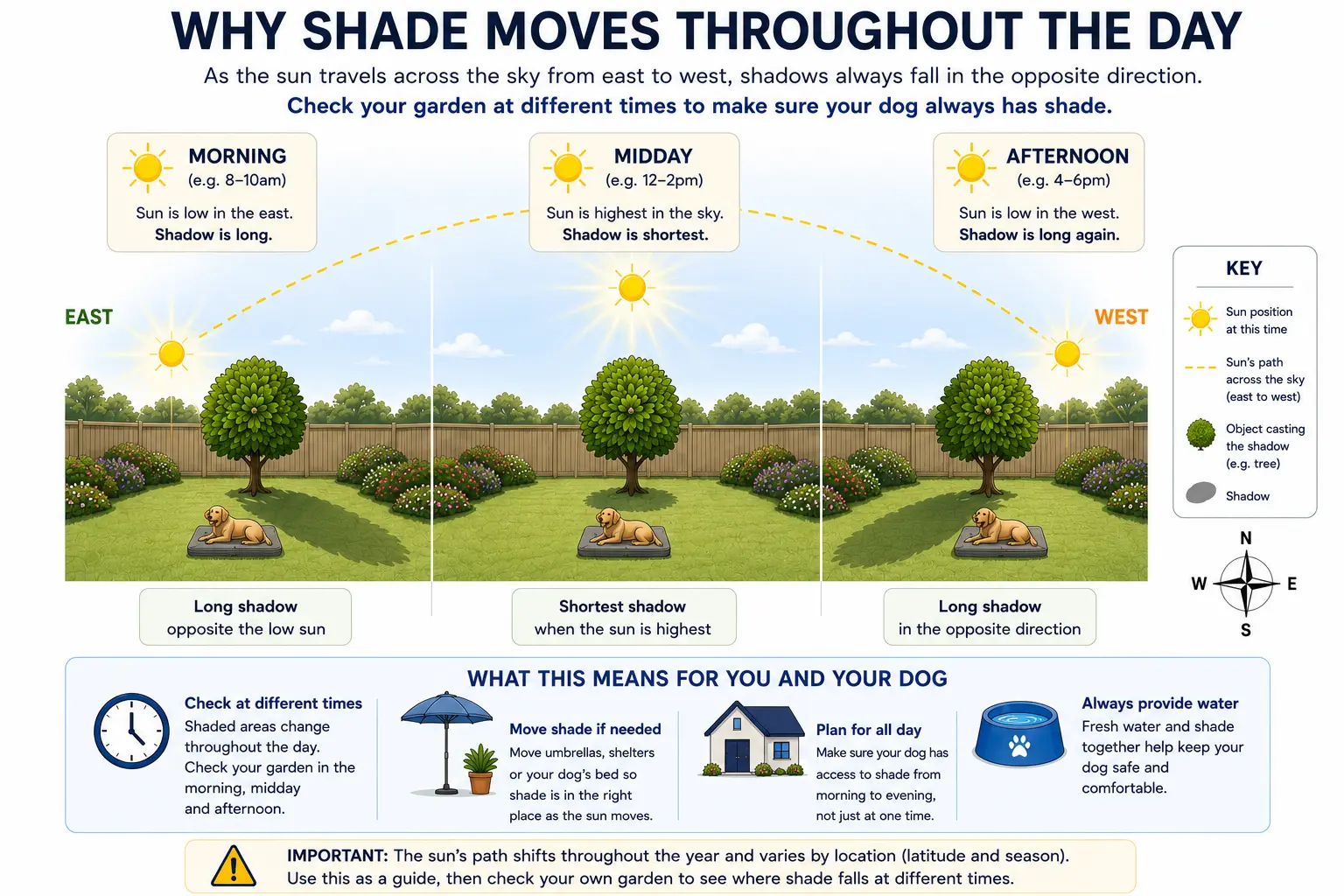
Before buying or building anything, spend a day observing the outdoor space.
Check it in the morning, around midday and later in the afternoon. Note:
- where direct sunlight falls;
- which areas are naturally shaded;
- how those shadows move;
- where your dog normally chooses to rest;
- whether walls, paving or artificial grass become noticeably warm;
- whether the proposed area remains well ventilated.
An area that is shaded at breakfast time may be in full sun later. The RSPCA specifically warns owners to account for the movement of the sun rather than assuming that morning shade will remain available all day.
Taking photographs from the same position at several points during the day can make the pattern easier to see.
If your dog already has a favourite resting place, start by assessing whether you can shade that area. Moving the shelter to an entirely different part of the garden may make it less likely that your dog will use it.
Step 2: Decide How Much Shade Your Dog Needs
There is no single correct shelter size for every dog.
The shaded footprint should be large enough to cover:
- your dog’s whole body when lying naturally;
- their bed or resting surface, where one is used;
- their water bowl, where practical;
- more than one dog if they are expected to share it;
- some additional space to allow for the changing angle of the sun.
Measure the usable shaded area rather than relying only on the outside dimensions shown for a shelter or canopy.
A product can have a large overall footprint but still provide limited shade beneath a low or sloping roof. Your dog should be able to stand, turn around and lie comfortably without pressing against hot fabric or an enclosed side.
Step 3: Choose the Right Type of Dog Shade
The right option depends on your space, budget, whether permanent alterations are possible and how often the shade needs to move.
Use Existing Building Shade
The simplest option may already be available.
Useful existing shade can come from:
- a covered patio;
- a porch;
- an open-sided outbuilding;
- the shadow of the house;
- an existing awning;
- a well-ventilated area beneath a raised structure.
This normally costs nothing and may provide more coverage than a small dog shelter.
However, check the area throughout the day. Walls and paving can retain heat, and a covered corner with little airflow may feel hotter than a more open part of the garden.
Existing shade is suitable only when it remains comfortable, ventilated and accessible.
Create Natural Shade with Trees and Large Shrubs
Trees and large shrubs can provide broad, attractive shade while helping the garden feel more sheltered.
Blue Cross recommends large shrubs, trees and large umbrellas as ways of creating shaded garden areas for dogs.
Natural shade works particularly well when:
- the plant canopy is already established;
- the area underneath is open and well ventilated;
- the plants are safe around dogs;
- falling branches, thorns or irritating foliage are not a concern;
- the shade is available at the times your dog uses the garden.
New planting is a longer-term solution rather than an immediate answer. Deciduous plants may also provide much less cover during parts of the year.
For a more complete outdoor enrichment project, see How to Create a Sensory Garden for Dogs.
For wider layout, planting and safety considerations, see How to Create a Dog Friendly Garden: The Ultimate Guide.
Use a Parasol or Cantilever Umbrella
A garden parasol is one of the easiest adjustable dog-shade ideas.
It can work well on a patio or in a small garden because you can reposition or tilt it as the sun moves. A cantilever design places the support pole away from the centre of the shaded area, leaving more room for a dog bed and water bowl.
Look for:
- a canopy large enough to cover the resting area;
- an appropriately heavy and compatible base;
- an adjustable angle;
- a secure opening mechanism;
- manufacturer guidance on wind and weather limits;
- a design that does not expose your dog to chewable cords or moving parts.
A lightweight parasol can become unstable in a breeze. Do not improvise a base or leave it open in conditions outside the manufacturer’s stated limits.
Install an Awning or Pergola
An awning or pergola can provide a larger permanent shaded area for both people and dogs.
A retractable awning is useful when you want to adjust the amount of cover. A pergola can provide long-term shade when used with a suitable roof, canopy or established climbing plants.
Consider:
- the direction of the sun;
- whether rainwater will drain safely;
- ventilation around the structure;
- the strength of walls, posts and fixings;
- permission from the property owner, where relevant;
- whether professional installation is needed.
A pergola without sufficient overhead cover may create attractive patterned shade but leave much of your dog exposed as the sun moves.
Use a Shade Sail
A shade sail can cover a larger or awkwardly shaped area without placing a central pole beside your dog.
It may suit a patio, courtyard or designated dog-resting zone, but safe installation matters. A tensioned sail can place considerable force on its fixing points.
Before using one:
- confirm that every anchor point is structurally suitable;
- follow the manufacturer’s instructions for fixings and tension;
- provide the recommended slope for drainage;
- keep cords and hardware away from your dog;
- check the product’s wind and weather limits;
- remove or retract it when instructed.
Do not assume that an ordinary garden fence, fascia board or improvised wooden post can safely support a tensioned sail.
If the shaded area is also part of a new boundary or dog zone, see Dog Fence Ideas for Gardens. The fencing guide should not be treated as structural approval for attaching a shade sail.
For permanent anchors, uncertain masonry or new structural posts, obtain suitable professional advice.
Use a Gazebo or Freestanding Canopy
A gazebo or freestanding canopy can provide generous temporary shade without permanent alterations.
It can be useful when:
- several dogs need space;
- the shaded area is shared with people;
- a permanent awning is unsuitable;
- the structure needs to be stored outside the warmer months.
Keep the sides open unless a particular panel is genuinely needed. Closing several sides can restrict airflow and create a warmer enclosed space.
The frame must be secured according to the manufacturer’s instructions. Pegs may not be suitable for every surface, while weights must be compatible with the structure and expected conditions.
Remove your dog and dismantle the canopy if it becomes unstable or conditions exceed its stated limits.
Choose a Portable Dog Shade Shelter
A portable dog shelter can be useful in a small garden or when the shaded space needs to move.
Before buying one, check:
- the usable internal dimensions;
- whether your dog can stand, turn and lie naturally;
- how open the sides are;
- whether air can move through the shelter;
- how the frame is secured;
- whether pegs can be used on your surface;
- the packed size and weight;
- how the fabric should be cleaned;
- the manufacturer’s weather limitations;
- whether low roof panels could trap warm air around a larger dog.
A claim that a shelter is suitable for a particular breed size is less useful than its actual internal measurements.
If you need portable shade specifically for trips to the coast, Beach Shade for Dogs explains how to choose and set up suitable shade for a dog at the beach.
Readers who need help comparing available designs can compare dog shade shelters in Best Dog Shade Shelters.
Make a Simple Temporary Sun Shelter
You may be able to create useful temporary shade without buying a specialist product.
A simple method is to place a light sheet or similar breathable fabric over a stable table, chair or stool, keeping several sides open.
PDSA recommends this type of low-cost shelter and advises avoiding fleece because thick material can trap heat.
To set it up safely:
- Choose a stable item that cannot easily tip.
- Use light fabric rather than thick insulating material.
- Keep several sides completely open.
- Secure the fabric so it cannot fall onto or entangle your dog.
- Make sure the dog can enter and leave freely.
- Check that the structure will not move in the breeze.
- Supervise your dog while it is in use.
- Move the shelter as the sun changes position.
This is a temporary, supervised solution rather than a permanent outdoor structure.
For a more substantial project, see how to build a more permanent DIY dog shade structure in DIY Dog Shade Structures.
Quick Comparison of Dog-Shade Ideas
| Shade method | Best for | Adjustable? | New purchase usually needed? | Main limitation |
|---|---|---|---|---|
| Existing building shade | The lowest-effort solution | Usually no | No | May move or be surrounded by heat-retaining surfaces |
| Trees and shrubs | Natural long-term garden shade | No | Sometimes | Takes time to establish and may be seasonal |
| Parasol | Patios and flexible positioning | Yes | Usually | Needs a stable base and regular repositioning |
| Awning | Broad patio coverage | Often | Yes | May require permanent installation |
| Pergola | A larger permanent resting area | Sometimes | Yes | Space, cost and the type of overhead cover |
| Shade sail | Wide or awkwardly shaped areas | Usually no | Yes | Requires safe anchors and correct tension |
| Gazebo or canopy | Large temporary shade | Sometimes | Yes | Anchoring, storage and wind limitations |
| Portable dog shelter | Compact or moveable shade | Yes | Yes | Limited coverage and stability |
| Temporary fabric shelter | Low-cost supervised use | Yes | Not necessarily | Must remain open, secure and supervised |
Step 4: Position and Secure the Shade Safely
Once you have selected a method, test its position before your dog uses it.
1. Mark the Shaded Footprint
Place the shelter temporarily or mark the expected shadow on the ground.
Check that it covers the dog’s full resting area rather than only the centre of the bed.
2. Preserve Airflow
Keep the shelter open on several sides.
Adding extra fabric may create more apparent shade but can also reduce ventilation. Avoid wrapping a gazebo, kennel or temporary shelter in heavy material.
3. Remove Hazards
Check for:
- trailing guy ropes;
- low cords;
- exposed hooks;
- sharp edges;
- unstable poles;
- accessible moving mechanisms;
- fixings your dog could chew;
- fabric that could collapse onto the dog.
Do not place the dog beneath the structure until these have been addressed.
4. Follow the Installation Instructions
Use the manufacturer’s specified:
- anchors;
- bases;
- tensioning method;
- compatible accessories;
- wind limits;
- storage instructions.
Do not invent your own structural fixings for a tensioned shade sail or permanent canopy.
5. Test Stability Without the Dog Present
Gently check that the structure is stable and that normal movement of the fabric will not frighten or strike your dog.
If the shelter lifts, rocks or collapses during testing, do not use it until the problem has been corrected.
6. Recheck It Later
Return at the time when the sun is strongest in that part of the garden.
If direct sunlight has reached the bed or water bowl, move, angle or enlarge the shade.
Step 5: Make the Shaded Area Comfortable
Your dog needs to choose the shaded area voluntarily, so comfort matters.
Provide Fresh Water
Place a clean water bowl within or immediately beside the shaded area where it cannot be knocked over easily.
Blue Cross recommends positioning water in shaded spots so it remains cooler for longer.
Refresh the water regularly. Do not assume that shade will keep it cool indefinitely.
Check the Ground
Shade over a hot surface may not create a comfortable resting area.
Check:
- paving;
- concrete;
- decking;
- gravel;
- artificial grass;
- dark-coloured surfaces.
If the ground remains uncomfortably warm, move the shelter or provide a suitable resting surface.
Choose Bedding Carefully
A stable outdoor bed, raised mesh bed or appropriate mat may improve comfort, but none is compulsory.
Avoid thick bedding that retains heat. Make sure any raised bed is:
- stable;
- correctly sized;
- undamaged;
- easy for your dog to get on and off;
- suitable for their mobility.
Keep the Space Open
Your dog should be able to move:
- into the shade;
- out of the shade;
- to their water;
- indoors or to another cooler location.
Do not tether, confine or shut your dog into a small shelter to make them use it.
Step 6: Test the Shade Before Relying on It
Before treating the setup as complete, check:
- Is your dog’s entire body shaded when lying down?
- Is there room for them to change position?
- Can air move freely through the space?
- Is the structure stable?
- Are ropes, fixings and mechanisms safely positioned?
- Is the ground comfortable?
- Is fresh water available?
- Can your dog leave freely?
- Does your dog choose to rest there?
- Will the shade remain in place later?
- Is the weather still suitable for outdoor rest?
- Can the structure be moved or stored if the wind increases?
Test the area over the hours in which it is intended to be used. A shelter that works for ten minutes after assembly may not provide enough shade later in the afternoon.
How to Tell Whether the Shaded Area Is Working
A successful shaded area should be:
- large enough for your dog to lie fully inside it;
- ventilated rather than stuffy;
- stable in suitable conditions;
- available when the sun reaches the resting area;
- positioned somewhere your dog uses voluntarily;
- supplied with fresh water;
- easy to leave.
Your dog may settle, sleep or move between the shaded area and indoors.
However, resting in the shelter does not prove that overheating is impossible. Continue to monitor your dog’s breathing, behaviour and comfort.
If your dog repeatedly abandons the shelter for a cooler indoor space, let them stay indoors. Do not try to make the outdoor setup work simply because you have bought or built it.
Common Dog-Shade Mistakes
Making the Shaded Area Too Small
A small canopy may cover part of your dog when the sun is directly overhead but expose them as the shadow moves.
Correction: Allow room for the whole resting area, water and some movement of the shadow.
Checking It at Only One Time of Day
Morning shade may disappear in the afternoon.
Correction: Check the location several times during the day and in the season when it will be used.
Covering Too Many Sides
Extra fabric can block airflow and trap warm air.
Correction: Keep several sides open and use light, appropriate material.
Ignoring the Surface Beneath the Shade
Paving or artificial grass can remain warm after direct sunlight has moved away.
Correction: Test the surface and move the shade or provide a suitable resting area.
Using an Unstable Lightweight Shelter
A canopy that tips or lifts can injure or frighten a dog.
Correction: Follow the specified anchoring instructions and dismantle it when conditions are unsuitable.
Attaching a Shade Sail to an Unsuitable Structure
A fence or fascia that looks solid may not be designed for the force created by a tensioned sail.
Correction: Use verified structural anchors and seek professional advice where necessary.
Treating UV Protection as Complete Heat Protection
UV-resistant fabric can reduce exposure to ultraviolet radiation, but it does not guarantee that the space beneath it will remain cool.
Correction: Consider airflow, ambient heat, surface temperature, activity and the individual dog.
Forcing the Dog to Stay Outside
Shade does not make outdoor conditions automatically suitable.
Correction: Give your dog free access to a cooler place and bring them indoors when needed.
Leaving the Shelter Unchecked
Wind, rain, sun angle and loose fixings can change the safety of the setup.
Correction: Inspect it before use and whenever conditions change.
Troubleshooting Your Dog’s Shaded Area
| What you notice | Possible practical reason | What to do next |
|---|---|---|
| Your dog will not use the shade | Poor position, noise, unfamiliar fabric or a warm surface | Move it closer to a preferred resting place and allow voluntary exploration |
| Sun reaches the bed later | The shadow has moved | Reposition, tilt or enlarge the shade |
| The space feels stuffy | Too many enclosed sides or a roof that is too low | Open the sides or choose a more ventilated shelter |
| The shelter moves in the wind | Inadequate anchoring or unsuitable conditions | Remove the dog and secure or dismantle the structure |
| The water becomes warm quickly | The bowl is partly exposed or sitting on a hot surface | Move it farther into the shade and refresh it |
| Your dog repeatedly goes indoors | The outdoor area is still uncomfortable | Allow them to stay inside |
| Your dog is heavily panting, weak, confused, vomiting or unsteady | Possible overheating or heatstroke | Move them to a cooler place, begin appropriate cooling first aid and contact a vet urgently |
RSPCA guidance lists heavy panting, difficulty breathing, excessive drooling, lethargy, poor coordination, vomiting and collapse among warning signs that require rapid action.
Maintaining Permanent and Portable Shade
Inspect the setup regularly and whenever the weather has been windy or wet.
Check for:
- loose fixings;
- stretched or torn fabric;
- unstable frames;
- rust;
- splintered wood;
- sharp edges;
- mould;
- chewing damage;
- frayed ropes;
- standing water;
- parts that no longer open or lock correctly.
Clean and store the shelter according to the manufacturer’s instructions. Allow fabric to dry before packing it away.
Reassess natural shade as plants grow, are pruned or lose their leaves. Repeat the sun-position check as the seasons change because the angle and duration of sunlight will vary.
Stop using any shelter that cannot be made stable or has damage that could injure, trap or entangle your dog.
Which Dog-Shade Option Should You Choose?
Use the simplest method that provides reliable, safe coverage.
- Use existing shade when it stays ventilated and covers the resting area at the right times.
- Choose a parasol when you need to adjust the angle or position frequently.
- Choose an awning or pergola for a larger permanent shared area.
- Choose a shade sail when broad coverage is needed and safe structural anchors are available.
- Choose a gazebo or canopy for flexible temporary coverage.
- Choose a portable dog shelter for a compact space or movable resting area.
- Use a simple fabric shelter when a secure, supervised temporary solution is enough.
- Bring your dog indoors when the outside temperature, humidity or your dog’s behaviour suggests that shade is not sufficient.
Final Dog-Shade Safety Checklist
Before your dog uses the area, confirm that:
- the whole resting space is shaded;
- the sun’s movement has been considered;
- airflow is unrestricted;
- the structure is stable;
- the ground is comfortable;
- fresh water is available;
- your dog can enter and leave freely;
- cords, fixings and chew hazards are inaccessible;
- current weather conditions are suitable;
- your dog will be monitored;
- a cooler indoor option remains available.
The best dog-shade idea is the one that works for your actual space and your individual dog. Create enough coverage, keep it open and stable, check it as the sun moves and never rely on shade alone when the weather is too warm for your dog to remain comfortable outside.
Read Next
- Shade Safety: Is Shade Enough to Protect Your Dog?
- Best Dog Shade Shelters