

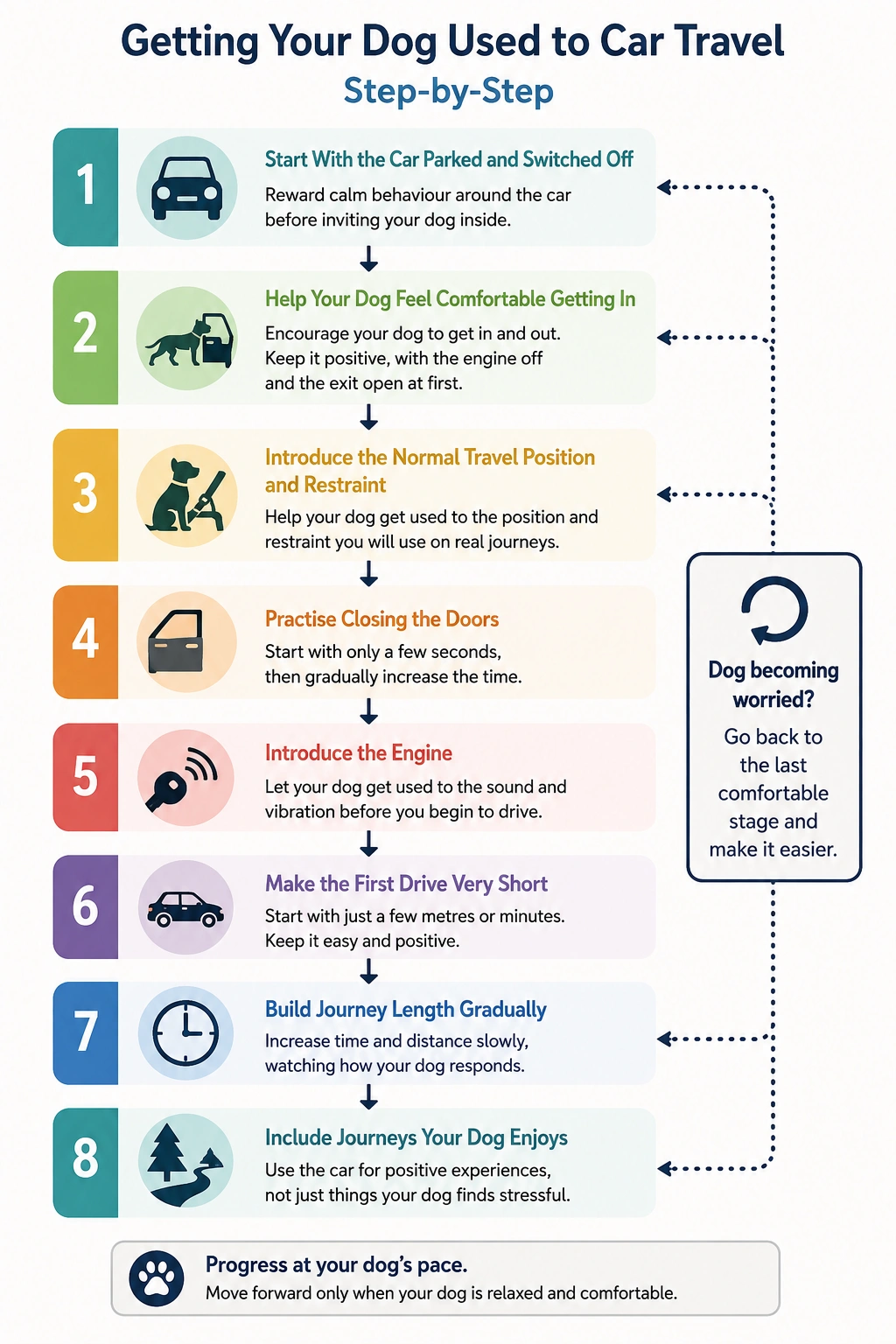
If your dog is unsure about travelling by car, the best approach is usually to introduce it gradually rather than starting with a full journey. Begin with the car parked and switched off, reward calm behaviour, then build up through sitting inside, closing the doors, starting the engine and taking very short drives.
Move forward according to how comfortable your dog is, not according to a fixed timetable. If they become noticeably worried or show signs of travel sickness, make the exercise easier or stop and address the underlying problem before continuing. This gradual approach is consistent with current guidance from Dogs Trust and Battersea.
Before You Start: Check Why Your Dog Dislikes the Car
A dog that has simply never travelled much needs a different approach from one that becomes severely frightened or physically sick in a moving vehicle.
Before starting, think about what actually happens around the car.
A dog who is inexperienced may hesitate at first but remain interested in treats, investigate the vehicle and gradually become more confident. A worried dog might back away, resist getting in, tremble, pace, vocalise or repeatedly try to leave.
Also watch for possible travel sickness. Signs can include excessive drooling, lip licking, repeated swallowing, retching and vomiting. Motion sickness and anxiety can overlap: feeling sick in the car can cause a dog to develop a negative association with travelling.
If your dog is showing signs like these, read our guide to car sickness in dogs before assuming that more behavioural training is the answer.
When to speak to your vet before training
Contact your vet if your dog:
- repeatedly vomits or appears nauseous in the car;
- suddenly becomes reluctant to travel when they were previously comfortable;
- appears to be in pain or physical discomfort;
- shows severe or escalating distress;
- has another health problem that might affect their ability to travel.
Blue Cross recommends seeking veterinary advice when a dog is an anxious traveller or suffers from car sickness.
Do not try to train a dog through obvious sickness, pain or severe fear.
What You Need Before You Begin
You do not need a large collection of specialist products to get a dog used to car travel.
For most dogs, the useful basics are:
- small, high-value treats your dog enjoys;
- a lead;
- the safe restraint or travel setup you intend to use on real journeys;
- comfortable, non-slip bedding where appropriate;
- a familiar blanket or bed if this helps your dog settle;
- ideally, another adult for the first moving-car sessions.
Dogs Trust suggests using familiar-smelling bedding for dogs that are tentative about entering a vehicle.
Your dog’s eventual travelling position should also be decided before you start taking real journeys. The Highway Code says dogs and other animals should be suitably restrained so that they cannot distract the driver or injure themselves or occupants if the vehicle stops quickly. It lists options including a seat-belt harness, pet carrier, dog cage and dog guard.
Our guide to travelling safely with a dog in a car covers restraint and general car safety in more detail.
How to Get Your Dog Used to the Car Step by Step
Some dogs will move through these stages quite quickly. Others may need many short sessions at one stage before they are ready for the next.
That variation is normal. What matters is that your dog remains comfortable enough to learn.
Step 1: Start With the Car Parked and Switched Off
Start without asking your dog to get into the car.
Park somewhere safe and quiet, switch the engine off and spend a little time around the vehicle. Reward your dog for calm behaviour, such as approaching the car voluntarily or simply standing nearby without becoming worried.
Dogs Trust recommends beginning by rewarding calm behaviour around the car before inviting the dog inside.
If your dog is already happy beside the car, you can move on quickly.
If they are reluctant even to approach it, start farther away. There is little benefit in leading a frightened dog straight up to the vehicle and hoping they will eventually give in.
Keep the first sessions easy enough for your dog to succeed.
Step 2: Help Your Dog Feel Comfortable Getting In
Once your dog is relaxed around the vehicle, open the door or other normal entry point and encourage them to investigate.
Use treats to make entering worthwhile, but avoid pulling or pushing a reluctant dog inside.
At first, getting in and immediately getting back out can be enough.
When your dog is comfortable doing that, encourage them to remain inside for a little longer. Keep the engine off and, initially, leave the exit open.
A familiar blanket or bed can help make the space feel less unfamiliar.
Dogs that cannot safely jump into a vehicle because of their size, age or mobility may need appropriate physical assistance or an access aid. The objective is not to make every dog jump into the car independently; it is to make entering and being inside as comfortable and predictable as possible.
Step 3: Introduce the Normal Travel Position and Restraint
Next, help your dog become comfortable in the position they will use when the car eventually moves.
That might involve a suitable harness, carrier, crate or another appropriate restraint arrangement. Let your dog experience the setup while the car is still stationary rather than introducing it for the first time immediately before a journey.
Reward calm behaviour and give them time to settle.
If the restraint itself is unfamiliar, introduce it separately where practical. You do not want the first moving journey to combine a strange car, an unfamiliar restraint, engine noise and movement all at once.
If you are considering carrying your dog in the boot area of a suitable vehicle, the question of whether a dog can travel in the boot of a car and how that space should be configured safely deserves separate consideration rather than being decided purely on convenience.
Step 4: Practise Closing the Doors
A dog that is comfortable sitting in an open car may feel very differently when the door closes.
Treat that as a separate stage.
Ask your dog to settle in their travel position, close the door briefly and then open it again while they are still comfortable.
Battersea recommends starting with only a few seconds and, for dogs worried by the movement of the door itself, even beginning by partially closing it before progressing to fully closed doors.
Gradually increase the time with the doors closed.
If your dog becomes more worried rather than more relaxed, shorten the exercise again.
Step 5: Introduce the Engine
Once your dog can settle comfortably in the stationary car with the doors closed, introduce the engine without immediately driving anywhere.
Starting the engine changes the experience significantly. There is noise, vibration and sometimes a change in airflow.
Start it, remain parked and observe your dog.
Reward calm behaviour. If your dog is comfortable, repeat the exercise on several occasions before adding movement if necessary.
Dogs Trust recommends gradually introducing the different sounds and sensations associated with the car rather than expecting a worried dog to cope with everything at once.
If starting the engine causes a noticeable increase in fear, switch it off and make this stage easier rather than immediately driving away.
Step 6: Make the First Drive Very Short
When your dog is relaxed with the engine running, introduce movement.
The first journey does not need to go anywhere useful. Its purpose is simply to let your dog experience the car moving and finish before the experience becomes overwhelming.
Choose a quiet route and drive smoothly. Accelerate, brake and corner gently where road conditions allow.
If possible, have another familiar adult travel with you. They can observe the dog while the driver concentrates fully on driving.
Current Dogs Trust and PDSA guidance both recommend beginning with very short journeys and building up gradually.
Keep the first successful drive deliberately easy.
Step 7: Build Journey Length Gradually
Once your dog can manage a very short drive comfortably, begin increasing the journey length.
There is no correct schedule that suits every dog.
A confident puppy might progress quickly. A dog with limited car experience or an unpleasant previous association may require much more repetition.
Look at the dog’s response rather than the calendar.
Only make the next journey more demanding when the current version has become comfortable and predictable. If adding distance causes a setback, shorten the next trip.
PDSA’s current guidance similarly recommends gradually building journey duration as the dog becomes accustomed to travelling.
Progress does not have to be perfectly linear. Going back one stage for a while is part of sensible training, not failure.
Step 8: Include Journeys Your Dog Enjoys
Once your dog is taking genuine short journeys, vary where the car takes them.
If every trip ends at somewhere your dog finds frightening or unpleasant, the vehicle itself can become a predictor of that experience.
Where practical, include simple journeys that lead to something your dog enjoys, such as a familiar walking location.
You can also occasionally practise sitting in the car without travelling anywhere. This helps prevent the sequence of getting into the vehicle from always predicting a long journey.
The aim is for car travel to become an ordinary part of life rather than a special event that reliably predicts stress.
How Do You Know Your Dog Is Ready for the Next Step?
Do not wait for a particular number of training sessions.
Look instead for signs that your dog is genuinely coping with the current stage.
Depending on the dog, encouraging signs can include:
- approaching the vehicle willingly;
- entering without being dragged or repeatedly coaxed;
- taking treats they would normally value;
- settling in their normal travel position;
- remaining comfortable when the doors close;
- coping with the engine starting without a marked increase in distress;
- completing a short drive without becoming progressively more worried;
- recovering normally after the journey.
You are looking for a pattern, not a single perfect performance.
Signs you may be moving too quickly
Make the exercise easier if your dog begins:
- repeatedly retreating from the car;
- trying persistently to escape;
- trembling or becoming unusually tense;
- pacing or being unable to settle;
- vocalising increasingly;
- refusing food they would normally take in that situation;
- panting heavily when heat or exertion does not explain it;
- showing nausea-related signs such as excessive drooling, repeated swallowing, lip licking or retching.
Dogs Trust advises owners to recognise signs of fear or stress and change the situation to help the dog feel safer rather than allowing distress to continue escalating.
One sign on its own does not necessarily tell you precisely what a dog is feeling, so look at the whole situation and changes from your dog’s normal behaviour.
What to Do If Your Dog Gets Worried During Training
If your dog becomes noticeably more worried when you introduce a new stage, do not keep increasing the difficulty in the hope that they will simply get used to it.
Instead:
- Stop progressing.
- Identify what changed.
- Return to an easier version of that stage.
- Repeat it until your dog is comfortable again.
- Make the next increase smaller.
For example, if your dog is relaxed in the open car but worries as soon as the door shuts, work on very brief or partial door closure.
If they are comfortable until the engine starts, practise the engine separately.
If the problem begins only when the car moves, return to much shorter drives and watch carefully for signs of motion sickness.
The goal is gradual familiarisation, not simply completing each step regardless of the dog’s response.
Common Mistakes When Getting a Dog Used to the Car
Starting with a long journey
A long first trip combines too many new experiences and gives you little opportunity to respond if your dog struggles.
Use deliberately easy journeys first.
Forcing a frightened dog into the vehicle
Physically forcing a dog through repeated fear does not teach them that the vehicle is safe.
Make the task easier enough that voluntary progress becomes possible. If the fear is severe enough that this is not achievable, seek professional help rather than continually escalating pressure.
Moving on because enough time has passed
There is no rule that says you should close the doors after three days or start driving after a week.
Progress when your dog is coping with the current stage.
Introducing everything at once
A new restraint, closed doors, an engine starting and movement can each be significant changes.
Breaking the experience into smaller pieces makes it easier to identify exactly what is causing difficulty.
Assuming every distressed dog is simply anxious
Drooling, repeated swallowing, lip licking, retching or vomiting may indicate motion sickness.
Continuing to expose a nauseous dog to journeys without addressing the sickness can make the association with the car worse.
Only using the car for experiences your dog dislikes
If possible, mix necessary journeys with trips that lead to places your dog enjoys.
Distracting yourself from driving
Once the car starts moving, the driver must concentrate on the road.
Use a suitable restraint and, during early journeys, take another adult if you need someone to observe or reward your dog.
Troubleshooting Car-Travel Training
| What you notice | What may be happening | What to do next |
|---|---|---|
| Your dog will not approach the car | You may be starting too close, or the car already predicts something unpleasant | Begin farther away and reward voluntary, calm approaches |
| Your dog gets in but immediately wants to leave | Remaining inside is currently too difficult | Keep stationary sessions shorter and build duration gradually |
| Your dog is comfortable until the doors close | Door movement or confinement may be the trigger | Practise partial or very brief closure before increasing duration |
| Your dog becomes worried when the engine starts | Noise or vibration may be the difficult part | Practise the engine while stationary before adding movement |
| Your dog is comfortable until the car moves | Movement may be frightening or could be making them nauseous | Return to extremely short trips and watch for travel-sickness signs |
| Your dog improves and then suddenly struggles | The latest increase may have been too large, or another factor has changed | Return to the last comfortable stage and rebuild more gradually |
| Your dog remains severely distressed despite gradual training | Ordinary familiarisation may not be enough | Speak to your vet and consider qualified behavioural support |
When to Get Professional Help
Some dogs need more than ordinary car familiarisation.
Speak to your vet if your dog becomes physically sick, appears painful, develops a sudden change in behaviour or shows severe distress around travelling.
Veterinary input is particularly important when sickness and fear may be interacting. Blue Cross recommends consulting a vet when a dog is an anxious traveller or suffers from car sickness.
If medical causes have been considered but your dog continues to show significant fear, panic or other serious behavioural difficulties, ask your vet about suitable behavioural support.
The Animal Behaviour and Training Council maintains a UK practitioner directory. Its Clinical Animal Behaviourists work with behavioural problems on veterinary referral.
This is different from the mild hesitation that many dogs can work through with ordinary gradual familiarisation. Dogs with substantial travel anxiety may need a more individual assessment and behaviour plan.
Preparing for Your Dog’s First Longer Journey
Once your dog can comfortably manage ordinary short journeys, familiarisation is no longer the only consideration.
A longer trip requires planning for restraint, breaks, water, comfort, route and the dog’s individual needs. Our complete guide to long-distance car travel with dogs covers that next stage.
Warm weather also needs separate consideration. Cars can become dangerously hot, and cooling products do not make an unsafe hot vehicle safe. Battersea advises keeping dogs cool during necessary travel, providing water and changing plans when conditions are too hot for safe car travel.
Where conditions are suitable for travel, our guide to the best cooling mats for cars and travel explains where a cooling mat may be useful as one part of keeping a dog comfortable.
Final Takeaway
Getting a dog used to car travel is less about completing a fixed training programme and more about making each new part of the experience manageable.
Start with the stationary car. Introduce getting in, settling, restraint, closed doors, the engine and movement separately where needed. Keep the first drives short, and increase the challenge only when your dog is coping comfortably.
If progress stops, make the task easier. If your dog is becoming sick, severely frightened or increasingly distressed, stop treating the problem as simple unfamiliarity and get the appropriate help.
Once your dog is comfortable travelling, the next priority is making sure every journey is set up safely.