
Hot weather can make your dog’s normal exercise routine unsafe long before they stop wanting to go out. The safest approach is not to try to maintain the same distance, duration or intensity regardless of the conditions. Instead, decide first whether outdoor exercise is appropriate, then adjust what you do to suit both the weather and your individual dog.
That might mean walking earlier, taking a shorter and slower route, swapping vigorous exercise for a gentle sniffing walk, or skipping outdoor exercise altogether and using indoor enrichment instead. Current UK veterinary and animal-welfare guidance supports reducing or avoiding exercise during hot conditions rather than trying to push through a normal routine.
The aim is simple: give your dog appropriate activity without turning exercise itself into a heat risk.
Before exercising your dog, decide whether it is safe to go out
Before deciding how to exercise your dog in hot weather, decide whether they should be exercising outside at all.
There is no single air temperature that is safe for every dog. Risk also depends on factors such as humidity, direct sunlight, the ground temperature, exercise intensity, your dog’s age, body condition, fitness and health, and how well they cope with heat. This is why a universal temperature cut-off can give a false sense of security.
If you are unsure whether conditions are suitable, first check whether it is too hot to walk your dog rather than starting a walk and seeing how they get on.
On particularly hot days, the safer choice may simply be to skip the walk. The British Veterinary Association currently advises walking in the early morning or late evening when temperatures are lower and says that, on particularly hot days, it may be safest not to walk at all.
Which dogs need extra care when exercising in hot weather?
Any dog can develop heat-related illness, but some need a more conservative approach.
Extra care is particularly important for flat-faced dogs such as French Bulldogs, Pugs and English Bulldogs; older dogs; puppies; overweight dogs; unfit dogs; and dogs with breathing difficulties or known heart or lung problems. PDSA also advises avoiding exercise altogether on hot days for some dogs in higher-risk groups, including dogs that are elderly, young, overweight, unwell or have breathing difficulties.
If you own a French Bulldog, the broader French Bulldogs and hot weather guide explains their particular vulnerabilities in more detail. And if your French Bulldog is panting unusually heavily in warm weather, the dedicated guide to why French Bulldogs pant in hot weather is the better place to assess that specific problem.
If your dog has a medical condition that affects their breathing, heart, mobility or ability to regulate heat, ask your vet what level of exercise is appropriate during warm weather rather than relying on general advice.
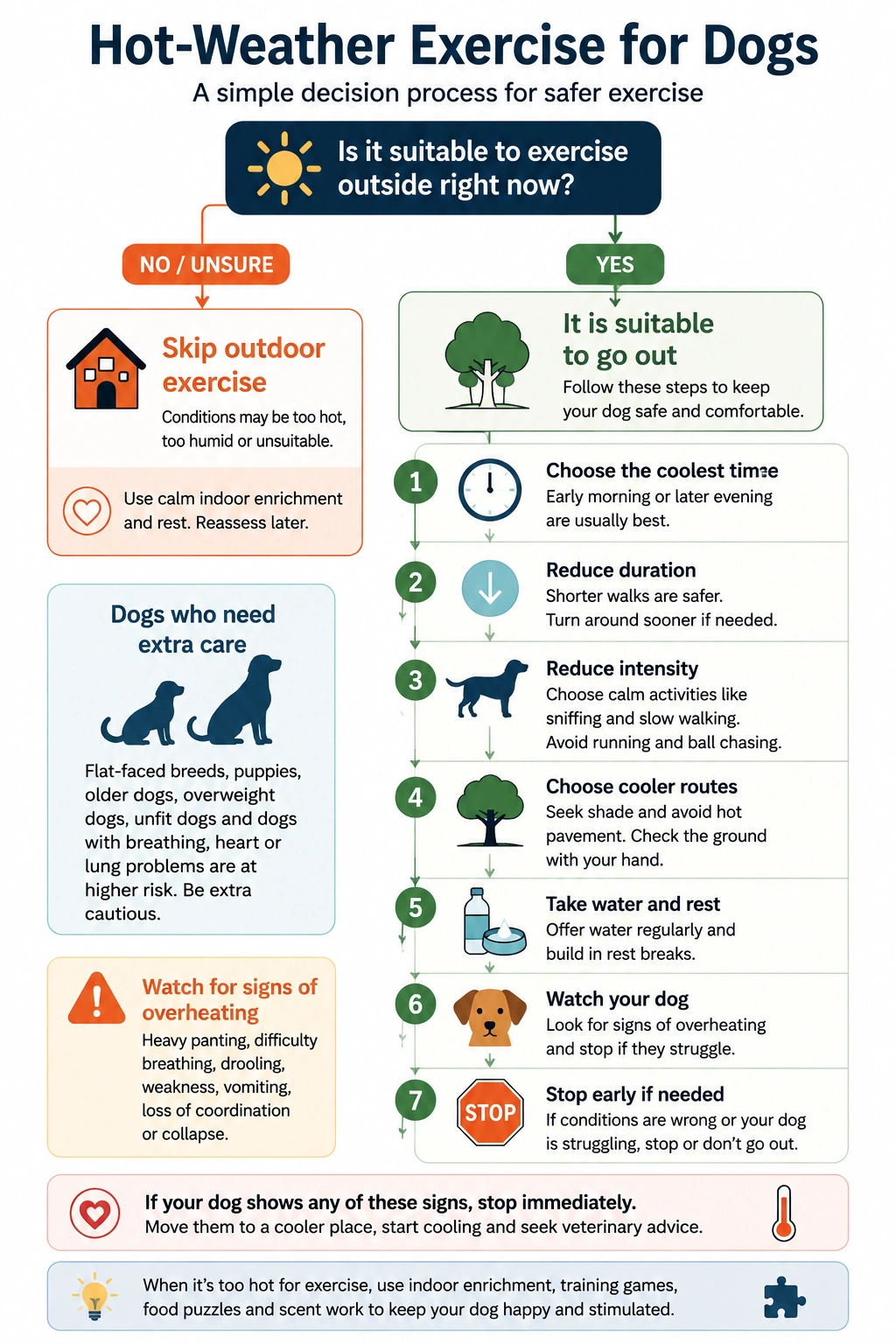
How to exercise your dog safely in hot weather: 7 steps
1. Move exercise to the coolest suitable part of the day
Early morning and later evening are usually better choices than the middle of the day because conditions are often cooler. This is also the approach recommended by UK organisations including the BVA, Dogs Trust, PDSA and RSPCA.
But don’t rely on the clock alone.
A warm, humid evening can still be unsuitable, and pavements and other hard surfaces may remain hot after the air has started cooling. Check the actual conditions before leaving rather than assuming that a particular hour automatically makes exercise safe.
For a more detailed decision, see the best time of day to walk your dog in hot weather.
2. Reduce the amount of physical exercise
Hot weather is not the time to insist on completing your dog’s normal distance or exercise quota.
If a walk remains appropriate, make it shorter. You might turn around sooner, use a compact route close to home or split activity into shorter sessions when conditions allow.
PDSA specifically recommends keeping walks shorter in warm weather, while current BVA advice warns against over-exercising dogs when conditions are hot.
There is no useful rule such as reducing every dog’s walk by a fixed percentage. A young, fit dog and an older dog with a breathing problem can have very different limits on the same day.
Judge today’s exercise on today’s dog and today’s conditions.
3. Reduce intensity as well as duration
A shorter outing is not necessarily safer if your dog spends the whole time sprinting.
Running alongside a bicycle, repeated ball chasing, sustained retrieving, vigorous off-lead running and other high-intensity activities can generate far more body heat than a calm walk.
The RSPCA advises against running or cycling with dogs when it is hot, while the BVA advises owners to avoid encouraging dogs to over-exert themselves during warm-weather play.
A better hot-weather outing, when conditions are suitable, may be a slow walk that allows plenty of sniffing and exploration. Dogs Trust describes sniffing as an important natural behaviour and a useful form of enrichment, so a shorter, more exploratory walk can still provide meaningful stimulation without trying to maximise physical exertion.
4. Choose a cooler route and safer surfaces
Where you exercise matters as well as when.
If possible, choose:
- shaded routes rather than long stretches in direct sun;
- grass or cooler surfaces where appropriate rather than hot tarmac;
- a shorter route with an easy way home;
- places where you can stop safely in the shade;
- routes that do not encourage prolonged high-intensity running.
Hot pavements can injure a dog’s paws as well as adding to the wider heat burden. The BVA specifically warns against walking dogs on hot tarmac.
If hard surfaces are likely to be an issue, check what pavement temperature is too hot for dogs before choosing your route.
For the wider practical precautions that apply once you actually go out, see walking your dog in hot weather safely.
5. Take water and build in rest breaks
Your dog should have access to fresh drinking water during warm weather, and carrying water is sensible when you will be away from an easy supply.
PDSA specifically recommends taking water on walks during warm conditions, while BVA guidance emphasises maintaining access to fresh drinking water, shade and adequate ventilation.
For longer outings, carry a portable bowl or dog water bottle if that makes providing water easier. You do not need specialist equipment if a simple container you already own works safely and conveniently.
Build rest into the outing as well. A break in the shade is more useful if it happens before your dog becomes distressed rather than after they are already struggling.
If you want more detail on normal drinking needs, see how much water a dog should drink.
6. Watch your dog, not your planned distance
A familiar route can create a misleading target.
Your dog does not need to complete a usual three-mile circuit simply because they normally do. Nor should an energetic dog be encouraged to keep chasing a ball merely because they are still willing to run.
Watch what your dog is actually doing.
Increasingly heavy panting, slowing down, repeatedly seeking shade, becoming reluctant to continue or behaving unusually should all make you reassess the outing. More serious signs such as difficulty breathing, excessive drooling, vomiting, weakness, poor coordination or collapse require immediate action. RSPCA and PDSA heatstroke guidance identify heavy panting, breathing difficulty, drooling, lethargy, vomiting, poor coordination and collapse among important warning signs of heat-related illness.
The sensible goal is not to discover your dog’s absolute limit. It is to finish exercise comfortably before they approach it.
7. Stop early — or don’t start — when conditions are wrong
Changing your mind is part of exercising safely.
If the weather is warmer than expected, your dog is struggling more than usual, the route is exposed, or conditions simply do not feel appropriate, shorten the outing or go home.
And if conditions are unsuitable before you leave, don’t start the walk merely because it is part of your dog’s normal routine.
Skipping a walk on a very hot day is safer than relying on a cooling vest, cooling mat or other product to make unsuitable exercise acceptable. Current RSPCA guidance specifically recommends home-based puzzle toys, training games and scent work when hot conditions make normal exercise risky.
During a period of exceptionally hot weather, see Walking Your Dog During a Heatwave for more specific guidance.
What can you do instead of a walk when it’s too hot?
A missed walk does not have to mean a day with nothing to do.
When outdoor exercise is inappropriate, shift the emphasis from strenuous physical activity to calm mental enrichment.
Useful options include short training sessions, scent games, hiding food or toys for your dog to find, suitable food puzzles, gentle indoor play, safe chewing activities and teaching simple new behaviours.
Dogs Trust recommends activities including scent work, food enrichment and training to provide mental stimulation, while the RSPCA specifically recommends puzzle toys, training games and scent work as safer alternatives to exercise during hot weather.
You do not need to recreate the physical workload of a normal walk indoors.
Trying to exhaust a high-energy dog because they have missed their usual exercise can simply replace one problem with another. The objective during genuinely hot conditions is to keep the dog safely occupied and engaged until normal activity becomes appropriate again.
Hot-weather exercise swaps
| Normal activity | Lower-intensity hot-weather alternative |
|---|---|
| Long walk | Shorter shaded sniffing walk, if conditions are suitable |
| Running or cycling | Slow controlled walking |
| Repeated ball chasing | Scent work or calm training |
| Long afternoon outing | Short early-morning outing |
| Outdoor exercise when conditions are unsuitable | Indoor enrichment and rest |
These are alternatives rather than guarantees of safety. If the conditions are unsuitable for outdoor exercise, choosing a gentler outdoor activity does not necessarily make them suitable.
What do you actually need for hot-weather exercise?
You do not need a collection of specialist summer products to exercise a dog responsibly.
For an outdoor outing, the essentials are usually straightforward: suitable walking equipment, access to fresh water, somewhere appropriate to rest and a route that allows you to change plans easily.
A portable water bottle or bowl can be genuinely useful when water is not otherwise available.
Cooling vests may have a place for some dogs when used correctly, but they should be treated as optional aids rather than permission to exercise in conditions that would otherwise be unsuitable. The same principle applies to cooling mats: they may help with comfort at home, but they do not make excessive exercise safe.
Your judgement about whether to exercise matters more than the amount of cooling equipment you own.
How do you know your hot-weather exercise plan is working?
Success does not mean completing the usual route.
A better measure is whether your dog remains comfortable throughout the activity and returns home without having been pushed towards overheating.
A sensible hot-weather routine should allow you to:
- adjust or abandon the plan as conditions change;
- keep physical activity calm and controlled;
- give your dog opportunities to rest and drink;
- finish before your dog becomes distressed;
- use indoor enrichment when outside exercise is inappropriate;
- return gradually to the normal routine when conditions become suitable.
Some dogs will need much larger changes than others. Their response is more important than copying another dog’s routine.
Stop exercising immediately if your dog may be overheating
If your dog develops signs that could indicate significant overheating or heatstroke, stop exercise immediately.
Warning signs can include very heavy panting, difficulty breathing, excessive drooling, lethargy or weakness, vomiting, loss of coordination, collapse or other marked changes in behaviour or responsiveness.
Move your dog away from the heat and begin appropriate cooling while seeking veterinary advice. Heatstroke can become a medical emergency, so this is not the time to finish the walk or wait to see whether your dog simply “cools down on their own”.
See Dog Heatstroke: Symptoms, Treatment & Prevention for the dedicated guidance on recognising heatstroke, cooling a dog safely and obtaining veterinary help.
Common mistakes when exercising dogs in hot weather
Trying to maintain the normal routine
A regular routine is useful until conditions make it inappropriate. Reduce, change or skip exercise rather than treating the normal route as something that must be completed.
Shortening the walk but keeping it intense
Twenty minutes of repeated sprinting can be more demanding than a longer calm sniffing walk. Consider intensity as well as duration.
Assuming an energetic dog will stop before overheating
Enthusiasm does not prove that continuing is safe. Owners still need to control the duration and intensity of exercise.
Assuming evening automatically means safe
The air, humidity and ground conditions may still be unsuitable. Check the actual environment before leaving.
Relying on shade alone
Shade can make an outing more comfortable but does not remove the effects of warm air, humidity, exertion or an individual dog’s vulnerability.
Treating cooling products as protection against unsafe conditions
A cooling vest, mat or bottle can be useful in the right circumstances, but none replaces the decision to reduce or avoid exercise when necessary.
Trying to “make up” a missed walk
Your dog does not need to compensate for every cancelled hot-weather walk with an exhausting indoor workout. Calm enrichment is often the more sensible temporary substitute.
Hot-weather exercise troubleshooting
| What you notice | What may be happening | Safer next action |
|---|---|---|
| Your dog tires much sooner than usual | Today’s conditions or activity are more demanding | Stop or shorten the exercise |
| Your dog repeatedly seeks shade | They may be becoming uncomfortable in the conditions | Stop, move somewhere cooler and reassess |
| Your dog is restless after a cancelled walk | Their normal routine has changed | Use calm training, scent work or another enrichment activity |
| The evening is still very warm | The clock has changed but conditions have not improved enough | Delay or skip outdoor exercise |
| Your dog keeps turning a gentle walk into sprinting | Self-selected intensity is too high | Use controlled walking or end the session |
| Your dog shows possible heatstroke signs | This may be heat-related illness rather than ordinary tiredness | Stop exercising, begin appropriate cooling and seek veterinary advice |
Should I walk my dog every day when it’s hot?
Not necessarily.
Regular exercise is normally important, but hot weather can temporarily change what is appropriate. UK veterinary and welfare organisations advise reducing, rescheduling or sometimes skipping walks when temperatures are high.
One missed or shortened walk is preferable to exposing your dog to unnecessary heat risk.
How do I tire my dog out when it’s too hot to walk?
You do not necessarily need to tire them out.
Instead, give them something mentally engaging to do. Short training sessions, sniffing and searching games, suitable food puzzles and other calm enrichment can help occupy a dog while strenuous outdoor exercise is inappropriate.
When the weather becomes suitable again, you can return towards the dog’s normal exercise routine.
Is indoor activity enough during very hot weather?
As a temporary hot-weather strategy, indoor enrichment can be a sensible alternative when outdoor exercise would create unnecessary risk.
It does not need to reproduce every benefit of your dog’s normal walk. The aim is to keep them appropriately occupied and comfortable until safer conditions return.
The safest exercise plan is the one you are willing to change
Exercising a dog safely in hot weather is less about finding a perfect temperature or buying specialist equipment and more about being flexible.
First decide whether outdoor exercise is appropriate. If it is, choose cooler conditions, reduce the duration and intensity, provide water and rest, and keep watching your individual dog. If it isn’t, skip the walk and use calmer enrichment instead.
And if your dog starts showing signs of overheating, stop immediately rather than trying to complete the planned exercise.