
French Bulldogs need more protection from hot weather than many longer-muzzled dogs. Their shortened airways can make panting less effective, so they may struggle to lose heat even when the conditions do not seem extreme to their owner.
There is no single temperature that is safe for every French Bulldog. Humidity, direct sunlight, exercise, excitement, body condition, age, health and the severity of any breathing restriction all affect the risk.
The safest approach is to prevent your French Bulldog from becoming noticeably hot, reduce or cancel activity when conditions are unsuitable, and act immediately if their breathing or behaviour deteriorates.
Key takeaways
- French Bulldogs can overheat more easily because their short muzzle and restricted airways may make panting less efficient.
- A temperature number alone cannot tell you whether conditions are safe.
- Prevention should begin before your dog appears distressed.
- A cooling mat or vest cannot make an unsafe walk or hot room safe.
- If your dog develops laboured breathing, weakness, confusion, vomiting or collapse, start cooling them and contact a vet immediately.
Why French Bulldogs struggle more in hot weather
Dogs do not cool themselves in the same way people do. Although they can lose a small amount of heat through their paw pads, they rely mainly on panting.
Panting moves air across moist surfaces in the mouth and respiratory tract. As moisture evaporates, heat is carried away from the body.
French Bulldogs are brachycephalic, which means they have a shortened head and muzzle. The same amount of soft tissue found in a longer canine head may be compressed into a much smaller space. This can result in narrow nostrils, restricted nasal passages, an elongated soft palate and a narrow windpipe.
These changes can form part of brachycephalic obstructive airway syndrome, usually shortened to BOAS. Affected dogs may have to work harder to move air, particularly during exercise, excitement or warm weather. BOAS signs can include noisy breathing, excessive panting at rest, poor exercise tolerance, gagging, disturbed sleep, blue gums and collapse.
A shorter muzzle also provides less internal surface area through which heat can be lost. The Royal Kennel Club notes that flat-faced dogs are more likely to develop heatstroke than dogs with longer muzzles, with risk increased further by BOAS or excess weight.
Not every French Bulldog has the same degree of airway restriction. However, noisy breathing should not automatically be dismissed as “normal for the breed”, particularly when it occurs at rest or during very mild activity.
How much heat can a French Bulldog tolerate?
There is no universally safe maximum temperature for a French Bulldog.
Two dogs can respond very differently to the same reading on a weather app. Even the same dog may cope differently from one day to the next.
Important factors include:
- Humidity
- Direct sunlight
- Air movement
- Length of exposure
- Exercise intensity
- Excitement or stress
- Access to water and a cooler resting place
- Body weight and fitness
- Age
- Heart or respiratory disease
- BOAS severity
- Previous heat-related illness
- Indoor ventilation
- Heat retained by roads, patios and artificial grass
High humidity makes panting less effective because moisture evaporates more slowly. Direct sun and hot surfaces can also expose a dog to substantially more heat than the reported shade temperature suggests.
Exercise adds another source of heat. A French Bulldog running, playing or pulling on the lead may therefore overheat in conditions that would be less concerning for the same dog resting calmly indoors.
Dogs Trust advises that there is no simple answer to when it is too hot to walk a dog and notes that dogs can overheat at any time of year. Flat-faced breeds require particular care.
For a detailed breed-specific assessment, see how hot is too hot for a French Bulldog.
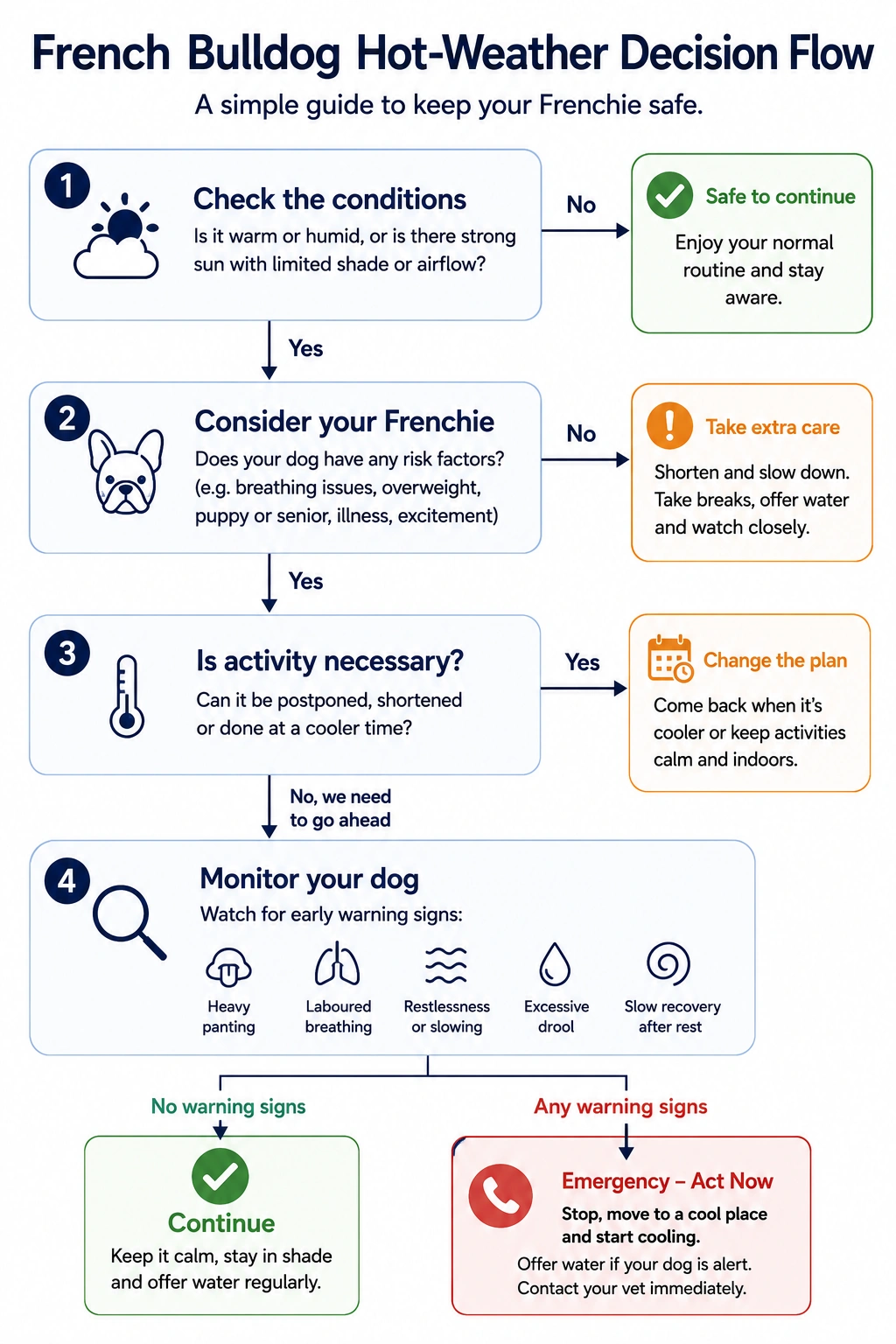
A practical way to assess the risk
| Situation | Sensible response |
|---|---|
| Cool conditions, calm dog and easy breathing | Continue a cautious normal routine |
| Conditions are becoming warmer or more humid | Shorten exposure and observe closely |
| Direct sun, poor airflow or energetic activity | Avoid or substantially modify the activity |
| Unusually heavy panting or slow recovery | Stop, move somewhere cool and assess the dog |
| Laboured breathing, weakness, confusion, vomiting or collapse | Begin cooling and contact a vet immediately |
This is a risk guide rather than a temperature guarantee. A dog showing breathing difficulty needs help regardless of the number on the thermometer.
Can French Bulldogs live in hot weather?
A French Bulldog can live through a UK summer or in a generally warm location, but that does not mean the breed tolerates heat well.
Safe management may require:
- A reliably cool indoor retreat
- Good ventilation or air conditioning
- Restricted daytime activity
- Careful journey planning
- Constant access to drinking water
- Close observation
- A willingness to cancel walks and outings
- Veterinary assessment of any breathing problems
An occasional warm day in the UK is different from a prolonged heatwave. Several hot days followed by warm nights can make it increasingly difficult to keep a home comfortable, particularly in upstairs rooms, conservatories and poorly ventilated properties.
Keeping a dog indoors does not automatically remove the risk. Heatstroke may occur during exercise, in a hot enclosed space or while a vulnerable dog is simply resting somewhere warm.
A French Bulldog that struggles during ordinary warm conditions should be assessed by a vet. More cooling equipment is not a substitute for investigating restricted breathing, excess weight or another health problem.
Which French Bulldogs are most vulnerable?
Every French Bulldog deserves additional care in warm weather, but the risk may be greater for dogs that:
- Have known or suspected BOAS
- Breathe noisily at rest
- Pant excessively after mild activity
- Are overweight
- Are very young or elderly
- Have heart or lung disease
- Have previously overheated
- Are unfit
- Are recovering from illness or surgery
- Become highly excited and struggle to settle
- Have difficulty recovering after exercise
- Are travelling in a carrier, vehicle or confined space
Being young and apparently healthy does not make a French Bulldog immune to heat-related illness.
Excess weight is particularly important because additional tissue around the throat and chest can worsen breathing restriction. PDSA recommends keeping flat-faced dogs at a healthy weight and using a harness rather than attaching the lead to a collar.
How to keep a French Bulldog safe at home
Create a genuinely cool resting area
Identify the coolest room before the weather becomes hot.
Close blinds or curtains before direct sunlight heats the room, improve airflow where it is safe to do so and give your dog space to choose where to rest. A fan may improve air movement, but your dog should be able to move away from it.
Do not assume that every indoor area is safe. Conservatories, sunrooms, upstairs bedrooms, sheds and enclosed porches can become very hot.
Check your dog regularly. A quiet dog is not necessarily a comfortable dog.
Provide fresh drinking water
Your French Bulldog should always have access to clean, fresh water.
During warm weather, it may help to:
- Place bowls in more than one room
- Refresh the water regularly
- Take water on every necessary journey
- Check that a bowl has not been tipped over
- Keep water close to the dog’s resting area
Do not force water into the mouth of a distressed or semi-conscious dog because it could be inhaled.
Reduce excitement and activity
Indoor activity still generates body heat.
Replace energetic games with calmer options such as:
- Food puzzles
- Sniffing games
- Gentle training
- Licking mats
- Short, calm interactions
- Rest in a cool room
Repeated ball chasing, running up and down stairs or frantic play with another dog may be unsuitable during warm conditions.
Use shade carefully
Shade helps reduce direct solar heating, but shade alone does not guarantee safety.
A shaded area may still be:
- Humid
- Poorly ventilated
- Surrounded by hot surfaces
- Enclosed
- Warmer than the house
- Exposed when the sun moves
Water, airflow, rest and access to a genuinely cooler location remain important.
Look after the coat normally
French Bulldogs have short coats, but this does not protect them from overheating.
Regular brushing can remove loose hair and maintain normal coat condition. Shaving a French Bulldog is not a general solution to hot-weather risk and may expose the skin unnecessarily.
For detailed seasonal coat care, see the French Bulldog shedding guide.
For a complete step-by-step routine, see how to keep a French Bulldog cool in summer.
Walking and exercising a French Bulldog in warm weather
A walk is not compulsory when conditions are unsafe.
Skipping or shortening one walk is far safer than attempting to compensate with a cooling vest, portable water bottle or frequent breaks after the dog has already become hot.
When a walk is appropriate:
- Choose the coolest suitable conditions available.
- Keep the route short and close to home.
- Use a comfortable harness.
- Carry water.
- Avoid running and repeated ball chasing.
- Allow the dog to set a slow pace.
- Stay away from exposed routes with no shade.
- Turn back at the first sign of difficulty.
- Observe how quickly breathing settles after activity.
Do not rely only on an early-morning or evening rule. Humidity may remain high and roads or pavements may retain heat after the air temperature begins to fall.
PDSA advises that flat-faced dogs may need their walk skipped entirely if it remains too hot throughout the day. It also recommends a harness to reduce pressure on the throat and carrying water even when the weather does not feel especially hot to the owner.
See how to exercise your dog safely in hot weather for wider activity planning and walking your dog in hot weather safely for the complete walking process.
For a decision focused specifically on this breed, see when it is too hot to walk a French Bulldog.
Travelling with a French Bulldog in hot weather
Never leave a French Bulldog unattended in a vehicle on a warm day, even with the windows partly open or the vehicle parked in shade.
Before an essential journey:
- Cool the car before loading the dog.
- Check that the air conditioning works.
- Avoid the hottest period where possible.
- Plan for congestion, breakdowns and delays.
- Position the dog away from direct sunlight.
- Maintain airflow around the dog.
- Carry more water than you expect to need.
- Monitor breathing throughout the journey.
- Have a plan for reaching a vet if the dog becomes unwell.
Opening a window is not a reliable way to keep a stationary car safe. Travel stress and excitement can also increase respiratory effort before the dog has even become physically active.
PDSA and other UK welfare organisations advise never leaving a dog in a car on a warm day, including for a few minutes or with the windows open.
Normal panting or a warning sign?
Panting is a normal cooling response, so some panting after activity is expected.
The important questions are whether it is proportionate, whether your dog can settle and whether breathing begins returning towards normal after activity stops.
Be more concerned when:
- Panting is much heavier than expected.
- Panting begins while the dog is resting.
- Breathing is noisy, strained or laboured.
- The abdomen is working hard with each breath.
- The dog cannot settle.
- Recovery takes unusually long.
- Drool becomes excessive or thick.
- The dog slows down or refuses to move.
- Gums are unusually bright red, pale, purple or blue.
- The dog becomes weak or uncoordinated.
- Vomiting or diarrhoea develops.
- The dog appears confused.
- The dog collapses or loses consciousness.
Heatstroke signs can progress from panting and breathing difficulty to drooling, vomiting, diarrhoea, abnormal gum colour, weakness, collapse, confusion and seizures.
For a more detailed assessment, see why your French Bulldog may be panting in hot weather.
Do not wait for collapse before seeking help. Sudden breathing difficulty in a flat-faced dog is an emergency.
What to do if your French Bulldog may be overheating
Heatstroke is an emergency
- Stop all activity.
- Move your dog to a cool, shaded and well-ventilated place.
- Start cooling immediately.
- Contact your vet as soon as possible.
- Continue cooling during the journey to the surgery where practical.
Do not delay action while searching for a thermometer or waiting to see whether the dog improves.
Pour cold tap water over the body while keeping it away from the nose and mouth, and use a fan, air conditioning or natural airflow if available.
For a young, conscious and otherwise healthy dog that is comfortable in water, immersion of the body while keeping the head above water may provide rapid cooling. For an older dog or one with significant health problems, veterinary guidance may favour spraying or pouring water combined with airflow.
Offer drinking water, but do not force the dog to drink.
Do not wrap the dog in a wet towel. Covering the body can trap heat, although the dog may be placed on a cool wet towel.
Current UK veterinary advice recommends cooling first and transporting second, because starting cooling promptly improves the chance of recovery.
See the complete guide to dog heatstroke symptoms and what to do for more detailed first-aid and veterinary information.
Even when your dog appears to recover, veterinary assessment remains important. Heatstroke can damage internal organs, and serious complications may not be obvious immediately.
Do cooling mats and vests help?
Cooling products can support sensible hot-weather management, but none of them can compensate for an unsafe environment or inappropriate activity.
Cooling mats
A cooling mat may give your French Bulldog a cooler surface on which to rest.
Use it:
- In a shaded, cool room
- According to the manufacturer’s instructions
- Where the dog can leave it voluntarily
- Under supervision if the dog chews bedding
- After checking it regularly for leaks or damage
A mat will not cool an overheated room and should not be treated as protection against heatstroke.
For help choosing one, see the guide to the best cooling mats for French Bulldogs.
Cooling vests
A cooling vest may support evaporative cooling when it is correctly fitted and maintained.
Check that it:
- Does not restrict the neck or chest
- Does not interfere with the harness
- Remains effective according to its instructions
- Is removed if it becomes warm, heavy or uncomfortable
- Is used only while the dog is supervised
A vest should never be used to extend a walk that would otherwise be unsafe.
See the best cooling vests for French Bulldogs for detailed selection guidance.
Portable water bottles
A portable bottle or travel bowl can make it easier to provide drinking water away from home.
It is useful equipment, but having water available does not prevent a dog from overheating during excessive exercise.
Thermometers
A room thermometer can help you understand how warm the dog’s resting environment has become.
Taking the dog’s body temperature may sometimes be useful when you have been shown how to do it safely. However, it should never delay immediate cooling or veterinary contact when your dog has breathing difficulty or other heatstroke signs.
Behaviour and breathing matter even when a temperature measurement appears unremarkable.
A practical hot-weather plan
Before a warm day
- Check the forecast and expected humidity.
- Identify the coolest room.
- Close curtains or blinds before the sun reaches the windows.
- Prepare water and safe cooling equipment.
- Plan calm indoor enrichment.
- Reschedule non-essential journeys.
- Save your vet’s daytime and out-of-hours telephone numbers.
Before going outside
- Look at your dog as well as the weather forecast.
- Consider humidity, sun, airflow and surface heat.
- Decide whether the outing is genuinely necessary.
- Carry water.
- Use a harness.
- Stay close enough to return quickly.
- Be prepared to cancel.
While outside
- Keep the pace slow.
- Avoid exciting games.
- Watch breathing and movement continuously.
- Use shade without assuming it makes the conditions safe.
- Turn around before your dog appears exhausted.
After activity
- Return to a cool area.
- Offer water.
- Allow uninterrupted rest.
- Observe how quickly breathing settles.
- Contact a vet if breathing remains heavy, noisy or laboured.
During a heatwave
Warm nights can be as important as hot afternoons because the house may have little opportunity to cool between days.
Reduce activity more aggressively, monitor the dog indoors and check sleeping areas before leaving the dog to rest.
When to speak to your vet
Arrange a non-emergency veterinary appointment if your French Bulldog:
- Pants excessively at rest
- Breathes noisily during mild activity
- Takes a long time to recover after a short walk
- Regularly gags, retches or regurgitates
- Sleeps sitting up or with the neck stretched out
- Has previously collapsed or overheated
- Has gained excess weight
- Appears unable to tolerate ordinary warm conditions
These signs may indicate BOAS or another condition that needs assessment.
Contact a vet urgently if your dog develops:
- Sudden or severe breathing difficulty
- Blue or purple gums or tongue
- Weakness
- Loss of coordination
- Confusion
- Repeated vomiting or diarrhoea
- Collapse
- Seizures
- Loss of consciousness
Frequently asked questions
Can French Bulldogs live in a hot climate?
They can live in a warm climate only when their environment and activity are managed very carefully. Reliable indoor cooling, restricted outdoor activity and individual veterinary assessment may be necessary. Being able to live somewhere does not mean the breed tolerates heat naturally.
Can a French Bulldog overheat indoors?
Yes. A warm, poorly ventilated room can be dangerous, particularly during a prolonged heatwave or warm night. Conservatories, upstairs rooms and enclosed spaces may become hotter than expected.
Should I shave my French Bulldog in summer?
Shaving is not normally an appropriate heat-management measure for a French Bulldog. Maintain the coat through ordinary brushing and grooming unless your vet recommends clipping for a specific medical reason.
Can a cooling vest make a hot walk safe?
No. A cooling vest may provide limited support, but it cannot make unsuitable conditions safe or compensate for excessive exercise.
Should I take my French Bulldog’s temperature if they are panting?
Only if you can do so safely and it does not delay cooling or veterinary contact. Laboured breathing, weakness, confusion or collapse require immediate action regardless of the thermometer reading.
The most important hot-weather rule
Manage the French Bulldog in front of you rather than relying on a universal temperature number.
Reduce activity before your dog begins struggling, provide a genuinely cool place to rest and never use cooling equipment as permission to continue an unsafe walk.
If breathing or behaviour suggests overheating, stop immediately, begin cooling and contact a vet.
Read next
- How Hot Is Too Hot for a French Bulldog?
- When Is It Too Hot to Walk a French Bulldog?
- Why Is My French Bulldog Panting in Hot Weather?
- How to Keep a French Bulldog Cool in Summer
- Dog Heatstroke: Symptoms, Treatment & Prevention (Complete Guide)
- French Bulldog Shedding: The Complete Guide