
Early morning is usually the best time to walk your dog in hot weather. Temperatures have had all night to fall, the sun is still low and pavements have had longer to cool. Late evening can also be a good option once the day’s heat has eased.
But there is no universally safe time such as “before 8am” or “after 6pm”. The weather, humidity, ground temperature and your individual dog matter more than the clock. On exceptionally hot days, there may be no sensible walking window at all — and missing a walk can be the safer choice.
Quick answer
Usually best: Early morning
Often suitable: Later evening, once conditions have cooled
Usually avoid: The warmer daytime and afternoon period
Most important: Choose according to the actual conditions and your dog, not a fixed time on the clock
What is the best time to walk a dog in hot weather?
For most dogs, early morning should be your first choice on a hot day, with later evening as the main alternative.
Both the RSPCA and PDSA advise walking dogs in the early morning or later evening when conditions are cooler. The RSPCA has also described early morning as usually the safest option when planning activity during very hot weather.
That does not mean every early-morning walk is safe or every afternoon walk is dangerous. Conditions vary enormously from one day and location to another.
A cool, breezy morning in northern England may present a very different situation from a humid morning during a heatwave in southern England. Your dog’s age, health, breed, fitness and ability to cope with heat also affect the decision.
If you are trying to decide whether the conditions themselves are safe enough rather than simply choosing between morning and evening, see whether it is too hot to walk your dog.
Why early morning is usually the safest choice
The main advantage of an early walk is simple: the environment has had the whole night to lose heat.
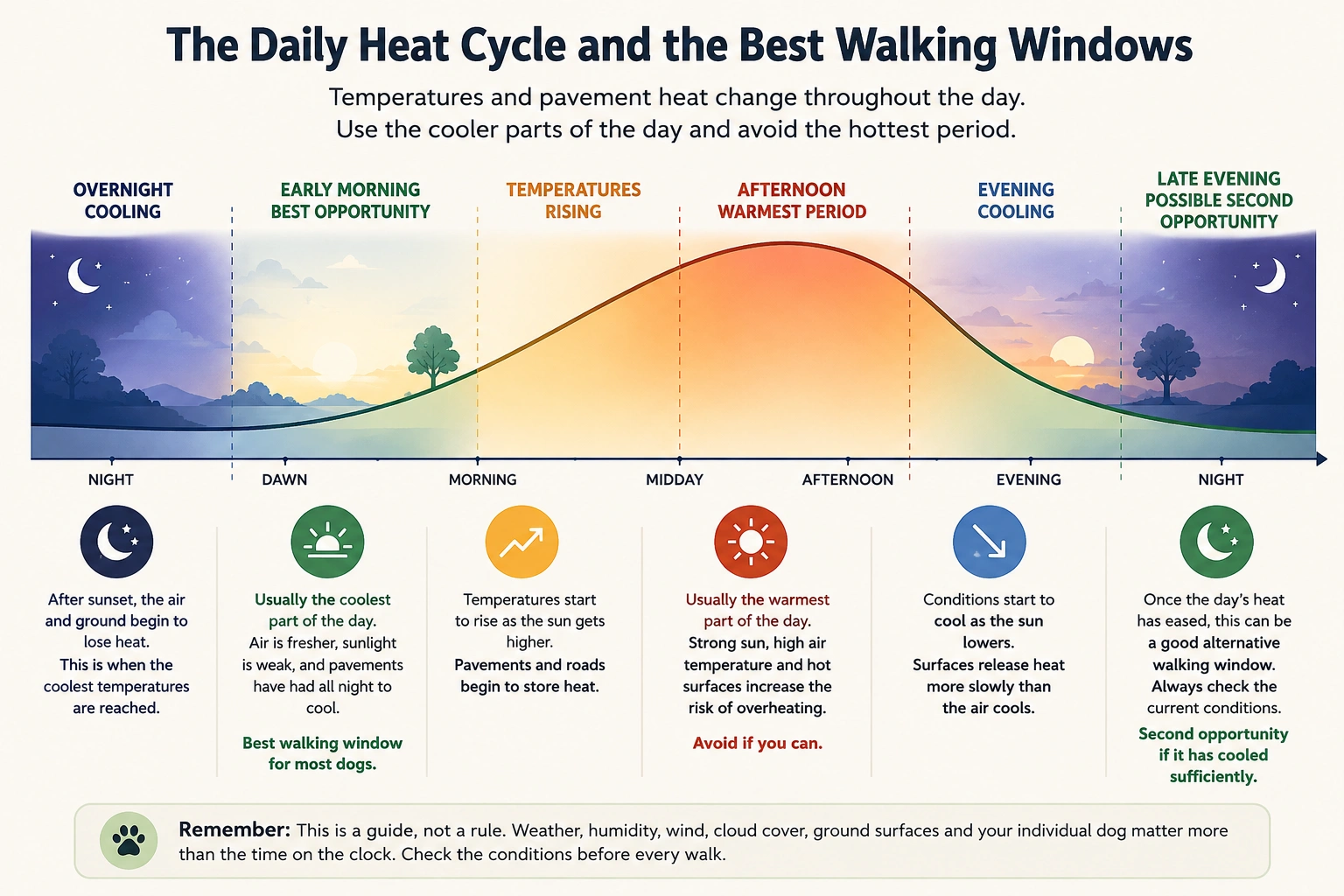
The Met Office explains that the coolest temperature of the day is usually recorded just before dawn, after the ground has been losing heat throughout the night. By contrast, the warmest part of the day is normally during the afternoon.
This gives an early-morning walk several potential advantages:
- the air is generally cooler;
- direct sunlight is weaker;
- roads and pavements have had longer to lose stored heat;
- your dog avoids exercising after hours of daytime warming.
You do not have to head out at the exact moment of sunrise. The important principle is to use the genuinely cooler part of the morning rather than relying on an arbitrary cut-off such as 8am.
Check the hourly forecast for where you live. If the temperature starts rising rapidly after sunrise, an earlier walk may be sensible. If the morning remains mild and cloudy, you may have a wider window.
Is morning better than evening for walking your dog?
Usually, yes — if you have a choice between two otherwise similar conditions, early morning has an advantage because both the air and surrounding surfaces have had overnight to cool.
Evening is still useful, particularly for owners who cannot walk early, but the end of daylight does not instantly remove the heat accumulated during the day.
| Factor | Early morning | Late evening |
|---|---|---|
| Air temperature | Usually close to the day’s lowest | Falling, but sometimes still high |
| Ground surfaces | Have had overnight to cool | May still retain daytime heat |
| Direct sunshine | Low around dawn | Reducing around dusk |
| After a very warm night | May still be uncomfortable | Previous daytime heat may persist |
| General hot-weather choice | Usually first choice | Useful alternative once conditions have genuinely cooled |
The comparison is a guide, not a guarantee.
A breezy 8pm can be more comfortable than a humid 6am after an exceptionally warm night. This is why the forecast and conditions outside your door matter more than choosing morning or evening on principle.
Why 8am or 6pm is not a safety rule
Fixed times are attractive because they make the decision seem straightforward.
Unfortunately, weather does not work to a timetable.
At the same hour on different days, you could have:
- very different air temperatures;
- full sunshine or thick cloud;
- still air or a cooling breeze;
- dry conditions or high humidity;
- pavements that have cooled or surfaces still holding considerable heat.
Where you live matters too. Conditions can vary substantially between regions of the UK and even between exposed urban streets and shaded rural routes nearby.
The safest rule is therefore:
Choose according to conditions, not the clock.
An evening walk should not go ahead simply because it is now 6pm. Equally, there is no reason to treat every summer morning after a particular hour as automatically unsafe.
Look at what the weather is actually doing.
The hottest part of the day is not necessarily midday
You will often see advice to avoid the midday sun. Avoiding strong daytime sunshine is sensible, but it can create the impression that temperatures peak exactly at noon.
They usually do not.
The Met Office explains that the warmest part of the day normally occurs during the afternoon, because the Earth’s surface continues absorbing more energy than it loses for a period after the sun reaches its highest point.
For dog walking, the practical lesson is that an afternoon walk may still be particularly demanding even though noon has passed.
Do not think:
“It’s 3pm now, so the hottest part of the day must be over.”
Instead, check the hourly temperature and current conditions.
How to decide whether your planned walking time is actually suitable
Time of day is only the first part of the decision.
Before leaving, make five checks.
1. Check the local hourly forecast
Do not rely only on the day’s headline maximum temperature.
Look at the temperature around the time you intend to walk and what is expected during the next hour or so.
If conditions are rapidly warming, the beginning of a walk can feel very different from the end.
2. Look at the conditions outside
Cloud, direct sunshine and airflow can change how demanding a walk feels.
A route with substantial shade may reduce exposure to direct sun, but shade does not automatically make hot weather safe. Air temperature, humidity, exertion and your dog’s individual risk still matter.
3. Consider humidity as well as temperature
Warm, humid conditions deserve particular caution.
The Royal Veterinary College notes that animals can overheat following excessive exercise in warm weather or in warm, humid, poorly ventilated conditions.
Humidity is therefore another reason not to rely on a fixed morning or evening time. A muggy early morning may be less suitable than the clock suggests.
For more detailed advice on adjusting your route, pace and walking plans in muggy conditions, see our guide to Walking Dogs in High Humidity.
4. Check the surface
The air may feel more comfortable while the pavement beneath your dog’s paws remains hot.
Choosing a cooler time of day reduces the risk, but does not remove the need to consider the ground itself.
For the detailed surface-temperature guidance, see what pavement temperature is too hot for dogs.
You can also use the dog pavement temperature chart when you need a quick-reference explanation of pavement temperature rather than air temperature.
5. Consider the dog in front of you
Two dogs walking the same route at the same time may not face the same risk.
Age, weight, fitness, health, coat and breathing ability can all affect how well a dog copes with heat.
If the timing looks marginal for your particular dog, postpone the walk rather than treating the forecast as permission to go.
Pavements can stay hot into the evening
One reason morning often has an advantage over evening is that hard surfaces can retain heat after the air begins to cool.
A pavement that has been exposed to sunshine for several hours does not immediately become comfortable because the sun is getting lower.
This is particularly important if your normal evening route includes exposed tarmac, paving or other hard surfaces.
Air temperature and pavement temperature are not the same measurement, and you should not try to calculate one reliably from the other. Surface heating depends on factors including sunlight, material, shade and local conditions.
That is why a cooler evening forecast should be treated as one part of the decision rather than proof that the walking surface is safe.
Some dogs need a much cooler walking window
Hot-weather walking advice cannot assume every dog has the same tolerance.
PDSA advises avoiding exercise on hot days completely for dogs that are unfit, elderly, young, overweight, unwell or have breathing difficulties.
Flat-faced — or brachycephalic — dogs need particular care. Their shortened skull shape can affect the airway and make effective cooling through panting more difficult. The RSPCA advises keeping flat-faced dogs out of the sun and either not walking them on hot days or using the cooler early-morning or late-evening periods.
Puppies and senior dogs can also be more vulnerable, while health conditions affecting breathing can increase risk.
This means there cannot be one clock time that is “safe for dogs”.
The appropriate window for a healthy adult dog may be inappropriate for a dog with breathing difficulties or another factor that makes heat harder to tolerate.
For breed-specific advice, see When Is It Too Hot to Walk a French Bulldog? and When Is It Too Hot to Walk a Labrador?, rather than assuming a general timing rule applies equally to every breed.
Sometimes the best time to walk is not today
Owners can understandably feel that skipping a daily walk is bad for their dog.
In extreme heat, however, forcing a walk into the least-bad part of the day can be less sensible than simply waiting for conditions to improve.
PDSA’s May 2026 hot-weather guidance states that during a heatwave, skipping a walk altogether may be the safest option, particularly for short-faced dogs.
That is important because exercise itself is a major cause of heat-related illness in dogs. Research using UK veterinary data found that exercise was the trigger in around three-quarters of recorded heat-related illness events.
Missing one walk does not mean your dog needs to spend the day with nothing to do.
Depending on your dog, you might use short training sessions, scent-based games, food enrichment or other calm indoor activities until outdoor conditions improve.
A complete guide to exercising your dog safely in hot weather covers how to adapt your dog’s activity when normal walks need to be reduced or replaced.
What if the evening is still hot?
Do not assume you have to walk because you have waited until evening.
If the temperature remains high, the air is humid or exposed surfaces are still hot, waiting until later — or until the following morning — may be the better option.
The same applies during prolonged hot spells where overnight temperatures remain unusually high.
This is where the simple “morning or evening” advice needs qualification: early and late are normally safer because they tend to be cooler, not because those periods possess any special safety threshold of their own.
During a heatwave, the decision may need to move beyond choosing a time and become a decision about whether outdoor exercise is appropriate at all.
A simple hot-weather walking-time checklist
Before clipping on the lead, ask:
- Is this genuinely one of today’s cooler periods?
- Has the temperature actually fallen — or is it still building?
- Can we avoid strong direct sunshine?
- Have exposed pavements and other hard surfaces cooled?
- Are the conditions unusually humid or still?
- Does my dog have any factor that makes heat harder to tolerate?
- Could this walk safely wait until conditions improve?
If several answers concern you, changing or postponing the walk is usually more sensible than trying to make your normal routine fit the weather.
Keep the walk itself appropriate too
Choosing the best time does not make the rest of the walk irrelevant.
A hot-weather outing may still need to be shorter, gentler or more shaded than your dog’s usual walk. Take drinking water where appropriate and avoid vigorous exercise when conditions are warm.
For the wider precautions beyond timing, see walking your dog in hot weather safely.
If your dog shows signs of overheating or heat-related illness, stop exercising them and move from routine walk planning to appropriate cooling and veterinary guidance. Heatstroke can be life-threatening and should not be treated as something a later or shorter walk will solve.
The bottom line
Early morning is normally the best time of day to walk your dog during hot weather, because both the environment and walking surfaces have had overnight to cool.
Late evening can also work well once temperatures and surfaces have genuinely fallen.
But the safest decision is never based on the clock alone. Check the forecast, sunshine, humidity, ground conditions and your individual dog. If conditions remain uncomfortable or your dog is particularly vulnerable, postpone the walk.
On some very hot days, the best walking time is another day.