
Any dog can develop heatstroke, but some dogs are much more vulnerable than others. UK veterinary research shows particularly high risk in flat-faced breeds such as English Bulldogs, French Bulldogs and Pugs, while Newfoundlands and Chow Chows have also shown markedly increased risk.
Breed is only part of the picture. Age, body size, weight, coat, health, fitness, exercise and environmental conditions can all affect how easily a dog overheats. A dog with several risk factors may need much greater protection from heat than breed alone would suggest.
If your dog is showing possible signs of heatstroke now: stop exercise or remove them from the hot environment, start cooling them immediately and contact a vet. Our Dog Heatstroke First Aid: What to Do in an Emergency guide explains the immediate steps to take.
Which dog breeds are most at risk of heatstroke?
One of the strongest recent sources of UK evidence comes from a 2024 VetCompass study of dogs attending Vets Now emergency clinics during the exceptionally hot summer of 2022.
Researchers analysed records from 167,751 dogs and identified seven breeds with significantly higher odds of heat-related illness than Labrador Retrievers. Flat-faced dogs overall had 4.21 times the odds of heat-related illness compared with dogs with medium-length skulls.
| Dog breed | Risk compared with Labrador Retrievers |
|---|---|
| Newfoundland | 15.48× |
| Chow Chow | 11.46× |
| English Bulldog | 11.09× |
| French Bulldog | 6.03× |
| Pug | 4.59× |
| Pomeranian | 3.45× |
| Staffordshire Bull Terrier | 2.58× |
These figures need some context. They come from one UK study of dogs presenting for emergency veterinary care in 2022 and compare each breed with Labrador Retrievers. They are relative risks within that study, not predictions that an individual Newfoundland, Chow Chow or Bulldog will develop heatstroke.
Earlier UK primary-care research found a somewhat different group of breeds at increased risk. In that study, Chow Chows, Bulldogs and French Bulldogs were again among those at greatest risk, alongside Dogues de Bordeaux, Greyhounds, Cavalier King Charles Spaniels, Pugs, Golden Retrievers and English Springer Spaniels.
The precise rankings therefore vary between studies and populations. The more important message for owners is that certain physical characteristics repeatedly emerge as important — particularly a flat face — and that no breed is immune to heatstroke.
Key takeaway
Breed can substantially affect heatstroke risk, but it cannot tell you whether an individual dog is safe. Body shape, weight, age, health, activity and environmental conditions all matter too.
Why are flat-faced dogs at greater risk?
Brachycephalic dogs — dogs with shortened, flat faces — are one of the clearest high-risk groups.
Examples include:
- English Bulldogs
- French Bulldogs
- Pugs
- Dogues de Bordeaux
- Boston Terriers
- Shih Tzus
- Cavalier King Charles Spaniels
Dogs cannot sweat over most of their bodies as humans do. Panting and evaporation from the respiratory tract are therefore important ways for them to lose excess heat.
The shortened skull and upper-airway abnormalities found in many brachycephalic dogs can make breathing less efficient. This matters particularly in warm conditions because anything that interferes with effective breathing can also interfere with the dog’s ability to cool itself.
The Royal Veterinary College identifies heat-related illness as a priority health issue for brachycephalic dogs, and recent UK emergency-care research found these dogs had more than four times the odds of heat-related illness compared with dogs with medium-length skulls.
Dogs affected by brachycephalic obstructive airway syndrome (BOAS) deserve particular caution because their breathing is already compromised.
If you own a flat-faced dog, don’t wait for extreme temperatures before adjusting exercise and watching for overheating. Heat-related illness can occur during ordinary activity when a vulnerable dog’s ability to lose heat cannot keep pace with the heat their body is producing.
Overweight dogs can struggle to lose heat
Weight matters too.
A large UK VetCompass study of more than 900,000 dogs found that dogs weighing more than the average for their breed and sex had increased odds of heat-related illness. Dogs weighing more than 50 kg were also at greater risk.
This doesn’t mean every large dog or every dog carrying extra weight will develop heatstroke. It means bodyweight should be considered alongside breed, fitness, health and environmental conditions.
UK veterinary and animal-welfare organisations also identify overweight dogs as a group requiring extra care in hot weather.
Maintaining a healthy body condition is therefore about more than joints and general fitness: it can also form part of reducing a dog’s vulnerability to heat.
If you are unsure whether your dog is a healthy weight, your vet or veterinary nurse can help you assess their body condition and establish an appropriate weight-management plan.
Are older dogs more vulnerable to heatstroke?
Older dogs can be more vulnerable, although there is no single age at which a dog suddenly becomes “high risk”.
The original UK VetCompass primary-care study found greater odds of heat-related illness in dogs aged two years and over compared with dogs under two. More recent emergency-care research also found increased risk in some older age groups.
Age becomes particularly important when it is combined with other changes. An older dog may have reduced fitness, reduced ability to regulate body temperature or underlying heart, respiratory or other health problems that make coping with heat harder.
Research into different heatstroke triggers also found that older dogs were particularly associated with heat-related illness caused by environmental heat, while younger dogs were more prominent among cases triggered by exercise.
So don’t judge an older dog’s ability to cope with heat by what they comfortably managed several summers ago. Adjust activity to the dog you have now.
Are puppies more at risk of heatstroke?
Puppies also need extra care in hot weather, but the evidence requires a little more nuance than simply saying “puppies are at greater risk”.
UK organisations including the RSPCA and PDSA identify very young dogs as potentially more vulnerable to overheating and advise extra caution with them in warm conditions.
However, large UK epidemiological studies do not show that puppies universally have the highest overall incidence of heat-related illness. In fact, one VetCompass study found increased overall odds in dogs aged over two, while research looking specifically at the cause of heat-related illness found younger male dogs had greater odds of cases triggered by exercise.
That distinction matters.
A puppy may enthusiastically continue running, playing or exploring without pacing itself sensibly. Rather than relying on age alone, control the intensity and duration of activity, provide frequent opportunities to rest and drink, and be prepared to stop before the puppy appears exhausted.
Other dogs that may be more vulnerable
Breed, age and weight are not the only considerations.
Large and giant dogs
Large body size can increase risk. The 2020 UK VetCompass study found dogs weighing more than 50 kg had greater odds of heat-related illness, while the more recent emergency-care study identified the Newfoundland as the highest-risk breed in its breed analysis.
Large dogs can generate and retain substantial amounts of heat, so their size should be considered alongside coat, activity, fitness and health.
Dogs with thick or double coats
A heavy coat can make heat loss more difficult, and thick- or long-coated dogs are identified by UK veterinary organisations as requiring additional care during warm weather.
That does not automatically mean shaving a thick- or double-coated dog is the solution. Coat type, grooming needs and the effects of clipping vary, and current veterinary research notes uncertainty around some advice about shaving double coats.
Regular appropriate grooming can help keep the coat in good condition and remove loose undercoat, but avoid treating shaving as a universal heatstroke-prevention measure.
Dogs with breathing or heart problems
Any condition that compromises breathing deserves particular attention because dogs depend heavily on their respiratory system to dissipate heat.
Dogs with known respiratory disease, BOAS or significant heart disease may therefore need a more conservative approach to exercise and warm weather. Ask your vet about appropriate limits if your dog has an existing condition.
Highly active and excitable dogs
One of the most important heatstroke facts for UK owners is that exercise is a major trigger.
A large VetCompass study found that 74.2% of recorded heat-related illness events were triggered by exertion. Of the exercise-related cases, most followed relatively ordinary activities such as walking rather than extreme sporting activity.
More recent emergency-care data from 2022 also found exercise to be the most frequently recorded trigger.
This means heatstroke prevention isn’t just about avoiding hot cars. A dog can generate dangerous amounts of body heat through activity, particularly when warm or humid conditions make it harder to lose that heat.
For practical ways to adjust activity safely, see How to Exercise Your Dog Safely in Hot Weather.
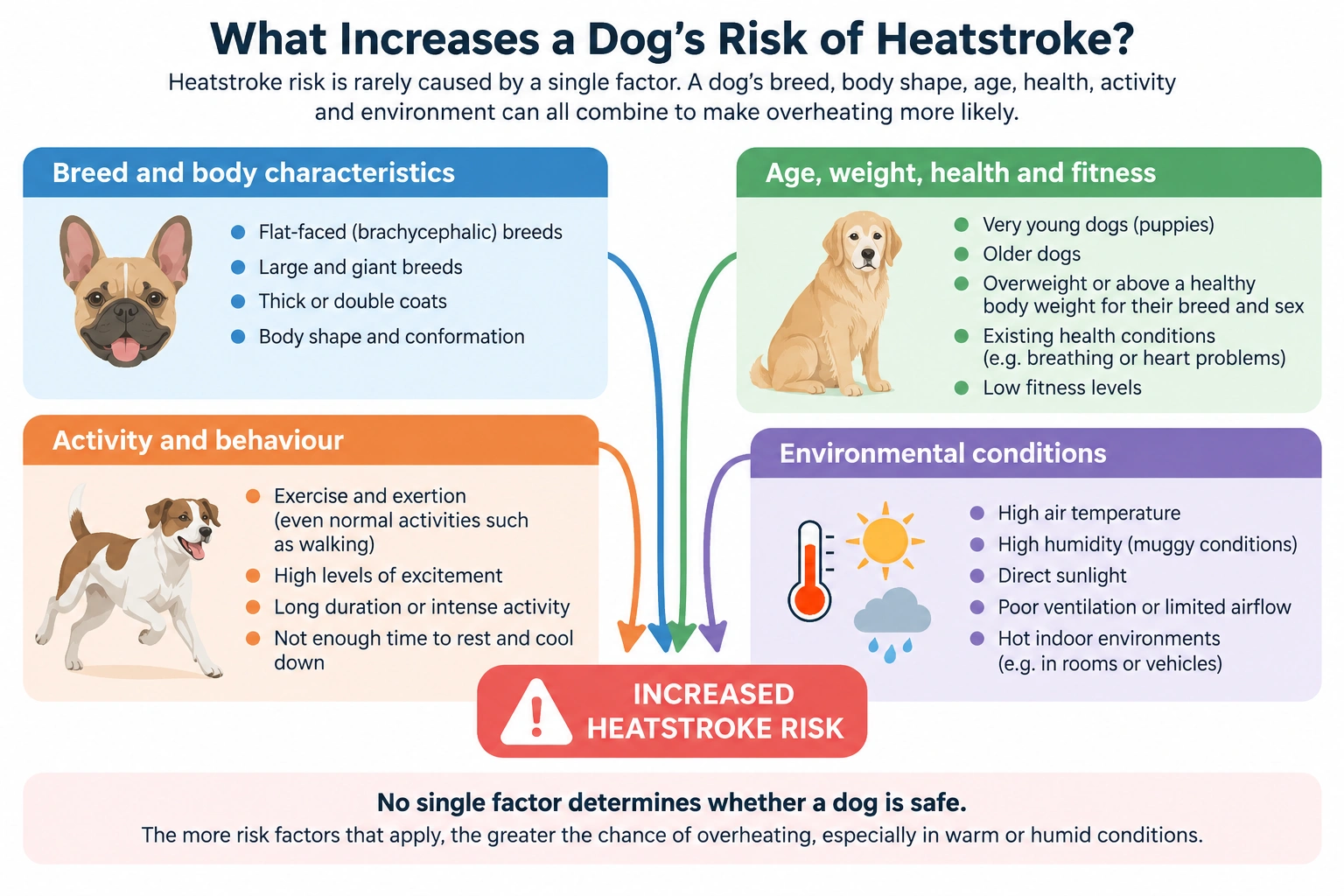
Heatstroke risk factors can combine
It is more useful to think of heatstroke risk as layers of vulnerability than to divide dogs into “safe” and “high-risk” breeds.
Consider a French Bulldog that is overweight, has BOAS and is running enthusiastically on a warm, humid afternoon. Several risk factors are operating at once:
- brachycephalic body shape;
- compromised breathing;
- excess bodyweight;
- exercise-generated heat;
- warm conditions;
- high humidity reducing the effectiveness of evaporative cooling.
Compare that with judging the situation simply from the dog’s breed or the air temperature and it becomes clear why one universal “safe temperature” for dogs would be misleading.
Humidity is particularly easy to overlook because a muggy day may not appear exceptionally hot. Our What Humidity Is Safe for Dogs? guide explains why temperature and humidity need to be considered together.
An older dog with heart disease resting in a warm room presents a different combination of risks. There may be no strenuous exercise and no blazing sunshine, yet the dog’s individual vulnerability and environment can still make overheating possible. Can Dogs Get Heatstroke Indoors? looks more closely at this less obvious route to heat-related illness.
A quick heatstroke risk check
Take extra care when one or more of these apply:
- your dog is flat-faced;
- they are overweight;
- they are very large;
- they are elderly or very young;
- they have a thick or heavy coat;
- they have breathing, heart or other relevant health problems;
- they are unfit;
- they become very excited or exercise intensely;
- conditions are hot, sunny or humid;
- they are somewhere with poor ventilation or limited ability to escape the heat.
This isn’t a diagnostic score. The more factors that apply, however, the stronger the reason to take a cautious approach.
How to protect a higher-risk dog in warm weather
If your dog has characteristics associated with increased heatstroke risk, prevention should begin before they look hot.
Exercise when conditions are cooler
Use cooler parts of the day and reduce the length or intensity of exercise when necessary. On particularly hot days, skipping strenuous exercise can be safer than trying to complete a normal routine.
Don’t assume that a dog who wants to continue exercising is safe to do so. Excitable dogs may not regulate their own activity sensibly.
Provide water, shade and somewhere genuinely cool
Make sure fresh drinking water is readily available and give your dog access to a cooler, well-ventilated area.
Remember that shade alone doesn’t remove other risk factors such as high humidity, strenuous exercise or trapped heat.
Watch your dog as well as the weather
Air temperature is useful information, but it cannot tell you exactly how an individual dog will cope.
Humidity, direct sun, air movement, activity, duration of exposure, body shape, age, weight, coat, health and acclimatisation can all change the picture.
Maintain a healthy weight and fitness level
Keeping your dog at an appropriate weight and maintaining suitable fitness can reduce avoidable risk.
Build exercise gradually rather than suddenly asking an unfit dog to undertake strenuous activity, particularly in warmer weather.
Be especially cautious with breathing problems
If your dog has BOAS or another respiratory condition, speak to your vet about how this affects exercise and heat tolerance.
No cooling product, paddling pool, fan or other accessory should be treated as permission to keep a vulnerable dog in conditions that would otherwise be unsafe.
For a fuller prevention plan, see Dog Heatstroke Prevention: How to Keep Your Dog Safe.
What if my dog is showing signs of heatstroke?
Knowing that your dog is high risk is useful for prevention, but don’t use breed or risk factors to decide whether symptoms are serious.
Any dog showing signs of heat-related illness needs attention.
Early signs can include:
- excessive panting, particularly when resting;
- abnormal or difficult breathing;
- lethargy or reluctance to continue exercising;
- excessive drooling;
- vomiting or diarrhoea;
- weakness or unsteadiness.
More severe heat-related illness can cause collapse, confusion, seizures, loss of consciousness and other life-threatening complications.
If you suspect heatstroke, stop whatever is making your dog hotter, start cooling them immediately and contact a vet. Don’t wait for severe signs to appear.
Our Dog Heatstroke Symptoms: Early Warning Signs You Should Never Ignore explains how the warning signs can progress, while Dog Heatstroke First Aid: What to Do in an Emergency gives the immediate action sequence.
For a broader overview of causes, symptoms, treatment and prevention, see Dog Heatstroke: Symptoms, Treatment & Prevention.
Heatstroke can progress rapidly, which is why waiting to “see how the dog goes” is unsafe when heat-related illness is suspected. How Quickly Can Heatstroke Kill a Dog? explains why prompt action matters.
The key point: every dog can get heatstroke
Some dogs clearly face greater heatstroke risk than others. Flat-faced breeds are particularly vulnerable, while UK research has also identified increased risk associated with certain individual breeds, large body size, excess weight and age.
But breed should never be treated as a heat-safety test.
Your dog’s body shape, age, weight, coat, fitness and health interact with what they are doing and the conditions around them. A dog with several risk factors deserves a particularly cautious approach to warm weather.
And regardless of breed, if a dog starts showing signs of heat-related illness, begin cooling immediately and contact a vet.
Frequently asked questions
Can a Labrador get heatstroke?
Yes. Any dog can develop heatstroke, including Labradors.
Labrador Retrievers have been used as the comparator breed in important UK studies because they are common and have relatively non-extreme body conformation. That does not mean Labradors are protected from heat-related illness.
Exercise, hot or humid conditions, excess weight, poor fitness, age and health can all increase an individual Labrador’s risk.
Can a dog get heatstroke when it isn’t extremely hot?
Yes. Heat-related illness is not restricted to exceptionally hot days.
UK research into dogs affected by heat-related illness found cases occurring across a wide range of environmental conditions. Exercise is especially important because muscular activity generates heat within the dog’s body.
This is why there is no single outdoor temperature below which every dog can be considered safe.
Does a black coat make a dog more likely to get heatstroke?
Dark fur can absorb more radiant energy from sunlight than lighter fur, but coat colour alone is not a reliable way to judge an individual dog’s heatstroke risk.
The stronger established risk factors include breed and body shape, bodyweight, age, health, coat characteristics, exercise and environmental conditions. Treat your dog’s overall risk profile and behaviour as more important than coat colour alone.