

You can have a colourful, interesting garden without filling it with plants that present a known poisoning risk to your dog. Rosemary, sage, calendula, cornflowers, sunflowers, hibiscus and fuchsia are among the plants Dogs Trust currently identifies as suitable choices for dog-friendly gardens, while Blue Cross also recommends basil and sage.
That does not mean any ornamental plant should be treated as dog food. Even plants regarded as dog-friendly can cause stomach upset if enough is eaten, and an otherwise suitable plant can still present problems through thorns, garden chemicals or simply being placed where an enthusiastic dog will repeatedly chew or dig at it.
If you think your dog has eaten or chewed a poisonous plant, contact your vet promptly. If your dog has collapsed, is having convulsions or has breathing difficulties, contact your vet immediately rather than waiting for symptoms to develop further. Animal PoisonLine also provides 24-hour specialist poisoning advice to UK pet owners on 01202 509 000.
What Does “Dog-Safe Plant” Actually Mean?
When a plant is described as dog-safe or dog-friendly, it usually means it is not recognised as presenting the same poisoning risk as plants such as yew, foxglove or rhododendron. It does not mean your dog should be encouraged to eat it.
Dogs Trust warns that even dog-friendly plants can cause stomach upset if a dog eats a large amount. Blue Cross goes further and advises against letting dogs deliberately eat garden plants or using plants to try to treat an upset stomach or other health problem.
There are other things to consider too.
A plant may be low-risk from a toxicity point of view but still have sharp thorns, irritating sap or tough seed heads. Fertilisers, weed killers, pesticides and slug-control products can also introduce a separate hazard around otherwise suitable planting.
So the most useful question is not simply, “Is this plant poisonous?” It is:
Is this a sensible plant to grow where my particular dog can reach it?
A calm adult dog that ignores flower beds presents a different practical risk from a puppy that digs up bulbs or a habitual plant-chewer.
Dog-Safe Flowers for UK Gardens
There is no need to avoid flowers altogether. Dogs Trust currently identifies several familiar flowering plants as suitable choices for dog-friendly gardens.
Calendula
Calendula provides bright yellow or orange flowers and works well in beds and borders. Dogs Trust includes it among its dog-friendly choices.
Cornflowers
Cornflowers are another Dogs Trust-listed option. Their blue flowers can work in borders as well as containers, making them useful where garden space is limited.
Sunflowers
Sunflowers are also included in Dogs Trust’s dog-friendly list. Taller varieties can add height and structure to a planting scheme, while smaller varieties can work well in containers.
Do not assume that being on a dog-friendly list makes fallen flower heads, stems or seeds something your dog should be allowed to consume freely.
Hibiscus
Dogs Trust lists hibiscus among dog-friendly garden plants. It can provide a more substantial flowering feature where the growing conditions suit the variety you choose.
Fuchsia
Fuchsia is another current Dogs Trust-listed option and can be useful where you want flowering plants in pots, containers or garden beds.
The important point is not to collect as many supposedly “pet-safe” species as possible. A smaller selection of plants supported by reliable dog-welfare guidance is more useful than a very long internet list assembled from uncertain or conflicting sources.
Dog-Friendly Herbs and Scented Plants
Herbs are particularly useful because many work well in containers as well as beds.
Rosemary
Dogs Trust identifies rosemary as suitable for a dog-friendly garden. Its strong scent also gives dogs something interesting to investigate without requiring the plant to be eaten.
Sage
Sage has particularly good support: both Dogs Trust and Blue Cross recommend it as a dog-friendly planting choice. Blue Cross specifically suggests basil and sage as plants that can create an interesting area for a dog to sniff.
Basil
Blue Cross identifies basil as another safe option for a dog-friendly garden. Growing it in a container can make it practical even on a small patio or paved garden.
Scented planting can make an outdoor space more interesting without needing a large garden. If you want to build scent, texture and exploration more deliberately into your garden, How to Create a Sensory Garden for Dogs is a natural next topic.
One plant that deserves particular caution is lavender. It is frequently described online as pet-friendly, but Dogs Trust currently lists lavender among plants that could be toxic to dogs. For that reason, it is not included in this dog-safe list.
Quick Guide to Dog-Friendly Garden Plants
| Plant | Type | Why it can work well | Important consideration |
|---|---|---|---|
| Rosemary | Herb/shrub | Scented and suitable for beds or containers | Do not encourage chewing or eating |
| Sage | Herb | Scented and supported by Dogs Trust and Blue Cross | Large amounts of plant material may still upset the stomach |
| Basil | Herb | Useful in containers and small gardens | Blue Cross advises against letting dogs deliberately eat garden plants |
| Calendula | Flower | Bright flowering option for beds and borders | Still supervise dogs that habitually chew plants |
| Cornflower | Flower | Colourful option for borders and containers | Check the exact plant you are buying |
| Sunflower | Flower | Adds height and visual interest | Do not treat seeds or plant material as freely edible |
| Hibiscus | Flowering plant | Attractive flowering option | Check the exact species and garden suitability |
| Fuchsia | Flowering plant | Useful in beds, pots and containers | Keep normal garden chemicals and treatments away from dogs |
These choices are based on current Dogs Trust and Blue Cross guidance rather than on the assumption that every plant commonly marketed as “pet-friendly” is automatically suitable.
If you have cats or other pets as well as a dog, check plants for those species separately. A plant being suitable around dogs does not automatically establish that it is suitable for every other animal. Dogs Trust specifically advises checking separately when other pets share the garden.
Common Garden Plants to Be Cautious About Around Dogs
Many familiar UK garden plants appear on current veterinary and animal-welfare hazard lists.
Examples include:
- daffodils, particularly the bulbs;
- foxgloves;
- hydrangeas;
- wisteria;
- yew;
- rhododendrons and azaleas;
- tulips;
- laburnum;
- lily of the valley;
- autumn crocus;
- ivy;
- laurel;
- larkspur and delphinium.
This is not an exhaustive list, and the level of risk is not identical for every plant. Dogs Trust, PDSA and the RHS all advise checking unfamiliar plants rather than assuming that a common garden species is harmless.
Bulbs deserve particular attention if your dog likes digging. PDSA notes that the bulbs of many plants can present a poisoning risk and recommends preventing pets from gaining access to them.
Common names can also cause confusion. Dogs Trust points out that true jasmine is not considered poisonous to dogs, while some different plants commonly called jasmine can be hazardous. That is a good example of why identifying the actual plant matters.
What If Your Garden Already Contains a Plant That Is Toxic to Dogs?
Discovering a potentially harmful plant does not mean you need to panic.
Start by identifying it accurately and finding out which parts present a risk. Then consider how likely your dog is to reach or eat them.
Dogs Trust recommends either avoiding poisonous plants or finding an effective way to keep dogs away from them. A secure barrier can sometimes be appropriate.
The practical decision will depend on the individual garden and dog. Think about whether:
- your dog chews plants;
- your dog digs up bulbs or roots;
- fruit, berries, seeds or leaves fall into areas your dog uses;
- pruning creates plant material your dog could pick up;
- the plant can be securely separated from the dog;
- removing the plant would be the safer and simpler option.
RHS guidance also recommends keeping prunings and uprooted plant material away from pets.
If restricting access is part of the solution, How to Dog Proof Your Garden can help you look at boundaries and access across the wider garden rather than focusing on plants alone.
What Should I Do If My Dog Eats a Garden Plant?
If you know or suspect that your dog has eaten a poisonous plant, contact your vet promptly.
Do not wait for obvious symptoms if you know the plant may be harmful. Dogs Trust advises speaking to a vet urgently after suspected ingestion of a poisonous garden plant.
If possible:
- Move your dog away from the plant so they cannot eat any more.
- Identify the plant or keep a sample of leaves, flowers, fruit or other relevant material.
- Note roughly when the exposure happened and how much may have been eaten.
- Contact your vet or, where appropriate, Animal PoisonLine for specialist advice.
- Follow the professional advice you are given.
The RHS recommends taking a sample of the plant when seeking veterinary advice. Animal PoisonLine likewise advises keeping a sample or other identifying information available.
Do not try to make your dog vomit at home and never give salt water to induce vomiting. Animal PoisonLine warns that attempting to make a pet vomit can create additional risks and may cause more harm.
If your dog has collapsed, is having convulsions, is struggling to breathe or is otherwise clearly very unwell, Animal PoisonLine advises contacting your vet immediately.
How to Choose New Plants When You Have a Dog
Rather than relying on a single giant “safe plants” list, use the same checking process whenever you buy something new.
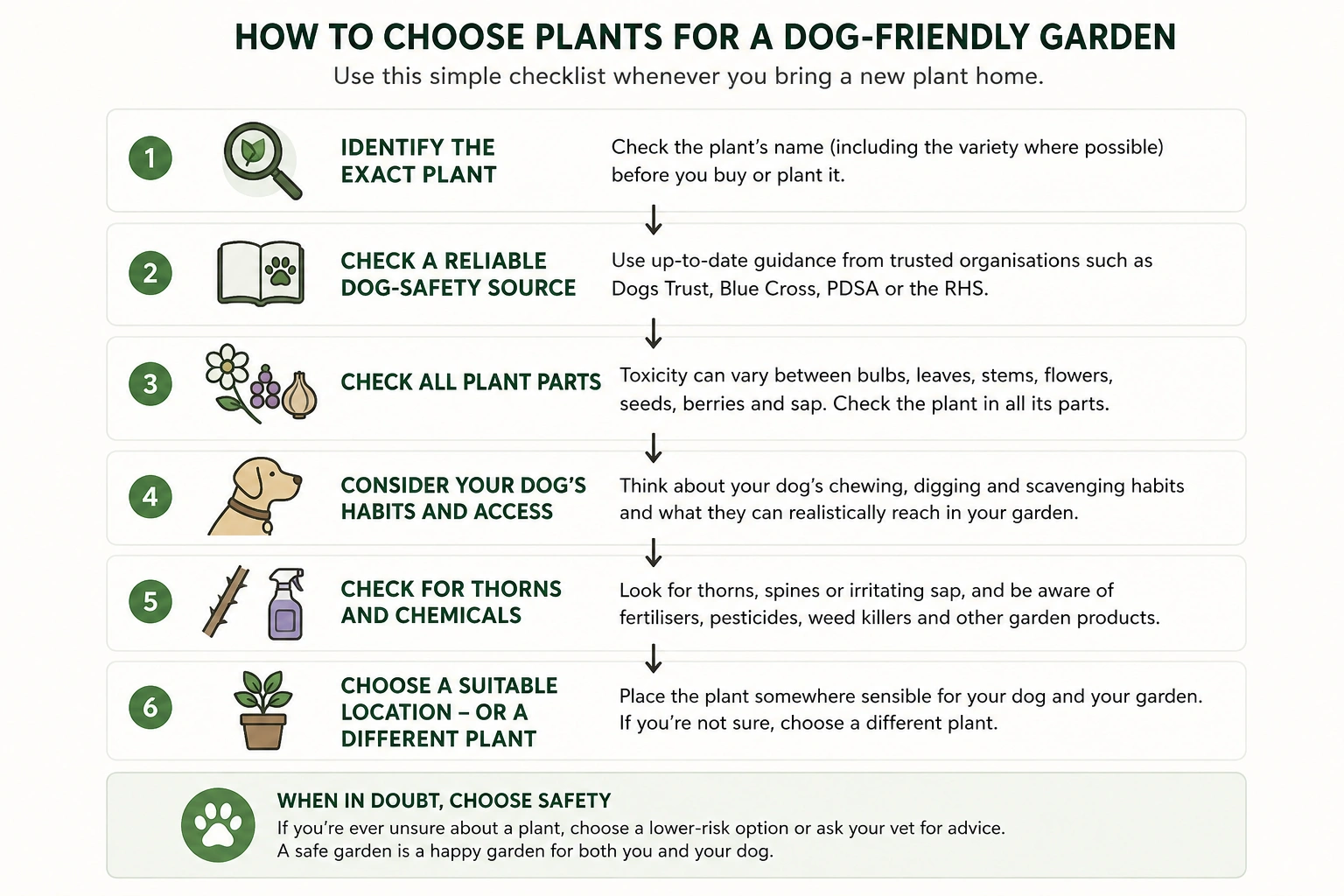
Identify the exact plant
Common names are not always enough. Where there could be confusion, check the botanical name on the label.
Check a reliable source
Use veterinary, animal-welfare or reputable horticultural guidance rather than assuming a retailer’s “pet-friendly” description tells you everything you need to know.
The Horticultural Trades Association’s potentially harmful plant guidance was developed with the Veterinary Poisons Information Service and includes pet hazards in its plant-labelling system.
Think about the whole plant
Flowers are only one part of the picture. Bulbs, roots, leaves, berries, seeds and fallen material may have different practical implications.
Think about your dog
A dog that never touches plants may need relatively little management. A puppy or habitual chewer needs much more careful plant placement and supervision.
Consider physical hazards too
A non-toxic plant with sharp thorns may still be a poor choice beside a narrow path, favourite running route or resting area.
Check what is being used on the plant
Pesticides, weed killers, fertilisers and other garden products introduce hazards of their own. Follow product instructions carefully and prevent access where required.
This approach remains useful even when you change the planting later, because it helps you assess the actual plant, the actual dog and the actual location rather than relying on a label alone.
Making the Rest of the Garden Dog-Friendly
Safe planting is only one part of creating an outdoor space that works well for a dog.
A secure boundary, suitable surfaces, places to rest and things to explore all matter too. Our guide to creating a dog-friendly garden brings those parts together.
It is also worth giving your dog suitable things to do rather than expecting flower beds to provide all their stimulation. Best Garden Toys for Dogs looks at play options for the garden.
In warm weather, planting can contribute useful natural shade, but it should not be the only plan for keeping a dog comfortable. Dog Shade for the Garden looks specifically at creating usable shaded areas. If your dog moves indoors when temperatures rise, Are Fans Safe for Dogs? explains what a fan can and cannot do for a hot dog.
The Bottom Line
A dog-friendly garden does not need to be a plant-free garden.
Start with well-supported choices such as rosemary, sage, basil, calendula, cornflowers, sunflowers, hibiscus and fuchsia, then consider how the plant will actually be used and accessed in your garden.
Most importantly, do not treat “dog-friendly” as meaning “safe to eat”. Identify unfamiliar plants carefully, keep recognised hazards away from your dog and seek veterinary advice promptly if you think your dog has eaten something poisonous.
Read next
- How to Create a Dog Friendly Garden: The Ultimate Guide
- How to Dog Proof Your Garden
- How to Create a Sensory Garden for Dogs