
A dog-friendly garden should be secure, comfortable and interesting for your dog, while still working as a practical outdoor space for everyone else in the household.
That does not mean filling the garden with dog equipment or redesigning every inch of it. The best approach is to remove serious hazards first, then plan shade, water, resting areas, routes and activities around the individual dog’s needs and behaviour.
A small courtyard can be dog-friendly. A large landscaped garden can be unsuitable. What matters is how safely and comfortably your dog can use the space.
The foundations of a dog-friendly garden
A well-planned dog garden should provide:
- secure boundaries and entrances;
- careful planting and safe storage;
- dependable shade and fresh water;
- a comfortable place to rest;
- suitable paths and surfaces;
- appropriate opportunities to sniff, play and explore;
- practical management of digging, toileting and garden wear;
- regular checks as the dog, plants and seasons change.
Safety comes first. Decorative features and enrichment only become worthwhile once escape routes, poisonous substances and other serious hazards have been addressed.
Start with your dog, not a garden trend
There is no single garden layout that suits every dog.
Before choosing plants, surfaces or garden features, consider how your own dog behaves and what they are physically able to do.
Think about:
- age and life stage;
- size and athletic ability;
- mobility or joint problems;
- whether the dog digs, climbs, chews or scavenges;
- whether they chase wildlife;
- sensitivity to noises or people passing the boundary;
- health conditions that affect breathing or temperature control;
- whether they tend to eat plants, compost or other objects;
- how they currently use the garden.
A calm senior dog may mainly need easy access, a comfortable resting place and gentle opportunities to sniff. A young, energetic dog that digs beneath fences and races around the perimeter requires a very different design.
Flat-faced dogs, overweight dogs, puppies, older dogs and dogs with breathing or medical problems may also be more vulnerable in warm weather. Their garden should make it particularly easy to retreat into shade or return indoors.
You should also consider what the people in the household need from the space. A successful design does not exclude the dog from the garden, but it does not require the entire garden to become a dog enclosure either.
Audit your existing garden before making changes
Begin by inspecting the garden as it is now.
Walk slowly around the full perimeter and look at the space from your dog’s approximate height. Hazards and escape routes are often less obvious when viewed from above.
Check:
- fences, walls and hedges;
- spaces beneath gates;
- loose panels or damaged posts;
- changes in ground level beside boundaries;
- bins, furniture or planters that could be used for climbing;
- sharp edges, exposed nails or wire;
- ponds and other water features;
- sheds, greenhouses and storage areas;
- compost bins and food waste;
- bulbs, fallen fruit, nuts and plant cuttings;
- chemicals, fuels and gardening products;
- tools, machinery, string and netting;
- hot, slippery, sharp or unstable surfaces;
- where shade falls at different times of day;
- whether clean water is always available.
Repeat the inspection after storms, building work, gardening or changes to the layout. A boundary that was secure in spring may develop a gap after soil dries, plants are cut back or a fence panel shifts.
A detailed audit also helps you prioritise. Repairing a gate or removing accessible poison is more important than buying toys or redesigning a border.
For a more detailed implementation process, follow a structured approach to how to dog-proof your garden rather than attempting every improvement at once.
Make the boundaries and entrances secure
A secure boundary must stop your particular dog from going through, underneath or over it.
There is no universal fence height that is suitable for every dog. The right solution depends on the dog’s:
- height and reach;
- jumping and climbing ability;
- digging behaviour;
- motivation to escape;
- access to objects beside the boundary;
- tendency to squeeze through narrow gaps.
Inspect the whole perimeter rather than focusing only on the main fence panels. Common weak points include:
- gaps beneath gates;
- loose gravel or soft soil at the base of a fence;
- spaces behind sheds;
- damaged hedging;
- low walls beside raised beds;
- bins, benches or timber stacks that act as steps;
- gates that can be pushed or nudged open.
Use secure catches and make sure everyone in the household understands the gate routine. Where visitors, tradespeople or children regularly use the garden, a second barrier or enclosed entrance area may reduce the chance of a dog slipping through an open gate.
Some dogs become highly aroused by people, dogs or wildlife visible through the boundary. Strategic screening can help, although it should not create a stuffy, sun-trapping area with poor airflow.
The separate guide to choosing secure fencing for your garden should be used when the reader needs detailed help comparing fencing styles, materials, barriers and escape-prevention options.
Divide the garden into useful zones
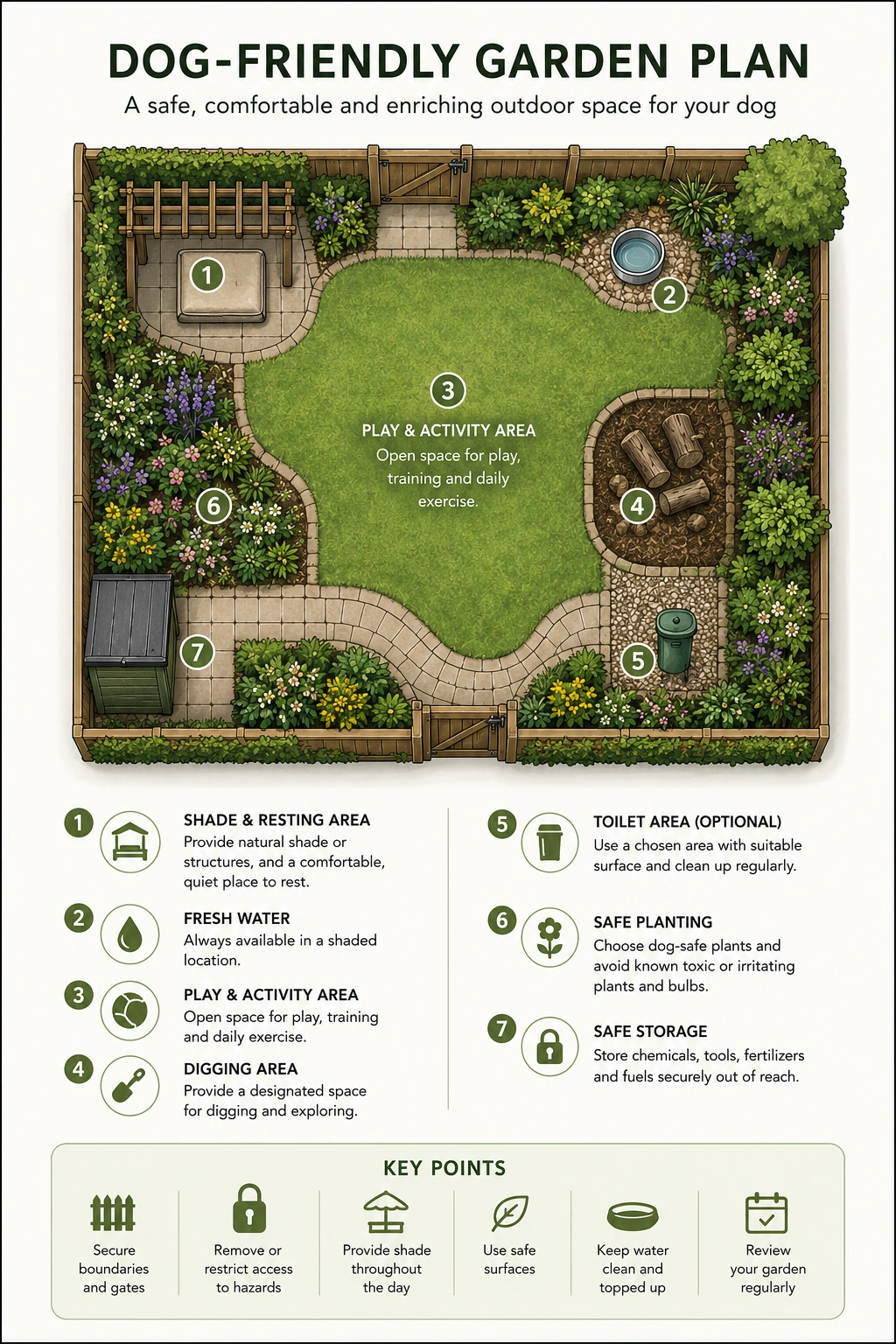
Garden zoning does not mean building a series of rigid enclosures. It simply means deciding what different areas of the garden are expected to do.
Depending on the space and the dog, useful zones may include:
- an open movement or play area;
- a quiet resting area;
- a shaded water station;
- robust planting;
- a sniffing or enrichment area;
- an optional digging area;
- an optional toilet area;
- restricted storage or gardening space.
Several functions can share one area. A shaded corner might include a bed, water and safe planting. A path around a border might provide both a practical route and an interesting sniffing trail.
Zoning can be particularly valuable where the dog’s habits repeatedly conflict with the garden. Rather than continually replacing plants on a favourite running route, it may be more practical to formalise the route with a durable surface and move vulnerable planting elsewhere.
Even a patio or compact courtyard can be divided informally through the position of containers, resting areas and activity spaces.
The aim is not to control every movement. It is to make the choices available to the dog safer and more acceptable.
Choose paths and surfaces that work for paws and people
A practical dog-friendly surface should be stable, maintainable and comfortable underfoot.
There is no single best surface for every garden. Grass, paving, decking, gravel, bark and artificial grass all have potential benefits and limitations.
Consider:
- heat in direct sunlight;
- drainage;
- slipperiness when wet;
- sharp edges or loose pieces;
- ease of cleaning;
- mud and wear;
- access for an older or less mobile dog;
- whether the dog is likely to chew or eat the material.
Hard surfaces can become uncomfortably hot in direct sun. Artificial grass, paving and other exposed materials should be checked during warm weather rather than assumed to remain safe. PDSA specifically warns that artificial grass, tarmac and sand can become hot enough to create a risk for dogs.
Avoid treating any hand test or temperature figure as a guarantee. Sun exposure, surface material, air temperature, wind and the individual dog all affect risk.
It is often better to provide a choice of surfaces and a clear route to a shaded or cooler area than to cover the whole garden with one material.
For dogs with mobility difficulties, prioritise firm, level routes without unexpected steps, unstable gravel or slippery corners.
Choose and manage garden plants carefully
A dog-friendly garden does not need to be plant-free, but planting should be chosen and managed with the dog in mind.
Start by identifying what is already growing. Do not assume that a familiar or commonly planted species is harmless.
Common UK gardens may contain plants that can be harmful to dogs, including foxglove, rhododendron, yew, wisteria and daffodil bulbs. Garden chemicals and plant material can also present different levels of risk depending on the substance and amount involved.
When planning new planting:
- research the exact plant rather than relying only on a common name;
- check bulbs, berries, leaves, flowers and seeds where relevant;
- account for fallen and pruned material;
- consider whether the dog actually chews plants;
- remember that puppies and persistent scavengers may require stricter controls;
- check suitability separately for cats or other pets;
- use fencing or positioning to restrict access where removal is unnecessary.
Plants commonly regarded as dog-friendly can still cause digestive upset if a dog eats enough of them. A “safe” label should never be treated as permission for unrestricted chewing.
Herbs such as rosemary and sage, and flowers including calendula, cornflowers and sunflowers, are among the options Dogs Trust identifies as potentially suitable for dog-friendly planting. Suitability still depends on the individual dog and the other animals sharing the garden.
Before adding unfamiliar species, see Dog-Safe Plants for Gardens for more detailed guidance on choosing plants that are safer for dogs.
If your dog may have eaten a poisonous plant
Move your dog away from the source and contact a vet immediately.
Do not wait for symptoms to appear and do not try to make the dog vomit unless a veterinary professional specifically tells you to do so. Take the plant, packaging or a photograph with you where this can be done safely.
Lock away chemicals, compost and gardening hazards
Plants are not the only potential danger in a garden.
Products and materials that require careful storage include:
- rat or mouse poison;
- slug and snail products;
- weedkillers;
- pesticides and insecticides;
- fertilisers, including bonemeal;
- barbecue lighter fluid;
- fuels, paint products and solvents;
- antifreeze;
- creosote;
- cocoa mulch;
- compost and food waste.
Dogs Trust advises contacting a vet promptly if a dog has come into contact with potentially poisonous garden chemicals such as rat poison, slug products, herbicides, insecticides, bonemeal fertiliser or barbecue lighter fluid.
Store these products in a secure cupboard or building the dog cannot access. Closing a shed door is not enough if the door can be pushed open or a bag can be reached through a gap.
Tools and materials can also injure dogs. Put away:
- secateurs and saws;
- mower and strimmer equipment;
- wire and stakes;
- loose netting;
- string and cable;
- broken pots;
- sharp-edged sheet materials.
Check the area before mowing or strimming, particularly if toys, chews or wildlife may be hidden in long grass.
Compost requires special care. Food waste and decomposing material can attract dogs, and mouldy contents may be dangerous. Use a secure container rather than an open heap where a scavenging dog can reach it.
Suspected poisoning
If you think your dog has eaten or contacted a poisonous substance:
- move the dog away from it;
- contact your vet immediately;
- preserve the packaging or a sample where safe;
- follow the vet’s instructions;
- never induce vomiting or give a home treatment unless directed by a vet.
The RSPCA specifically advises against “watching and waiting” after suspected poisoning.
Provide reliable shade, water and a cool resting place
Shade and water should be part of the garden design, not an afterthought added only during a heatwave.
Observe the garden across the day. An area shaded in the morning may be fully exposed by mid-afternoon.
Shade can come from:
- buildings;
- mature trees;
- suitable shrubs;
- pergolas or canopies;
- parasols;
- temporary shade structures.
Make sure the shaded area is large enough for the dog to lie comfortably and is not enclosed in a way that restricts airflow.
The RHS recommends providing shaded areas and water stations in warmer weather, while PDSA advises that dogs should always have access to shade and fresh water.
Place water in a stable container and keep it:
- clean;
- topped up;
- out of direct sun where practical;
- away from chemicals or contaminated runoff.
A second bowl may be sensible in a large garden or where one could easily be overturned.
A washable outdoor bed can provide a comfortable resting place, but position it in dependable shade. Cooling mats may offer additional comfort for some dogs, but no cooling product makes an excessively hot garden safe.
Bring the dog indoors when outdoor conditions are unsuitable. Do not rely on shade alone if the dog is distressed, exercising heavily or unable to cool down.
For detailed options, follow the specialist advice on creating dependable shade for your dog in the garden.
Watch for signs of overheating
Warning signs can include unusually heavy or distressed panting, weakness, wobbling, confusion, vomiting or collapse.
Move the dog to a cooler place, begin appropriate cooling and contact a vet immediately. The dedicated guide explains the signs of dog heatstroke and what to do in an emergency. PDSA advises beginning cooling promptly and contacting a vet as soon as possible.
Give your dog opportunities to sniff, play and explore
A garden that is physically secure but offers nothing to do may still be frustrating.
Dogs experience much of the world through smell. A useful enrichment area can include:
- safe plants with different scents;
- varied but comfortable surfaces;
- routes between robust planting;
- hidden toys or suitable food-search activities;
- opportunities to observe the environment;
- a quiet place away from activity.
RHS guidance recommends sensory areas, different textures and safe planting to provide mental stimulation and encourage exploration.
Enrichment does not need to be permanent or expensive. Rotate a small number of suitable activities rather than filling the garden with unused equipment.
Possible activities include:
- scattering part of a normal food allowance through clean grass;
- hiding a toy in an easy location;
- short training games;
- sniffing trails;
- supervised water play;
- simple search games.
Account for the dog’s health, diet and temperament. Food-search activities may not suit every dog, and water play must always be supervised.
For a more detailed planting and layout process, use the specialist guide to create a sensory garden for your dog.
Plan for natural behaviours rather than fighting them
Dogs do not understand that a particular border is decorative or that the lawn should remain perfect.
A practical garden works with normal behaviour and redirects it where necessary.
Digging
Some dogs dig to explore smells, bury objects, seek cooler soil or release energy.
If digging is persistent, consider providing an acceptable digging area. This could be a defined patch of loose soil or sand containing suitable toys or safe items to find.
Reward the dog for using the permitted area and protect vulnerable planting while the new habit develops. Dogs Trust also recommends providing a designated digging place and making it rewarding.
Repeated punishment without providing an alternative may simply cause the dog to dig when no one is watching.
Patrolling
Many dogs repeatedly follow the same route around a fence or border.
Instead of continually repairing that strip, consider creating a stable path. Keep fragile plants away from tight corners and leave enough room for the dog to turn without crashing into pots, furniture or sharp edging.
Chewing and scavenging
Remove hazardous materials rather than relying solely on training.
Provide suitable chews or activities, but continue supervising a dog that eats soil, stones, mulch, plants or other objects.
Sudden or persistent ingestion of unusual materials may require veterinary or behavioural advice rather than a garden-design solution alone.
Chasing wildlife
Birds, squirrels, cats, foxes and hedgehogs may all attract a dog’s attention.
Position wildlife feeding areas thoughtfully and use barriers where necessary. Avoid placing feeders directly above the dog’s main activity or toilet area.
Garden design may reduce opportunities, but it cannot guarantee that a dog will ignore wildlife. Supervision and training remain important.
Decide whether your garden needs a dedicated dog area
A separate dog area can be useful, but it is not essential in every garden.
Possible uses include:
- a consistent toilet area;
- an approved digging patch;
- a supervised play area;
- a calm resting space;
- temporary separation from gardening or maintenance work;
- protecting newly planted beds.
A dog area should still provide suitable space, shade, water and contact with the household. It should not become permanent isolation or a substitute for walks, training and companionship.
Toilet areas
A dedicated toilet area can make cleaning and lawn management easier, especially in a small garden.
Consider:
- easy access;
- drainage;
- a surface the dog is willing to use;
- cleaning;
- distance from food and water;
- how the dog will be trained to use it.
For detailed advice on substrate, drainage and training, see How to Create a Dog Toilet Area in the Garden.
Runs and managed enclosures
A run may be useful for short, supervised periods or for temporary management, but it is not automatically the best answer.
Consider:
- why the run is needed;
- how long the dog will use it;
- shelter, shade and water;
- secure construction;
- visibility and interaction;
- floor comfort and drainage;
- the dog’s emotional response.
Read the specialist guidance before deciding whether a garden dog run is appropriate. A run should never be used to justify leaving a dog outdoors in unsuitable weather or for prolonged periods without interaction.
Protect the garden without making it hostile to the dog
A shared garden will usually show some evidence that a dog uses it.
The aim should be sensible durability rather than an unrealistic expectation that every plant and blade of grass remains untouched.
Practical approaches include:
- placing robust plants beside regular routes;
- using raised beds where appropriate;
- temporarily protecting newly planted areas;
- leaving adequate space around corners;
- creating a permitted digging area;
- establishing a practical toilet routine;
- moving delicate containers away from play areas;
- giving the dog an alternative before restricting a favourite activity.
Avoid deterrents that could frighten, injure or poison the dog. Products described as natural or pet-friendly should still be checked carefully before use.
The garden should also remain pleasant for people. Seating, paths, planting and dog features can coexist when the layout accounts for how the dog actually moves through the space.
For more layout inspiration after the safety and planning principles are established, explore dog-friendly garden design ideas.
Adapt the garden to your available space and budget
A dog-friendly garden does not have to be large or expensive.
Small gardens and courtyards
Prioritise:
- secure boundaries;
- clean water;
- reliable shade;
- a comfortable resting place;
- a small number of flexible activities;
- practical cleaning and drainage.
Use containers carefully and make sure the dog cannot knock them over, eat the plants or become trapped between them.
Space-intensive exercise may need to happen elsewhere, but even a small garden can support sniffing, training and calm outdoor time.
Patios and hard-surfaced gardens
Provide:
- comfortable resting surfaces;
- shade throughout the day;
- opportunities to sniff and explore;
- good drainage;
- regular cleaning;
- protection from surfaces that become hot.
A few safe containers, different textures and rotating activities can make a hard-surfaced area more interesting without overcrowding it.
Rented gardens
Focus on reversible changes such as:
- freestanding barriers;
- landlord-approved fence repairs;
- containers;
- portable shade;
- movable beds;
- temporary protection around planting.
Obtain permission before making structural changes. Tenancy terms differ, so do not assume that a particular alteration is automatically allowed.
Improvements on a limited budget
Spend first on reducing risk.
A sensible priority order is:
- repair escape points;
- remove or secure poisonous substances;
- provide shade and fresh water;
- make the main routes safe;
- protect vulnerable planting;
- add enrichment gradually.
Many effective changes involve repositioning, repairing or removing something rather than buying a new product.
Create your dog-friendly garden in the right order
Trying to redesign everything at once can make the project unnecessarily expensive and difficult.
Use a phased plan.
Phase 1: Make it safe
- inspect the entire boundary;
- repair escape points;
- secure gates;
- remove or isolate dangerous plants;
- lock away chemicals and tools;
- secure compost and waste;
- assess ponds and water features.
Phase 2: Make it comfortable
- establish reliable shade;
- provide fresh water;
- add a suitable resting place;
- deal with hot, sharp or slippery surfaces;
- improve access for dogs with limited mobility.
Phase 3: Make it practical
- identify regular routes;
- divide the space into useful zones;
- protect important planting;
- plan cleaning and toileting;
- organise secure storage.
Phase 4: Make it interesting
- add sniffing opportunities;
- provide suitable play;
- create a digging area where useful;
- introduce safe textures;
- rotate activities.
Phase 5: Observe and adjust
Watch how the dog uses the finished space.
Ask:
- Which features are ignored?
- Where does the dog naturally rest?
- Does shade remain available?
- Are new escape routes developing?
- Is a particular route becoming worn?
- Does the dog appear calm or frustrated?
- Are any objects being chewed or eaten?
A dog-friendly garden develops through observation. The first layout does not have to be the final one.
Maintain the garden as conditions change
Garden safety is not a one-off project.
Check regularly for:
- storm damage;
- loose gates or panels;
- gaps created by digging;
- seasonal plant growth;
- fallen berries, fruit, nuts or bulbs;
- plant cuttings;
- damaged toys;
- exposed wire or netting;
- contaminated water;
- moved shade;
- leaking chemical containers;
- new mushrooms or unfamiliar plants;
- slippery algae on paving or decking.
Reassess the space when:
- a puppy grows;
- a dog becomes older or less mobile;
- a new dog joins the household;
- behaviour changes;
- the garden is redesigned;
- a shed, greenhouse or water feature is added;
- chemicals have been used;
- extreme weather damages the garden.
Keep observing rather than assuming that a familiar garden is permanently safe.
Frequently asked questions
Does a dog-friendly garden need to be large?
No. A small garden, patio or courtyard can still provide secure boundaries, shade, water, comfortable rest and opportunities to sniff or train.
The dog may need exercise elsewhere, but garden size alone does not determine whether the space is safe or useful.
Can I make a rented garden dog-friendly?
Yes, although structural changes may require permission.
Start with reversible measures such as movable shade, containers, freestanding barriers and portable resting areas. Report damaged boundaries to the landlord and check the tenancy terms before installing fencing or making permanent alterations.
Do I need to remove every plant that could be toxic?
Not necessarily, but the risk must be managed responsibly.
Removal may be the safest option where a dog persistently chews plants or where highly hazardous material is easily accessible. In other cases, secure separation and careful maintenance may be appropriate.
Identify plants accurately and seek veterinary advice immediately after suspected ingestion.
Is artificial grass suitable for dogs?
It can work in some gardens, but it is not automatically the best choice.
Consider installation quality, drainage, cleaning, odour control, surface temperature and whether the dog is likely to chew it. Artificial grass can become hot in direct sunlight, so the dog must have access to cooler surfaces and shade.
Should my dog have a separate area in the garden?
Only when it serves a clear purpose.
A toilet, digging or temporary management area can be useful, but the dog should not be routinely isolated in a small section without shade, water, exercise or interaction.
Build the garden around the dog you actually have
The best dog-friendly garden is not the one with the most equipment or the most elaborate design.
Start by preventing escape and removing serious hazards. Then provide shade, water, comfortable rest and suitable routes. Once those foundations are secure, add planting, play and enrichment that reflect your dog’s real behaviour.
Observe how the space is used and adjust it over time. A garden designed around the dog you actually have will be safer, easier to maintain and more enjoyable for everyone.