
Dogs can swim safely in some rivers, but a river should never be assumed to be safe simply because the water looks calm or clean.
Choose only a shallow, slow-moving stretch with stable access, several easy exit points and no current pollution, flooding or blue-green algae warnings. Keep your dog close, supervise continuously and stay out if you are uncertain about the current, water quality or your dog’s ability to cope.
Contact a vet urgently if your dog may have swallowed water containing blue-green algae, develops breathing difficulty, collapses, has a seizure or becomes severely weak or uncoordinated after swimming. Do not enter dangerous water to rescue a dog; call the emergency services.
Are rivers safe for dogs?
Some shallow, slow-moving rivers can be suitable for supervised dog swimming. Fast-flowing water and flooded rivers are dangerous because a current can quickly carry a dog away, while floodwater may contain branches, rubbish and other hidden debris.
River conditions can also change from one visit to the next. A place that was manageable during dry weather may become deep, fast or polluted after rain.
Before allowing your dog into a river, check three things:
- The river: Is the current slow, the water shallow and the bank easy to leave?
- The water quality: Are there any pollution, sewage or blue-green algae warnings?
- Your dog: Can your dog swim confidently without becoming tired or distressed?
A “yes” to one of these does not compensate for a “no” to another. A strong swimmer can still be swept away, and clean-looking water can still contain harmful microorganisms.
Do not let your dog enter the river if…
Keep your dog out when any of the following apply:
- The current is fast, turbulent or difficult to judge.
- The river is flooded, unusually high or rapidly rising.
- There is a weir, sluice, rapid, waterfall or sudden drop nearby.
- The bank is steep, unstable, muddy or undercut.
- There is no obvious place for your dog to climb out.
- Boats or other fast-moving watercraft use the channel.
- You can see submerged branches, wire, fishing line, rubbish or dense vegetation.
- Warning signs advise against entering the water.
- Sewage pollution or poor water quality has been reported.
- Blue-green algae is suspected or officially reported.
- You notice dead fish, an unusual smell, concerning discolouration or unexplained surface scum.
- Your dog is reluctant, unwell, exhausted or physically unsuited to the conditions.
The absence of a warning sign does not prove that an ordinary stretch of river has been tested or declared safe.
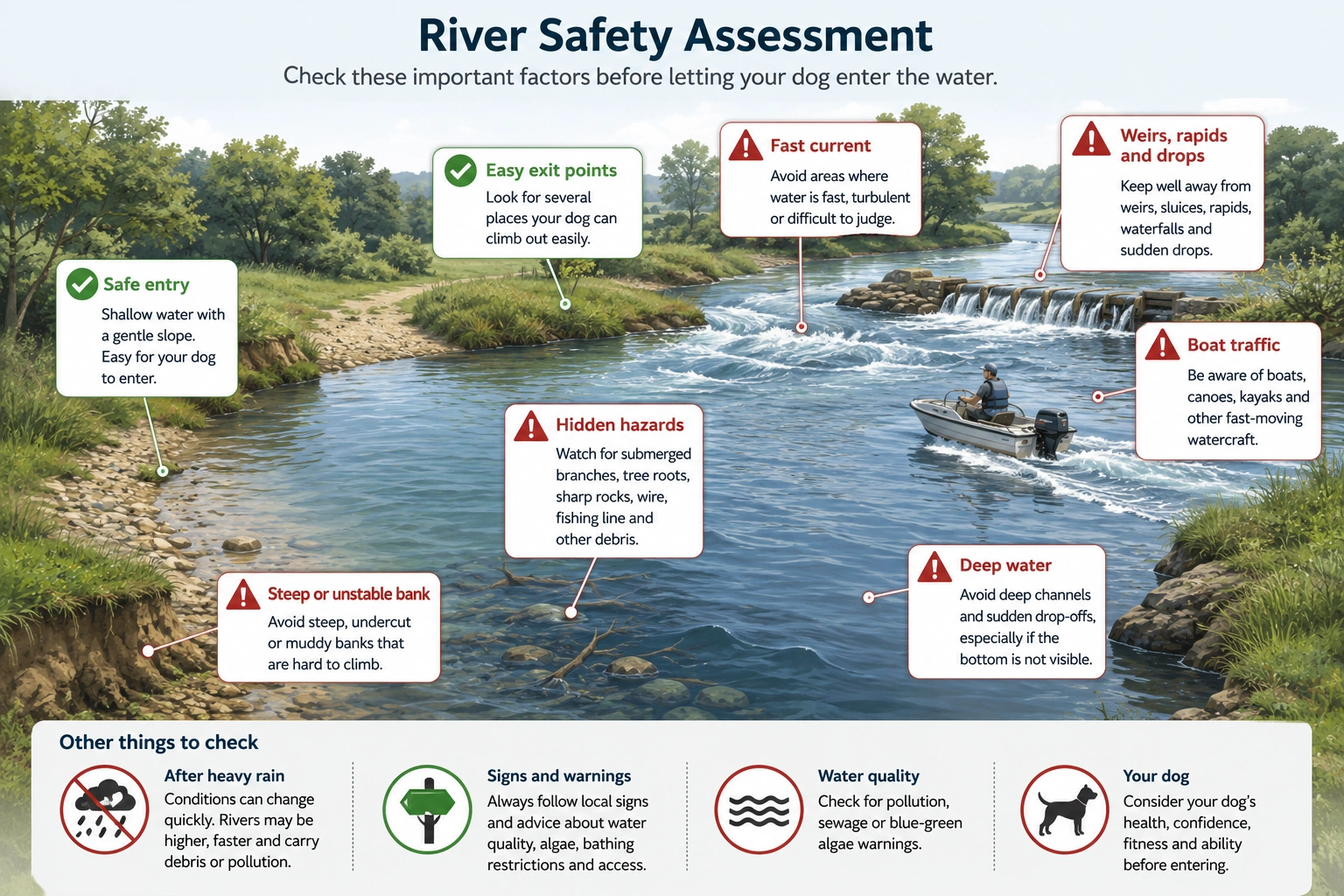
How to tell if a river is safe for your dog
No single check can guarantee that a river is safe. Use the following assessment every time you visit.
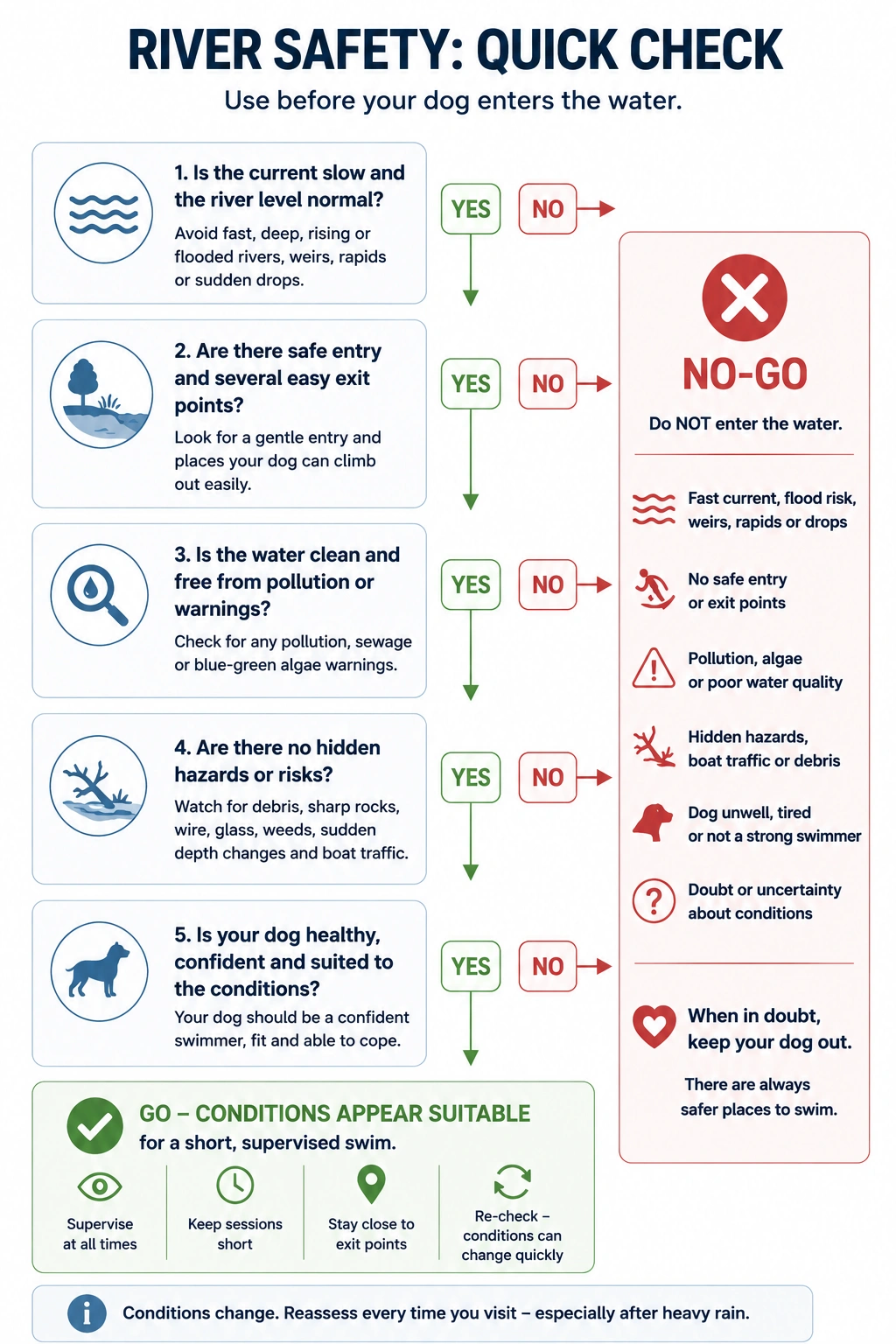
Check the current and river level
Watch the surface for a few minutes before your dog enters. Leaves, sticks or foam moving quickly downstream may indicate a stronger current than the surface initially suggests.
Avoid water that is:
- moving rapidly;
- visibly turbulent;
- unusually deep;
- rising;
- carrying debris;
- close to a weir, rapid or other structure.
A smooth surface does not necessarily mean there is no stronger flow underneath.
Flooded rivers should always be avoided, in line with PDSA water safety advice. As well as stronger currents, floodwater can carry branches, litter and contaminants that are difficult to see.
Find a shallow entry and several exits
A suitable entry point should have a firm, gently sloping bank where your dog can walk into the water without jumping.
Check that your dog could also leave the river:
- from the same place;
- a short distance downstream;
- without climbing a vertical or slippery bank;
- without crossing deep or fast water.
Several reachable exits are particularly important because even a mild current may move a dog away from the original entry point.
Avoid concrete-sided channels, unstable mud, undercut banks and places where vegetation blocks the edge.
Look for hidden hazards and other river users
Rivers may contain hazards below the surface, including:
- branches and tree roots;
- sharp rocks;
- broken glass;
- fishing hooks and line;
- wire;
- rubbish;
- thick weeds;
- sudden changes in depth.
Also look upstream and downstream for boats, anglers, livestock, wildlife and people taking part in water sports.
Do not throw a toy towards the middle of a river, a deep channel, the opposite bank or any area where your dog may struggle to return.
Check local signs, restrictions and water information
Always follow signs and local instructions. Dogs may be excluded from some areas because of wildlife, livestock, fishing, waterworks, private access or safety concerns.
In England, the Environment Agency monitors designated bathing waters during the bathing season, normally from 15 May to 30 September. It checks for organisms used to indicate faecal contamination and publishes annual water-quality classifications. Some designated sites also receive short-term pollution-risk forecasts.
However, designated bathing-water status does not mean that a location is guaranteed to be safe. Official guidance expressly notes that designation itself does not prove that the water meets the required standard or is safe for bathers.
Annual classifications are based on samples collected over a period of up to four years, so an “excellent” or “good” classification is not a real-time test of the water you are looking at today.
Most ordinary river locations are not designated bathing waters. Where information is available, check the relevant official service:
- Environment Agency information for England;
- Natural Resources Wales;
- the Scottish Environment Protection Agency;
- DAERA in Northern Ireland.
Water-quality information is only one part of the decision. It does not assess the current, bank, depth, underwater debris or whether the site is suitable for your dog.
Be especially cautious after heavy rain
Rain can raise the river level, strengthen the current and wash animal waste, agricultural runoff, litter and other contaminants into the water.
Avoid swimming during heavy rain and while the river remains:
- high;
- fast;
- discoloured;
- debris-filled;
- affected by a pollution warning.
There is no single waiting period that makes every UK river safe after rain. Conditions vary between rivers and catchments, so use current local information and wait until the river has visibly returned to normal.
Is river water safe for dogs to drink?
Dogs should not be encouraged to drink river water, even where the river appears suitable for swimming.
Open water can contain microorganisms and may be affected by sewage, livestock waste, agricultural runoff and other pollution. Designated bathing waters are monitored for human health, but many ordinary river sites are not routinely sampled.
Possible risks include:
- bacteria and other microorganisms;
- sewage contamination;
- animal urine and leptospirosis bacteria;
- blue-green algae toxins;
- excessive water ingestion during prolonged play.
Carry fresh tap water and a portable bowl. Call your dog out regularly for a rest and a drink, rather than allowing them to become thirsty enough to drink from the river.
A small accidental mouthful does not mean a dog will necessarily become ill. Monitor your dog and contact a vet if vomiting, diarrhoea, marked tiredness, weakness, wobbliness, coughing, breathing difficulty or other concerning changes develop.
Blue-green algae can occur in rivers
Blue-green algae is a group of bacteria known as cyanobacteria. It is often associated with lakes and ponds, but it can also affect slow-moving freshwater, including rivers.
Some types produce toxins that can cause severe or fatal illness in dogs. Dogs should not swim in or drink from suspect water, and a vet should be contacted immediately after possible ingestion.
A bloom may appear as:
- green or blue-green scum;
- streaks resembling paint;
- flakes, clumps or small dots;
- foam at the edge of the water;
- greenish-brown surface material.
However, appearance alone cannot establish whether a bloom is toxic. Some harmful cyanobacteria may not form an obvious surface layer.
Keep your dog out when algae is suspected or a warning is displayed. If contact occurs:
- Remove your dog from the water.
- Prevent further drinking.
- Prevent coat licking where practical.
- Rinse the coat with clean tap water if this can be done safely.
- Contact a vet urgently and explain where and when the exposure occurred.
For detailed symptoms and veterinary guidance, see Blue-Green Algae and Dogs: Symptoms, Treatment & Prevention.
For a step-by-step response after possible exposure, see What to Do If Your Dog Drank or Swam in Blue-Green Algae.
River water and leptospirosis
Leptospirosis is a bacterial infection that can be spread through water or wet ground contaminated by the urine of infected animals, including rats.
Swimming in contaminated freshwater may expose a dog through the mouth, nose, eyes or damaged skin. Keeping your dog’s vaccination protection current can reduce the risk, particularly if your dog regularly swims or spends time around farms, wildlife or rodents.
Vaccination does not make every river safe, and protection may not cover every strain of the bacteria. Ask your vet which vaccination schedule is appropriate for your dog.
Avoid stagnant, polluted or flood-affected water and contact your vet if your dog becomes unwell after a possible exposure.
Which dogs are at greater risk in rivers?
Any dog can get into difficulty, including experienced and powerful swimmers.
Extra caution is needed with:
- puppies;
- older dogs;
- inexperienced or reluctant swimmers;
- brachycephalic dogs with short noses;
- short-legged or heavy-bodied dogs;
- dogs with poor fitness;
- dogs with heart or breathing conditions;
- dogs with joint, spinal or neurological problems;
- dogs recovering from illness or surgery;
- dogs that become fixated on retrieving toys;
- dogs without a reliable recall.
Do not assume that breed reputation proves swimming ability. Some individual dogs dislike water, tire quickly or struggle to keep their head comfortably above the surface.
Never throw or push a dog into a river. Allow the dog to decide whether to enter and keep the first experience shallow and controlled.
How to supervise a dog swimming in a river
Even a carefully selected river requires close supervision.
Start in shallow water
Let your dog enter from a gently sloping bank. Stay close and allow the dog to paddle before moving into deeper water.
Keep your dog near the bank
Do not encourage swimming across the river or towards the opposite bank. Conditions may be different in the centre of the channel.
Keep sessions short
Swimming is tiring. End the session before your dog becomes exhausted, starts swallowing water repeatedly or struggles to maintain a comfortable body position.
On warm, humid days, remember that high humidity can also make it harder for dogs to lose heat effectively through panting. See what humidity is safe for dogs for guidance on assessing humidity alongside temperature, activity and your individual dog.
Repeated retrieval games can encourage a dog to ignore fatigue and ingest more water. For more detailed guidance on fatigue, session length and excessive swimming, see Can Dogs Swim Too Much?
Take regular breaks
Call your dog out, offer fresh water and allow time to rest. Reassess the river conditions before permitting another entry.
Maintain control
A reliable recall is valuable, but it does not make unsafe water acceptable.
A line may help control a dog close to a shallow bank, but it can snag on branches, rocks or vegetation. Never allow a long line to trail freely through moving water, and attach it to a suitable harness rather than creating pressure on the neck.
Follow broader swimming precautions
River-specific checks should sit alongside general preparation, fatigue management, supervision and emergency planning. See the complete dog swimming safety guide when that guide is available.
When a dog life jacket may help
A well-fitted dog life jacket can provide extra buoyancy and visibility for:
- inexperienced swimmers;
- dogs with limited stamina;
- dogs swimming from a boat;
- dogs that need additional support in otherwise appropriate water.
Look for secure adjustment, appropriate buoyancy, good visibility and a strong assistance handle.
A life jacket does not:
- make a fast river safe;
- prevent a dog being swept downstream;
- remove entanglement risk;
- guarantee that the dog can leave the water;
- replace close supervision.
For help deciding when flotation equipment may be appropriate, see Does My Dog Need a Life Jacket?
Do not use a life jacket as a reason to permit swimming in flooded, polluted or physically hazardous water.
What to do if your dog gets into trouble
If your dog is being swept away
Do not enter a fast or flooded river. Human rescuers can also be overcome by the current.
Call the emergency services if there is immediate danger. Where it is safe to do so, move along the bank and encourage your dog towards a reachable downstream exit.
Do not lean over an unstable bank or enter a weir, rapid or deep channel.
If your dog has inhaled water or is struggling to breathe
Remove the dog from the water only if you can do so without putting yourself at risk.
Contact a vet immediately after significant water inhalation or breathing difficulty.
Seek emergency veterinary care for:
- laboured or rapid breathing;
- persistent coughing after a serious incident;
- collapse;
- severe weakness;
- blue, grey or very pale gums;
- loss of consciousness.
Do not assume that a dog needs no assessment merely because they appear to recover after struggling in the water.
If pollution or blue-green algae is suspected
Stop further exposure and contact a vet promptly. Suspected blue-green algae exposure should be treated urgently because illness can progress rapidly.
Tell the vet:
- the location;
- the time of exposure;
- whether your dog drank the water;
- how long your dog was in the water;
- any signs you have noticed;
- whether an official warning was present.
Do not delay veterinary advice while trying home remedies.
What to do after your dog has swum in a river
After an uncomplicated swim:
- Rinse your dog with clean tap water.
- Dry the coat thoroughly, particularly in cool or windy weather.
- Check the paws and pads for cuts, hooks, glass or debris.
- Check the coat for fishing line, plants and parasites.
- Dry the outer ears gently.
- Offer fresh drinking water.
- Monitor your dog for unusual behaviour or illness.
Do not insert cotton buds or other objects into the ear canal. or more detailed aftercare advice, see Dog Ear Care After Swimming.
Rinsing may remove mud and surface contaminants from the coat, but it cannot undo water that has been swallowed or guarantee that infection or poisoning will not occur.
Contact a vet if your dog develops vomiting, diarrhoea, unusual tiredness, loss of appetite, coughing, breathing changes, weakness, poor coordination or any other concerning signs after the swim.
Quick river-swimming safety checklist
Before the swim
- Dogs are permitted in the water.
- There is no pollution, sewage or algae warning.
- The river is not flooded or unusually high.
- The current is slow.
- Entry is shallow and stable.
- More than one exit is available.
- There is no nearby weir, rapid or boat channel.
- No serious debris or entanglement hazard is visible.
- Recent rain has not made conditions unsafe.
- Your dog is willing, healthy and physically capable.
- You have fresh drinking water.
- You can supervise continuously.
During the swim
- Keep your dog close to the bank.
- Keep the session short.
- Take regular breaks.
- Prevent prolonged retrieval games.
- Discourage drinking from the river.
- Stop if your dog becomes tired or distressed.
- Leave immediately if conditions change.
After the swim
- Rinse with clean water.
- Dry the coat and outer ears.
- Check paws, skin and coat.
- Offer fresh drinking water.
- Monitor for illness.
The safest verdict
Rivers are not automatically safe or unsafe for dogs. The answer depends on the current conditions, water quality, access, exits and the individual dog.
Choose only shallow, slow-moving water with safe banks and no current warnings. Keep the swim short and closely supervised. When any part of the assessment is uncertain, keep your dog out and choose a more controlled activity or another safe way to help your dog stay cool, or one of the planned safer places for dogs to swim instead.
Read next
- Safe Places for Dogs to Swim
- Blue-Green Algae and Dogs: Symptoms, Treatment & Prevention