
Dogs can get sunburn, particularly where their skin is pale, exposed or protected by only a thin covering of fur. The nose, ear tips, eyelids and tummy are among the areas most commonly affected.
The best way to prevent dog sunburn is to reduce unnecessary exposure to strong ultraviolet (UV) radiation and protect vulnerable skin. That can mean changing when and where your dog spends time outside, providing reliable shade, applying suitable dog-safe sunscreen to exposed areas and, for some dogs, using protective clothing.
Sunscreen can be useful, but it should be one part of a wider sun-protection routine rather than the only precaution you take.
Key takeaway
The best way to prevent dog sunburn is to combine sensible sun exposure with reliable shade and protection for vulnerable skin. Dog-safe sunscreen can help on exposed areas, while some white, hairless or thin-coated dogs may also benefit from protective clothing.
For a broader explanation of the condition, including symptoms and treatment, see our complete guide to dog sunburn.
The Best Ways to Prevent Sunburn in Dogs
A practical dog sunburn prevention routine has several layers:
- Identify the parts of your dog that have pale, exposed or thinly haired skin.
- Reduce prolonged exposure when UV levels are stronger.
- Make sure your dog has access to reliable shade.
- Use a suitable dog-safe sunscreen on vulnerable areas where appropriate.
- Consider sun-protective clothing if a larger area of skin needs protection.
- Reassess protection after swimming or other activities that may remove sunscreen.
- Check vulnerable skin after spending time outdoors.
How much protection your dog needs depends on the individual dog and the conditions. A densely coated dog with well-pigmented skin may need very different precautions from a white, hairless or thin-coated dog.
Sunburn risk is also not the same thing as heat risk. A dog does not have to be dangerously hot to be exposed to damaging UV radiation, so don’t use air temperature alone to decide whether sun protection is needed.
Which Dogs Need the Most Sun Protection?
Any dog can have areas that are vulnerable to sun damage, but some have much less natural protection than others.
Take particular care if your dog has:
- white or very light-coloured fur;
- pale or pink skin;
- a naturally thin or sparse coat;
- hairless areas;
- patches of hair loss;
- scars or other exposed skin;
- areas that have been clipped or shaved very short.
Pale skin underneath white or light fur can be particularly vulnerable. Even a dog with a thick coat may have less-protected areas around the nose, eyes, ears and underside.
A dog with hair loss may also need extra sun protection while the underlying cause is investigated or treated. If your dog develops unexplained bald patches, don’t treat sun protection as a substitute for finding out why the hair is being lost.
For dogs with particularly extensive areas of vulnerable skin, Sun Protection for White, Hairless & High-Risk Dogs provides a useful next step.
Which Parts of a Dog Are Most Likely to Burn?
The areas most likely to need attention are those with little fur or light pigmentation.
Common vulnerable areas include:
- the nose and muzzle;
- ear tips and sparsely haired parts of the ears;
- eyelids and skin around the eyes;
- the tummy and groin;
- inner thighs;
- bald or thinly haired patches;
- scars and clipped areas.
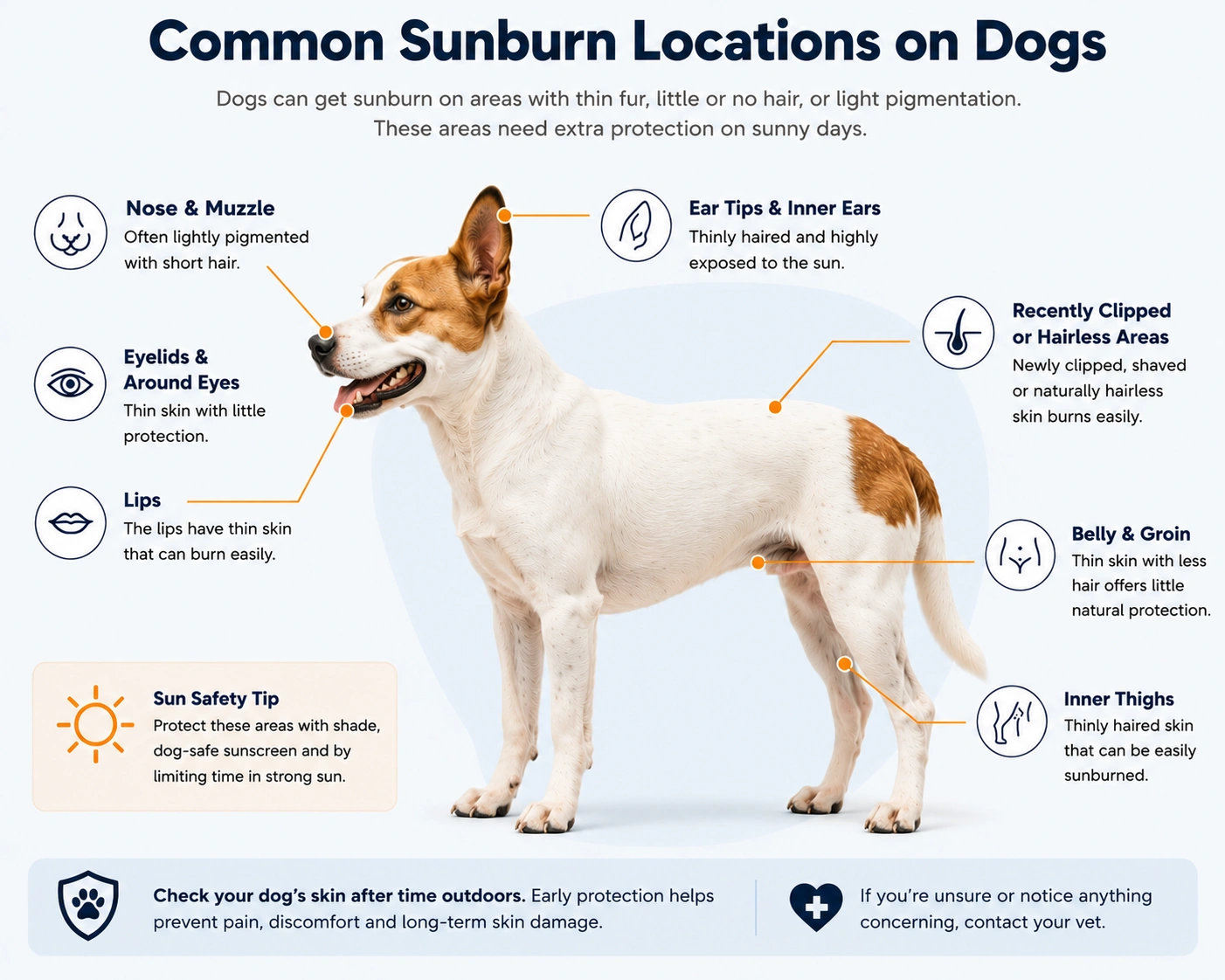
PDSA specifically identifies the ears, nose, eyelids and tummy as common sites for sunburn in pets.
You don’t necessarily need to cover every centimetre of your dog in sunscreen. Start by looking at where the coat and pigmentation provide the least natural protection.
Pay particular attention to the nose and ears
The nose and ear tips are easy to overlook because they are relatively small areas, but they can be highly exposed.
A persistent sore, ulcer, scab or other unusual change on the nose or ears shouldn’t simply be assumed to be sunburn. Skin problems have many possible causes and persistent or concerning changes should be checked by a vet.
For more focused advice about protecting this particularly exposed area, see Dog Nose Sunburn: Causes, Treatment & Prevention.
1. Reduce Your Dog’s Exposure to Strong Sun
Reducing UV exposure is the foundation of preventing sunburn.
Where practical, plan longer walks and extended outdoor activities for times when the sun is less intense rather than spending long periods outside around the strongest part of a sunny day.
PDSA recommends avoiding walks in the middle of hot days and favouring mornings and evenings. However, don’t turn that into a rigid rule that a particular time is automatically safe. Conditions vary with the season, weather and location.
The UK’s Met Office UV forecast is a useful planning tool because it tells you about ultraviolet radiation rather than simply air temperature.
Cloud also doesn’t automatically remove the risk. Significant UV radiation can penetrate cloud, so a bright but cloudy day should not automatically be treated as a no-protection day.
A simple habit is to check both the weather forecast and the UV forecast before a long summer walk, beach trip, garden day or holiday outing.
2. Provide Reliable Shade
Shade reduces direct sun exposure and gives your dog somewhere protected to rest.
Useful shade should:
- be large enough for your dog to get fully underneath it;
- remain available as the sun moves;
- allow good airflow;
- provide enough room for your dog to settle comfortably;
- allow your dog to move in and out freely.
A tree, parasol, canopy or open shelter may all work in the right situation.
However, shade should not create false reassurance. A small patch of shade can move surprisingly quickly, and the air underneath a shelter can still become uncomfortably hot.
Shade also doesn’t remove every source of UV exposure. Think of it as one layer of protection rather than a guarantee that unlimited outdoor time is safe.
If you’re planning longer periods outdoors, our guide to shade safety explains what shade can — and cannot — do to protect your dog.
3. Use Dog-Appropriate Sunscreen on Vulnerable Skin
Sunscreen can be useful when parts of your dog’s skin cannot be adequately protected by fur, shade or clothing.
Typical areas include pale ear tips, exposed parts of the nose or muzzle, sparsely haired skin, the belly and clipped or hairless patches.
How to choose sunscreen for your dog
Choose a sunscreen that is suitable for dogs rather than assuming the sunscreen you use yourself will also be appropriate for your pet.
This matters because dogs may lick sunscreen from their skin. PDSA advises avoiding sunscreens containing zinc oxide or para-aminobenzoic acid (PABA) because these ingredients can be toxic to pets.
Important: Don’t assume human sunscreen is safe for dogs
Dogs may lick sunscreen from their skin. Some human sunscreens contain ingredients that aren’t suitable for pets, including zinc oxide or PABA. Choose a product suitable for dogs and ask your vet if you’re unsure about a particular formulation.
PDSA’s current guidance recommends pet-safe sunscreen that is SPF30 or higher and waterproof.
If you’re unsure about a particular formulation, ask your vet rather than choosing on SPF alone.
Our guide to dog sunscreen vs human sunscreen explains the differences in more detail and what to check before putting a product on your dog.
How to apply dog sunscreen safely
Always follow the instructions supplied with the particular product because application and reapplication requirements can vary.
PDSA recommends trying a small amount on a limited area first and allowing 24 hours to check for a reaction before wider use.
When applying sunscreen:
- Concentrate on the exposed or lightly pigmented areas that actually need protection.
- Keep the product away from the eyes and other areas excluded by its instructions.
- Apply it before the planned sun exposure, following the manufacturer’s directions.
- Distract your dog from immediately licking the product off.
- Reapply it as directed, particularly when swimming or other activity may have removed it.
If applying sunscreen becomes a struggle or your dog develops irritation after using a product, stop and ask your vet for advice.
For a more detailed application routine, see How to Apply Dog Sunscreen Correctly.
Sunscreen doesn’t make prolonged sun exposure safe
Putting sunscreen on a vulnerable dog isn’t a reason to leave them in strong sunlight for longer.
Continue using shade, sensible outing times and indoor breaks. The aim is to reduce overall UV exposure as well as protect particular patches of skin.
If you’re choosing between products, Best Dog Sunscreens (UK Buyer’s Guide) can help you compare appropriate options.
4. Consider UV-Protective Clothing for Vulnerable Dogs
For a dog with a large area of thinly covered or hairless skin, protective clothing may sometimes be more practical than applying sunscreen over a substantial part of the body.
A suitable garment can provide a physical barrier between vulnerable skin and direct sunlight, but it needs to be appropriate for both the dog and the weather.
Check that clothing:
- fits properly without rubbing;
- doesn’t restrict normal movement;
- allows adequate ventilation;
- remains comfortable when worn;
- doesn’t become heavy or uncomfortable if wet;
- doesn’t contribute to overheating.
Watch your dog rather than assuming that because a garment is marketed for sun protection it will be comfortable in every situation.
Protective clothing should complement sensible exposure management, not replace it.
For more detail about when garments may help and what to look for, see Sun Protection Clothing for Dogs.
5. Take Extra Care Around Water and on Long Days Outdoors
Beach days, paddling, swimming and holidays can create a different challenge from an ordinary walk because a dog may spend much longer outdoors.
Swimming can also remove sunscreen, depending on the product.
Before a longer outing:
- identify the areas of your dog’s skin that need protection;
- take enough sunscreen for any required reapplication;
- provide dependable shade;
- make sure fresh drinking water is available;
- plan regular breaks away from direct sun;
- check that protective clothing remains comfortable;
- reassess your dog’s skin during the day.
Follow the sunscreen manufacturer’s instructions after swimming rather than assuming that one application will last all day.
Beaches deserve particular care because natural shade may be limited. If you’re planning a day by the sea, our guide to beach shade for dogs explains how to create a practical shaded base without assuming that shade makes unsuitable conditions safe.
Remember that sunburn and overheating are different hazards. On warm days, you need to manage both.
6. Check Your Dog’s Skin After Time in Strong Sun
Get into the habit of looking at vulnerable areas after significant sun exposure.
Check the nose, ear tips, around the eyes, tummy and any pale, bald or thinly haired patches.
Possible signs of sunburn include:
- redness;
- tenderness or pain;
- itching;
- flaking;
- crusting;
- blisters.
These signs aren’t specific enough to diagnose sunburn on their own. Allergies, infections and other skin conditions can cause similar changes.
If you’re trying to decide whether a skin change could be sun damage, Dog Sunburn Symptoms: What Does Dog Sunburn Look Like? explains the signs and important lookalikes in more detail.
What If Your Dog Is Already Sunburnt?
Prevention advice is no longer enough if your dog’s skin is already red, sore or damaged.
Move your dog out of direct sunlight and prevent further exposure.
PDSA advises that mild sunburn can often be managed at home, but severe sunburn should be checked by a vet straight away. Contact your vet promptly if your dog is in significant pain, the skin is blistered or badly damaged, the affected area is extensive, the problem is worsening, or you’re unsure how serious it is.
Don’t start experimenting with human aftersun, painkillers or unverified home remedies.
Our guide to treating dog sunburn safely explains what to do next and when veterinary help is needed.
Dog Sunburn Prevention Checklist
Before spending significant time outdoors in sunny conditions, run through this quick check:
| Check | What to do |
|---|---|
| Vulnerable skin | Identify pale, hairless, clipped or thinly haired areas |
| UV conditions | Check the UV forecast as well as the temperature |
| Timing | Avoid unnecessarily prolonged exposure when the sun is strong |
| Shade | Make sure reliable, well-ventilated shade will actually be available |
| Sunscreen | Use a suitable dog-safe product where needed and follow its instructions |
| Clothing | Consider appropriate UV-protective clothing for larger vulnerable areas |
| Swimming | Check whether sunscreen needs reapplying afterwards |
| Skin check | Look over vulnerable areas during and after prolonged exposure |
| Changes | Seek veterinary advice for painful, severe, unusual or persistent skin problems |
The most important point is that these measures work together. There isn’t one product that makes every dog safe from sun exposure.
Can Dogs Get Sunburnt on Cloudy Days?
Yes. Cloud doesn’t block all ultraviolet radiation.
The Met Office notes that UV levels can remain significant despite cloud cover, so don’t judge sunburn risk entirely by whether the sky looks clear or whether the day feels particularly hot.
For a vulnerable dog, check the UV forecast and consider the expected duration of exposure rather than relying on cloud alone.
Does My Dog Need Sunscreen Every Time They Go Outside?
Not necessarily.
The level of protection should reflect your dog’s skin and coat, the areas that are exposed, the UV conditions and how long they will be outside.
A densely coated dog going outside briefly under low-UV conditions is very different from a white, thin-coated dog spending hours outdoors on a sunny summer day.
You also don’t need to rely on sunscreen every time protection is required. Changing the timing of an activity, using reliable shade or protecting vulnerable skin with suitable clothing may sometimes be more practical.
For a more individual decision about when sunscreen is useful, see Does Your Dog Need Sunscreen?
The Safest Approach to Dog Sunburn Prevention
Preventing dog sunburn is less about finding one perfect product and more about managing your dog’s total UV exposure.
Know which parts of your dog are vulnerable. Check the UV conditions. Avoid unnecessary prolonged exposure, provide dependable shade and use dog-appropriate sunscreen or protective clothing where they genuinely help.
Most importantly, keep looking at the dog in front of you. Coat coverage, skin pigmentation and exposure vary considerably, so the right level of protection will not be identical for every dog.
If the skin becomes painful, blistered, persistently sore or otherwise concerning despite those precautions, move your dog out of direct sunlight and contact your vet rather than simply applying more sunscreen.