
French Bulldogs need particularly careful management in warm weather. Their short, flat faces can make panting less effective at getting rid of excess heat, so preventing them from becoming too hot in the first place is much safer than waiting until they need cooling down.
Keeping a French Bulldog cool in summer mainly means providing a cool place to rest, reducing exercise and excitement when conditions are warm, making fresh water readily available and planning walks, car journeys and outdoor time around your individual dog and the conditions.
Cooling mats, vests and fans can help in the right circumstances, but they are additions to good heat management rather than substitutes for it.
Key takeaway
The key to keeping a French Bulldog cool is prevention. Keep them in a cool environment, reduce exercise and excitement as temperatures rise, provide easy access to fresh water and monitor their breathing and behaviour. Cooling products can help, but they don’t make unsafe conditions safe.
Why French Bulldogs need extra care in summer
Dogs rely heavily on panting to lose excess body heat. French Bulldogs are brachycephalic — meaning they have a shortened skull and flat face — and their airway anatomy can make this cooling process less efficient.
Research from the Royal Veterinary College has found French Bulldogs to be at substantially increased risk of heat-related illness compared with Labrador Retrievers. Dogs affected by brachycephalic obstructive airway syndrome (BOAS) can have even greater difficulty regulating their temperature because obstruction within the airway interferes with effective airflow and cooling.
That doesn’t mean every French Bulldog will cope with heat in exactly the same way. Weight, age, health, fitness, airway function, activity, humidity and the individual dog all matter.
For a broader look at these risks and how they affect the breed, see our French Bulldogs and Hot Weather: The Complete Guide.
Before hot weather arrives: prepare your French Bulldog’s cooling routine
Don’t wait until your French Bulldog is panting heavily before deciding how to cool them. A few preparations make managing a warm day much easier.
Find the coolest places in your home
Work out which rooms stay coolest as the day warms up.
A room that feels comfortable first thing in the morning can become much warmer once direct sunlight reaches the windows. Closing curtains or blinds before strong sunshine enters can help reduce solar heating.
Give your French Bulldog access to the coolest suitable area available. Cool hard flooring can also provide an alternative to a warm bed or carpet.
If you use a fan, position it safely and make sure your dog can move away from the airflow whenever they want. Our guide to Are Fans Safe for Dogs? explains how to use one safely and where its limitations lie.
Plan walks before the day gets hot
Check the weather before deciding when — or whether — to walk.
Early morning or later evening will often be cooler than the middle of the day, but don’t assume that the time alone makes a walk safe. Hot, humid weather can remain uncomfortable well into the evening.
For French Bulldogs, there is no single outdoor temperature that guarantees a safe walk. Your dog’s health, breathing, activity level and the conditions all matter.
Our When Is It Too Hot to Walk a French Bulldog? guide can help when you’re deciding whether conditions are suitable for a walk.
Put water where your dog can easily reach it
Your French Bulldog should always have access to fresh drinking water.
On a warm day, it can be useful to put bowls in more than one regularly used area, particularly if your dog moves between the house and garden. Take fresh water and a suitable drinking container when you go out.
There’s no need to force a dog to drink. Make water readily available and let them choose when to use it.
Know your dog’s normal breathing
Learn what your French Bulldog looks and sounds like when resting comfortably and after ordinary mild activity.
This gives you a useful personal baseline. A noticeable change in panting, breathing noise, recovery time or willingness to continue an activity is more informative than relying on the weather forecast alone.
French Bulldogs that regularly struggle to breathe, pant excessively with little exertion or cope poorly with relatively mild warmth should be assessed by a vet.
How to keep a French Bulldog cool in summer
The most effective summer routine reduces the amount of heat your dog gains and produces in the first place.
1. Keep the coolest part of the house available
Encourage your French Bulldog to spend the warmest part of the day in the coolest suitable part of your home.
Close curtains or blinds where direct sunshine is heating a room. Use safe ventilation where it genuinely makes the space more comfortable, and use air conditioning if you have it.
Be careful with conservatories, garden rooms and other heavily glazed spaces. They can become much hotter than the rest of the house.
Your dog should always be able to choose where to lie rather than being confined to a sunny bed or warm room.
2. Reduce exercise before your French Bulldog becomes hot
Don’t use visible overheating as the signal to end exercise.
On warm days, shorten walks, slow the pace and choose cooler conditions. In very hot or humid weather, skipping the walk may be safer, particularly for a flat-faced breed.
Remember that exercise isn’t limited to walking. Fetch, chasing, running around the garden and excited play all generate body heat.
If conditions aren’t suitable for normal outdoor exercise, use calm indoor alternatives such as scent games, food puzzles or short training sessions instead.
3. Keep fresh drinking water within easy reach
Make clean water available throughout the day and check bowls regularly.
Take water on walks and outings rather than relying on finding some when you arrive. A portable bottle and travel bowl can be useful away from home, but you don’t need specialist equipment indoors if an ordinary clean bowl does the job.
Water is important, but drinking water alone cannot protect a French Bulldog from an environment or level of exercise that is too hot for them.
4. Give them a cool, shaded place to rest
Shade is useful because it reduces direct exposure to the sun, but don’t assume that shade automatically means your dog is cool enough.
A shaded patio or garden can still be very warm, particularly when the air is hot and humid or there is little airflow.
Give your French Bulldog the option of going back inside to a cooler area rather than expecting them to remain outdoors because shade is available.
5. Use airflow where it genuinely helps
A fan can make a resting area more comfortable and can be useful alongside other cooling measures.
However, dogs don’t cool in exactly the same way people do, and a fan should never be treated as protection against an excessively hot room. If the environment itself is becoming too warm for your French Bulldog, move them somewhere cooler rather than simply turning up the fan.
Make sure cables are secure, the fan cannot be knocked over and your dog can leave the airflow.
6. Use cooling mats and vests as optional support
Cooling products can be useful, but a French Bulldog doesn’t need a collection of gadgets to stay safe in summer.
A cooling mat can give your dog another resting option. Place it somewhere suitable and let your dog choose whether to use it. Check it regularly for damage, particularly if your dog is likely to chew or scratch it.
If you’re considering one, Best Cooling Mats for French Bulldogs can help you choose an appropriate design.
A properly fitted cooling vest may also be useful in some situations. Follow its instructions carefully and continue monitoring your dog rather than assuming the vest makes warm conditions safe. Best Cooling Vests for French Bulldogs looks specifically at the options for this breed.
Environmental management should always come first. If it’s too hot for an activity without a cooling product, don’t assume adding the product makes the activity safe.
7. Keep outdoor activity short, calm and purposeful
A quick trip into the garden can turn into a burst of running or excited play surprisingly easily.
During warmer periods, keep toilet breaks calm and avoid encouraging vigorous games. Make sure shade and drinking water are available and allow your dog to return indoors whenever they want.
If your French Bulldog starts panting more heavily or appears reluctant to continue, stop the activity and move them somewhere cooler.
8. Plan car journeys and days out around the heat
Think about your French Bulldog’s entire journey rather than just the destination.
If travel is necessary, avoid the hottest part of the day where possible, cool the vehicle before your dog gets in and make sure air can circulate effectively around the part of the vehicle where your dog travels. Take fresh water and be prepared to change or abandon your plans if conditions become unsuitable.
Never leave a French Bulldog unattended in a car in warm weather. Opening a window or parking in the shade does not make a hot car safe.
For a more detailed travel setup, see How to Keep a Dog Cool in the Car: Best Cooling Products.
9. Watch your French Bulldog, not just the thermometer
Weather apps and temperature readings are useful planning tools, but they can’t tell you exactly how your individual dog is coping.
Watch their breathing, behaviour and willingness to continue.
A French Bulldog that is comfortable should be able to settle and recover appropriately after mild activity. If panting keeps increasing, breathing becomes more laboured or noisy, your dog slows down, refuses to continue or seems distressed, stop.
Don’t push on simply because another French Bulldog appears comfortable or because your dog normally manages the same activity.
How do you know if your French Bulldog is getting too hot?
Panting is a normal cooling mechanism, so panting by itself doesn’t automatically mean your French Bulldog has heatstroke. What matters is the intensity, the circumstances and whether your dog is recovering.
Warning signs of heat-related illness can include:
- increasingly heavy or persistent panting
- fast or difficult breathing
- excessive drooling or foaming around the mouth
- unusual tiredness or reluctance to move
- weakness or wobbliness
- abnormal gum colour
- vomiting or diarrhoea
- confusion
- collapse
- seizures.
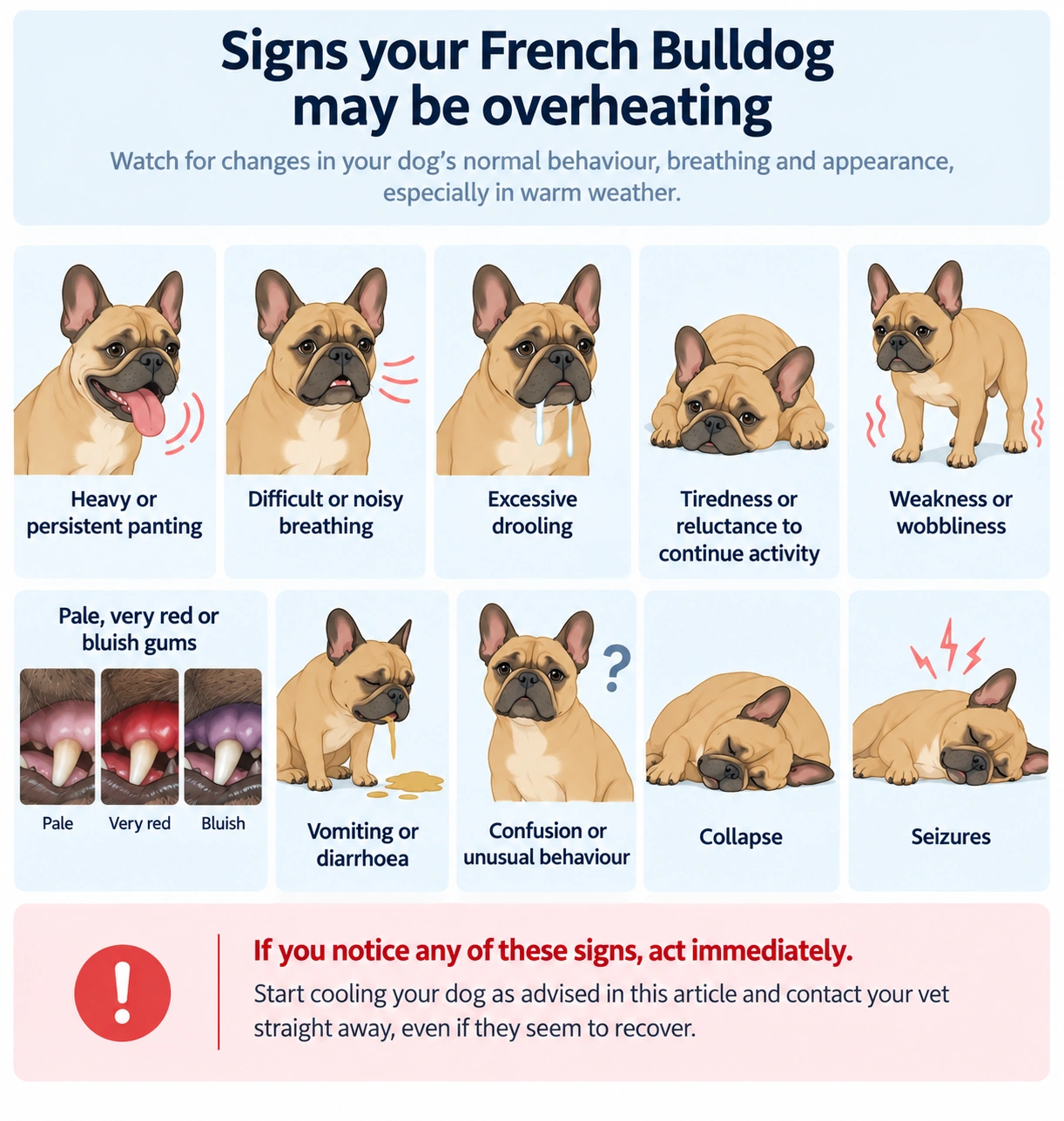
Don’t wait for the most severe signs before acting.
If your French Bulldog begins struggling during a walk or activity, stop immediately and move them somewhere cool. Persistent or worsening breathing difficulty in a flat-faced dog needs particular caution.
For a fuller explanation of heat illness and its progression, see Dog Heatstroke: Symptoms, Treatment & Prevention.
What to do if your French Bulldog starts overheating
Suspected heatstroke is an emergency. Start cooling your dog and contact a vet as soon as possible.
Move your French Bulldog into a cool or shaded, well-ventilated area and stop all exercise.
Begin cooling immediately. Current veterinary guidance supports using cool or cold tap water over the body, while keeping water away from the nose and mouth, together with airflow from a fan or air conditioning where available. Offer drinking water, but don’t force your dog to drink.
Don’t cover your dog with a wet towel. This can trap heat rather than allowing it to escape.
Contact your vet promptly and follow their instructions. If your dog needs to travel to the surgery, continue cooling them during the journey where practical.
Don’t delay veterinary help because your French Bulldog seems better after cooling. Heatstroke can cause serious internal complications.
Common summer cooling mistakes to avoid
| Mistake | Better approach |
|---|---|
| Waiting for obvious distress before cooling things down | Prevent heat build-up by adjusting the environment and activity early |
| Assuming shade makes outdoor conditions safe | Consider air temperature, humidity, airflow and your dog’s behaviour too |
| Walking because it’s your dog’s normal walk time | Change, shorten or skip the walk when conditions aren’t suitable |
| Relying on a cooling mat or vest | Treat cooling products as optional support, not protection against unsafe heat |
| Looking only at the temperature | Watch your individual dog’s breathing, behaviour and recovery |
| Encouraging energetic garden play because your dog isn’t on a walk | Remember that any vigorous activity produces body heat |
| Leaving a dog in a car because the windows are open or the car is shaded | Never leave your French Bulldog unattended in a warm vehicle |
| Assuming poor heat tolerance is simply normal for a French Bulldog | Discuss persistent breathing or heat-intolerance problems with your vet |
What if your French Bulldog struggles even in mild warm weather?
French Bulldogs are more vulnerable to heat than many longer-nosed breeds, but that doesn’t mean significant breathing difficulty should simply be accepted as normal.
If your dog regularly becomes excessively breathless after modest activity, takes a long time to recover, struggles during relatively mild weather, has very noisy breathing or appears unable to exercise comfortably, speak to your vet.
Brachycephalic obstructive airway syndrome can impair breathing and heat regulation. Excess weight can also make respiratory problems and heat management more difficult.
Rather than compensating indefinitely with more cooling equipment, veterinary assessment can help establish whether an underlying airway or health problem is contributing to your dog’s poor heat tolerance.
A simple French Bulldog summer routine
Morning: Check the forecast and conditions. If a walk is appropriate, go while it is cooler and keep the intensity suited to your dog.
Before the house heats up: Close blinds or curtains where strong sunshine enters. Make sure the coolest resting area is accessible and refill water bowls.
Warmest part of the day: Keep activity calm. Use indoor enrichment instead of energetic exercise and let your French Bulldog rest somewhere cool.
Before going outside: Check the actual conditions rather than relying on the time of day. Take water if you’re leaving home and be prepared to shorten or cancel the outing.
During activity: Watch breathing and behaviour. Stop before your French Bulldog becomes distressed.
After activity: Give your dog a cool place to recover with access to water. Their breathing should settle rather than becoming progressively heavier.
Evening: Don’t assume it has become cool enough simply because the sun is lower. Check conditions again before deciding on another walk.
Should you shave a French Bulldog to keep them cool?
A French Bulldog’s short coat doesn’t usually need shaving as a summer cooling measure.
Regular grooming can remove loose hair and keep the coat in good condition without stripping away the normal protection it provides. If shedding becomes difficult to manage, Best Brush for French Bulldog Shedding can help you choose an appropriate grooming tool, while Why Is My French Bulldog Shedding So Much? explains when heavier shedding may have another cause.
If your dog has a skin or coat problem, ask your vet before making significant changes to their grooming routine.
The bottom line
The safest way to keep a French Bulldog cool in summer is to prevent excessive heat build-up: provide a cool environment and fresh water, reduce exercise and excitement when conditions are warm, plan outings carefully and watch how your individual dog is coping.
Cooling mats, vests and fans can be useful additions, but none of them makes an unsuitable environment or activity safe.
Most importantly, don’t wait for severe heatstroke symptoms before acting. If your French Bulldog’s breathing or behaviour tells you they are struggling, stop the activity and cool them down. If you suspect heatstroke or they are having difficulty breathing, begin cooling and contact a vet promptly.
Read next
- French Bulldogs and Hot Weather: The Complete Guide
- Best Cooling Vests for French Bulldogs
- How to Keep a Dog Cool in the Car: Best Cooling Products