
Some French Bulldogs can paddle or swim for short distances, but they should not be treated as naturally safe or reliable swimmers. Their flat-faced anatomy, possible breathing limitations and individual body shape can leave them with little margin for error in the water.
A French Bulldog should only enter water voluntarily, under constant close supervision, with an easy exit immediately available. A correctly fitted dog life jacket is strongly advisable whenever the water is deeper than the dog can comfortably stand in.
If your dog is struggling in water, do not put yourself in danger trying to rescue them. Call 999 for professional help if the location makes a rescue unsafe. Once the dog is out, difficulty breathing, collapse, blue or grey gums, persistent coughing or reduced responsiveness require immediate veterinary help. PDSA specifically warns owners not to enter dangerous water after a dog because people lose their lives attempting rescues.
Can French Bulldogs actually swim?
Some French Bulldogs can paddle and move themselves through water. Others struggle to keep a comfortable position or become tired and distressed very quickly.
The safest answer is therefore:
- Can some French Bulldogs swim? Yes.
- Are French Bulldogs reliably strong swimmers? No.
- Should their ability be assumed? No.
- Should one ever swim unsupervised? Never.
A dog that has paddled successfully in shallow water has not necessarily shown that they can cope with deep water, a swimming pool, waves or a current. Their ability may also change as they grow older, gain weight or develop breathing, heart, joint or mobility problems.
“Can swim” and “safe around water” are not the same thing.
Why is swimming riskier for French Bulldogs?
Breathing problems can reduce their safety margin
French Bulldogs are brachycephalic, meaning they have a shortened, flat-faced skull shape. Some are affected by brachycephalic obstructive airway syndrome, commonly called BOAS.
BOAS can cause restricted airflow, noisy or difficult breathing, poor exercise tolerance and overheating. Cambridge University’s BOAS assessment system classifies dogs with moderate or severe respiratory signs as clinically affected and requiring management or treatment. Importantly, signs may become more apparent after exercise than they are at rest.
Swimming is physical exercise. A French Bulldog that already struggles to breathe efficiently has less capacity to cope with exertion, excitement, warm weather or an unexpected difficulty in the water.
Snorting, harsh breathing and poor recovery after exercise should not simply be accepted as normal for the breed. The British Veterinary Association identifies airway defects, breathing difficulty and overheating among the serious welfare problems associated with brachycephaly.
Ask your vet before introducing swimming if your French Bulldog:
- has noisy or laboured breathing;
- becomes breathless after mild exercise;
- takes a long time to recover after activity;
- has suspected or diagnosed BOAS;
- has previously collapsed or become faint;
- has a heart, lung, spinal or mobility condition;
- is recovering from illness or surgery.
Build, fitness and mobility also matter
Swimming ability varies between individual French Bulldogs. Weight, body proportions, fitness, muscle strength, age and mobility can all affect how comfortably a dog moves in water.
An overweight or poorly conditioned dog may become tired sooner. Puppies may panic or lack coordination, while older dogs may have reduced strength, arthritis or other conditions that make entering and leaving the water difficult.
Do not judge suitability from breed alone. Assess the health, breathing, confidence and movement of the individual dog.
Panic and fatigue can develop quickly
A frightened dog may paddle frantically rather than efficiently. This increases effort and can make breathing harder.
Even a dog that begins calmly may struggle if:
- the water becomes unexpectedly deep;
- the exit is difficult to find;
- the sides are steep or slippery;
- waves repeatedly cover the face;
- a current carries the dog away;
- the dog becomes cold;
- the session lasts too long.
Excitement can also hide developing fatigue. End the session while your dog still appears comfortable rather than waiting until they are visibly exhausted.
How can I decide whether my French Bulldog should swim?
Use the following as a practical decision guide, not as a substitute for veterinary advice.
| Factor | Lower-risk situation | Do not proceed |
|---|---|---|
| Breathing | Quiet, comfortable breathing and normal recovery after mild exercise | Noisy, laboured or unusually rapid breathing, or poor exercise recovery |
| Health | No relevant health concern and suitable activity agreed with your vet where necessary | BOAS concerns, heart or lung disease, illness, recent surgery or significant mobility problems |
| Behaviour | Relaxed, curious and entering voluntarily | Fear, freezing, scrambling, retreating or trying to escape |
| Water | Shallow, calm, clean and easy to leave | Deep water, strong current, waves, steep sides or hidden hazards |
| Supervision | A responsible adult remains within immediate reach | The owner is distracted, distant or unable to lift the dog |
| Duration | A very short session with frequent rests | Repeated retrieval, prolonged paddling or visible fatigue |
| Conditions | Mild weather and a comfortable water temperature | Hot conditions, very cold water or signs that the dog is chilling |
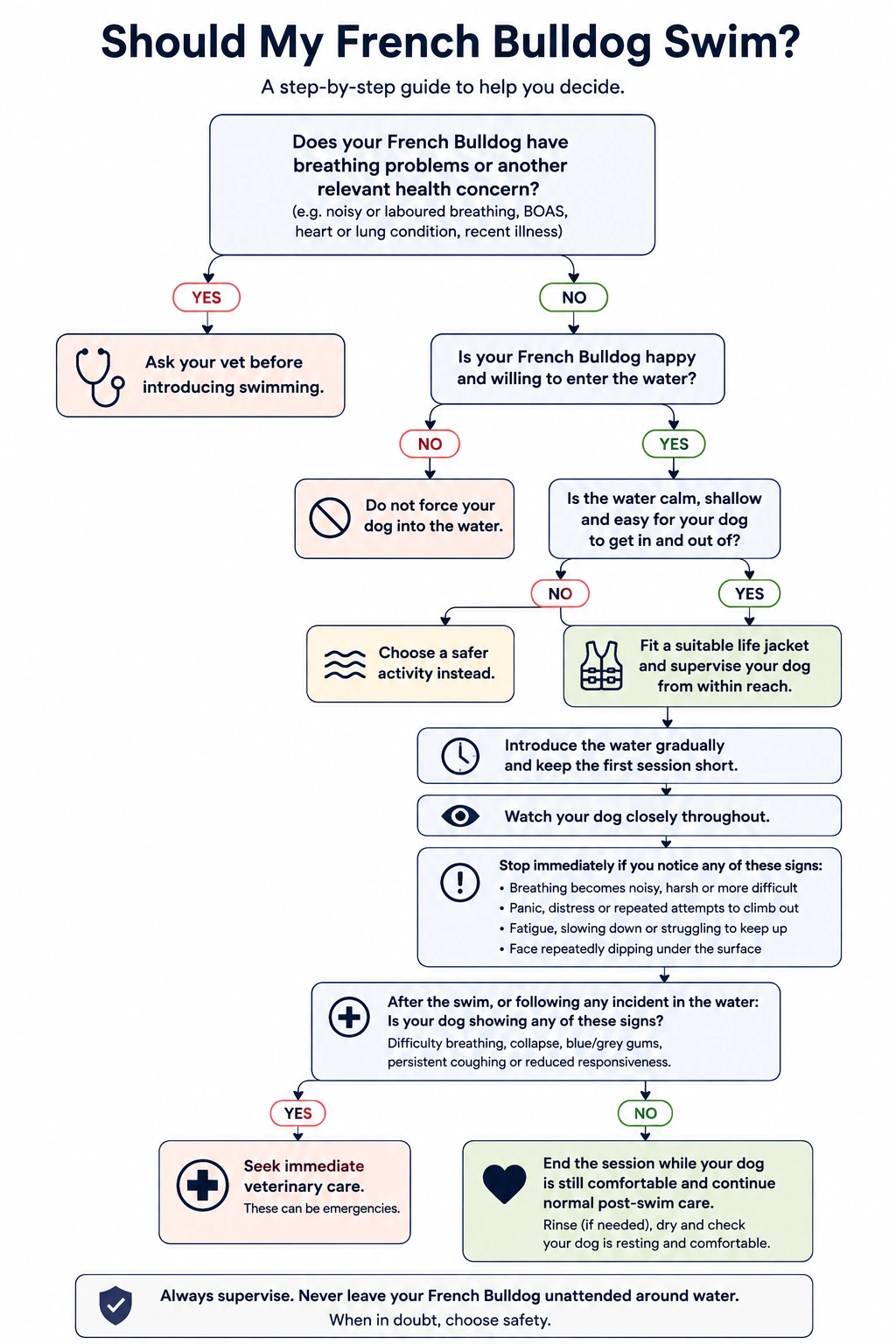
Do not allow swimming when several small concerns combine. For example, a warm day, an excited dog and mildly noisy breathing may together create much more risk than any one factor considered alone.
For wider advice about breathing, exercise and warm-weather care, read our guide to French Bulldogs and hot weather.
How should I introduce a French Bulldog to water?
The first experience should be gradual, voluntary and easy to stop.
- Introduce the life jacket away from the water. Let your dog sniff it, wear it briefly and move around in it before relying on it near water.
- Check the fit carefully. It should stay secure without pressing on the throat, restricting the shoulders or making breathing more difficult.
- Start beside calm, shallow water. Choose somewhere your dog can stand with their head well clear of the surface.
- Allow voluntary entry. Never throw, push, drag or carry a reluctant dog into the water.
- Stay within immediate reach. Be ready to support or lift your dog using the jacket’s handle.
- Make the exit obvious. Your dog should not have to search for steps, a ramp or the bank.
- Keep the first experience very short. A few calm moments are more useful than a long session that ends in fatigue or panic.
- Watch breathing continuously. Stop if it becomes noisier, faster or more effortful.
- End on a calm note. Bring your dog out before they become tired.
- Rinse and dry them where appropriate. Check the skin, paws, ears and folds for irritation or trapped moisture.
PDSA advises allowing dogs to take to water at their own pace, encouraging them back to shore after a few minutes so they learn how to leave, and never leaving them unattended around water.
A French Bulldog that dislikes water does not need to be taught to enjoy swimming. There are safer ways to provide exercise, enrichment and relief from warm weather.
Does a French Bulldog need a life jacket?
A well-fitted dog life jacket is strongly advisable whenever a French Bulldog may:
- enter water deeper than standing depth;
- swim rather than paddle;
- travel on a boat or paddleboard;
- play beside a pool, lake or river;
- encounter an unexpected drop into deep water.
Useful features include:
- suitable flotation for the dog’s size and build;
- secure, adjustable straps;
- a strong lifting handle;
- good visibility;
- freedom of shoulder movement;
- a fit that does not press on the throat or restrict breathing.
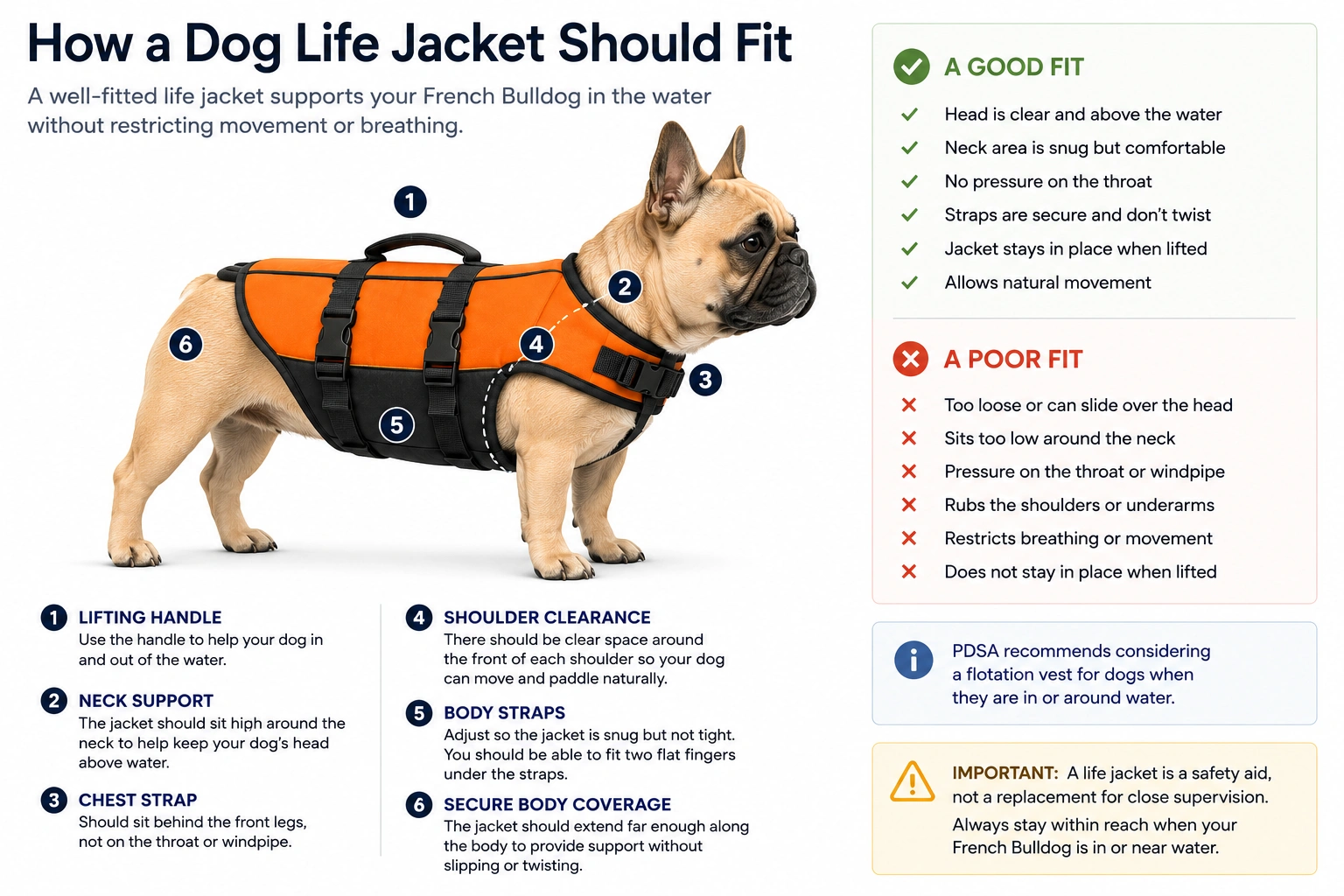
PDSA recommends considering a flotation vest to help keep a dog above the water, particularly during activities in which the dog could swallow water or become tired.
A life jacket is backup equipment, not permission to take greater risks. It cannot compensate for poor breathing, exhaustion, rough water, an inaccessible exit or inadequate supervision.
For help choosing one, see our guide to the best swimming vests and life jackets for French Bulldogs.
Are swimming pools safe for French Bulldogs?
A controlled private pool may appear safer than open water, but accidental access and difficulty finding the exit can make it dangerous.
To reduce the risk:
- prevent unsupervised access with secure barriers;
- fit the life jacket before the dog approaches the pool;
- provide broad steps, a stable ramp or another exit the dog can use;
- do not rely on a steep human ladder;
- show the dog the exit repeatedly;
- remain close enough to lift them immediately;
- keep every session short;
- do not allow repeated drinking of pool water;
- rinse and dry the dog afterwards where appropriate.
Do not assume that a frightened or tired dog will remember where the steps are. A pool with vertical sides and no usable exit can become dangerous even for a dog that has swum there before.
For a fuller assessment of pool access, exits, water quality and other hazards, see Are Swimming Pools Safe for Dogs?
Can French Bulldogs swim at beaches, rivers and lakes?
These environments introduce risks that cannot be judged from the dog’s swimming ability alone.
Beaches
Waves, tides, currents, salt water, hot sand and limited shade can all affect safety. A French Bulldog that appears comfortable paddling at the water’s edge may not cope when a wave lifts them off their feet.
Keep them in calm, shallow water, remain within reach and do not encourage them to chase toys out to sea. Our complete dog beach safety guide covers the wider shore-specific risks.
Rivers and lakes
Currents, steep banks, underwater obstacles, cold water, pollution and toxic blue-green algae can make apparently calm water unsafe.
Never allow entry where:
- warning signs are displayed;
- the water looks discoloured or has surface scum;
- dead fish or other animals are present;
- the current is strong;
- the banks make exit difficult;
- recent heavy rain may have affected water quality.
Blue-green algae can be fatal to dogs. Blue Cross advises calling a vet immediately if a dog may have swallowed water containing it.
Read the wider dog swimming safety guide before choosing an outdoor swimming location.
Can a French Bulldog swim for too long?
Yes. Even when a French Bulldog appears to enjoy the water, prolonged swimming increases fatigue, breathing demand and the chance of swallowing too much water.
There is no universal safe duration. Suitability depends on the individual dog, water conditions, temperature, exertion and health.
Keep sessions very short and include frequent rests. Stop before your dog begins to slow down.
Repeatedly retrieving balls or toys can be particularly demanding because excitement encourages the dog to continue after they would otherwise rest. Water play can also cause a dog to swallow excessive amounts of water.
Water intoxication is rare but potentially fatal. PDSA advises limiting time in the water, providing regular breaks, using suitable floating rather than round toys, considering a flotation vest and maintaining constant supervision.
See Can Dogs Swim Too Much? for the wider signs, risk factors and prevention advice.
When should a French Bulldog stop swimming?
Remove your dog from the water immediately if you notice:
- breathing becoming noisy, harsh or laboured;
- unusually rapid panting;
- repeated coughing, gagging or retching;
- the face repeatedly dipping below the surface;
- frantic, uneven or poorly coordinated paddling;
- slowing down or losing forward movement;
- difficulty keeping the head up;
- panic or repeated attempts to climb onto you;
- weakness, wobbling or reduced responsiveness;
- blue, grey or unusually pale gums;
- shivering or obvious signs of chilling;
- vomiting or a swollen abdomen.
Do not wait to see whether obvious breathing difficulty improves while the dog remains in the water.
When should I contact a vet?
Contact a vet immediately if your French Bulldog:
- has been submerged or rescued after struggling in water;
- is having difficulty breathing;
- collapses or becomes weak;
- has blue, grey or very pale gums;
- is confused, uncoordinated or unusually sleepy;
- coughs persistently after inhaling water;
- vomits repeatedly;
- develops marked abdominal swelling;
- shows tremors, seizures or other neurological signs after swallowing a large amount of water;
- may have swallowed water containing blue-green algae.
Trouble breathing is an emergency requiring immediate veterinary care. Near-drowning can also contribute to severe respiratory complications, and inhaled material can cause aspiration pneumonia.
Call the veterinary practice before travelling where possible. Explain what happened and follow its first-aid and transport instructions.
Do not attempt to diagnose or treat a respiratory complication at home.
What are safer alternatives if swimming is unsuitable?
A French Bulldog does not need to swim to enjoy water or stay comfortable.
Depending on the individual dog, safer options may include:
- voluntary paddling in very shallow water;
- walking through ankle-deep water;
- playing beside a sprinkler without biting at the water jet;
- resting in a cool, shaded area;
- using a suitable cooling mat;
- using a cooling vest where appropriate;
- indoor enrichment during hot weather.
A dog should never be forced into water for cooling. Flat-faced breeds are more vulnerable to heat-related illness because panting may be less effective, so prevention and early action remain essential.
Our guides to cooling mats for French Bulldogs and cooling vests for French Bulldogs provide alternatives for dogs that should not swim.
Swimming is also not a substitute for heatstroke treatment. If a dog is showing signs of heatstroke, stop the activity, begin appropriate cooling and contact a vet urgently. Current RSPCA guidance is to cool the dog first and transport them to a vet once cooling has begun.
The bottom line
Some French Bulldogs can enjoy very brief, controlled paddling or swimming, but none should automatically be considered safe or reliable swimmers.
Keep your dog within immediate reach, provide a clearly usable exit and use a properly fitted life jacket wherever deep water is possible. Never force them into water, and stop at the first sign of breathing difficulty, panic, fatigue or loss of coordination.
The safest activity is the one that suits your individual dog. For some French Bulldogs, that will mean shallow paddling rather than swimming—and that is perfectly acceptable.
Read next
- Dog Swimming Safety Guide
- Best Swimming Vests and Life Jackets for French Bulldogs
- French Bulldogs and Hot Weather: The Complete Guide