
A dog’s body temperature can provide important information when heatstroke is suspected, but there isn’t one thermometer reading that can safely diagnose or rule out heatstroke on its own.
A normal resting temperature for most dogs is roughly 37.6–39.2°C (99.7–102.6°F). A core temperature of 41°C (105.8°F) or above is critically high, particularly when a dog has been exposed to heat or strenuous exercise and is showing signs of heat-related illness.
But don’t wait for a dog’s temperature to reach 41°C before taking action. A dog with suspected heatstroke should be moved away from the heat, cooled immediately and assessed by a vet. Clinical signs and the circumstances matter alongside the thermometer reading.
Suspect heatstroke right now?
Stop exercise and move your dog away from the heat. Start cooling them immediately with water that is cooler than their body, concentrating on the body rather than pouring water over the head. Create airflow if possible and contact a vet or emergency vet for advice. Cooling should begin before transport rather than waiting until you reach the veterinary practice.
Don’t delay cooling while trying to obtain the perfect temperature reading.
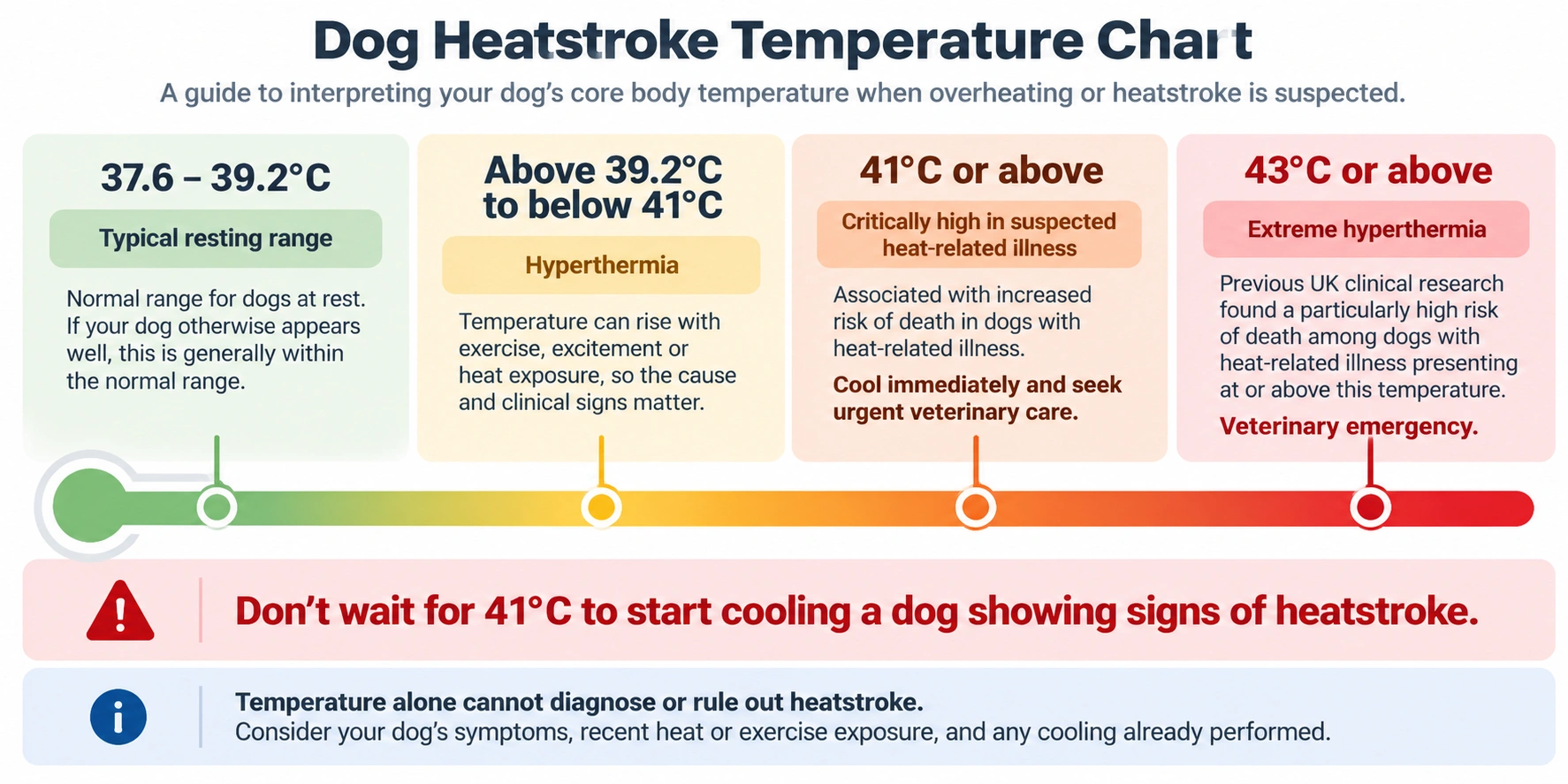
Dog Heatstroke Temperature Chart
The chart below is a practical guide to interpreting a dog’s core body temperature when overheating or heatstroke is suspected.
| Dog’s body temperature | What it may mean | What to do |
|---|---|---|
| 37.6–39.2°C (99.7–102.6°F) | Typical normal range for dogs at rest | If your dog otherwise appears well, this is generally within the normal range. Symptoms and circumstances still matter. |
| Above 39.2°C but below 41°C | Hyperthermia. Temperature can rise with exercise, excitement or heat exposure, so the cause and clinical signs matter. | Stop exercise or heat exposure. If heat-related illness is suspected, begin cooling and seek veterinary advice. |
| 41°C (105.8°F) or above | Critically elevated temperature. In dogs with heat-related illness, this is associated with increased risk of death. | Treat suspected heatstroke as an emergency. Cool immediately and seek urgent veterinary care. |
| 43°C (109.4°F) or above | Extreme hyperthermia. Previous UK clinical research found a particularly high risk of death among dogs with heat-related illness presenting at or above this temperature. | Veterinary emergency. Continue appropriate first aid while arranging immediate veterinary treatment. |
Important: this is an interpretation chart, not a diagnostic test. A dog can have serious heat-related illness with a temperature below 41°C, particularly if cooling has already started or some time has passed since the original heat exposure.
Equally, a high temperature needs to be interpreted alongside the dog’s symptoms, recent activity and circumstances.
What Temperature Is Heatstroke in Dogs?
There is no single temperature at which every dog can be said to have heatstroke.
Historically, temperatures above 41°C have often been used as a threshold for canine heat-related illness. Research using UK veterinary records has shown why the picture is more complicated.
A 2021 Royal Veterinary College VetCompass study found that dogs with heat-related illness presenting at 41°C or above had an increased risk of death, with an even greater risk among dogs presenting at 43°C or above. However, the researchers concluded that temperature alone was not sufficiently reliable to determine the severity of heat-related illness.
More recent UK emergency-care research has refined that position. The revised 2026 VetCompass clinical grading tool treats 41°C or above as a critical body temperature that can indicate increased risk when considered alongside the dog’s clinical signs.
The practical message for an owner is much simpler:
Don’t wait for a particular number before cooling a dog that appears to be suffering from heatstroke.
Temperature is useful evidence. It isn’t the only evidence.
For a complete overview of heatstroke in dogs, including symptoms, treatment and prevention, see Dog Heatstroke: Symptoms, Treatment & Prevention (Complete Guide).
What Is a Normal Body Temperature for a Dog?
A commonly used normal rectal-temperature range for dogs is approximately 37.6–39.2°C (99.7–102.6°F).
You may see slightly different normal ranges quoted by reputable veterinary and animal-welfare organisations. That doesn’t mean one is necessarily wrong. Body temperature varies, and measurement methods and reference populations can also differ.
Exercise and excitement can temporarily increase a dog’s temperature. This is one reason a reading just above the normal range should not automatically be interpreted as heatstroke.
What matters is the complete picture:
- What has the dog been doing?
- Has the dog been exercising?
- Has there been significant heat exposure?
- Is the dog panting heavily or struggling to breathe?
- Are there changes in behaviour or alertness?
- Is the temperature continuing to rise?
- Has cooling already taken place?
For a breed-specific example of normal-temperature interpretation, see What Is a Golden Retriever’s Normal Body Temperature?
When Does a Dog’s Temperature Become Dangerous?
Risk doesn’t suddenly switch from “safe” to “dangerous” at one precise decimal point. Temperature should be interpreted as part of a developing clinical picture.
Around 40°C
A temperature around 40°C is above the usual resting range, but the number alone doesn’t tell you the cause.
A healthy dog can become considerably warmer during strenuous exercise, for example. But a dog at around 40°C that has been exposed to heat and is showing excessive panting, breathing difficulty, weakness or other signs of heat-related illness should not simply be watched until the temperature reaches a higher threshold.
Remove the source of heat or stop exercise, begin appropriate cooling and seek veterinary advice.
Around 41°C
A core temperature of 41°C or above should be treated very seriously in a dog with suspected heat-related illness.
The revised 2026 VetCompass grading system classifies 41°C and above as a critical temperature criterion. UK emergency-clinic data found that this temperature was associated with increased risk of death in dogs with moderate or severe heat-related illness.
This does not mean that every dog reaching 41°C will suffer severe consequences, nor that a dog below 41°C is safe.
It means 41°C is a significant warning threshold, not a line to wait for before acting.
Around 42°C
At temperatures around 42°C, there should be no question of waiting to see whether the dog improves on its own if heatstroke is suspected.
Severe hyperthermia can damage tissues and organs, and both the temperature reached and the duration of overheating can influence the consequences.
Immediate cooling and emergency veterinary care are required.
Around 43°C and above
Temperatures around or above 43°C (109.4°F) represent extreme hyperthermia.
In an earlier VetCompass study of dogs presenting to UK veterinary practices with heat-related illness, dogs presenting at 43°C or above had a substantially higher risk of death than dogs presenting below that threshold.
That doesn’t mean 43°C is a universal “fatal temperature”. Some dogs in the research survived temperatures at or above this level, while serious or fatal heat-related illness can occur at lower recorded temperatures.
If you are concerned about how rapidly severe heatstroke can deteriorate, How Quickly Can Heatstroke Kill a Dog?explains why prompt action matters.
Why Temperature Alone Cannot Tell You How Severe Heatstroke Is
A thermometer reading is a snapshot.
Several factors can make that snapshot misleading if it is considered in isolation.
The dog may already have been cooled
If you’ve poured water over your dog, moved them into air conditioning or otherwise started cooling them, their temperature may have fallen substantially by the time it is measured.
A lower reading doesn’t erase any injury that occurred while the dog was hotter.
The temperature can change quickly
Body temperature isn’t fixed during a heat-related emergency. It may rise during continued heat exposure or fall rapidly once effective cooling starts.
The duration of overheating matters
How long a dog remains dangerously hot is important as well as the highest temperature reached.
This is one reason rapid cooling is so important.
Serious illness can continue after the temperature falls
Cooling addresses the hyperthermia, but it doesn’t necessarily reverse damage that has already occurred.
A dog that appears cooler after a suspected episode of heatstroke may still require veterinary assessment.
Dogs don’t all respond to heat in the same way
Breed, body shape, age, bodyweight, fitness, underlying disease, acclimatisation, activity and environmental conditions can all affect risk.
The safest approach is therefore:
Look at the temperature, the symptoms and what has happened to the dog — not the thermometer reading in isolation.
Signs That Matter Alongside Your Dog’s Temperature
Possible early signs of heat-related illness include:
- heavy or excessive panting;
- persistent panting that doesn’t settle appropriately;
- restlessness or agitation;
- excessive drooling;
- changes in breathing;
- very red gums or tongue;
- lethargy or reluctance to continue exercising.
More serious signs can include:
- weakness;
- difficulty breathing;
- confusion or abnormal behaviour;
- vomiting or diarrhoea;
- collapse;
- loss of coordination;
- seizures;
- reduced responsiveness.
Not every dog will show the same signs or develop them in the same order.
A normal or falling temperature should therefore not be used to dismiss concerning symptoms after significant heat exposure.
For a fuller guide to recognising the progression of heat-related illness, see Dog Heatstroke Symptoms: Early Warning Signs You Should Never Ignore.
What to Do If Your Dog’s Temperature Is Too High
If heatstroke is suspected, think:
1. Stop
Stop exercise immediately and move the dog away from the source of heat.
Find shade or a cooler, well-ventilated environment where possible.
2. Cool
Begin cooling straight away.
Current UK guidance supports using water that is cooler than the dog’s body temperature, rather than delaying while trying to find tepid water.
Apply water to the dog’s body and create air movement with a fan, breeze or air conditioning where possible.
For a young, otherwise healthy and conscious dog, immersion in cool water may provide rapid cooling where this can be done safely. Older dogs, dogs with underlying health conditions and unconscious dogs require greater care; follow veterinary advice.
Avoid pouring water directly over the head of a dog that is already struggling to breathe.
3. Contact a vet
Contact your vet or nearest emergency veterinary practice.
Tell them:
- what happened;
- how long the dog may have been exposed to heat or exercising;
- the symptoms you’ve seen;
- any temperature readings you’ve taken;
- what cooling you’ve already performed.
4. Transport
Follow the vet’s instructions and transport the dog in a cool, well-ventilated vehicle.
The principle is cool first, transport second: start cooling rather than delaying all treatment until you reach the veterinary practice.
For a dedicated step-by-step emergency sequence, see Dog Heatstroke First Aid: What to Do in an Emergency.
When Should You Stop Cooling a Dog?
It is possible to continue active cooling for too long, so cooling needs an appropriate stopping point.
The 2026 RECOVER veterinary first-aid guidelines suggest stopping active pre-hospital cooling when a dog’s rectal temperature reaches approximately 39.7–40°C (103.5–104°F), then drying the dog.
This is important, but the number needs context.
The recommendation is based largely on expert opinion rather than strong clinical trial evidence, and the guidance contains additional considerations for dogs with significant upper-airway obstruction.
So don’t treat 39.7°C as another universal magic number.
If you are in contact with a vet, follow their instructions. The objective is to reduce dangerous hyperthermia rapidly without continuing active cooling unnecessarily once an appropriate temperature has been reached.
Veterinary assessment can still be necessary even after the dog’s temperature has returned towards normal.
How to Take a Dog’s Temperature Safely
Rectal temperature provides the core-temperature measurement most commonly used in veterinary heatstroke assessment and research.
A digital thermometer can therefore be useful if you already have one available and can take the reading safely.
But obtaining a temperature is not more important than cooling the dog.
Don’t spend valuable time searching for a thermometer while a dog continues to overheat. And don’t struggle with a distressed, confused, collapsing or aggressive dog simply to obtain a reading.
If taking a temperature is difficult or unsafe, concentrate on cooling the dog and contacting a vet.
Common Temperature Mistakes That Could Delay Treatment
“It isn’t heatstroke unless the temperature reaches 41°C”
This is unsafe.
A dog may have clinically important heat-related illness below 41°C, and cooling may already have lowered the temperature before it is measured.
Think of 41°C as an important critical threshold, not the starting gun for treatment.
“The temperature has come down, so my dog is fine”
Not necessarily.
A lower temperature shows that the dog is cooler. It does not prove that heat-related injury hasn’t occurred.
Concerning symptoms following significant overheating still warrant veterinary advice.
“I should wait until I’ve taken the dog’s temperature before cooling”
No.
If the circumstances and symptoms suggest heatstroke, cooling should begin immediately.
Don’t allow a thermometer to become a reason for delay.
“Cold or cool water will send an overheated dog into shock”
This longstanding advice has been challenged by modern veterinary evidence and UK animal-welfare guidance.
Current guidance prioritises rapid, effective cooling and recommends water that is cooler than the dog’s body. The exact cooling method should take the dog’s age, health and condition into account.
“I should wrap the dog in wet towels”
Don’t wrap an overheated dog in wet towels.
A towel underneath a dog can be useful if necessary, but covering the body can trap heat rather than allowing it to escape efficiently.
Applying water directly to the body while creating airflow is generally more useful.
“If my dog is indoors, it can’t be heatstroke”
Heat-related illness isn’t limited to dogs outside in direct sunshine.
Dogs can overheat in hot, poorly ventilated indoor environments too. Can Dogs Get Heatstroke Indoors? explains the circumstances in which indoor heat can become dangerous.
Why Some Dogs Are More Vulnerable to Heatstroke
The same temperature and environment don’t create exactly the same risk for every dog.
Dogs that may need particular care include:
- flat-faced or brachycephalic breeds;
- older dogs;
- overweight dogs;
- dogs with respiratory or cardiovascular disease;
- dogs with reduced fitness;
- dogs exercising intensely;
- dogs that aren’t acclimatised to warmer conditions.
Brachycephalic dogs are especially important because their shortened skull shape can impair effective respiratory heat loss.
Individual vulnerability is another reason not to rely on a single body-temperature threshold to decide whether a dog is safe.
Dog Breeds Most at Risk of Heatstroke looks more closely at which dogs are particularly vulnerable and why.
Dog Heatstroke Temperatures: The Bottom Line
A dog’s normal resting body temperature is roughly 37.6–39.2°C, while 41°C or above is a critically high temperature in the context of suspected heat-related illness.
But the most important rule is not to wait for a particular number.
If your dog has been exposed to excessive heat or strenuous exercise and is showing signs of heat-related illness, stop the heat exposure, start cooling immediately and contact a vet.
A temperature reading can help you understand the situation. It should never become a reason to delay action.