

Most dogs do not need medicated ear drops every time they go swimming. If your dog’s ears look healthy and they are comfortable, the sensible routine is usually to check them and gently dry the outer ear after the swim.
Some dogs are more prone to ear problems, particularly frequent swimmers or dogs with a history of recurrent ear trouble. In those cases, your vet may recommend a suitable canine ear cleaner or drying solution as part of an individual routine.
The important distinction is between routine ear hygiene and treating an ear problem. Red, painful, swollen, smelly or discharging ears need veterinary advice rather than repeated cleaning or experimenting with over-the-counter drops.
Key takeaway
most dogs don’t need medicated drops after every swim; check and gently dry healthy ears; dogs prone to problems may need a vet-recommended cleaner/drying routine; painful/red/smelly/discharging ears need veterinary advice.
Do Dogs Need Ear Drops After Swimming?
Not routinely.
PDSA advises that most dogs do not need their ears cleaned regularly. However, dogs that develop ear infections after swimming may benefit from having their ears cleaned and dried afterwards, with the appropriate frequency discussed with their vet.
That means there is no universal rule that every dog should receive ear drops after every swim.
It also helps to distinguish between three things that are sometimes described simply as “ear drops”:
- Ear cleaners are intended to remove wax, dirt and debris as part of routine hygiene.
- Drying ear products may be recommended for dogs whose ears are particularly prone to remaining damp after swimming.
- Medicated ear drops are used to treat diagnosed ear conditions and may contain antibacterial, antifungal or anti-inflammatory medicines.
Medicated drops should not be used as a routine preventative measure unless your vet has specifically prescribed them.
For a dog with normal, comfortable ears, checking and drying may be all that is needed.
Why Can Swimming Cause Ear Problems in Some Dogs?
The inside of a dog’s ear canal normally has its own protective skin barrier and cleaning mechanisms.
Swimming can introduce additional moisture. If the ear canal remains persistently damp, the skin can become macerated — softened and damaged by prolonged moisture — which can make it easier for opportunistic bacteria or yeasts to multiply.
Merck Veterinary Manual lists excessive moisture from swimming as one of the factors that can increase the risk of otitis externa, the veterinary term for inflammation of the external ear canal. It also notes that chronic moisture can impair the skin’s barrier function.
Swimming itself is therefore not the only cause of ear infections.
Other factors can include:
- allergies or other skin disease;
- the shape of the ear and ear canal;
- excessive hair;
- wax and debris;
- parasites;
- foreign material;
- previous or chronic ear disease.
Two dogs can swim in exactly the same water and have completely different ear-care needs afterwards.
What Should You Do With Your Dog’s Ears After Swimming?
A simple check after swimming is more useful than automatically reaching for a bottle of ear cleaner.
Check the ears first
Before cleaning anything, look at your dog’s ears and notice how they are behaving.
Pay attention to:
- unusual redness;
- swelling;
- discharge;
- a strong or unfamiliar smell;
- obvious tenderness;
- repeated scratching;
- rubbing the ears;
- persistent head shaking.
If the ear looks sore or your dog appears uncomfortable, don’t keep cleaning in the hope that the problem will disappear.
PDSA recommends speaking to your vet if the ears are inflamed, painful or have an unusual smell rather than simply treating them as dirty ears.
Gently dry the outer ear
Use a clean, soft towel to dry the ear flap and the fur around the ear.
You do not need to push a towel, cotton bud or other object down into the ear canal.
Letting your dog shake their head naturally can also help move moisture and loose material towards the outer part of the ear.
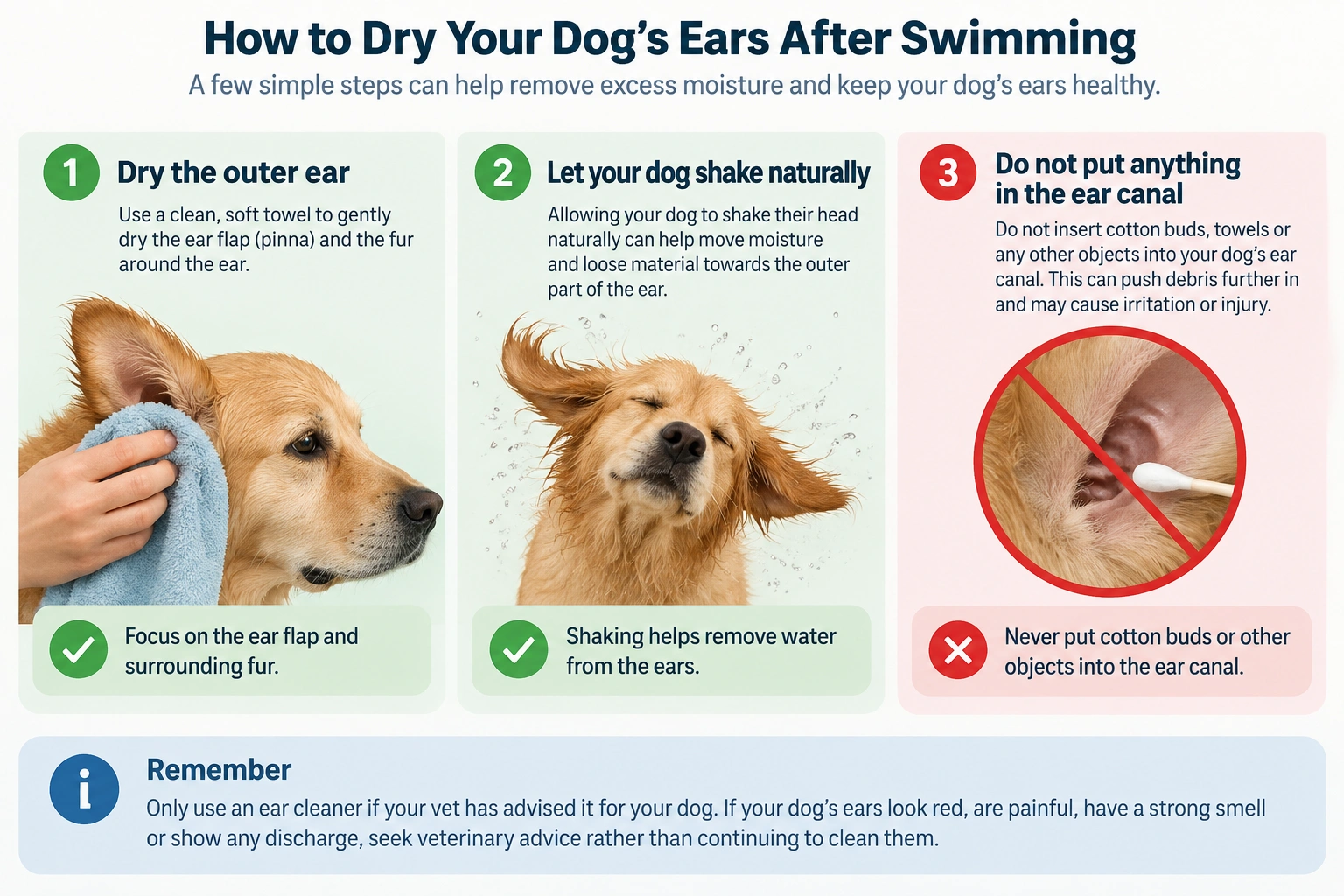
Dogs that swim regularly may benefit from a more specific veterinary ear-care routine, but that should be based on the individual dog rather than automatically applied to every swimmer.
For owners of particularly enthusiastic water dogs, the Labrador Swimming: The Complete Guide and Golden Retriever Swimming: The Complete Guide also cover the wider after-swim care these breeds may need.
Use an ear cleaner only when it is appropriate
If your vet has advised cleaning your dog’s ears after swimming, use a product specifically intended for canine ears and follow the instructions provided.
A typical ear-cleaning method involves applying the recommended cleaner, gently massaging the base of the ear and allowing the dog to shake before wiping away material that has reached the accessible outer ear.
The exact routine and frequency should depend on the dog.
A dog with naturally clean, comfortable ears should not be subjected to unnecessary cleaning simply because they have been in water.
What Kind of Ear Cleaner Is Best After Swimming?
The best ear cleaner after swimming is not necessarily the strongest product or the one marketed most aggressively towards “swimmer’s ear”.
It is one that is:
- formulated specifically for dogs;
- appropriate for routine ear hygiene rather than an undiagnosed infection;
- suitable for your individual dog’s ears;
- used at an appropriate frequency;
- applied according to veterinary or manufacturer instructions.
For dogs that swim frequently and are prone to moisture-related problems, Merck notes that a veterinarian may recommend a drying agent.
That does not mean every dog needs one.
Ear cleaner is not the same as infection treatment
This distinction is especially important when searching for the “best ear drops for dogs after swimming”.
A routine cleaner may help remove wax, debris or excess moisture. It does not diagnose or treat the underlying cause of a painful or infected ear.
Medicated ear preparations may contain antibacterial, antifungal or anti-inflammatory ingredients, depending on the condition being treated. Their selection may depend on examination of the ear and tests performed by a vet.
Using medication left over from an earlier ear infection — even in the same dog — is therefore not a good substitute for finding out what is causing the new problem.
What Should You Avoid Putting in a Dog’s Ears?
Dog ears are sensitive, and more intervention is not necessarily better.
Avoid:
- pushing cotton buds down the ear canal;
- using human ear treatments unless your vet has specifically advised them;
- hydrogen peroxide or harsh household cleaners;
- vinegar mixtures or other home-made remedies;
- essential-oil preparations not prescribed for the ear;
- leftover prescription drops from a previous illness;
- repeatedly cleaning an ear that is painful or inflamed.
Merck advises against cotton swabs because they can push debris farther into the canal, and also warns that irritating home remedies can worsen inflammation.
Products designed for people should not automatically be assumed safe for dogs. If you are uncertain what belongs in your dog’s ear, ask your vet before using it.
Which Dogs May Need Extra Ear Care After Swimming?
There is no single type of dog that inevitably develops swimming-related ear problems, but some dogs deserve closer monitoring.
Frequent swimmers
The more often a dog swims, the more frequently its ears are exposed to moisture.
A dog that swims several times a week may therefore need a different routine from a dog that paddles in shallow water twice each summer.
Dogs with previous ear problems
A history of recurring ear inflammation or infection is particularly important.
If your dog’s ears repeatedly become itchy, sore or smelly after swimming, ask your vet whether swimming is contributing and whether a preventative cleaning or drying routine would be worthwhile.
Repeatedly treating the symptoms without identifying the underlying cause can allow chronic problems to continue.
Dogs with allergies or skin problems
Ear inflammation and allergic skin disease are closely linked in some dogs.
Swimming may aggravate an already vulnerable ear without being the primary cause.
If your dog regularly develops ear trouble as well as itchy skin, paw licking or other recurrent skin symptoms, veterinary investigation is more useful than simply trying different ear cleaners.
Dogs with floppy or hairy ears
Ear shape and hair can influence airflow and how readily moisture escapes, but neither makes ear disease inevitable.
PDSA notes that floppy outer ears and excessive hair can predispose some dogs to ear problems, while Merck lists ear conformation among several possible contributing factors.
Don’t routinely pluck hair from the ear canal simply because your dog swims. Merck notes that hair removal itself can cause inflammation when it is unnecessary.
Breed reputation can be misleading in both directions. Some breeds are strongly associated with water but individuals still vary enormously in their swimming ability and care needs. The Best Dogs for Swimming guide looks at swimming suitability more broadly.
Can You Clean a Dog’s Ears Too Often?
Yes.
Cleaning healthy ears too frequently can irritate the delicate skin of the ear canal.
PDSA’s guidance is straightforward: most dogs do not need regular ear cleaning unless there is a reason for it.
This is why a rule such as “clean both ears after every swim” is too simplistic.
The appropriate routine depends on:
- how often your dog swims;
- how much moisture tends to remain in the ears;
- how much wax they naturally produce;
- previous ear disease;
- allergies or skin conditions;
- what your vet has found during examination;
- how the ears respond to cleaning.
If your dog’s ears remain healthy without a cleanser, there is no advantage in making the routine more complicated.
If problems repeatedly follow swimming, ask your vet to help establish a maintenance plan rather than increasing cleaning frequency on your own.
When Does Your Dog Need a Vet Rather Than Ear Cleaner?
Routine cleaning is appropriate only for an ear that is suitable for routine cleaning.
Contact your vet if you notice:
- significant redness;
- swelling;
- pain;
- a strong or unpleasant smell;
- pus or other discharge;
- blood;
- persistent scratching;
- repeated vigorous head shaking;
- marked sensitivity when the ear is touched;
- recurring problems after swimming.
Signs such as a head tilt, loss of balance, unusual eye movements or poor coordination can indicate a deeper ear problem and should be assessed promptly.
Do not try to decide at home whether an inflamed ear has a bacterial infection, yeast infection, allergy, foreign body or another cause.
Different problems can produce similar symptoms, and treatment depends on what is actually happening inside the ear.
Quick post-swim ear decision guide
| What you notice | Sensible next step |
|---|---|
| Ears look normal and your dog is comfortable | Gently dry and check them. Medicated drops are not automatically needed. |
| Your dog swims frequently and has previously had moisture-related ear trouble | Ask your vet whether a routine canine cleaner or drying product is appropriate. |
| A little ordinary wax is present but the ear is comfortable | Follow your dog’s normal vet-approved ear-care routine, if they have one. |
| Redness, pain, strong smell, swelling or discharge | Stop routine cleaning and contact your vet. |
| Head tilt, loss of balance, severe pain or obvious neurological signs | Seek prompt veterinary assessment. |
How Can You Reduce Ear Problems Before the Next Swim?
Good ear care begins before you put anything into the ear canal.
Know what normal looks and smells like
Check your dog’s ears when they are healthy.
Knowing their normal appearance and smell makes a change much easier to notice.
Choose the swimming location carefully
Dirty or hazardous water creates problems well beyond the ears.
For outdoor freshwater swimming, check current conditions, water quality, access and hazards before allowing your dog in. Our guide to checking whether a river is safe for dogs to swim in covers the additional risks of river swimming.
Pools have a different set of considerations, including access, exits, supervision and concentrated pool chemicals. See dog swimming-pool safety for those precautions.
For the wider checks that apply wherever your dog swims — including entry and exit points, fatigue, water ingestion and emergencies — use the Dog Swimming Safety Guide.
Consider prevention if your dog repeatedly has trouble
A dog that predictably develops ear trouble after swimming deserves an individual plan rather than repeated improvised treatment.
Your vet may recommend changes to swimming frequency, a suitable post-swim cleanser or drying product, investigation of underlying skin disease, or another preventative approach.
Dog Ear Protection for Swimming also looks specifically at ways of reducing water exposure where additional ear protection is appropriate.
Think about the whole swimming setup
Ear care is only one part of preparing a dog for the water.
If your dog needs additional buoyancy, the Best Dog Life Jackets (UK Buyer’s Guide) compares current options for UK owners.
Best Dog Swimming Accessories covers the wider equipment that can make regular swimming trips easier and more practical.
Neither specialist equipment nor ear products make an unsafe swimming location safe, so supervision and choosing appropriate water still come first.
Frequently Asked Questions
Can I use human swimmer’s ear drops on my dog?
Not unless your vet specifically tells you to.
Human products may contain ingredients or concentrations that have not been selected for your dog’s ears, and ear symptoms can have several different underlying causes.
Use products formulated for dogs and seek veterinary advice if the ear is painful, inflamed, smelly or producing discharge.
Should I clean my dog’s ears after every swim?
Not necessarily.
Many dogs need only an ear check and gentle drying. Dogs that repeatedly develop problems after swimming may benefit from a specific cleaning or drying routine recommended by their vet.
Unnecessary frequent cleaning can itself irritate the ear.
Can swimming cause an ear infection in dogs?
Swimming can contribute to the conditions in which ear problems develop because excess moisture can impair the normal skin barrier inside the ear canal. It is not the only cause.
Allergies, parasites, foreign bodies, ear anatomy and existing skin disease can also be involved.
If infections repeatedly follow swimming, veterinary investigation is more useful than assuming water alone is responsible.
The Bottom Line
Most dogs do not need medicated ear drops after every swim.
Check the ears, gently dry the outer ear and leave healthy ears alone unless your dog has an established reason for additional care. Dogs that swim frequently or repeatedly develop ear problems may benefit from a vet-recommended cleanser or drying routine.
If the ear becomes painful, red, swollen, smelly or produces discharge — or your dog develops persistent head shaking, a head tilt or balance problems — move beyond routine cleaning and contact your vet.
Read next
- Dog Ear Protection for Swimming
- Dog Swimming Safety Guide
- Best Dog Swimming Accessories