
Keeping a dog cool in the car is not about finding one clever product. The safest approach combines a cool vehicle, sensible journey timing, airflow, water, a comfortable resting surface and regular checks on your dog.
Cooling mats, fans, travel water bottles and sunshades can all help while you are travelling. But none of them makes it safe to leave a dog unattended in a warm parked car. Dogs Trust warns that a dog can die in a hot car within minutes and that winding a window down is not enough.
Key takeaway
The best car-cooling setup is a layered one: cool the vehicle before your dog gets in, travel at a cooler time when possible, use air conditioning or effective airflow, block direct sun, carry water and add a suitable cooling surface if it helps your dog. Keep checking the dog throughout the journey.
The most important rule: cooling products do not make a parked car safe
A cooling mat, fan or temperature monitor can reduce discomfort or give you useful information. It cannot turn a hot parked car into a safe place to leave a dog.
Never leave a dog unattended in a warm car
Cooling products can make supervised journeys more comfortable, but they cannot make a parked car safe. Temperatures can rise dangerously quickly, even with shade or open windows.
The temperature inside a vehicle can rise dangerously quickly. Blue Cross gives the example that when it is 24°C outside, a car can reach 38°C within minutes. Its wider hot-weather guidance also warns that parking in shade or putting the windows down is not enough protection.
That means the purpose of dog cooling products for cars is to make supervised travel safer and more comfortable. They are not permission to leave the dog behind while you shop, eat or run an errand.
For the specialist safety question, see Can You Leave a Dog in a Car?
What actually keeps a dog cooler during a car journey?
It helps to think in layers rather than products. A safer cooling setup combines several simple steps, with products supporting the system rather than replacing the basics.
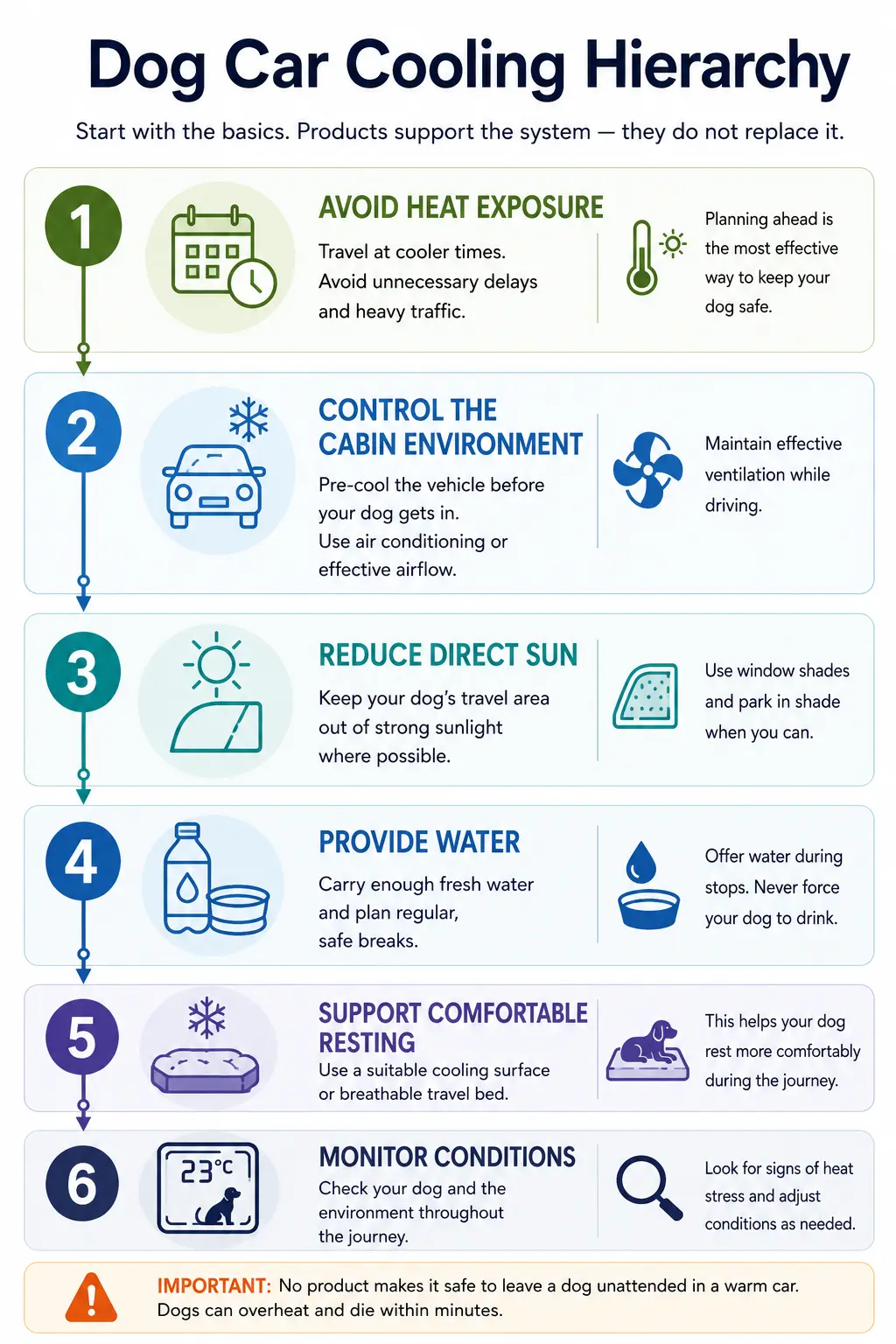
The first layer is avoiding unnecessary heat exposure. Dogs Trust recommends thinking carefully about whether a car trip is needed, travelling at cooler times where possible, planning breaks and avoiding congested roads or busy times when you may become stuck in traffic.
The second layer is controlling the car environment. Cool the cabin before your dog gets in. Use the vehicle’s air conditioning where available, or maintain effective ventilation while driving.
The third layer is reducing direct sun exposure. Keep your dog out of direct sun where possible. Window sunshades can help reduce solar exposure during supervised journeys.
The fourth layer is providing water. Carry enough water for the journey plus delays, and make sure your dog has opportunities to drink during suitable breaks.
The fifth layer is supporting comfortable resting. Provide your dog with a suitable place to lie and use cooling products where they solve a genuine comfort problem.
The sixth layer is monitoring conditions. Check the dog rather than assuming that because you feel comfortable in the front of the car, the dog is comfortable in a crate or boot area farther away.
The basic hierarchy
| Priority | What it means in practice | Useful products |
|---|---|---|
| Avoid excess heat | Travel at a cooler time and avoid predictable delays | No product required |
| Cool the cabin | Pre-cool the car and maintain effective airflow | Air conditioning, fan |
| Reduce direct sun | Keep the dog’s area out of strong sunlight | Window sunshades |
| Provide water | Carry enough for the journey and breaks | Travel bottle, non-spill bowl |
| Improve resting comfort | Give the dog a suitable place to lie | Cooling mat or breathable travel bed |
| Monitor the dog | Check behaviour and the actual travel area | Temperature monitor |
A product should support this system, not replace it.
Which dog cooling products for cars are most useful?
The best choice depends on where your dog travels and what problem you are trying to solve.
| Product type | Best for | Main limitation |
|---|---|---|
| Cooling mat | Providing a cooler resting surface | Does not cool the whole vehicle |
| Cooling dog car seat or breathable travel bed | Smaller dogs travelling on a seat | Must still allow safe restraint |
| Cooling fan | Improving local airflow | Moving hot air is not the same as cooling the cabin |
| Travel water bottle | Offering water during stops | Does not control temperature |
| Non-spill bowl | Longer journeys and planned breaks | Must be positioned safely |
| Window sunshade | Reducing direct solar exposure | Does not stop a parked car heating up |
| Temperature monitor | Checking conditions in the dog’s area | An alert is information, not protection |
| Car hammock or seat cover | Creating a practical travel area | Not inherently a cooling product |
| Crate or dog guard | Safe restraint and travel organisation | Airflow and temperature still need separate attention |
| Car harness | Restraining a dog on a seat | Fit and compatibility matter |
For most owners, the priorities are straightforward: a cool cabin, shade from direct sun, water and a suitable resting surface. Add specialist equipment only when it solves a specific need.
If you also want a cooling mat for use outside the car, our guide to the best dog cooling mats compares the strongest general-purpose options.
Cooling mats can make the resting area more comfortable
A cooling mat is one of the simplest additions to a warm-weather car setup. It gives the dog the option of lying on a surface designed to feel cooler than an ordinary padded bed or blanket.
Different mats use different methods. Some contain pressure-activated gel, while others use water or heat-dispersing fabrics. The right choice depends on the dog, the available space and how the mat will be used.
A car mat should:
- fit the dog’s actual travel area without folding dangerously;
- stay stable rather than sliding around;
- be suitable for the dog’s size;
- be used according to the manufacturer’s instructions;
- be checked regularly for damage.
A mat is less suitable for a dog likely to chew or puncture it unless the product is specifically designed to withstand that behaviour.
Most importantly, a cooling mat cools the surface beneath the dog. It does not make an overheated car safe.
If you’re ready to compare the different types and sizes available, our guide to the Best Cooling Mats for Cars & Travel explains which mats are best for different vehicles, travel crates and dog sizes, helping you choose the right option for your setup.
What about a cooling dog car seat?
The phrase cooling dog car seat can mean several things: a breathable seat-style bed, a cooling pad fitted into a travel seat, or a raised travel bed designed to improve airflow.
The key question is not whether the product has “cooling” in its name. Ask:
- Can the dog still be suitably restrained?
- Is the surface breathable?
- Does the dog have enough room to change position?
- Will the product stay secure during braking?
- Does it block or reduce airflow around the dog?
For a small dog travelling on a passenger seat, a padded cooling seat may improve comfort. For a large dog in the boot, a full-size mat or well-ventilated travel bed may make more sense.
Car fans can help airflow, but they have limits
A dog cooling fan can be useful when the dog travels in an area that receives less airflow than the front seats, such as a crate or rear load space.
The fan should be securely positioned so that it cannot become a projectile, cannot be chewed and does not interfere with safe restraint.
But a fan has an important limitation: it moves air; it does not necessarily make hot air cool. If the cabin itself is dangerously hot, circulating that air is not an adequate solution.
For detailed selection criteria, positioning and product options, see Best Dog Cooling Fans for Cars.
Carry water your dog can actually drink from
Water is essential on warm journeys, but the best container is the one you can use easily and safely when the dog needs it.
A dog travel water bottle can be convenient for short stops because the bottle and drinking trough are combined. A non-spill bowl may be more practical for longer breaks or for dogs that dislike drinking from bottle-style dispensers.
Carry enough water for the journey plus delays. Do not assume you will be able to buy water at the next stop.
The specialist Best Dog Travel Water Bottles (UK Buyer’s Guide) covers bottle styles and selection in more depth.
Sunshades can reduce direct heat on the dog
A dog lying in direct sun through a side or rear window may be much hotter than the driver.
The Kennel Club recommends window sunshades as one way to help reflect the sun’s rays and keep the car cooler while travelling. It also advises avoiding the hottest times of day, making regular stops and ensuring access to water.
A shade should not obstruct the driver’s view or interfere with safe use of the vehicle.
And, again, shade is not a parked-car safety system. The sun moves, outside conditions change and the whole cabin can still heat up.
Temperature monitors are useful alarms, not safety guarantees
A temperature monitor can be valuable because the dog’s part of the vehicle may not feel the same as the driver’s seat.
This is particularly relevant when a dog travels:
- in the rear load space;
- in a crate;
- behind a dog guard;
- in a large vehicle with uneven airflow.
Choose a monitor that lets you see the temperature where the dog actually is, rather than relying only on the dashboard display.
Connected monitors may also provide alerts, but they introduce other points of failure: batteries, signal coverage, software and connectivity.
Use a monitor to answer, “What is happening where my dog is?” Never use it to justify leaving a dog unattended.
Safe restraint still matters in hot weather
Cooling and restraint must work together.
Rule 57 of the Highway Code says dogs and other animals should be suitably restrained so they cannot distract the driver or injure the driver, themselves or others if the vehicle stops quickly. It gives a seat belt harness, pet carrier, dog cage and dog guard as examples.
A cooling setup should therefore never require you to let a dog roam loose around the car.
Think about the whole arrangement:
- Can air reach the dog?
- Is the restraint suitable for the travel position?
- Can the dog lie comfortably?
- Is the cooling mat secure?
- Could a fan, bottle or other item become a projectile?
- Can you check the dog easily?
For the wider journey setup, see How to Travel with a Dog in a Car Safely.
Car seat covers and hammocks can support a cooler setup
Car hammocks and seat covers are not usually cooling products in their own right, but they can make a warm-weather travel setup easier to manage.
A suitable cover can:
- protect seats from water and mud after drink breaks;
- create a stable surface beneath a cooling mat;
- make it easier to keep the travel area clean;
- reduce the temptation to use thick, heat-retaining blankets simply to protect upholstery.
Look for a cover that works with your dog’s restraint system and does not block ventilation.
Avoid assuming that a waterproof surface will be comfortable in heat. Some materials can become warm or slippery, so the dog may still need an appropriate resting layer.
Crates and dog guards need good airflow around them
A crate can provide secure travel, and a dog guard can keep a dog separated from the passenger area. Neither automatically provides a cool environment.
Check whether:
- luggage blocks ventilation;
- the crate receives conditioned air;
- direct sun reaches the dog;
- a heavy cover traps heat;
- the dog has enough room to rest comfortably.
A cooling mat may fit inside some travel crates, but it must lie safely and suit the dog. Do not obstruct ventilation in an attempt to create shade.
Cooling towels should be used with care
A cooling towel may be useful in some circumstances, but it is not a substitute for cooling the car or changing the journey plan.
Do not drape a wet towel over an overheating dog. Current RSPCA advice warns that damp towels over the body can trap heat; the priority in suspected heatstroke is active cooling and urgent veterinary help.
The specialist article Do Cooling Towels Really Cool Dogs? looks at the question in more depth.
Do not rely on these five things
An open window
Dogs Trust explicitly warns that winding a window down is not enough to keep a dog safe in a hot vehicle.
Parking in the shade
Shade can move, and the cabin can still become dangerously hot.
A bowl of water
Water matters, but it does not prevent the air inside a parked car from heating up.
One cooling product
A mat, fan or vest cannot compensate for a dangerously hot environment.
A temperature alert
An alert tells you that conditions have changed. It does not protect the dog if you cannot act immediately.
How to choose the right setup for your dog and car
There is no single best combination for every dog.
If your dog travels on a rear seat
Consider:
- a suitable car harness or carrier;
- a breathable seat cover or secure travel bed;
- protection from direct sun;
- water for planned stops.
A cooling mat may work if it stays stable and does not interfere with the restraint.
If your dog travels in the boot
Pay particular attention to airflow and direct sun. The rear of a vehicle can feel very different from the front.
A useful setup may include:
- a suitable dog guard or secured crate;
- a correctly sized cooling mat;
- a securely mounted fan if additional airflow is genuinely needed;
- a temperature monitor positioned near the dog.
If your dog travels in a crate
Do not block ventilation with luggage or heavy covers. Make sure any mat fits safely and check that the dog is receiving enough airflow.
If your dog is anxious in the car
Stress and heat can be difficult to distinguish because both may involve panting and restlessness.
If the main problem is fear, pacing or travel distress rather than the temperature itself, How to Keep a Dog Calm in the Car is the more useful next guide.
If your dog is particularly vulnerable to heat
Some dogs need more conservative journey planning. Blue Cross identifies elderly, flat-faced, overweight and large-breed dogs among those at increased risk of overheating.
A Labrador owner, for example, may also find How to Keep a Labrador Cool in Summer useful for broader breed-specific warm-weather planning.
Before you travel: a warm-weather car checklist
Before setting off
- Check whether the journey is really necessary.
- Consider travelling at a cooler time.
- Check the route for likely congestion and delays.
- Cool the cabin before your dog gets in.
- Make sure the restraint system is secure.
- Check that air can reach the dog.
- Block direct sun where practical.
- Pack enough water for the journey and delays.
- Secure loose equipment.
During the journey
- Check the dog regularly.
- Pay attention to the temperature where the dog is travelling.
- Use air conditioning or effective ventilation.
- Stop for planned water and comfort breaks.
- Be prepared to change the journey if the dog is becoming too hot.
At every stop
- Keep the dog with you.
- Offer water.
- Move to a cooler place if needed.
- Reassess whether it is safe to continue.
Stop the journey if your dog is becoming too hot
Do not keep driving towards your destination simply because you are nearly there.
Warning signs can include:
- heavy panting;
- difficulty breathing;
- excessive drooling;
- unusual lethargy;
- drowsiness;
- poor coordination;
- vomiting;
- collapse.
These signs can indicate serious overheating. The RSPCA advises acting quickly if a dog is suffering in the heat, and veterinary guidance treats suspected heatstroke as an urgent problem.
For the full warning-sign guide, see Dog Heatstroke Symptoms: Early Warning Signs You Should Never Ignore.
Emergency action
If you think your dog may have heatstroke, stop the journey and begin appropriate cooling while seeking urgent veterinary advice. Do not wait to see whether the dog improves before getting help.
When should you postpone the journey?
The safest cooling product is sometimes a change of plan.
Consider delaying or cancelling a non-essential trip when:
- the weather is unusually hot;
- your route is likely to involve long traffic delays;
- the vehicle cannot maintain a comfortable environment;
- the dog is already unwell;
- the dog has shown signs of heat stress;
- you cannot provide safe breaks;
- the destination itself will expose the dog to excessive heat.
Dogs Trust specifically advises owners to think twice about car trips in hot weather and, where travel is necessary, to plan the timing, breaks and route.
If you’re travelling as part of a summer break, our guide to dog-friendly holidays in the UK explains how to choose accommodation, destinations and activities that are better suited to travelling with a dog in warm weather.
The best car-cooling setup is a system, not a gadget
For most dogs, start with the basics: a cool vehicle, sensible journey timing, effective airflow, protection from direct sun, enough water and regular checks.
Then add products for specific problems. A cooling mat can improve the resting surface. A fan can improve local airflow. A travel bottle makes water easier to offer. A temperature monitor can reveal conditions you might otherwise miss.
But none of those products replaces supervision or good judgement. If the journey cannot be kept comfortable and safe for the dog, change the journey rather than adding more equipment.
Read next
- Best Dog Cooling Fans for Cars
- Best Dog Travel Water Bottles (UK Buyer’s Guide)
- How to Keep a Dog Calm in the Car